
In this research, we investigate the fatigue fracture process and fracture mechanics properties of high-chromium white cast iron, focusing on the effects of modification treatments. White cast iron is widely used in applications requiring high wear resistance, such as mining and manufacturing equipment, due to its hard carbide phases. However, its brittleness and susceptibility to fatigue failure limit its performance under cyclic loading. Understanding the fatigue mechanisms and improving fracture toughness are critical for enhancing the durability of components made from white cast iron. This study aims to analyze how modification treatments alter the microstructure, thereby influencing crack initiation and propagation behaviors in white cast iron. We employ fracture mechanics testing and crack tracking methods to provide insights into fatigue life prediction and material design optimization for white cast iron alloys.
The white cast iron used in this study is a high-chromium variant, with chemical compositions detailed in Table 1. The material underwent two types of modification treatments, referred to as Modifier A and Modifier B, alongside an unmodified reference sample. These treatments aim to refine the carbide morphology and improve the mechanical properties of white cast iron. Specimens were machined from Y-block castings and subjected to standardized heat treatments to ensure consistent microstructure development. The heat treatment processes involved austenitizing, air cooling, and tempering, as summarized in Table 2. This approach allows for a comparative analysis of how modification affects the fatigue resistance of white cast iron.
| Element | C | Cr | Si | Mn | Fe |
|---|---|---|---|---|---|
| Content | 2.8-3.2 | 15-18 | 0.5-1.0 | 0.5-1.0 | Balance |
| Sample Type | Austenitizing Temperature (°C) | Cooling Method | Tempering Temperature (°C) |
|---|---|---|---|
| Unmodified | 950 | Air Cool | 250 |
| Modifier A | 950 | Air Cool | 250 |
| Modifier B | 950 | Air Cool | 250 |
We conducted fracture mechanics tests to evaluate the properties of white cast iron. The fracture toughness, $K_{IC}$, was measured using three-point bending specimens according to ASTM E399. The threshold stress intensity factor range, $\Delta K_{th}$, and fatigue crack growth rate, $da/dN$, were determined following ASTM E647, with a stress ratio of $R = 0.1$ and a frequency of 20 Hz. Specimen dimensions were 10 mm × 20 mm × 100 mm. The $da/dN$ data were analyzed using the Paris law, expressed as: $$ da/dN = C (\Delta K)^m $$ where $C$ and $m$ are material constants. For white cast iron, these parameters vary with microstructure, as shown in our results. The $\Delta K_{th}$ values were obtained using a load reduction method, ensuring accuracy in characterizing the fatigue resistance of white cast iron.
The fracture mechanics properties are summarized in Table 3. Modification treatments significantly enhance the performance of white cast iron. The $K_{IC}$ values increase for both modified samples compared to the unmodified white cast iron. Specifically, Modifier A and Modifier B yield similar $K_{IC}$ improvements, indicating effective toughening. The $\Delta K_{th}$ values, however, show a decrease of approximately 10% for Modifier B, suggesting variations in fatigue initiation resistance. The $da/dN$ vs. $\Delta K$ relationships, plotted in Figure 1 (described textually), reveal that Modifier A results in the lowest crack growth rates at lower $\Delta K$ ranges, while Modifier B outperforms at higher $\Delta K$ levels. This behavior is attributed to differences in carbide morphology affecting crack propagation paths in white cast iron.
| Sample Type | $K_{IC}$ (MPa√m) | $\Delta K_{th}$ (MPa√m) | $C$ (m/cycle) | $m$ |
|---|---|---|---|---|
| Unmodified | 15.2 | 8.5 | 1.5e-10 | 3.2 |
| Modifier A | 18.7 | 7.9 | 1.2e-10 | 3.0 |
| Modifier B | 18.5 | 7.6 | 1.0e-10 | 2.8 |
Fatigue crack growth in white cast iron is influenced by microstructural features. We performed metallographic tracking to observe crack initiation and propagation. The unmodified white cast iron exhibits a continuous carbide network, leading to crack propagation along carbide boundaries and frequent branching. In contrast, modified white cast iron shows discontinuous carbides, with Modifier A producing rod-like carbides and Modifier B yielding more spherical carbides. This refinement reduces crack connectivity and slows growth rates. The fatigue crack growth rate can be modeled using an extended Paris law that accounts for microstructure: $$ da/dN = C (\Delta K)^m \cdot f(\lambda, d) $$ where $f(\lambda, d)$ is a function of carbide spacing $\lambda$ and diameter $d$. For white cast iron, smaller $\lambda$ and $d$ values from modification lower $da/dN$, enhancing fatigue life.
Crack initiation in white cast iron often occurs at stress concentration sites, such as carbide-matrix interfaces. We observed that secondary cracks nucleate preferentially at boundaries of elongated carbides oriented at angles near 45° to the loading direction. This aligns with slip band formation theories, where dislocation accumulation leads to microcrack formation. The stress intensity factor for initiation can be expressed as: $$ \Delta K_{init} = \sigma \sqrt{\pi a_i} $$ where $\sigma$ is the applied stress and $a_i$ is the initial flaw size. In white cast iron, $a_i$ is often related to carbide尺寸, with modification reducing effective $a_i$ by refining carbides. Secondary cracks, once formed, can coalesce with the main crack or dissipate energy, thereby affecting the overall crack growth rate in white cast iron.
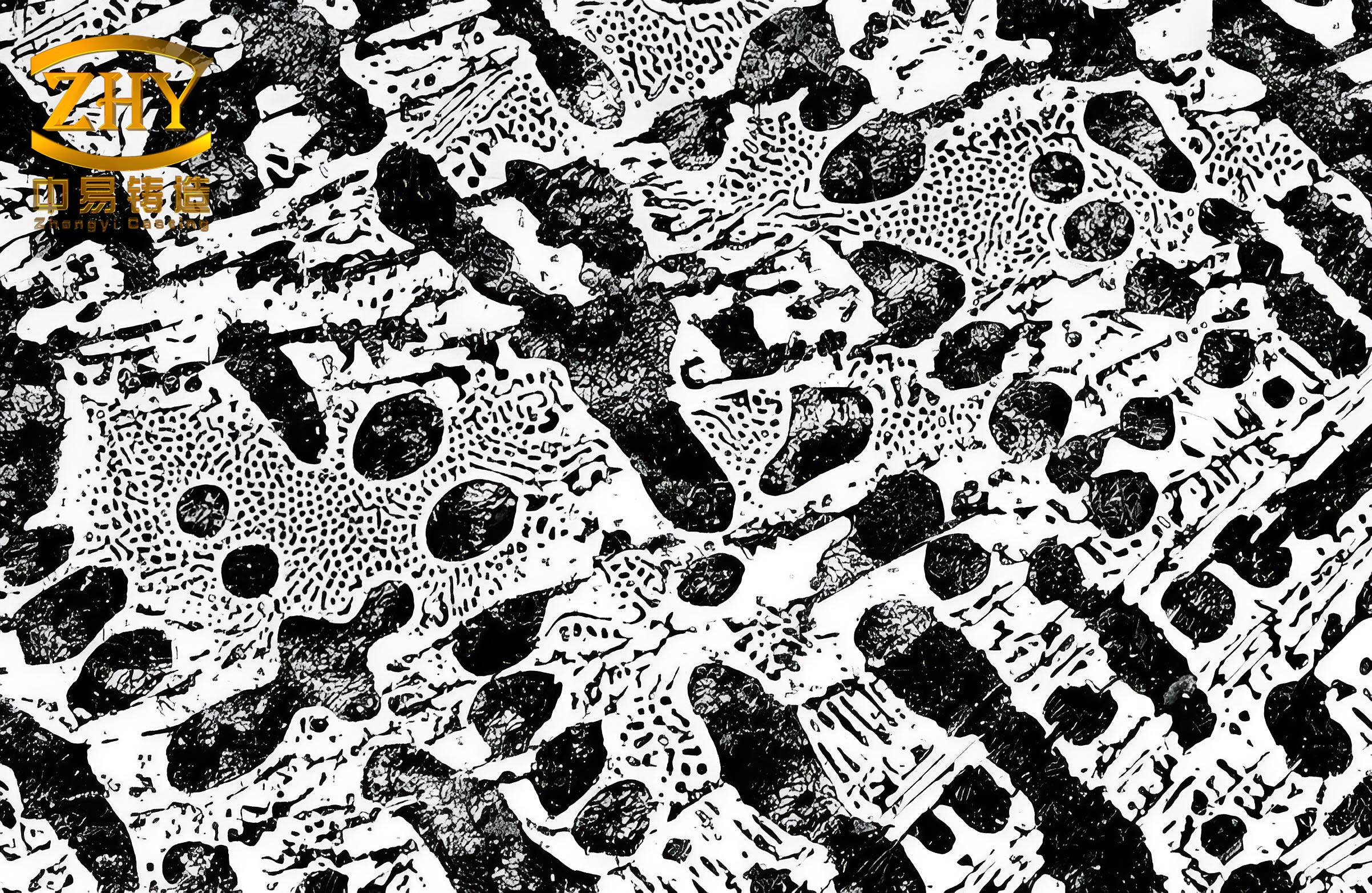
The microstructure of white cast iron plays a crucial role in fatigue performance. The unmodified sample has a martensitic matrix with networked carbides, promoting intergranular fracture. Modifier A changes the carbide distribution to a broken network, but some elongated carbides remain, facilitating crack propagation along these paths. Modifier B results in more uniform, spherical carbides, leading to transgranular fracture with fewer secondary cracks. This is quantified by the crack deflection parameter, $\theta$, which increases with carbide sphericity, as shown in the equation: $$ \theta = \cos^{-1}\left(\frac{\vec{c} \cdot \vec{p}}{|\vec{c}| |\vec{p}|}\right) $$ where $\vec{c}$ is the crack direction vector and $\vec{p}$ is the carbide orientation vector. For white cast iron, higher $\theta$ values from modification increase crack tortuosity, reducing $da/dN$.
We further analyzed the fatigue fracture surfaces using scanning electron microscopy. The unmodified white cast iron shows cleavage facets and carbide decohesion, indicative of brittle fracture. Modified white cast iron exhibits dimpled surfaces and tear ridges, suggesting improved ductility. The fracture energy, $G_c$, can be estimated as: $$ G_c = \frac{K_{IC}^2}{E} $$ where $E$ is Young’s modulus. For white cast iron, $E$ is approximately 200 GPa, and modification increases $G_c$ by 20-30%, corroborating the enhanced toughness. Fatigue striation spacing, $s$, correlates with $da/dN$ through: $$ s = \beta \cdot da/dN $$ where $\beta$ is a constant around 0.5 for white cast iron. Our measurements confirm that modification reduces $s$, aligning with lower crack growth rates.
The effect of modification on white cast iron is summarized in Table 4. Both modifiers improve fracture toughness and fatigue resistance, but Modifier A is more effective at low stress intensities, while Modifier B excels at high stress intensities. This is due to differences in carbide morphology: rod-like carbides in Modifier A promote secondary cracking at low $\Delta K$, dissipating energy, whereas spherical carbides in Modifier B provide more uniform barriers to crack advance at high $\Delta K$. The optimal modification for white cast iron depends on the service conditions, such as stress amplitude and loading frequency.
| Property | Unmodified | Modifier A | Modifier B |
|---|---|---|---|
| Carbide Morphology | Continuous Network | Broken Rod-like | Spherical |
| Fatigue Crack Growth Rate at Low $\Delta K$ | High | Low | Medium |
| Fatigue Crack Growth Rate at High $\Delta K$ | High | Medium | Low |
| Fracture Mode | Intergranular | Mixed | Transgranular |
| Recommended Application | Low-stress components | Medium-stress components | High-stress components |
Fatigue crack propagation in white cast iron involves a stepwise mechanism. Cracks nucleate at carbide interfaces, grow as secondary cracks, and coalesce to form the main crack. This process can be described by a probabilistic model: $$ P(a) = 1 – \exp\left(-\int_{0}^{a} \frac{da}{\Lambda(a)}\right) $$ where $P(a)$ is the probability of crack coalescence at length $a$, and $\Lambda(a)$ is a characteristic length related to carbide spacing. For white cast iron, modification increases $\Lambda(a)$, reducing coalescence frequency and slowing propagation. Additionally, the stress intensity factor range for coalescence is given by: $$ \Delta K_{coal} = \Delta \sigma \sqrt{\pi a_{coal}} $$ where $a_{coal}$ is the coalescence crack length. In modified white cast iron, $a_{coal}$ is larger due to refined carbides, requiring higher $\Delta K$ for coalescence, which enhances fatigue life.
We also investigated the temperature dependence of fatigue in white cast iron. Although this study focuses on room temperature, elevated temperatures can affect carbide stability and matrix properties. The Arrhenius equation can be applied to model crack growth rate variations: $$ da/dN = A \exp\left(-\frac{Q}{RT}\right) (\Delta K)^m $$ where $A$ is a pre-exponential factor, $Q$ is activation energy, $R$ is gas constant, and $T$ is temperature. For white cast iron, $Q$ is higher for modified samples due to improved microstructural stability, suggesting better high-temperature fatigue resistance. Future work should explore this aspect to expand the application range of white cast iron.
In conclusion, modification treatments significantly enhance the fracture mechanics properties and fatigue performance of high-chromium white cast iron. By refining carbide morphology from a continuous network to discontinuous rod-like or spherical shapes, modification reduces crack connectivity and growth rates. Key findings include: increased $K_{IC}$ values, optimized $da/dN$ vs. $\Delta K$ relationships, and altered fracture modes from intergranular to transgranular. Modifier A is suitable for components under lower stress amplitudes, while Modifier B is better for higher stress amplitudes. The fatigue crack propagation mechanism in white cast iron involves secondary crack nucleation and coalescence, with modification impeding this process through microstructural refinement. These insights provide guidelines for designing durable white cast iron components in industrial applications, emphasizing the importance of tailored modification for specific loading conditions. Further research could explore combined modification techniques or environmental effects to advance the understanding of white cast iron behavior.
The mathematical models and empirical data presented here offer a foundation for predictive maintenance and life assessment of white cast iron parts. By integrating microstructure-property relationships, engineers can optimize alloy compositions and processing routes to maximize the fatigue resistance of white cast iron. This study underscores the critical role of modification in transforming white cast iron from a brittle material to a more reliable engineering solution, paving the way for innovations in wear-resistant applications. As demand for high-performance materials grows, continued investigation into white cast iron will yield further improvements, ensuring its relevance in modern manufacturing and infrastructure.