
As a researcher focused on advanced manufacturing techniques, I have extensively studied the challenges associated with producing high-integrity sand casting parts for critical railway components. In this work, I delve into the comprehensive analysis and optimization of the sand casting process for railway freight car coupler bodies, which are essential sand casting parts in the hook buffer system. These components must withstand extreme operational stresses, and their internal soundness, or compactness, is paramount for safety. The inherent complexity of coupler geometries—featuring varying wall thicknesses from 10 mm to 80 mm and numerous thermal junctions—makes them prone to shrinkage defects like porosity and cavities during solidification. Traditional trial-and-error methods are costly and time-consuming. Therefore, I employed numerical simulation technology to predict and mitigate these defects, followed by physical validation, ensuring the production of reliable sand casting parts.
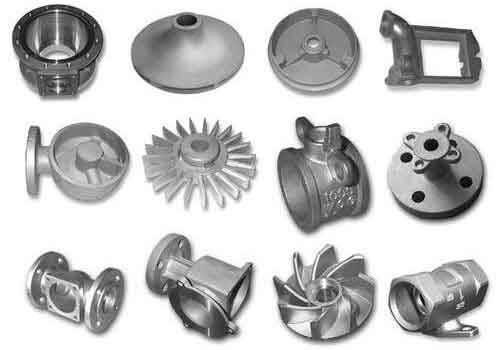
The initial sand casting process for the 17-type coupler body, a representative E-grade steel sand casting part, was set up with minimal technological interventions to establish a baseline. The molding arrangement was two castings per mold box, with a gating system designed to minimize post-casting cutting work. The ingate was positioned at the coupler shank area, with its end elevated at a height of approximately 25 mm. This configuration, while simplifying finishing operations, introduced potential issues during metal filling. A visual representation of such complex sand casting parts during production is provided below, illustrating the intricate mold assemblies typically involved.
To preemptively analyze the casting process, I utilized AnyCasting simulation software. The first step involved creating a digital twin of the casting and mold system. The model was divided into seven variable grid regions to balance computational accuracy and efficiency: left edge, left hook head, left shank, gating system and tail, right shank, right hook head, and right edge. The mesh counts for these regions were 10, 90, 55, 70, 55, 90, and 10, respectively. Since E-grade steel was not directly available in the material database, SM25C, a steel with similar carbon content, was selected. The key process parameters and boundary conditions for the simulation are summarized in the table below.
| Parameter | Value or Setting | Remarks |
|---|---|---|
| Casting Type | Sand Casting | – |
| Material | SM25C (Analogous to E-grade steel) | Used for simulation |
| Initial Mold Temperature | 25 °C | – |
| Pouring Temperature | 1580 °C | – |
| Pouring Cup Radius | 30 mm | – |
| Pouring Speed | 75 cm/s | Calculated for 30s filling time |
| Heat Transfer Coefficient (Air-Casting/Mold) | 0.001 cal/(cm²·s·°C) | Standard reference value |
| Heat Transfer Coefficient (Casting-Mold) | 0.1 cal/(cm²·s·°C) | Standard reference value |
| Activated Models | Gravity, Shrinkage, Surface Tension, Turbulence, Oxidation/Slag Entrapment | For comprehensive physics |
| Simulation End Condition | 100% Solid Fraction | – |
The mold filling analysis revealed critical insights. The molten metal first entered the mold cavity at the shank region and then flowed forward to fill the hook head and backward to fill the tail. However, the upward-tilted ingate caused the stream to impinge on the core at the shank, disrupting laminar flow and creating turbulence. This turbulent flow persistently eroded the sand core at the impact zone, as described by the fluid dynamics momentum equation. The localized force can be approximated by:
$$ F \approx \rho v^2 A $$
where \( \rho \) is the metal density, \( v \) is the flow velocity, and \( A \) is the impacted area. This erosion risk increases the likelihood of sand inclusion defects in the final sand casting parts, necessitating a redesign of the gating system to promote smoother, downward-filling flow.
The solidification analysis was crucial for predicting shrinkage defects. Without adequate risers or chills, isolated liquid pools formed at various thermal centers, leading to shrinkage porosity and cavities. The solidification time \( t_s \) for a sand casting part can be estimated using Chvorinov’s rule:
$$ t_s = k \left( \frac{V}{A} \right)^n $$
where \( V \) is volume, \( A \) is surface area, \( k \) is a mold constant, and \( n \) is an exponent (typically ~2). Areas with high \( V/A \) ratios (thermal junctions) solidified last, creating vulnerable spots. The simulation’s “Residual Melt Modulus” function mapped these defect-prone zones layer by layer. The predicted shrinkage locations in the coupler body are summarized in the following table, correlating simulated cross-sections with expected defect severity.
| Cross-Section Designation | Location in Coupler Body | Predicted Defect Severity (Simulation) | Primary Defect Type |
|---|---|---|---|
| Section 1 | Upper hook ear region | High (Isolated liquid pool) | Shrinkage cavity |
| Section 2 | Transition zone near hook head | Very High | Major shrinkage |
| Section 3 | Inner cavity of hook head | Critical | Large shrinkage porosity |
| Section 4 | Shank wall thickness change area | Medium | Micro-porosity |
| Section 5 | Lower shank region | Medium | Micro-porosity |
| Section 6 | Tail front section | Medium | Shrinkage porosity |
| Section 7 | Tail middle section | Low | Minor porosity |
| Section 8 | Tail end section | Critical | Shrinkage cavity |
To validate the simulation accuracy, I oversaw the production of two mold boxes identical to the simulated initial process. After casting, the coupler bodies were sectioned precisely at the planes corresponding to the simulation cross-sections. The internal compactness was inspected and graded according to standard criteria. The results confirmed a strong correlation: locations predicted by the simulation to have severe shrinkage exhibited corresponding defects in the actual sand casting parts. The defect grades for the initial process castings are listed below, demonstrating the simulation’s predictive capability for such complex sand casting parts.
| Physical Cross-Section | Corresponding Simulated Section | Observed Defect Grade (1-6 Scale) | Description |
|---|---|---|---|
| A-A (Hook Head) | Section 1 & 2 | 5 | Significant shrinkage cavities |
| B-B (Hook Head) | Section 2 & 3 | 5 | Major shrinkage porosity |
| C-C (Hook Head) | Section 3 | 6 | Extensive shrinkage defects |
| D-D (Hook Head) | Section 4 | 3 | Moderate micro-porosity |
| E-E (Hook Head) | Section 5 | 3 | Moderate micro-porosity |
| F-F (Shank) | Section 6 | 3 | Moderate shrinkage |
| G-G (Shank/Tail) | Section 7 | 2 | Minor porosity |
| H-H (Tail) | Section 8 | 6 | Large shrinkage cavity |
Based on the simulation and validation findings, I implemented a series of targeted process improvements to achieve sound sand casting parts. The goal was to ensure directional solidification toward effective feeders and to reduce isolated hot spots. The modifications were grounded in fundamental principles of feeding and heat transfer. The required feeding volume \( V_f \) to compensate for shrinkage can be estimated as:
$$ V_f = \beta V_c $$
where \( \beta \) is the volumetric shrinkage coefficient of the alloy (approx. 0.03-0.06 for steel) and \( V_c \) is the volume of the feeding zone. The improvements are detailed systematically below.
| Improvement Measure | Location/Component | Technical Rationale | Expected Outcome |
|---|---|---|---|
| Replacement with Exothermic Riser | Original vent at hook head and upper hook ear | Enhances thermal gradient and prolongs feeding; exothermic reaction provides extra heat. The efficiency can be modeled by an enhanced mold constant \( k’ \) in Chvorinov’s rule. | Eliminate shrinkage in Sections 1 & 2. |
| Installation of Conformal External Chills | Upper and lower mold at Sections 2, 3, 6 | Increases local cooling rate, reducing \( V/A \) ratio and solidification time. Chill effectiveness relates to heat extraction: \( Q_{chill} = h_c A_c (T_m – T_c) t \), where \( h_c \) is interface heat transfer coefficient. | Suppress hot spots, promote directional solidification. |
| Placement of Internal Chills | Inside cavity at Sections 2 & 3 | Direct heat absorption within thick sections, acting as thermal bridges to accelerate cooling in core regions. | Mitigate major shrinkage in hook head interior. |
| Conversion to Exothermic Blind Riser | Tail riser | Improves feeding pressure and thermal efficiency compared to open riser; reduces heat loss from top surface. | Eliminate tail cavity (Section 8). |
| Redesign of Ingate Geometry | Gating system at shank | Change from upward to downward gentle slope; reduces flow velocity \( v \) and impact force \( F \), promoting laminar flow and minimizing sand erosion. | Prevent sand inclusions and turbulence-related defects. |
| Addition of Blind Riser | Between upper and lower pull lugs in Section 3 inner cavity | Provides dedicated feeding source for a critical isolated hot spot identified by simulation. | Directly feed the heavy section, eliminating shrinkage. |
| Application of Conformal External Chill | Core at right side of Section 4 inner cavity | Balances cooling symmetry and addresses localized thermal mass. | Reduce micro-porosity in shank region. |
After implementing these optimized process parameters, new sand casting parts were produced. Subsequent dissection and inspection of the critical sections revealed a remarkable improvement in internal compactness. The previously defective areas now exhibited grades 1 or 2 (on a scale where 1 is best), fully meeting the stringent technical specifications for railway coupler bodies. This success underscores the power of integrating numerical simulation with practical foundry knowledge to perfect the manufacturing of demanding sand casting parts. The final quality assessment results for the improved sand casting parts are consolidated in the following table.
| Assessment Plane (Per Standard) | Location on Coupler | Defect Grade after Improvement (1-6 Scale) | Status vs. Requirement |
|---|---|---|---|
| Head A-A | Critical load-bearing zone | 1 | Pass (Max allowed: 3) |
| Head B-B | High-stress transition area | 2 | Pass (Max allowed: 5) |
| Head C-C | Inner hook head cavity | 2 | Pass (Max allowed: 4) |
| Head D-D | Wall thickness change region | 1 | Pass (Max allowed: 4) |
| Head E-E | Lower hook head | 1 | Pass (Max allowed: 4) |
| Head F-F | Shank front | 1 | Pass (Max allowed: 2) |
| Head G-G | Shank middle | 2 | Pass (Max allowed: 3) |
| Tail A-A | Tail front | 1 | Pass (Max allowed: 3) |
| Tail B-B | Tail middle | 1 | Pass (Max allowed: 4) |
| Tail C-C | Tail key area | 2 | Pass (Max allowed: 4) |
| Tail D-D | Tail end | 2 | Pass (Max allowed: 4) |
In conclusion, this detailed investigation demonstrates a robust methodology for optimizing the sand casting process of critical railway components. The use of AnyCasting software provided accurate predictions of filling behavior and solidification defects, which were confirmed through physical dissection of initial sand casting parts. The simulation-driven process modifications—incorporating exothermic risers, strategic chilling, and gating redesign—successfully eliminated shrinkage defects, yielding coupler bodies with excellent internal compactness. This approach significantly reduces development time and cost while enhancing the reliability of sand casting parts. Future work could involve integrating more advanced material models and multi-scale simulations to further refine the process for other complex sand casting parts. The principles and workflow established here, combining simulation, validation, and targeted improvement, offer a valuable template for advancing the quality and efficiency of sand casting production across heavy-industry sectors.