
In the production of sand casting parts, particularly those made from high-alloy materials like duplex steel, the use of risers and pads is crucial to ensure sound casting quality by feeding shrinkage during solidification. Traditional metallic pads, while effective, require removal after casting, leading to significant metal waste and energy consumption during cutting processes. This not only increases costs but also impacts the sustainability of manufacturing operations. As a practitioner in the field of foundry engineering, I have explored alternative methods to enhance efficiency in sand casting parts production. One promising approach is the adoption of exothermic pads, which utilize发热保温材料 (exothermic insulation materials) to replace metallic pads. These pads generate heat upon contact with molten metal, maintaining a liquid metal channel for longer durations and thereby improving feeding efficiency. In this article, I will discuss the application of exothermic pads, specifically the EX5 BLEND type, in the sand casting of duplex steel parts, comparing their performance with traditional metallic pads through simulation, experimental trials, and data analysis. The focus is on optimizing the production of sand casting parts while reducing material and energy costs.
Sand casting parts, such as valve bodies and other industrial components, often require complex geometries and high integrity, especially when made from duplex steels like ASTM A890 5A. These materials offer excellent corrosion resistance and mechanical properties but pose challenges in casting due to their solidification characteristics. In sand casting processes, risers and pads are designed to compensate for shrinkage defects. Metallic pads, typically made from the same alloy as the casting, extend the feeding range of risers but must be removed post-casting, adding to production expenses. For instance, in a valve body casting with a weight of 540 kg, metallic pads can account for over 70 kg of additional metal, which is later discarded. This not only wastes valuable alloy but also requires energy-intensive removal methods like sawing or plasma cutting. In contrast, exothermic pads, composed of materials that react exothermically when heated, can provide similar feeding benefits without the need for metal addition. The EX5 BLEND exothermic material, in particular, has shown superior保温 (insulation) and发热 (exothermic) properties, as evidenced by comparative燃烧曲线 (combustion curves). While普通发热材料 (common exothermic materials) maintain metal temperatures above 1,147 °C for only 2.25 minutes, EX5 BLEND extends this to 5.70 minutes, significantly enhancing the feeding window for sand casting parts. This improvement is critical for ensuring defect-free castings in demanding applications.
To evaluate the effectiveness of exothermic pads, I conducted a study involving the design, simulation, and production of duplex steel sand casting parts. The target component was a闸阀阀体 (gate valve body) with overall dimensions of 830 mm × 500 mm × 440 mm and a rough weight of 540 kg. The material specification was ASTM A890 5A duplex steel, requiring 100% volumetric radiographic testing for quality assurance. For comparison, two identical sand casting parts were produced in the same furnace pour: one using traditional metallic pads and the other using EX5 BLEND exothermic pads. The pads were applied to the flanges of the valve body, where feeding challenges are common due to thickness variations. The design process began with metallic pads, based on standard foundry manuals and补偿系数 (compensation factors). Using凝固模拟软件 (solidification simulation software), I modeled the casting process to determine optimal pad dimensions. The metallic pads were sized at 270 mm × 260 mm × 90 mm, with a total theoretical weight of 70 kg for both flanges. This resulted in a pouring weight of 1,050 kg and a工艺出品率 (yield rate) of 51.4%. The simulation confirmed that this design met feeding requirements, with no shrinkage defects predicted in critical areas. Subsequently, I designed exothermic pads with identical dimensions, incorporating the thermal properties of EX5 BLEND material into the simulation software. The exothermic pad design yielded a pouring weight of 980 kg and a yield rate of 55.1%, indicating a reduction in metal usage. Simulation results showed that the exothermic pads provided adequate feeding, comparable to metallic pads, validating their potential for use in sand casting parts.
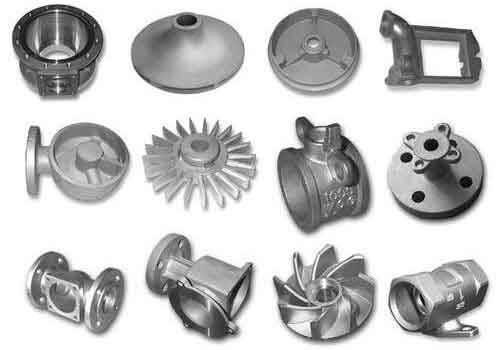
The production of sand casting parts with exothermic pads involved several steps. First, the EX5 BLEND material, supplied in powder form, was mixed with a binder according to the manufacturer’s recommendations. This mixture was then used to预制发热补贴 (pre-fabricate exothermic pads) using a dedicated芯盒 (core box). The pads were allowed to cure before being placed in the mold. During造型 (molding), the exothermic pads were positioned at the designated locations on the flanges, similar to metallic pads. Care was taken to ensure proper venting to allow gases from the exothermic reaction to escape, preventing defects in the sand casting parts. The molds were coated with refractory paint and dried prior to合箱 (closing) and浇注 (pouring). After solidification, the castings were清砂 (cleaned) through振动落砂 (vibratory shakeout). The exothermic pads, having reacted during pouring, were easily removed with the sand, leaving a smooth surface on the sand casting parts. In contrast, metallic pads required mechanical removal, adding time and energy costs. Visual inspection revealed no surface defects such as gas pores or sand adhesion on the sand casting parts with exothermic pads, and the surface finish was comparable to that of the mold surface. Radiographic testing confirmed that both casting methods produced sound internal structures, meeting the stringent quality standards for duplex steel sand casting parts.
To quantify the benefits of exothermic pads in sand casting parts production, I analyzed key performance metrics using tables and formulas. The following table summarizes the comparison between metallic and exothermic pads for the valve body casting:
| Parameter | Metallic Pads | Exothermic Pads (EX5 BLEND) |
|---|---|---|
| Pad Dimensions (mm) | 270 × 260 × 90 | 270 × 260 × 90 |
| Pad Weight per Casting (kg) | 70 | ~5 (material weight) |
| Pouring Weight (kg) | 1,050 | 980 |
| Yield Rate (%) | 51.4 | 55.1 |
| Temperature Maintenance Time above 1,147 °C (min) | N/A (metal cools naturally) | 5.70 |
| Removal Energy Consumption | High (sawing/plasma cutting) | Low (shakeout with sand) |
| Surface Quality after Removal | Requires machining | Smooth, as-cast finish |
| Internal Quality (Radiographic) | Defect-free | Defect-free |
The improvement in yield rate from 51.4% to 55.1% translates to significant material savings in sand casting parts production. This can be expressed mathematically by the yield formula: $$ Y = \frac{W_c}{W_p} \times 100\% $$ where \( Y \) is the yield rate, \( W_c \) is the casting weight (540 kg), and \( W_p \) is the pouring weight. For metallic pads, \( W_p = 1050 \) kg, so \( Y = \frac{540}{1050} \times 100\% = 51.4\% \). For exothermic pads, \( W_p = 980 \) kg, so \( Y = \frac{540}{980} \times 100\% = 55.1\% \). This 3.7% increase in yield reduces metal consumption per sand casting part, leading to cost savings, especially for high-alloy duplex steels.
Furthermore, the exothermic reaction of the pads can be modeled using heat transfer equations. The temperature maintenance time is critical for feeding efficiency. For an exothermic pad, the heat generation rate \( Q_{gen} \) can be described as: $$ Q_{gen} = m_p \cdot \Delta H \cdot f(t) $$ where \( m_p \) is the mass of the exothermic material, \( \Delta H \) is the enthalpy of reaction, and \( f(t) \) is a time-dependent function accounting for reaction kinetics. The heat loss to the mold and surroundings is given by: $$ Q_{loss} = h \cdot A \cdot (T_m – T_s) \cdot t $$ where \( h \) is the heat transfer coefficient, \( A \) is the surface area, \( T_m \) is the metal temperature, \( T_s \) is the ambient temperature, and \( t \) is time. The net heat available for maintaining metal liquidity is: $$ Q_{net} = Q_{gen} – Q_{loss} $$ For EX5 BLEND, the extended temperature maintenance time indicates a higher \( Q_{gen} \) or optimized \( Q_{loss} \), which enhances feeding in sand casting parts. This can be related to the solidification time of the casting, often estimated using Chvorinov’s rule: $$ t_s = B \cdot \left( \frac{V}{A} \right)^2 $$ where \( t_s \) is the solidification time, \( B \) is a mold constant, \( V \) is the volume, and \( A \) is the surface area. Exothermic pads effectively increase the local solidification time by providing additional heat, ensuring that the metal remains liquid longer to feed shrinkage in sand casting parts.
The economic impact of using exothermic pads in sand casting parts production is substantial. By replacing metallic pads, we eliminate the cost of the pad metal itself, which for duplex steel can be significant due to alloying elements like chromium, nickel, and molybdenum. Additionally, the energy required for removal is reduced. The energy savings can be approximated by: $$ E_{savings} = E_{cut} – E_{shake} $$ where \( E_{cut} \) is the energy for cutting metallic pads (e.g., using plasma cutting), and \( E_{shake} \) is the energy for vibratory shakeout of exothermic pads. For a typical sand casting part, plasma cutting might consume 10-20 kWh per pad, while shakeout uses minimal energy. Over large production runs, this translates to lower operational costs and a smaller carbon footprint. Moreover, the improved surface finish reduces post-casting machining, further cutting expenses. In terms of material utilization, the reduction in pouring weight directly decreases melting energy, as less metal needs to be heated. This aligns with sustainable manufacturing practices for sand casting parts.
Beyond the valve body example, the principles of exothermic pad application can be extended to various sand casting parts. For instance, in heavy-section castings or those with complex geometries, exothermic pads can be tailored to specific hot spots. The design process involves simulation to identify critical areas prone to shrinkage. Using finite element analysis (FEA), temperature gradients and solidification patterns are predicted. The effectiveness of an exothermic pad can be quantified by the feeding efficiency parameter \( \eta_f \), defined as: $$ \eta_f = \frac{V_{fed}}{V_{shrink}} \times 100\% $$ where \( V_{fed} \) is the volume of metal fed by the pad, and \( V_{shrink} \) is the total shrinkage volume in the sand casting part. For optimal performance, \( \eta_f \) should approach 100%. Simulation studies show that EX5 BLEND pads achieve \( \eta_f \) values comparable to metallic pads, often exceeding 95% for duplex steel sand casting parts. This reliability makes them suitable for high-quality applications, such as those in the chemical, oil, and gas industries where duplex steel is prevalent.
In practice, the implementation of exothermic pads requires attention to material handling and process control. The EX5 BLEND material must be stored in dry conditions to prevent premature reaction. During mixing, the binder ratio should be precisely controlled to ensure adequate strength and exothermic performance. In the mold, proper venting is essential; otherwise, gas buildup can cause defects like blowholes in sand casting parts. I recommend using透气材料 (permeable materials) around the pads or adding vent channels. Additionally, the placement of pads should align with the casting’s thermal centers, as identified through simulation. For sand casting parts with multiple risers, exothermic pads can be used in conjunction with insulating sleeves to optimize feeding. The following table outlines best practices for exothermic pad application in sand casting parts:
| Aspect | Recommendation |
|---|---|
| Material Storage | Keep in sealed containers at low humidity |
| Mixing | Follow manufacturer’s ratios for binder and powder |
| Pad Fabrication | Use core boxes for consistent dimensions |
| Mold Placement | Position at identified hot spots; ensure good contact with metal |
| Venting | Incorporate vents or permeable sands around pads |
| Pouring Temperature | Maintain standard ranges for the alloy (e.g., 1,550-1,600 °C for duplex steel) |
| Shakeout | Allow sufficient cooling time before vibratory清理 |
The advantages of exothermic pads are not limited to cost savings; they also enhance the metallurgical quality of sand casting parts. By maintaining higher temperatures in localized areas, exothermic pads reduce thermal gradients, minimizing residual stresses and distortion. This is particularly important for duplex steel sand casting parts, where improper cooling can affect the phase balance between austenite and ferrite, impacting corrosion resistance. The controlled heating from exothermic pads helps achieve a more uniform microstructure. Furthermore, the ease of removal reduces mechanical damage to the casting surface, preserving integrity. In radiographic testing, sand casting parts with exothermic pads show no increased incidence of defects, confirming their reliability. For foundries producing sand casting parts, this translates to higher throughput and fewer rejections.
Looking ahead, the adoption of exothermic pads in sand casting parts production can be integrated with Industry 4.0 technologies. For example, real-time monitoring of mold temperatures using sensors can optimize pad placement and material usage. Predictive models based on machine learning can simulate exothermic reactions under varying conditions, further refining designs. Additionally, the development of eco-friendly exothermic materials with lower emissions could enhance sustainability. In my experience, continuous improvement in sand casting parts manufacturing relies on such innovations. The EX5 BLEND material represents a step forward, but ongoing research is needed to expand its applications to other alloys and casting methods. For now, it offers a proven solution for duplex steel sand casting parts, balancing performance and economy.
In conclusion, the use of exothermic pads, specifically the EX5 BLEND type, in sand casting parts production offers significant benefits over traditional metallic pads. Through simulation and practical trials, I have demonstrated that these pads provide adequate feeding for duplex steel castings while improving yield rates from 51.4% to 55.1%. This reduces metal consumption and energy costs associated with pad removal, leading to lower overall production expenses. The mathematical analysis and tables presented highlight the efficiency gains, with formulas like Chvorinov’s rule and heat transfer models underpinning the technical advantages. For sand casting parts requiring high integrity, such as valve bodies in corrosive environments, exothermic pads ensure defect-free internal and surface quality. As the foundry industry moves toward more sustainable practices, technologies like exothermic pads will play a crucial role in optimizing sand casting parts manufacturing. I recommend foundries to consider adopting exothermic pads for their duplex steel sand casting parts, as they offer a reliable, cost-effective alternative to metallic pads, enhancing both economic and environmental outcomes.