
In the production of heavy-section ductile iron casting, where wall thicknesses often exceed 100 mm, the slow solidification process presents significant challenges. These include graphite flotation, chunky graphite formation, slag inclusions, and gas porosity on upper surfaces, leading to high rejection rates. This article details our approach to manufacturing a large marine connecting sleeve component, weighing approximately 8.5 tons with a pouring weight over 10 tons. The main wall thickness is 150 mm, with maxima reaching 300 mm. The key to success lay in a meticulously designed process combining high-temperature nodularization with subsequent ladle-to-ladle inoculation to facilitate low-temperature pouring, thereby mitigating the inherent risks of heavy-section ductile iron casting.
The fundamental issue with heavy-section ductile iron casting is the extended solidification time, which can be estimated using Chvorinov’s rule:
$$t = k \left( \frac{V}{A} \right)^2$$
where \( t \) is the solidification time, \( V \) is the volume of the casting, \( A \) is its surface area, and \( k \) is a mold constant. For sections over 150 mm, solidification times can easily surpass three hours. This prolonged period allows for severe nodularizer fade and graphite degeneration. Therefore, controlling composition, nodularization, inoculation, and pouring parameters is paramount for producing sound heavy-section ductile iron casting.
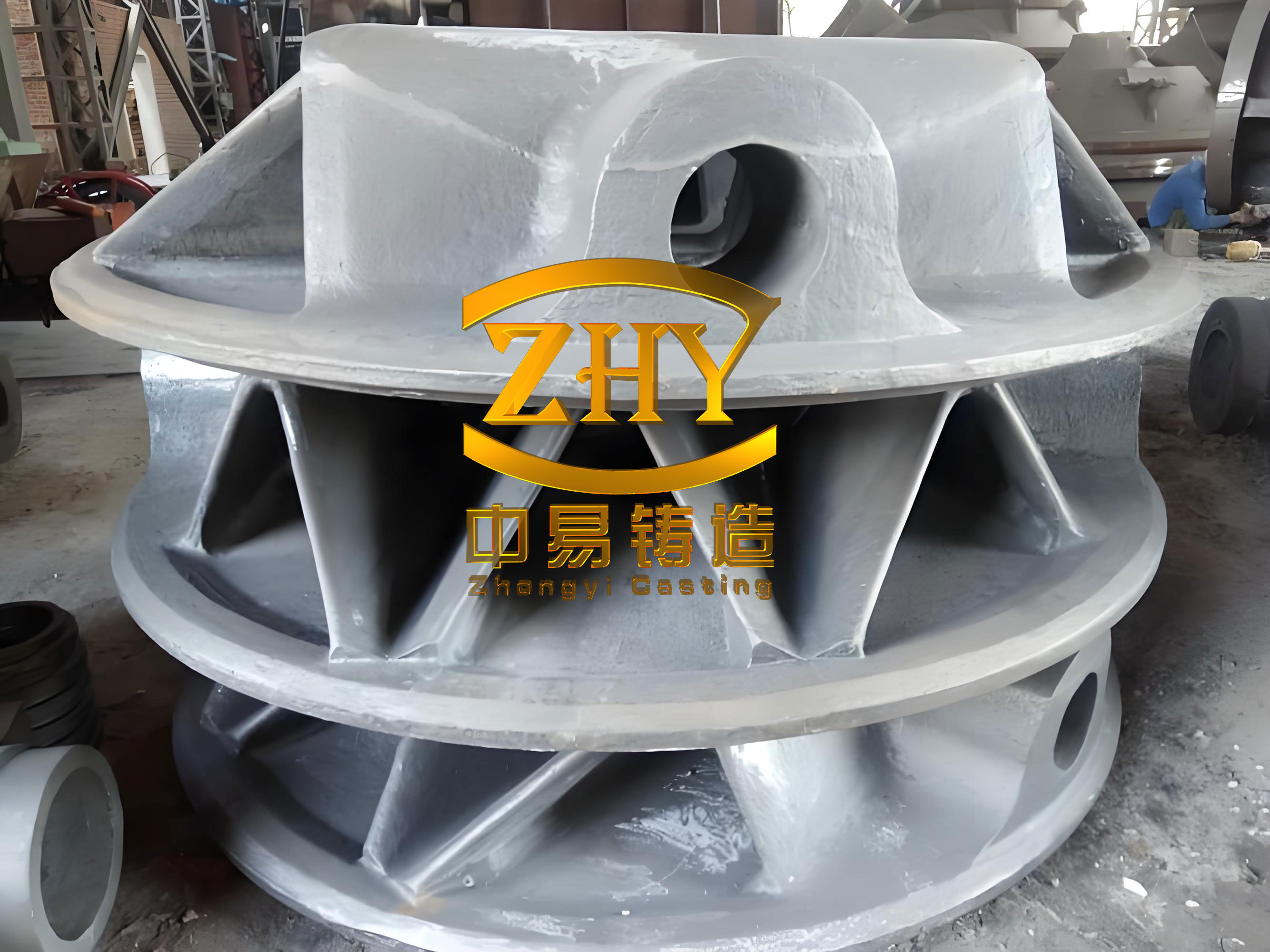
The target material was EN-GJS-450-10. The chemical composition was carefully designed to balance mechanical properties against the propensity for graphite abnormalities in heavy-section ductile iron casting. Carbon equivalent (CE) is a critical parameter. A high CE promotes good fluidity and reduces shrinkage but increases the risk of graphite flotation. We aimed for a CE of 4.3%, calculated traditionally as:
$$CE = C + \frac{1}{3}(Si + P)$$
Alloying strategy was crucial. While silicon solid-solution strengthening can achieve the required tensile strength, high silicon levels in heavy-section ductile iron casting promote the formation of deleterious chunky graphite. Therefore, copper alloying was selected. Copper provides pearlite stabilization and strength without significantly harming ductility or promoting chunky graphite. Trace elements like antimony (Sb) were added in controlled amounts to further suppress ferrite formation. The finalized composition range is presented in Table 1.
| Element | Target Weight (%) | Role in Heavy-Section Ductile Iron Casting |
|---|---|---|
| C | 3.6 – 3.7 | Primary graphite former, affects fluidity and shrinkage. |
| Si | 2.0 – 2.4 | Ferritizer, raises CE. Controlled to avoid chunky graphite. |
| Mn | 0.35 – 0.45 | Pearlite promoter, but kept low to preserve toughness. |
| P | < 0.04 | Undesirable, forms hard phosphides, lowers toughness. |
| S | < 0.02 | Undesirable, consumes Mg, creates inclusions. |
| Cu | 0.7 – 0.9 | Primary alloying element for pearlite strength. |
| Sb | ~0.0035 | Trace pearlite stabilizer. |
| Mg (residual) | 0.04 – 0.05 | Essential for graphite spheroidization. |
The nodularization process is the heart of ductile iron casting. For this heavy-section ductile iron casting, we employed the sandwich method (a type of pouring-in method). The choice of nodularizing agent was based on several factors. Given the planned low pouring temperature, a potent agent with 6.0% Mg was selected. Rare Earth (RE) content, particularly Cerium, was kept low (<1%) as high RE can adversely affect graphite morphology in thick sections. The agent also had strict limits on MgO content (<0.5%) to maximize effective Mg yield and minimize slag. Calcium content was moderated to avoid delaying reaction onset or weakening nodularization. The nodularization temperature was critically set between 1470°C and 1500°C. High-temperature treatment enhances slag separation due to lower metal viscosity, described by the relationship for fluidity:
$$\mu = \mu_0 \exp\left(\frac{E}{RT}\right)$$
where \( \mu \) is viscosity, \( \mu_0 \) is a constant, \( E \) is activation energy, \( R \) is the gas constant, and \( T \) is temperature. Lower viscosity at high temperature facilitates efficient slag removal post-reaction. The reaction kinetics were carefully monitored; an ideal vigorous boil ensured good Mg absorption, decarbonization, and slag removal, leading to consistent and homogeneous ductile iron casting.
Inoculation is arguably even more critical than nodularization for heavy-section ductile iron casting, as it determines the final graphite count and morphology. Various methods exist, each with pros and cons for ductile iron casting production, summarized in Table 2.
| Method | Description | Advantages for Ductile Iron Casting | Disadvantages for Heavy-Section Casting |
|---|---|---|---|
| Cover Inoculation | Inoculant placed over nodularizer in the ladle. | Stabilizes nodularization reaction. | High risk of fade due to long holding time. |
| Stream Inoculation during Tapping | Inoculant added to metal stream while tapping into treatment ladle. | Good dispersion using reaction turbulence. | Some fade possible before pouring. |
| Ladle-to-Ladle (Pouring) Inoculation | Inoculant added during transfer of treated metal to a second ladle. | Combines effective inoculation with temperature drop. | Requires additional handling step. |
| In-Stream Inoculation during Pouring | Inoculant added to metal stream entering the mold. | Minimal fade, highly efficient. | Requires precise feeding equipment. |
| In-Mold Inoculation | Inoculant blocks placed in gating system. | Excellent efficiency, no fade. | Requires perfect slag control, variable consumption. |
For our heavy-section ductile iron casting, the contradiction was clear: high-temperature nodularization was needed for clean metal, but low-temperature pouring was needed to shorten solidification time and minimize graphite degeneration. The solution was a two-stage inoculation process. First, a minor amount of inoculant (0.2% of iron weight) was used as cover inoculation primarily to buffer the nodularization reaction. After complete nodularization and thorough slag removal, the key step was performed: ladle-to-ladle inoculation. The treated iron was poured into a pre-heated second ladle. During this transfer, 0.5% of a barium-bearing silicon inoculant was added. This achieved three goals simultaneously: 1) It introduced a potent, fresh inoculant at the last practical moment, maximizing graphite nucleation sites crucial for heavy-section ductile iron casting. 2) The act of transfer significantly cooled the metal from ~1470°C to approximately 1300°C, enabling the desired low-temperature pour. 3) It provided additional mixing, ensuring homogeneity in the final ductile iron casting bath. Finally, during the actual casting pour, an additional 0.2% inoculant was added via in-stream inoculation for a final graphite nucleation boost. The total inoculation sequence is represented schematically:
$$\text{Inoculation Effect} = I_0 \cdot e^{-\lambda t} + \Delta I_{\text{ladle-to-ladle}} \cdot e^{-\lambda t_{\text{short}}} + \Delta I_{\text{stream}}$$
where \( I_0 \) is the initial inoculation, \( \lambda \) is the fade rate constant, \( t \) is time, and \( \Delta I \) are the incremental inoculation effects.
The pouring practice was designed for speed to complement the low temperature. The entire 10-ton batch of ductile iron casting was poured within 100 seconds. Fast pouring minimizes temperature loss in the gating system and helps maintain thermal gradients conducive to directional solidification, even in heavy-section ductile iron casting. The gating system was designed with effective slag traps to ensure only clean metal entered the mold cavity.
Quality verification is essential for any ductile iron casting process, especially for demanding heavy-section applications. The produced casting was subjected to a comprehensive battery of tests. Visual and surface inspection revealed no visible defects. Magnetic particle inspection according to EN 1369:2012 confirmed surface quality met the required SM2/LM2/AM2 level. Ultrasonic testing per EN 12680-3:2011 showed no internal discontinuities exceeding the specified Level 3 acceptance criteria, confirming the soundness of the heavy-section ductile iron casting.
Metallographic examination is the definitive test for ductile iron casting. A 70-mm attached wedge block was used for standard assessment. The graphite morphology was excellent, as shown in Table 3. More importantly, a sample taken from the heavy-section casting body itself (300 mm thick) was examined. Despite the challenges of slow cooling, the nodularity remained above 85%, demonstrating the effectiveness of the ladle-to-ladle inoculation process in suppressing graphite degeneration in heavy-section ductile iron casting. The graphite nodule count, a key indicator of inoculation potency, was satisfactory.
| Property | Standard / Requirement | Result (Attached Block) | Result (Casting Body) |
|---|---|---|---|
| Nodularity (V+VI) | ISO 945-1; ≥90% (Req.) | 95% | >85% |
| Graphite Nodule Count | ISO 945-1 | 120 nodules/mm² | Assessed as adequate |
| Graphite Size | ISO 945-1 | Size 6 | Size 6-7 |
| Pearlite Content | ISO 945-1 | 5-10% | 10-15% |
| Tensile Strength (Rm) | EN-GJS-450-10; ≥430 MPa | 451 MPa | N/A |
| Yield Strength (RP0.2) | EN-GJS-450-10; ≥295 MPa | 315 MPa | N/A |
| Elongation (A) | EN-GJS-450-10; ≥9% | 12% | N/A |
| Brinell Hardness (HBW) | EN-GJS-450-10; 160-200 | 170 | ~175 |
The mechanical properties of the attached test block, detailed in Table 3, comfortably exceeded the EN-GJS-450-10 specifications. This confirms that the combined chemical, processing, and inoculation strategy successfully produced a high-integrity heavy-section ductile iron casting.
Further scientific analysis of the process can be undertaken. The effectiveness of inoculation in ductile iron casting is often related to undercooling. The number of graphite nodules, \( N \), can be related to undercooling, \( \Delta T \), and inoculant particle potency, often expressed as:
$$N = k_N \cdot (\Delta T)^m$$
where \( k_N \) and \( m \) are material constants. The ladle-to-ladle inoculation, performed just before pouring, maximized \( \Delta T \) during solidification by lowering the pouring temperature, thereby promoting a higher \( N \). This is vital for heavy-section ductile iron casting to ensure a fine, uniform graphite structure despite slow cooling.
The success of this project for heavy-section ductile iron casting hinged on several interlinked factors. The chemical composition, with controlled CE and the use of copper alloying, provided a stable base matrix resistant to abnormal graphite formation. The high-temperature nodularization ensured a strong, consistent Mg treatment and, crucially, allowed for the removal of virtually all reaction slag before the critical inoculation step. The innovative use of ladle-to-ladle inoculation was the cornerstone. It broke the traditional compromise by decoupling the high-temperature requirement for clean nodularization from the low-temperature requirement for pouring. This process provided a massive, late-stage inoculation event that dramatically increased graphite nucleation sites while simultaneously achieving the target pouring temperature of ~1300°C. The final in-stream inoculation served as an added safeguard. The rapid pouring then locked in these favorable conditions.
In conclusion, the production of high-quality heavy-section ductile iron casting, such as the marine component described, demands an integrated approach. No single parameter guarantees success. By strategically combining a balanced chemistry, vigorous high-temperature nodularization with clean slag-off, and a potent, temperature-lowering ladle-to-ladle inoculation process followed by fast pouring, it is possible to overcome the formidable challenges posed by slow solidification. This methodology effectively controls graphite morphology, minimizes shrinkage and inclusion defects, and delivers consistent mechanical properties that meet stringent international standards. The ladle-to-ladle inoculation technique, therefore, proves to be an exceptionally valuable tool in the arsenal of foundry engineers specializing in heavy-section ductile iron casting. Future work could focus on quantitatively modeling the thermal and nucleation effects of this transfer process to further optimize inoculant type and amount for different section sizes of ductile iron casting.