
In my experience as a casting engineer, the production of complex components like the dewatering machine base presents significant challenges due to structural intricacies and stringent performance requirements. The dewatering machine base, which supports operational components and transmission devices, must dissipate vibrations to the ground while ensuring stability, necessitating high strength, stiffness, vibration damping, and machinability. Traditional sand casting methods often led to defects such as sand inclusions, blowholes, and cracks, resulting in low product qualification rates. To address these issues, I implemented the lost foam casting (LFC) process, also referred to as EPC (Expanded Polystyrene Casting), which leverages foam patterns that vaporize during pouring to form the mold cavity. This approach eliminates the need for cores and complex molding operations, significantly reducing defects. In this article, I will detail the application of lost foam casting for the dewatering machine base, incorporating technical analyses, formulas, and tables to illustrate the process optimization. Throughout, I emphasize the advantages of lost foam casting and EPC in enhancing quality and efficiency.
The dewatering machine base is a hollow shell structure with external rib reinforcements, measuring 1146 mm × 1140 mm × 436 mm and weighing 500 kg in its cast form. Key features include 180 mm × 100 mm × 25 mm rectangular lifting holes on the sidewalls and multiple ribs with thicknesses of 20 mm and 25 mm to bolster strength and rigidity. The maximum wall thickness is 35 mm, and the component requires machining on the top, bottom, and side surfaces with allowances of 8 mm and 6 mm, respectively. Technical specifications demand freedom from shrinkage porosity, gas holes, and cracks post-machining, underscoring the need for dense, defect-free castings. The structural complexity, characterized by thin walls and internal cavities, makes it a typical box-type casting, where conventional sand casting struggles with issues like misruns and core shifts. By adopting lost foam casting, I aimed to overcome these limitations through a holistic process design.
Initially, sand casting was employed using red pine for the full pattern and river sand for molding. The process involved three-part molding with a split plane at the top and bottom surfaces, and core assemblies for internal features like the lifting holes and motor installation area. However, this method frequently resulted in defects due to operational complexities: uneven sand compaction led to local hard or soft spots, improper venting caused gas entrapment, and core misalignment produced shifts. As summarized in Table 1, the defect rate was unacceptably high, with only about 75% of castings meeting quality standards after machining. This prompted a shift to lost foam casting, which leverages the vaporization of expandable polystyrene (EPS) patterns to create precise molds without the need for cores or parting lines.
| Defect Type | Sand Casting Incidence (%) | Lost Foam Casting Incidence (%) |
|---|---|---|
| Sand Inclusions | 15 | 2 |
| Gas Holes | 12 | 3 |
| Cracks | 8 | 1 |
| Shrinkage Porosity | 10 | 2 |
| Overall Rejection Rate | 25 | 5 |
In the lost foam casting process, material selection is critical. I used EPS boards with a density of 17.5 kg/m³ (0.0175 g/cm³) for the pattern and gating system, as this low density ensures complete vaporization during pouring while maintaining structural integrity during molding. The mold material consisted of 20-40 mesh magnesium olivine sand, chosen for its high refractoriness and permeability, which facilitates gas escape and reduces burning-on defects. The EPS patterns were manually carved and assembled using polyvinyl acetate emulsion as an adhesive, ensuring dimensional accuracy to within ±1 mm of the design specifications. To prevent distortion during vibration compaction, which is a common issue in EPC due to the low stiffness of foam, I applied a specialized alcohol-based coating in three layers, achieving a thickness of 1.5–2 mm. This coating enhances surface finish and withstands the mechanical stresses of dry sand filling and high-temperature metal冲刷.
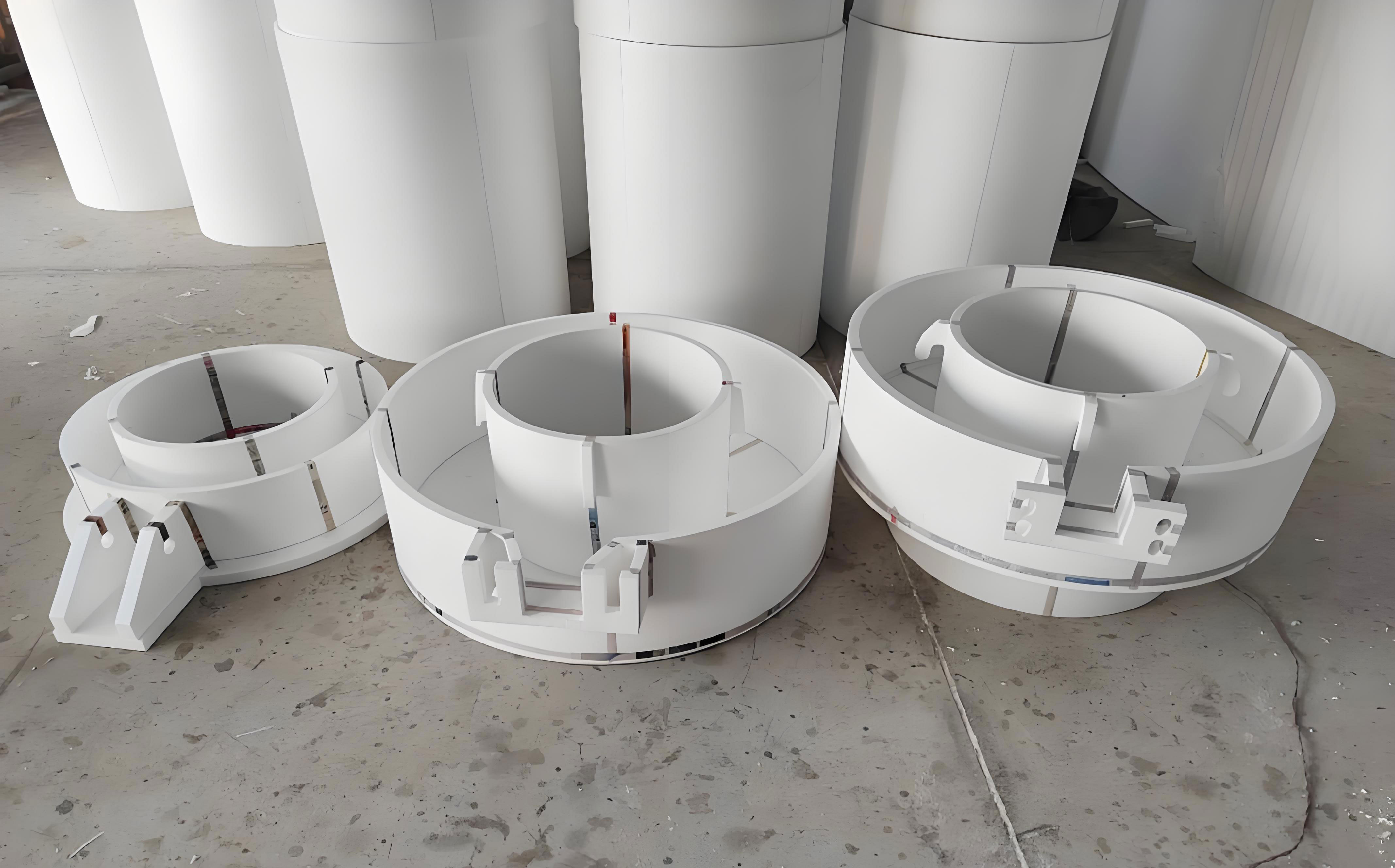
The gating system design in lost foam casting is paramount to ensuring smooth metal flow and minimizing defects like slag inclusions and gas porosity. I employed an open, stepped gating system with two levels of ingates and a parting plane injection approach. This system comprises one pouring cup, one sprue, two runners, and four ingates, all fabricated from EPS. To compensate for the obstructive effects of foam vaporization—which absorbs heat and impedes fluidity—I oversized the cross-sections compared to conventional sand casting. The sprue diameter was set at 50 mm, the runners had a trapezoidal cross-section of 44 mm × 30 mm × 46 mm, and the ingates featured a flat cross-section of 45 mm × 41 mm × 14 mm. The volumetric flow rate can be estimated using the formula for pouring time, which I derived based on the cast weight and empirical data:
$$ t = \frac{W}{\rho \cdot A \cdot v} $$
where \( t \) is the pouring time (s), \( W \) is the cast weight (500 kg), \( \rho \) is the molten iron density (approximately 7000 kg/m³), \( A \) is the total cross-sectional area of the ingates (m²), and \( v \) is the flow velocity (m/s). For this setup, with \( A \) calculated as \( 4 \times (0.045 \times 0.041) = 0.00738 \, \text{m}^2 \) and \( v \) assumed as 0.5 m/s for low-turbulence flow, the pouring time is approximately 30–40 seconds, aligning with the optimal range for lost foam casting. Additionally, I incorporated slag traps in the runners to enhance slag removal, critical for preventing inclusions in machined surfaces.
Venting and feeding are crucial in lost foam casting to address gas evolution and solidification shrinkage. I positioned two 35 mm × 20 mm top overflow risers symmetrically on the highest side of the pattern to aid feeding and two 70 mm × 200 mm open risers on the upper surface for gas and slag evacuation. The riser design accounts for the solidification dynamics, with the modulus method used to ensure adequate feeding:
$$ M = \frac{V}{A} $$
where \( M \) is the modulus (cm), \( V \) is the volume of the casting section (cm³), and \( A \) is the surface area (cm²). For the thickest section (35 mm), \( M \approx 1.75 \, \text{cm} \), requiring risers with a higher modulus to delay solidification. The pouring temperature was controlled between 1310°C and 1380°C to balance fluidity and shrinkage—too high a temperature increases liquid contraction, while too low one hinders feeding. The low-temperature, fast-pouring strategy mitigates cracking risks by reducing thermal gradients. Table 2 summarizes key process parameters for the lost foam casting application, highlighting the optimization efforts.
| Parameter | Value | Remarks |
|---|---|---|
| EPS Density | 17.5 kg/m³ | Ensures complete vaporization |
| Coating Thickness | 1.5–2 mm | Applied in three layers |
| Pouring Temperature | 1310–1380°C | Optimized for fluidity and shrinkage |
| Pouring Time | 30–40 s | Fast pouring to reduce defects |
| Mold Sand | 20-40 mesh Mg olivine | High permeability and thermal stability |
| Gating Ratio (Sprue:Runner:Ingate) | 1:1.2:1.1 | Oversized for EPC requirements |
Pattern assembly and molding are delicate stages in lost foam casting. I assembled the EPS patterns and gating system separately, coating and drying them before adhesion to prevent warping. For areas with poor sand accessibility, such as around inclined ribs, I used self-curing sand patches to ensure uniform compaction. The mold was filled with dry sand via a rain-type sand feeding system on a 3D vibration table, which applies vertical and horizontal oscillations to achieve a compaction density of 1.6–1.8 g/cm³. The vibration parameters—frequency of 50–60 Hz and amplitude of 0.5–1 mm—were calibrated to prevent pattern deformation, a common issue in EPC for large, thin-walled castings. The sand filling and compaction are simultaneous, enhancing mold uniformity and reducing the risk of voids.
Thermal aspects of lost foam casting involve complex heat transfer during foam decomposition. The energy balance during vaporization can be expressed as:
$$ Q_{\text{vaporization}} = m_{\text{EPS}} \cdot L_{\text{v}} $$
where \( m_{\text{EPS}} \) is the mass of the EPS pattern (approximately 0.5 kg for this base) and \( L_{\text{v}} \) is the latent heat of vaporization (around 1000 kJ/kg for EPS). This energy absorption cools the molten metal, necessitating higher pouring temperatures than in sand casting. I calculated the temperature drop \( \Delta T \) due to foam decomposition using:
$$ \Delta T = \frac{Q_{\text{vaporization}}}{m_{\text{metal}} \cdot c_p} $$
with \( m_{\text{metal}} = 500 \, \text{kg} \) and \( c_p = 0.5 \, \text{kJ/kg·°C} \) for iron, yielding \( \Delta T \approx 2°C \), which is manageable within the controlled pouring range. This emphasizes the importance of temperature management in lost foam casting to avoid premature solidification.
The benefits of lost foam casting are evident in the improved quality metrics. Post-machining, the defect rate dropped to below 5%, and the casting density met the required mechanical properties. The elimination of parting lines and cores in EPC reduced inaccuracies like misruns and core shifts, while the dry sand mold minimized gas-related defects. Moreover, the process simplified production by omitting pattern withdrawal and core setting, cutting labor costs by an estimated 20%. Table 3 compares the overall performance between sand casting and lost foam casting, underscoring the superiority of EPC for complex geometries.
| Aspect | Sand Casting | Lost Foam Casting |
|---|---|---|
| Pattern Material | Red Pine | EPS Foam |
| Molding Complexity | High (cores, multi-part) | Low (monolithic pattern) |
| Typical Defect Rate | 25% | 5% |
| Machining Allowance | 6–8 mm | 4–6 mm (reduced due to accuracy) |
| Production Cycle Time | Longer | Shorter by 15% |
| Material Utilization | Moderate | High (minimal waste) |
In conclusion, the application of lost foam casting for the dewatering machine base demonstrates its efficacy in producing high-integrity castings with complex geometries. Through careful design of the gating system, controlled pouring parameters, and optimized pattern making, I achieved a qualification rate exceeding 90%, far surpassing the results from sand casting. The EPC process not only reduces defects but also enhances dimensional accuracy and surface finish, making it ideal for box-type castings requiring rigorous machining. Future work could focus on automating pattern fabrication and integrating simulation tools to further refine the lost foam casting process. As casting technologies evolve, lost foam casting and EPC will continue to play a pivotal role in advancing manufacturing efficiency and product quality.