
In my extensive experience within the heavy machinery and foundry sector, I have consistently observed the pivotal role that nodular cast iron plays in the manufacturing of critical, thick-section components for mining equipment. The demand for larger, more efficient mining machinery has driven the development of massive cast parts such as grinding plate bodies, end covers, bearing seats, riding wheels, slag basins, blast furnace cooling walls, and conical sleeves. These components often operate under extreme loads, abrasive conditions, and cyclic stresses, necessitating a material that combines high strength, excellent toughness, good wear resistance, and reliable castability. Nodular cast iron, with its unique graphite spheroidization achieved through magnesium or rare earth treatment, fulfills these requirements exceptionally well for thick sections. This article delves into the application specifics, production challenges, and technological advancements associated with using nodular cast iron for these demanding parts. I will discuss various case studies, summarizing key parameters through tables and exploring underlying metallurgical principles with formulas to provide a comprehensive technical perspective.
The fundamental advantage of nodular cast iron in thick sections lies in its microstructure. Unlike flake graphite in gray iron, the spheroidal graphite nodules act as “crack arrestors,” mitigating stress concentration and thereby imparting superior ductility and fatigue resistance. However, producing sound, high-integrity nodular cast iron castings with sections exceeding 200 mm, and often reaching 600 mm, presents significant challenges. These include the tendency for graphite degeneration (e.g., chunk graphite formation), shrinkage porosity, and segregation of alloying elements during the prolonged solidification. Overcoming these requires precise control over metallurgy, melting, treatment, and casting design.
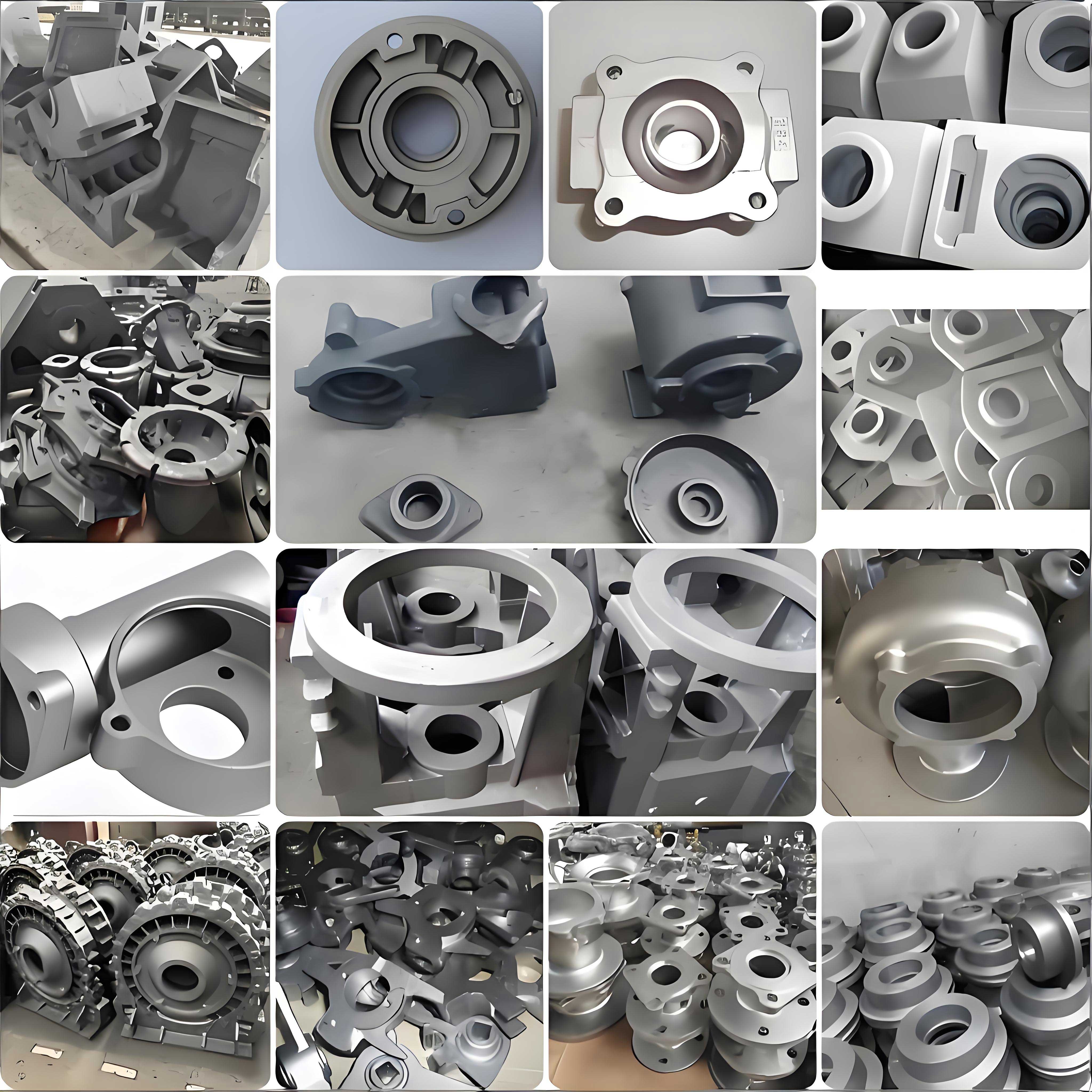
Let me begin with a detailed examination of specific component applications. The grinding plate body for vertical roller mills is a quintessential example of a thick-section nodular cast iron part. These components are central to grinding operations in cement and mineral processing. A typical grinding plate body can weigh between 49 to 142 tonnes, with maximum thermal section diameters (hot spots) ranging from 400 to 600 mm. The material specification often calls for a grade equivalent to QT400-15A, requiring a minimum tensile strength of 400 MPa and an elongation of 15%. The production of such a massive nodular cast iron casting hinges on a robust process chain. The charge composition typically involves high-purity pig iron with low sulfur content, high-quality steel scrap, and a controlled percentage of returns. The key to successful production is the treatment process. I have found that the wire-feeding inoculation method, followed by stream inoculation, yields excellent and consistent results. The treatment temperature is critical, usually maintained between 1360°C and 1380°C, with a pouring temperature range of 1310°C to 1340°C. The gating system is designed as bottom-pouring and semi-open to ensure calm filling. Feeding is accomplished via large insulating risers, often arranged in a pattern to cover the major thermal centers. Non-destructive testing (NDT) like ultrasonic and magnetic particle inspection is mandatory for such critical parts to ensure internal soundness and surface integrity.
The following table summarizes key data for several major thick-section nodular cast iron components used in mining machinery:
| Component Name | Typical Material Grade | Approximate Weight Range (tonnes) | Maximum Wall Thickness / Hot Spot (mm) | Primary NDT Requirements |
|---|---|---|---|---|
| Grinding Plate Body | QT400-15A / EN-GJS-400-18U | 49 – 142 | 400 – 600 | Ultrasonic Testing (UT), Magnetic Particle Testing (MT) |
| Ball Mill End Cover | QT500-7 | ~22.6 | >200 | UT, MT (to EN standards) |
| Bearing Seat | EN-GJS-400-18U | ~16 | >300 | UT, Fluorescent MT |
| Riding Wheel (Support Roller) | QT700-2 | ~7.5 | ~415 | UT, Dye Penetrant Testing (PT) |
| Slag Basin | QT500-7 | ~1.35 | ~100 | Visual, Dimensional |
| Blast Furnace Cooling Wall | QT400-18 | ~3 | 250 – 280 | Metallographic, Mechanical Testing |
| Four-Sided Conical Sleeve | QT500-7 | ~3.1 | 75 – 170 | UT (to high-grade standards) |
From a metallurgical standpoint, the composition and treatment of nodular cast iron for thick sections are meticulously designed. The carbon equivalent (CE) is a fundamental parameter that influences fluidity, shrinkage behavior, and final microstructure. For thick-section nodular cast iron, the CE is often optimized to balance these properties, typically ranging from 4.1% to 4.4%. The carbon equivalent is calculated using the formula:
$$ CE = C + \frac{Si + P}{3} $$
where C, Si, and P are the weight percentages of carbon, silicon, and phosphorus, respectively. A higher CE improves fluidity and graphitization potential but must be controlled to avoid excessive shrinkage and graphite flotation. For grades like QT700-2 used in riding wheels, which require high strength, the CE is kept lower, and alloying elements like copper or nickel may be added. The effectiveness of the nodularizing treatment can be quantified by the nodularity percentage, a key metric in microstructure evaluation:
$$ \text{Nodularity} (\%) = \frac{N_{\text{nodular}}}{N_{\text{total}}} \times 100 $$
Here, \( N_{\text{nodular}} \) is the number of graphite particles with an aspect ratio close to 1 (spherical), and \( N_{\text{total}} \) is the total number of graphite particles. For thick-section castings, maintaining a nodularity above 80% in the thermal center is challenging but essential for achieving the required elongation and impact properties.
Another critical aspect is solidification control. The solidification time \( t_s \) for a thick-section casting can be estimated using Chvorinov’s rule:
$$ t_s = k \left( \frac{V}{A} \right)^n $$
where \( V \) is the volume of the casting, \( A \) is its surface area, \( k \) is the mold constant, and \( n \) is an exponent typically close to 2. For a large, thick-walled nodular cast iron component, the modulus \( (V/A) \) is very high, leading to extremely long solidification times. This prolonged cooling in the mushy zone increases the risk of inter-dendritic segregation and chunk graphite formation. To counteract this, the inoculation process is intensified. I employ a combined inoculation strategy involving pre-inoculation (e.g., during tapping), post-inoculation (wire-feeding or in-mold), and late stream inoculation. The efficiency of an inoculant, often a FeSi alloy containing elements like Ca, Ba, or Sr, can be related to its fade time. The dissolved magnesium content after treatment is also crucial and follows a decay curve:
$$ [Mg]_{t} = [Mg]_{0} \cdot e^{-\lambda t} $$
where \( [Mg]_{t} \) is the magnesium content at time \( t \), \( [Mg]_{0} \) is the initial content after treatment, and \( \lambda \) is a fade constant dependent on temperature and slag conditions. For thick-section nodular cast iron, maintaining sufficient residual magnesium throughout the long pouring and solidification sequence is vital.
Let’s explore the production details for a high-strength component like the riding wheel (support roller) for a rotary kiln. This nodular cast iron part, made of QT700-2, must withstand enormous cyclic compressive loads. Its production requires a carefully designed feeding system. Given its cylindrical shape with a thick section of over 400 mm, a combination of top insulating risers and chills is used. The riser sizing is based on the required feeding volume to compensate for the shrinkage of nodular cast iron, which is significant (approximately 4-6% volume contraction). The necessary riser volume \( V_r \) can be approximated by:
$$ V_r = \frac{V_c \cdot \beta}{\alpha – \beta} $$
where \( V_c \) is the volume of the casting region fed by the riser, \( \beta \) is the fractional shrinkage of the metal (∼0.06 for nodular cast iron), and \( \alpha \) is the fractional efficiency of the riser (typically 0.1-0.2 for insulating risers). The use of chills accelerates cooling in specific areas to create directional solidification towards the risers. The heat extraction rate of a chill is a function of its material and contact area.
The table below provides a comparative overview of typical process parameters for producing two different grades of thick-section nodular cast iron:
| Process Parameter | High-Ductility Grade (e.g., QT400-18) | High-Strength Grade (e.g., QT700-2) |
|---|---|---|
| Target Carbon Equivalent (CE) | 4.2% – 4.4% | 3.9% – 4.1% |
| Typical Alloying Additions | Minimal; sometimes Ni for wall thickness >300mm | Cu (0.5-1.0%), Mo (0.2-0.4%), or Ni |
| Nodularizing Method | Wire-feeding or Tundish Cover | Sandwich Method (MgFeSi) or Wire-feeding |
| Nodularizer Type/Amount | MgFeSi (1.3-1.6%) or Rare Earth-Mg | MgFeSi (1.5-1.8%) with lower Rare Earth |
| Inoculation Strategy | Multiple: Pre-, Post-, and Stream (Total 0.8-1.2%) | Multiple: Pre-, Post-, and Stream (Total 0.6-1.0%) |
| Pouring Temperature | 1330°C – 1360°C | 1320°C – 1350°C |
| Solidification Control | Extensive use of Insulating Riser Sleeves | Combination of Riser Sleeves and Chills |
| Key Microstructure Goal | Ferrite >90%, Nodularity >80% at center | Pearlite matrix (60-80%), Fine nodular graphite |
The bearing seat is another fascinating application where nodular cast iron provides an optimal balance of strength, stiffness, and damping capacity. For a large bearing seat weighing around 16 tonnes, the specification EN-GJS-400-18U demands even higher elongation (>12%) than the standard. To achieve this in sections over 300 mm, nickel is frequently added in amounts of 0.4-0.6% to suppress pearlite formation and promote ferrite, even at slow cooling rates. The melting practice for such high-integrity nodular cast iron involves using raw materials with low trace element levels (e.g., Ti, Pb, Sb, Bi) that can interfere with graphite nodularization. The relationship between tensile properties and microstructure can be expressed through empirical models. For instance, the yield strength \( \sigma_y \) of ferritic nodular cast iron can be related to the silicon content and nodule count \( N_v \) (nodules per unit volume):
$$ \sigma_y \approx \sigma_0 + K_{Si} \cdot [Si] + K_{N} \cdot (N_v)^{-1/2} $$
where \( \sigma_0 \) is a base strength, and \( K_{Si} \) and \( K_{N} \) are constants. A high nodule count, achieved through effective inoculation, refines the matrix structure and improves mechanical properties uniformly across thick sections.
For components like the blast furnace cooling wall, the challenge is to maintain a predominantly ferritic matrix with high thermal conductivity in very thick sections (250-280 mm). The process involves a “low-temperature melting, high-temperature superheating” approach. The iron is melted quickly at a relatively low temperature to minimize oxidation, then superheated to around 1480°C for a short time to ensure complete dissolution of nuclei before treatment. A composite inoculation process—including ladle inoculation, transfer ladle inoculation, and stream inoculation—is employed. The success is measured by the microstructure at the thermal center: nodularity grade 2-4, graphite size 5-6, and ferrite volume fraction exceeding 95%, leading to elongation values above 12.5%.
The four-sided conical sleeve presents a different challenge due to its complex geometry with multiple sliding surfaces and varying wall thickness. The requirement for a surface free of spiky graphite (vermicular degeneration) necessitates strict control over the last stages of solidification. The use of graphite chills in thermal junctions is effective in this regard. The cooling power of a chill can be modeled by considering it as a heat sink. The heat flux \( q \) at the chill-casting interface is given by:
$$ q = h_{i} ( T_{cast} – T_{chill} ) $$
where \( h_{i} \) is the interfacial heat transfer coefficient, which is high for a metal chill, and \( T_{cast} \) and \( T_{chill} \) are the temperatures of the casting surface and chill, respectively. This rapid heat extraction shifts the solidification front and prevents the formation of undesirable graphite shapes at the surface of the nodular cast iron component.
In conclusion, the application of nodular cast iron in thick-section mining machinery components is a testament to the material’s versatility and the foundry industry’s technological prowess. From massive grinding plates to high-strength riding wheels, nodular cast iron provides an optimal combination of properties that ensure reliability and longevity in harsh mining environments. The production of these components is a complex interplay of metallurgy, thermodynamics, and engineering design, governed by principles that can be captured in formulas and optimized through careful parameter control. The future of nodular cast iron in this sector is promising. I believe there is substantial scope for further development. The ongoing trend towards even larger and more efficient mining equipment will continue to push the boundaries, demanding nodular cast iron castings with ever-greater wall thickness, more complex geometries, and enhanced property combinations—all while aiming to reduce overall manufacturing costs and lead times. Advancements in simulation software for solidification modeling, improved inoculant technologies, and the development of new alloying strategies will be key to meeting these future challenges and expanding the frontiers of what is possible with nodular cast iron.