
In the foundry industry, sand casting has long been a fundamental process due to its cost-effectiveness, versatility, and adaptability for single-piece, batch, and mass production. The use of sand casting is particularly significant in producing complex components like rear axle housings, which require high strength, rigidity, and density to withstand operational stresses and prevent leakage. This article explores the application of sand casting in the trial production of low-carbon steel rear axle housings, detailing the process from initial design to final optimization. Through iterative testing and modifications, we established a mature casting process for the JT6120 axle housing, emphasizing the flexibility and advantages of sand casting in resolving defects and improving yield.
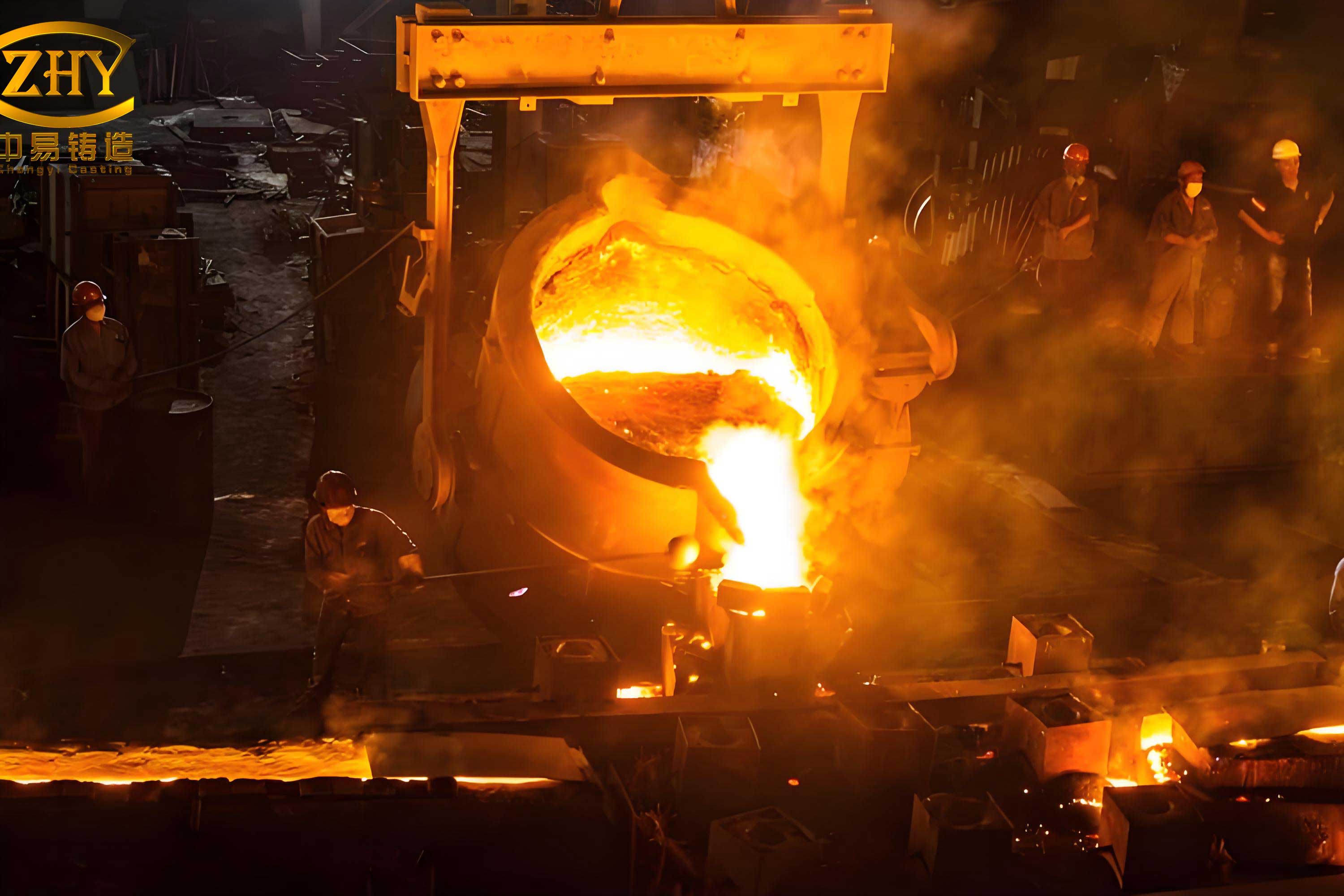
The sand casting process relies on inexpensive and readily available molding materials, making it ideal for experimental setups where modifications are frequent. In this study, we focused on a ZG35 steel rear axle housing with a weight of 184 kg, requiring a smooth surface free from defects like porosity, slag inclusions, shrinkage cavities, and cracks. After machining, the casting must pass a 0.5 MPa hydrostatic test without leakage. The housing’s thin-walled box structure, with non-uniform thickness, poses challenges due to low-carbon steel’s poor casting properties, such as high shrinkage. The sand casting method allowed us to address these issues through practical trials, leading to a robust process.
To understand the casting requirements, we analyzed the geometry and thermal characteristics. The housing has outer dimensions of 1442 mm × 393 mm × 148 mm, with a main wall thickness of 50 mm. Critical areas include upper and lower annular planes, where thickness ranges from 13 mm to 14 mm, plus machining allowances and process corrections totaling 21 mm to 25 mm. These regions involve rod-plate connections, creating significant hot spots. We calculated the modulus of these hot spots to guide riser and chill placement. The modulus M is defined as the volume-to-surface-area ratio, crucial for predicting solidification behavior. For the upper annular plane, the modulus is approximately 2.76 cm, while for the lower plane, it is 1.25 cm. Flange sections have a modulus of 1.7 cm. These values informed our sand casting design to ensure soundness in thin-walled areas.
| Feature | Dimension (mm) | Modulus (cm) |
|---|---|---|
| Outer轮廓 | 1442 × 393 × 148 | — |
| Main Wall Thickness | 50 | — |
| Upper Annular Plane (with allowance) | Thickness: 13 + 21 = 34 | 2.76 |
| Lower Annular Plane (with allowance) | Thickness: 14 + 25 = 39 | 1.25 |
| Flange Sections | — | 1.70 |
In sand casting, the molding material selection is critical for achieving desired surface finish and minimizing defects. We used sodium silicate self-hardening sand for molding, which offers good collapsibility and strength. The core, forming the internal cavity of the housing, was made from resin-bonded sand for steel castings, coated with zircon flour-based fast-drying paint to prevent burn-on. To enhance core yield and reduce cracking risks, we incorporated relief holes in the core design. The sand casting process allowed easy adjustments to core geometry and placement based on trial outcomes.
Determining the pouring position is a key step in sand casting to control solidification and defect formation. We positioned the lower annular plane (Φ310–Φ424) in the drag part of the mold, as it is a machined surface requiring high integrity. The upper annular plane (Φ308–Φ424), with its larger modulus, was placed in the cope to facilitate riser placement for feeding. This orientation leverages the principles of directional solidification, essential in sand casting for heavy sections.
The gating system design in sand casting directly impacts fluid flow, turbulence, and defect formation. We calculated the gating dimensions based on empirical formulas to ensure proper filling. The total cross-sectional area of ingates (ΣFingate) was determined using the formula:
$$ \Sigma F_{\text{ingate}} = \frac{W}{\rho \cdot t \cdot v} $$
where W is the casting weight (184 kg), ρ is the steel density (approximately 7.8 g/cm³), t is the pouring time (≥20 seconds), and v is the flow velocity. For our sand casting setup, we derived ΣFingate = 26 cm², with individual ingates sized at 30 mm × 35 mm × 40 mm. The cross-sectional area of the runner (ΣFrunner) was 28.6 cm² (48 mm × 56 mm × 55 mm), and the sprue (ΣFsprue) was 38.46 cm² (diameter 70 mm). The ratio ΣFsprue : ΣFrunner : ΣFingate was maintained at 1 : 1.5 : 1.4 to ensure progressive filling and reduce turbulence. This gating design is typical in sand casting to minimize slag entrapment and oxidation.
| Component | Dimensions (mm) | Cross-Sectional Area (cm²) | Ratio |
|---|---|---|---|
| Sprue | Φ70 | 38.46 | 1.0 |
| Runner | 48 × 56 × 55 | 28.6 | 1.5 |
| Ingates | 30 × 35 × 40 | 26.0 | 1.4 |
Riser and chill design in sand casting is crucial for compensating shrinkage and controlling solidification. Based on modulus calculations, we placed eight risers and ten chills at hot spots to promote directional solidification. The risers were designed using the hot-spot circle method, where the riser size is proportional to the hot-spot diameter. The modulus of the riser Mr should exceed that of the casting hot spot Mc by a factor, typically 1.2, to ensure adequate feeding:
$$ M_r \geq 1.2 \times M_c $$
For example, for a hot spot with Mc = 2.76 cm, the riser modulus should be at least 3.31 cm. We used side risers initially, but as discussed later, this led to defects. Chills were placed in the drag at thick sections to accelerate cooling and achieve simultaneous solidification, a common technique in sand casting to reduce shrinkage porosity.
The casting yield, defined as the ratio of casting weight to total poured weight, was initially 55%, calculated as:
$$ \text{Yield} = \frac{W_{\text{casting}}}{W_{\text{total}}} \times 100\% $$
where Wcasting is 184 kg. This low yield indicated significant metal loss in risers and gating, prompting optimization in later trials. The sand casting process allows for easy adjustment of riser sizes to improve yield without costly mold changes.
Shrinkage allowance is another critical factor in sand casting design. We applied a linear shrinkage rate of 1.3% in the length direction and 2% in other directions, based on the steel’s solidification characteristics. This compensates for contraction during cooling, ensuring dimensional accuracy. The formula for pattern dimension Lpattern is:
$$ L_{\text{pattern}} = L_{\text{casting}} \times (1 + \alpha) $$
where α is the shrinkage allowance (0.013 or 0.02). In sand casting, such allowances are incorporated into the pattern design to achieve net-shape castings after contraction.
The trial production involved melting ZG35 steel in a 600 kg induction furnace, followed by deoxidation with aluminum and rare-earth ferrosilicon. Pouring was done using a 6T ladle into the sand molds, with a follow-up pour to feed shrinkage. The pouring temperature ranged from 1540°C to 1560°C, and pouring time exceeded 20 seconds to ensure smooth filling. The sand casting molds were stripped after more than 10 hours to avoid cracking due to residual stresses. These parameters were monitored closely, as sand casting is sensitive to pouring conditions.
However, the initial sand casting scheme revealed several defects. First, shrinkage porosity occurred at the roots of four side risers, indicating insufficient feeding. Second, hot cracks appeared in internal rib areas and, in some castings, on the lower annular plane. Third, sand burning and adhesion were observed at flange ends, making cleaning difficult. These issues are common in sand casting when riser design, core yield, or cooling rates are suboptimal.
To address shrinkage porosity, we analyzed the riser design. The side risers increased thermal interference at hot spots, so we replaced them with top risers. This change improved feeding but added complexity, requiring additional cores and increasing cutting time. Alternatively, we considered using padding (or chills) to relocate shrinkage to non-critical areas. Based on directional solidification principles, we added padding to the upper sections, effectively diverting porosity away from machined surfaces. This adjustment in the sand casting process eliminated shrinkage defects without compromising yield.
Cracking was identified as hot cracking, influenced by steel composition, casting geometry, and restraint from molds or cores. In sand casting, core yield is vital to prevent cracking during contraction. We found that cores with inadequate relief holes led to cracks, while those with sufficient holes did not. Thus, we switched to core sands with better yield, such as oil-bonded sand, and standardized relief hole dimensions. We ensured core wall thickness did not exceed 35 mm at relief points. Additionally, for cracks on the lower annular plane, we added a环形冷铁 (annular chill) at the Φ310 region to均衡 cooling. These modifications in the sand casting process resolved cracking issues.
| Defect Type | Location | Probable Cause | Corrective Action |
|---|---|---|---|
| Shrinkage Porosity | Side riser roots | Inadequate riser feeding | Replaced side risers with top risers; added padding |
| Hot Cracks | Internal ribs and lower plane | Poor core yield; uneven cooling | Used oil-bonded cores with relief holes; added chills |
| Sand Adhesion | Flange ends | Insufficient mold coating | Enhanced zircon flour coating; controlled pouring temperature |
Sand adhesion was mitigated by improving the mold coating application and adjusting pouring temperature. In sand casting, using refractory coatings like zircon flour reduces metal penetration into the sand. We also optimized the sand composition to enhance refractoriness.
After these improvements, the sand casting process produced sound castings with no visible defects. Over 500 castings were manufactured, all passing machining and hydrostatic tests. The yield increased to 75%, saving 40 kg of steel per casting and boosting economic efficiency. This demonstrates the adaptability of sand casting for iterative optimization.
The modulus method played a key role in riser design. We recalculated moduli for critical sections to verify riser adequacy. For a cylindrical riser, the modulus Mr is given by:
$$ M_r = \frac{V}{A} = \frac{\pi r^2 h}{2\pi r (r + h)} $$
where r is the radius and h is the height. By matching riser moduli to casting hot spots, we ensured efficient feeding. The sand casting process facilitated easy riser size adjustments through pattern modifications.
Another aspect is the solidification time ts, estimated using Chvorinov’s rule:
$$ t_s = k \left( \frac{V}{A} \right)^2 = k M^2 $$
where k is a constant dependent on mold material and metal properties. In sand casting, k is relatively high due to the insulating nature of sand, leading to longer solidification times. This necessitates careful riser design to maintain feeding paths.
We also evaluated the gating system’s efficiency using the Reynolds number Re to assess flow turbulence:
$$ Re = \frac{\rho v D}{\mu} $$
where D is the hydraulic diameter, and μ is the dynamic viscosity. For steel in sand casting, maintaining Re below 2000 is desirable to minimize turbulence. Our gating ratios helped achieve laminar flow, reducing slag inclusion risks.
The use of chills in sand casting alters the local cooling rate. The chill’s effectiveness can be quantified by the heat transfer coefficient hc. We placed chills at strategic points to promote uniform solidification. The number and size of chills were based on thermal analysis, considering the casting’s geometry.
In terms of core design, the yield strength of core sands affects crack prevention. We tested various binders and found oil-bonded sands provided optimal yield. The core’s collapse was ensured by designing relief holes with diameters proportional to core volume. This is a standard practice in sand casting for complex cores.
The economic benefits of sand casting are evident from the yield improvement. The initial yield of 55% was low due to oversized risers. After optimization, the yield increased to 75%, calculated as:
$$ \text{New Yield} = \frac{184}{184 + \text{riser weight}} \times 100\% $$
where riser weight was reduced by optimizing dimensions. This highlights how sand casting allows for material savings through iterative design.
Furthermore, the sand casting process enabled rapid prototyping. We made multiple pattern changes without significant cost, as sand molds are inexpensive. This flexibility is crucial for trial production where designs evolve. For instance, we modified riser types from side to top, added padding, and adjusted core designs within short lead times.
The quality control measures included non-destructive testing like visual inspection and pressure tests. All castings from the improved sand casting process met the stringent requirements, demonstrating the process’s reliability. The sand casting method’s ability to produce dense, leak-proof castings is vital for automotive components like axle housings.
In conclusion, sand casting proved to be an effective method for developing a mature casting process for the JT6120 rear axle housing. Its advantages—low-cost materials, mold flexibility, and adaptability for modifications—facilitated successful trial production. By addressing defects through riser redesign, core yield improvements, and chill placement, we achieved high-quality castings with improved yield. The sand casting process is not only suitable for mass production but also invaluable for experimental phases where process parameters are refined. This study underscores the enduring relevance of sand casting in foundry practice, particularly for complex steel castings requiring high integrity.
To summarize key formulas and data, we present the following table:
| Parameter | Symbol | Formula/Value | Role in Sand Casting |
|---|---|---|---|
| Modulus | M | M = V/A | Guides riser and chill design |
| Gating Ratio | ΣFsprue:ΣFrunner:ΣFingate | 1:1.5:1.4 | Controls flow and minimizes turbulence |
| Shrinkage Allowance | α | 1.3% (length), 2% (others) | Compensates for solidification contraction |
| Casting Yield | Yield | Yield = (Wcasting/Wtotal) × 100% | Measures material efficiency |
| Solidification Time | ts | ts = k M2 | Predicts feeding requirements |
| Reynolds Number | Re | Re = ρvD/μ | Assesses flow regime in gating |
Through this sand casting project, we demonstrated how traditional foundry techniques can be optimized with systematic analysis. The sand casting process remains a cornerstone of metal casting, offering unparalleled versatility for diverse applications. Future work could involve simulation software to further refine sand casting parameters, but hands-on trials remain essential for validation. The success with the rear axle housing reinforces the value of sand casting in producing high-performance components for the automotive industry.