
The production of complex sand casting parts remains a cornerstone of modern manufacturing, serving critical industries from automotive to heavy machinery. The technical challenges in producing high-integrity sand casting parts are inherently tied to the design and integration of the molding line itself. Issues such as unstable mold transport, inefficient reuse of tooling like flasks and weights, low overall productivity, and excessive reliance on manual labor are prevalent in conventional setups. To address these systemic inefficiencies, we designed and implemented a fully automated horizontal parting molding line. This line integrates several key mechanisms—including an automated flask and weight transfer system, precision baseplate handling and clamping, and synchronized mold ejection—all orchestrated by a central Programmable Logic Controller (PLC). The application of this line has demonstrated significant improvements in production flow smoothness, a substantial increase in the output rate of sand casting parts, a marked reduction in labor intensity, and an overall optimization of the manufacturing environment.
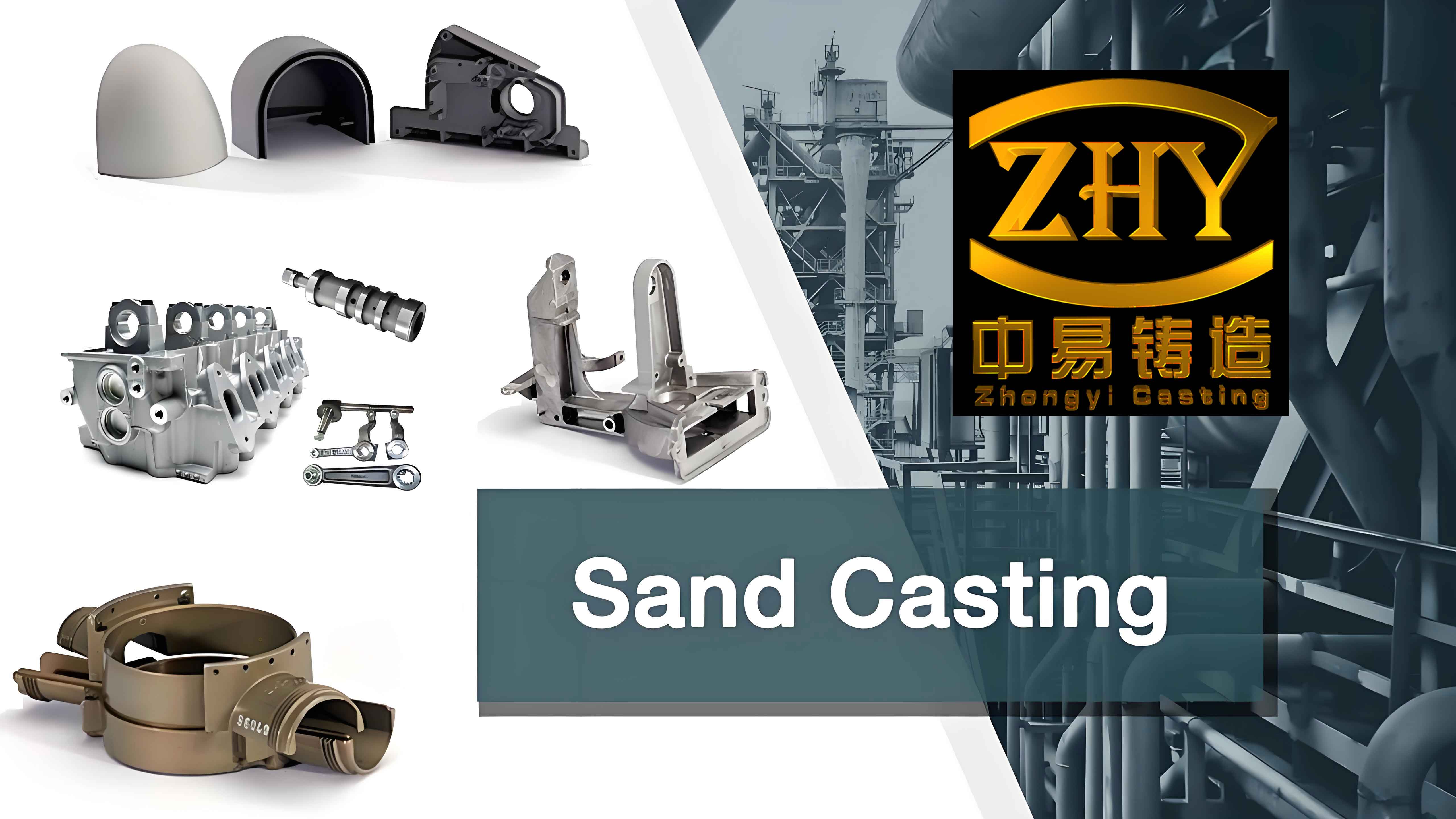
Sand casting, as a primary method for manufacturing complex sand casting parts, involves creating a mold from a sand aggregate. The quality, dimensional accuracy, and surface finish of the final sand casting parts are directly influenced by the stability and precision of the molding process. Horizontal parting with reusable flasks is a widely adopted technique due to its relative simplicity and cost-effectiveness compared to other methods. However, transitioning from semi-automated or manual horizontal lines to a fully integrated automated system presents significant engineering challenges. The core objectives for our design were to achieve precise positioning throughout the cycle, enable closed-loop recycling of all tooling (flasks, weights, baseplates), maximize equipment utilization, and eliminate manual intervention in core processes like flask handling, pouring, and shakeout.
System Architecture and Production Flow Design
The design process began with a comprehensive analysis of the production requirements for the target sand casting parts, which included automotive wheel hubs and clutch components. The annual capacity target was set at 12,000 tonnes, translating to approximately 440,000 molds per year. The plant operates on a two-shift system. The layout was engineered to ensure a logical, unidirectional flow of materials with minimal backtracking, optimizing floor space usage in a 140m x 24m facility.
The automated line is structured around four main parallel conveyor tracks, each serving a distinct phase of the production cycle for sand casting parts. Track 1 is the pouring line, where assembled molds receive molten metal. Track 2 is the flask/weight return and mold feed line. Tracks 3 and 4 are cooling lines, where the poured sand casting parts solidify. The system is fed by two identical horizontal parting molding machines, which receive sand from an overhead distribution system connected to the sand preparation plant. A key feature is the underground network of belt conveyors that automatically collect and return spilled and reclaimed sand to the processing unit, maintaining a clean shop floor and enabling efficient material reuse.
The operational sequence for producing sand casting parts is a continuous, PLC-synchronized loop. It can be summarized in the following stages:
- Molding: The molding machine compacts sand around the pattern to form the cope and drag halves. After molding, the completed sand mold (without flask) is pushed onto a carrier baseplate on Track 1.
- Baseplate Transport & Clamping: A baseplate transfer device indexes the baseplate to a precise workstation. A clamping mechanism secures the baseplate to prevent any movement during subsequent operations.
- Flask & Weight Assembly: An automated flask and weight transfer unit picks up a reusable flask and a weighting iron from Track 2 and lowers them precisely onto the sand mold on Track 1, creating a ready-to-pour assembly.
- Transfer to Pouring: The clamped assembly is transferred onto the pouring line (Track 1 alignment).
- Automated Pouring: An automatic pouring machine fills the mold cavity with molten metal to form the sand casting parts.
- Cooling: The filled mold is transferred to the long cooling lines (Tracks 3/4) and moves slowly to allow the sand casting parts to solidify.
- Flask/Weight Removal: After cooling, the mold returns to a transfer point. The flask/weight transfer unit removes the flask and weight from the spent mold and places them back onto Track 2, ready for the next cycle. A scraping device cleans residual sand from the weight during this transfer.
- Shakeout & Part Recovery: The exposed sand mold on its baseplate is pushed into a vibrating conveyor and then into a shakeout drum. The sand is broken apart, cooled, and conveyed to the recycling system. The cleaned sand casting parts are discharged onto a sorting conveyor for final processing.
- Baseplate Return: The empty baseplate is recirculated back to the start of Track 1 to receive a new sand mold.
This closed-loop automation ensures continuous production of sand casting parts with high repeatability.
Detailed Design of Key Mechanisms
The reliability and precision of the automated line for sand casting parts hinge on the robust design of its core mechanical subsystems.
1. Molding System Interface
The twin molding machines form the genesis of the process. Each machine is equipped with independent cope and drag modules, sand magazines, and hydraulic systems for pattern draw and mold push-off. The critical interface is the push-off cylinder that ejects the finished sand mold squarely onto the waiting baseplate on the conveyor line. The machine’s control system is integrated with the main line PLC, providing signals for “mold ready” and “cycle start.”
2. Baseplate Clamping and Positioning Mechanism
To achieve the micron-level stability required for precise flask placement and to prevent mold shift during transfer—a common defect source in sand casting parts—we designed a four-point synchronized clamping system. The mechanism uses a single pneumatic cylinder acting through a linkage and a gear train to rotate two parallel shafts in opposite directions. Attached to the ends of these shafts are clamping arms that grip the edges of the baseplate. The relationship between cylinder stroke ($S_{cyl}$) and the clamping angle ($\theta_{clamp}$) can be expressed as:
$$S_{cyl} = L_{arm} \cdot [\sin(\theta_{initial}) – \sin(\theta_{initial} – \theta_{clamp})]$$
where $L_{arm}$ is the effective length of the linkage arm and $\theta_{initial}$ is its starting angle. This design ensures simultaneous, equal-force clamping on all four sides. Proximity sensors confirm both the presence of the baseplate and the fully clamped/open states.
3. Automated Flask and Weight Transfer Unit
This is a pivotal subsystem for enabling the reusable flask concept for sand casting parts production. It is a gantry-style unit spanning Tracks 1 and 2. It features independent vertical actuators for the flask and the weight, each equipped with a pneumatically-operated gripping head. The grippers engage with dedicated lift points on the flask frames. The entire gantry moves horizontally on a precision rail system driven by a servo motor and timing belt.
The transfer sequence minimizes cycle time: The unit picks up a flask-weight set from Track 2, lifts, traverses to Track 1, lowers to place the set onto a clamped sand mold, releases, and returns. Positioning accuracy is ensured by guide pins on the gripper head that mate with bushings on the flask, guaranteeing perfect alignment every time and eliminating mismatch defects in sand casting parts.
4. Baseplate Transfer and Switching Devices
The movement of baseplates between the different track alignments is handled by dedicated transfer cars. These cars shuttle perpendicular to the main flow. A baseplate is indexed to the end of a track, where a hydraulic pusher on the transfer car engages and moves it onto the car’s platform. The car then moves laterally until aligned with the next track, and another pusher discharges the baseplate. Dampers and position sensors ensure smooth, shock-free engagement and discharge. The devices at the pouring station and cooling line feed are critical for maintaining the production rhythm for sand casting parts.
| Component | Key Feature | Specification / Function |
|---|---|---|
| Molding Machine | Type & Capacity | Horizontal Parting, Flaskless, 120 molds/hour/machine |
| Flask Transfer Unit | Positioning Accuracy | ±0.5 mm (via guide pin/bushing system) |
| Baseplate Clamp | Clamping Force | Adjustable, 2-5 kN per point |
| Transfer Car | Drive & Control | Servo Motor, Programmable Accel/Decel |
| Main Conveyor Tracks | Length & Capacity | Track 3/4: 120m each, ~220 baseplates in cooling |
| Control System | Architecture | Central PLC with distributed I/O and CC-Link network |
5. Mold Ejection and Sand Recycling Conveyor
After flask removal, the spent sand mold must be fed into the shakeout system. A heavy-duty chain pusher engages the baseplate and propels the entire mold onto an inclined vibrating grid conveyor. The vibration breaks down the sand mold, separating the sand from the cluster of sand casting parts. The sand falls through the grid into the underground return conveyor, while the parts move forward for cleaning. The underground belt conveyor system, with multiple feed points from spill areas and the shakeout, is the backbone of the sand reclamation process, ensuring a clean environment for producing sand casting parts.
Integrated Control System Design
The seamless coordination required for the high-speed production of sand casting parts is achieved through a hierarchical control system centered on a Mitsubishi FX5U series PLC. The system architecture employs a mix of communication networks for robustness and speed.
The main PLC acts as the central brain, executing the master sequence program. It communicates with the two molding machine controllers via a dedicated RS-485 network (configured as an N:N network), exchanging status and trigger signals. A CC-Link fieldbus network connects the main PLC to remote input/output (I/O) stations located near the actuators and sensors on the conveyor lines, transfer devices, and clamping stations. This network handles all real-time digital I/O for valves, cylinders, motors, and sensors. The human-machine interface (HMI), a Weintek touchscreen, is connected via Ethernet, providing operators with real-time visualization, manual control panels, alarm logging, and production data for the sand casting parts.
The control logic is based on a state machine model, where each device (clamp, transfer car, flask unit) operates in predefined states (e.g., “Idle”, “Execute”, “Done”, “Fault”). Transitions between states are triggered by sensor inputs (e.g., “baseplate at position”, “flask gripped”) and interlock signals from other devices. This ensures absolute sequential safety; for example, the flask unit will not lower unless the baseplate clamp signals “CLAMPED AND READY.” The pouring cycle is integrated, with the line PLC providing a “MOLD IN POSITION” signal to the automatic pouring furnace and receiving a “POUR COMPLETE” signal back.
| Input Address | Device/Signal | Output Address | Device/Action |
|---|---|---|---|
| X0 | Auto/Manual Mode Selector | Y10 | Mold Ejection Pusher Forward |
| X4 | Emergency Stop (Line) | Y20 | Flask Transfer Unit Traverse Forward |
| X21 | Flask Unit Fault | Y24 | Flask Gripper Clamp (ON) |
| X26 | Mold Ejection Position Sensor | Y30 | Transfer Car 1 Pusher Extend |
| X40 | Line Interlock from Pouring Station | Y54 | Permit to Molding Machine 1 to Push |
| X44 | Molding Station Emergency Stop | Y62 | Line Running Indicator |
The cycle time for producing one set of sand casting parts is governed by the slowest operation, typically the molding cycle or the cooling time. The PLC’s timer and counter functions are used to manage dwell times and synchronize the faster mechanical transfers with the slower processes, maximizing throughput. The theoretical maximum cycle rate ($C_{max}$) in molds per hour can be approximated by considering the bottleneck station time ($T_{bottleneck}$):
$$C_{max} = \frac{3600}{T_{bottleneck}}$$
In our optimized line, the synchronized transfer operations have a cycle time shorter than the molding machine’s cycle, making the molding process the primary pacing element for sand casting parts output.
Performance Analysis and Operational Results
The implemented automated horizontal parting line has been in full-scale production, manufacturing the specified sand casting parts. The performance metrics confirm the design’s success in addressing the initial challenges.
1. Productivity and Output: The line consistently achieves its design capacity. Compared to the previous semi-automated method requiring 32 operators per day, the fully automated line operates over two 8-hour shifts with only 2 operators per shift for monitoring and minor intervention. This represents a direct labor reduction of approximately 94% for the core molding-to-shakeout operations. The output of sand casting parts has increased significantly, with the line achieving a steady-state production rate that meets the annual target of 12,000 tonnes.
2. Quality Improvement: The precision clamping and guided flask placement have virtually eliminated mold shift and mismatch defects, which are critical quality factors for complex sand casting parts. The consistent, automated handling prevents the jarring and misalignment common in manual or cart-based systems. The scrap rate for the sand casting parts produced on this line has fallen to a very low level, directly contributing to higher yield and lower cost per part.
3. Resource Efficiency and Environment: The closed-loop recycling of flasks, weights, and baseplates eliminates the waste and handling costs associated with single-use or poorly managed tooling. The automated underground sand return system keeps the production area clean, reduces silica dust exposure, and ensures nearly 100% of process sand is captured and sent for reconditioning. The optimized layout has also reduced the footprint dedicated to the molding and cooling processes, freeing up plant space.
| Performance Metric | Previous Semi-Automated Line | New Fully Automated Line | Improvement |
|---|---|---|---|
| Direct Labor (Core Process) | 32 persons | 4 persons | -87.5% |
| Estimated Annual Output* | ~7,500 tonnes | 12,000 tonnes | +60% |
| Rejected Sand Casting Parts (Scrap Rate) | ~8-10% | <1% | ~90% Reduction |
| Flask/Weight Loss/Damage | High (Manual Handling) | Negligible | Near Elimination |
| Production Area Utilization | Inefficient, Cluttered | Optimized, Clean Flow | Significantly Improved |
| *Output normalized for comparable operating hours. | |||
The operational success can be quantified by an overall equipment effectiveness (OEE) style metric tailored for sand casting parts production, considering availability (A), performance rate (P), and quality rate (Q):
$$OEE_{casting} = A \times P \times Q$$
Where:
- $A$ is high due to robust mechanical design and predictive maintenance enabled by the PLC.
- $P$ approaches the theoretical maximum as the line runs at designed speed with minimal stoppages.
- $Q$ is greatly enhanced by the precision automation, driving the product close to 1.
The resulting high $OEE_{casting}$ demonstrates the line’s efficiency in converting raw materials into saleable sand casting parts.
Conclusion
The design and application of this fully automated horizontal parting molding line present a comprehensive solution for the high-volume production of quality sand casting parts. By innovating key mechanisms for precise baseplate handling, closed-loop flask/weight transfer, and integrated material flow, the system overcomes the traditional limitations of instability, low efficiency, and high labor dependency. The central PLC-based control system seamlessly orchestrates all subsystems, ensuring reliability and synchronization. The results from actual production validate the design: a dramatic increase in productivity for sand casting parts, a superior quality yield, a transformative reduction in manual labor, and a cleaner, safer, and more efficient foundry environment. This automated line model provides a viable and highly effective blueprint for modernizing sand casting operations, offering a competitive edge in the manufacturing of essential metal components.