
As a casting engineer specializing in heavy-duty components, I have extensive experience in developing processes for complex nodular cast iron parts. In this article, I will share a detailed methodology for producing a multi-tubing bearing box used in steam turbines, focusing on the challenges and solutions associated with embedding metal oil tubes. Nodular cast iron, known for its excellent ductility and strength, is the material of choice for such applications due to its ability to withstand dynamic loads and thermal cycles. The successful integration of oil tubes into the casting requires meticulous planning, simulation, and process control to ensure dimensional accuracy and structural integrity.
The bearing box in question is a critical component that supports and lubricates bearings in turbine systems. Its complex geometry, with varying wall thicknesses and embedded oil passages, demands a robust casting approach. The use of nodular cast iron, specifically grade QT400-18, provides the necessary mechanical properties, but the incorporation of steel oil tubes adds another layer of complexity. Throughout this discussion, I will emphasize key aspects of nodular cast iron processing, including gating design, solidification control, and defect prevention, while repeatedly highlighting the advantages of nodular cast iron for such intricate castings.
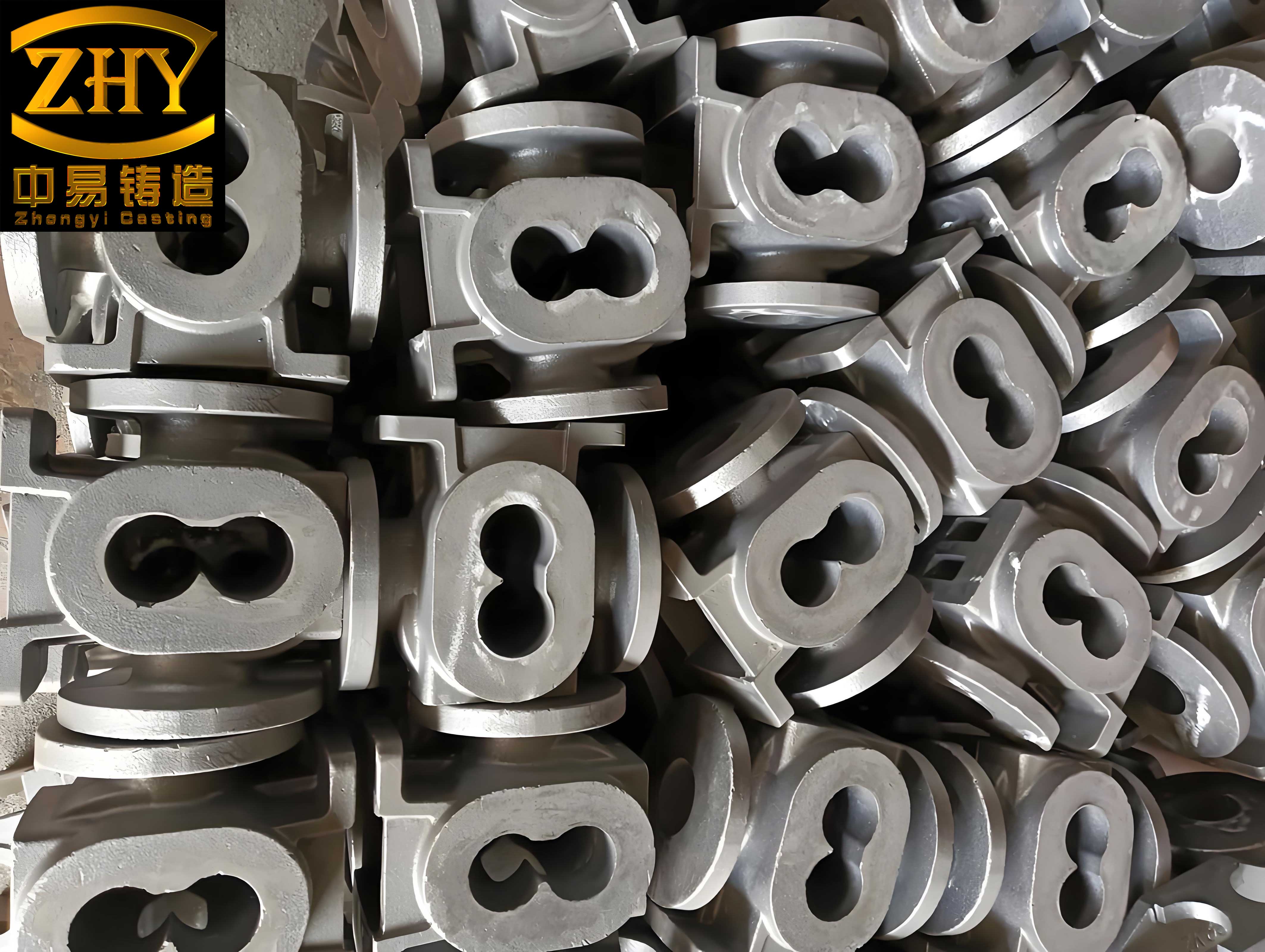
The bearing box has an overall envelope of 2,613 mm × 1,056 mm × 740 mm and a weight of 3,187 kg. It features both thick sections (up to 220 mm) and thin walls (down to 40 mm), creating significant thermal gradients during solidification. Four oil tubes are embedded within the casting: two straight tubes with an inner diameter of 90 mm and length of 740 mm, and two curved tubes with an inner diameter of 26 mm and length of 450 mm, all made from ASTM A106 Gr.B steel with a wall thickness of 11 mm. The curved tubes have a three-dimensional bend, making their shape control and positioning particularly challenging. The tubes are equipped with fusion-promoting rings welded to their surfaces to enhance bonding with the nodular cast iron matrix.
| Property | Minimum Value | Typical Range |
|---|---|---|
| Yield Strength | 300 N/mm² | 300-350 N/mm² |
| Tensile Strength | 420 N/mm² | 420-500 N/mm² |
| Elongation | 11% | 11-18% |
| Hardness (HB) | 155 | 155-200 |
Non-destructive testing (NDT) is mandatory for this casting, with 100% magnetic particle inspection (MT) and ultrasonic testing (UT) required. UT standards specify Level 2 for critical areas like flange faces and Level 3 for other regions. The oil tubes must be free of cracks, porosity, and surface defects, with internal smoothness and roundness tolerances within 2 mm at bends. Prior to casting, the tubes undergo degreasing, pickling, shot blasting, and tin plating to ensure proper fusion with the nodular cast iron. The plating requirements are summarized in Table 2.
| Parameter | Specification |
|---|---|
| Coating Hardness (HB) | 5 |
| Appearance | Bright White |
| Thickness | 25-30 μm |
The primary difficulties in casting this nodular iron component include: (1) controlling the shape and positioning of the three-dimensionally curved tubes, (2) managing thermal expansion and distortion of the tubes during pouring, which could lead to mold wall failure and sand inclusion defects, (3) preventing core sand adhesion inside the curved tubes, as cleaning would be extremely difficult, and (4) ensuring accurate alignment of high-aspect-ratio cored holes (e.g., a 60 mm diameter hole over 560 mm height) for machining allowance. These challenges necessitate a holistic approach combining empirical knowledge and computational simulation.
To address these issues, the oil tubes are fabricated and prepared with precision. The curved tubes are extended by 60 mm on one end to facilitate fixation during molding. A custom gauge plate is used to verify their geometry against design specifications. Surface preparation involves removing oxides and contaminants, followed by electroplating with tin to a thickness of 25–30 μm. This coating promotes metallurgical bonding with the nodular cast iron and prevents oxidation during the casting process. The importance of surface treatment cannot be overstated, as it directly impacts the integrity of the tube-cast iron interface.
The molding strategy employs a horizontal parting plane along the top face of the bearing box, with the entire casting located in the drag half. This simplifies core assembly and gating layout. The main cavity core forms the internal geometry and is seated in the drag, while a separate runner core positions the horizontal gating channels below the casting. For the tall cored holes, a precision core with locating prints is used; a dedicated template ensures vertical alignment during molding, and compressible seals are placed at the top to accommodate any movement during pouring. All cores are made from chromite sand to resist burn-on and veining, which is crucial for maintaining surface quality in nodular cast iron castings.
Embedding the oil tubes requires careful design of core assemblies. For the curved tubes, one end is anchored in a core, while the extended end is positioned in the mold cavity. To accommodate thermal expansion, foam plugs are inserted at both tube ends within the core prints, allowing axial displacement without stressing the mold. The tubes are packed with dry sand to maintain internal shape and prevent collapse during heating. For the straight tubes, full-length core boxes encapsulate the tubes, with one end fitting into the drag and the other keyed into the main cavity core. Expansion gaps are calculated based on the thermal expansion coefficient of steel and the solidification shrinkage of nodular cast iron. The core sand inside the tubes is coated with a refractory wash to avoid sintering, and venting channels are incorporated using hollow nylon ropes to evacuate gases during pouring. This venting system connects to external vents in the cope, ensuring no gas entrapment occurs.
The gating and feeding system is designed to achieve quiescent filling and controlled solidification. An open gating system is used, with ingates located at the bottom flange to minimize turbulence. The ingate velocity is kept below 1 m/s to prevent mold erosion and oxide formation. A choke in the runner ensures early filling and slag trapping. Feeding design relies on modulus calculations to place risers and chills optimally. The thermal modulus, defined as the ratio of volume to cooling surface area ($M = V/A$), is a key parameter for predicting solidification patterns. Using simulation software, the modulus distribution is analyzed to identify hot spots. Chills are strategically placed to accelerate cooling in thick sections, while insulating sleeves and exothermic compounds are applied to risers to extend their feeding range. The riser design ensures directional solidification toward the feeders, critical for nodular cast iron to avoid shrinkage porosity.
Solidification simulation plays a vital role in validating the process. The solidification time ($t$) can be estimated using Chvorinov’s rule: $$t = B \left( \frac{V}{A} \right)^2$$ where $B$ is the mold constant dependent on material and mold properties. For nodular cast iron, the solidification behavior is influenced by graphite expansion, which can counteract shrinkage. However, in heavy sections, the expansion may not fully compensate, necessitating external feeding. The simulation model incorporates the thermal properties of nodular cast iron and steel tubes to predict temperature gradients and potential defect sites. By iterating on chill placement and riser size, the process is optimized to ensure soundness.
Another critical aspect is the control of microstructure in nodular cast iron. The nodularity and count of graphite spheres affect mechanical properties. The cooling rate influences matrix formation; slower cooling promotes ferrite, while faster cooling leads to pearlite. For QT400-18, a ferritic matrix is desired, achieved through proper inoculation and controlled cooling. The presence of steel tubes alters local cooling rates, so thermal analysis is essential. The heat transfer between the steel tube and the surrounding nodular cast iron can be modeled using Fourier’s law: $$q = -k \frac{dT}{dx}$$ where $q$ is heat flux, $k$ is thermal conductivity, and $dT/dx$ is the temperature gradient. Ensuring adequate heat extraction through chills prevents carbides and excessive pearlite formation.
| Parameter | Value/Range | Remarks |
|---|---|---|
| Pouring Temperature | 1,350–1,400°C | Optimized for fluidity and shrinkage control |
| Inoculant Addition | 0.6–0.8 wt% | Ferro-silicon based inoculant |
| Mold Material | Chromite Sand | For cores and critical surfaces |
| Riser Type | Insulated Sleeve with Exothermic | To enhance feeding efficiency |
| Chill Thickness | 20–30 mm | Steel chills for local heat extraction |
The production trial confirmed the effectiveness of this methodology. The cast bearing box met all dimensional tolerances, with the oil tubes accurately positioned and free from distortion. NDT inspections revealed no unacceptable defects, and mechanical tests satisfied the requirements for nodular cast iron QT400-18. The oil tubes exhibited excellent fusion with the matrix, and internal surfaces were clean without sand adhesion. This success demonstrates the viability of the process for mass production of similar nodular cast iron components with embedded conduits.
In conclusion, the casting of multi-tubing bearing boxes in nodular cast iron requires a comprehensive approach addressing design, material preparation, and process engineering. Key factors include precise tube positioning, allowance for thermal expansion, optimized gating and feeding, and rigorous simulation. The inherent properties of nodular cast iron, such as good castability and mechanical performance, make it suitable for such complex applications. Future work could explore advanced simulation techniques or alternative coating materials to further enhance reliability. This experience underscores the importance of integrating traditional foundry wisdom with modern computational tools to tackle challenges in nodular cast iron casting.
Throughout this article, I have emphasized the role of nodular cast iron in enabling the production of high-integrity components. The ductility and strength of nodular cast iron are critical for withstanding operational stresses, while its casting characteristics allow for intricate designs. By sharing these insights, I hope to contribute to the broader knowledge base on nodular cast iron processing, particularly for applications involving embedded elements. The methodologies described here are applicable to a range of heavy-industry castings where reliability and precision are paramount.