
In modern foundry technology, the deep application of Computer-Aided Engineering (CAE) simulations, such as casting process analysis, has revolutionized the industry by efficiently addressing practical production and engineering challenges. This advancement aligns with the growing trend towards diversified and green manufacturing. With initiatives like the “Belt and Road” fostering economic and technological collaboration, domestic universities, research institutes, and enterprises have intensified efforts in developing and applying indigenous CAE tools like FT-Star and Huazhu CAE. This synergy drives innovation in manufacturing internet models and enhances the precision of casting production. In this study, I employ Anycasting software to simulate and analyze the mold filling and solidification processes of a nodular cast iron automotive pump body, observing variations in temperature, velocity, and pressure fields during pouring. This approach eliminates the need for extensive physical trials to validate design rationality, thereby reducing costs and time.
The foundation of numerical simulation for casting processes lies in three-dimensional modeling of the component, gating system, and feeding system. For this purpose, I utilized Pro/E software to create detailed 3D models of the pump body castings, including the mold, gates, and risers. These models were assembled with appropriate constraints to form a cohesive system and exported in “.stl” format for subsequent simulation. This step ensures accurate representation of geometric features, which is critical for reliable finite element analysis.
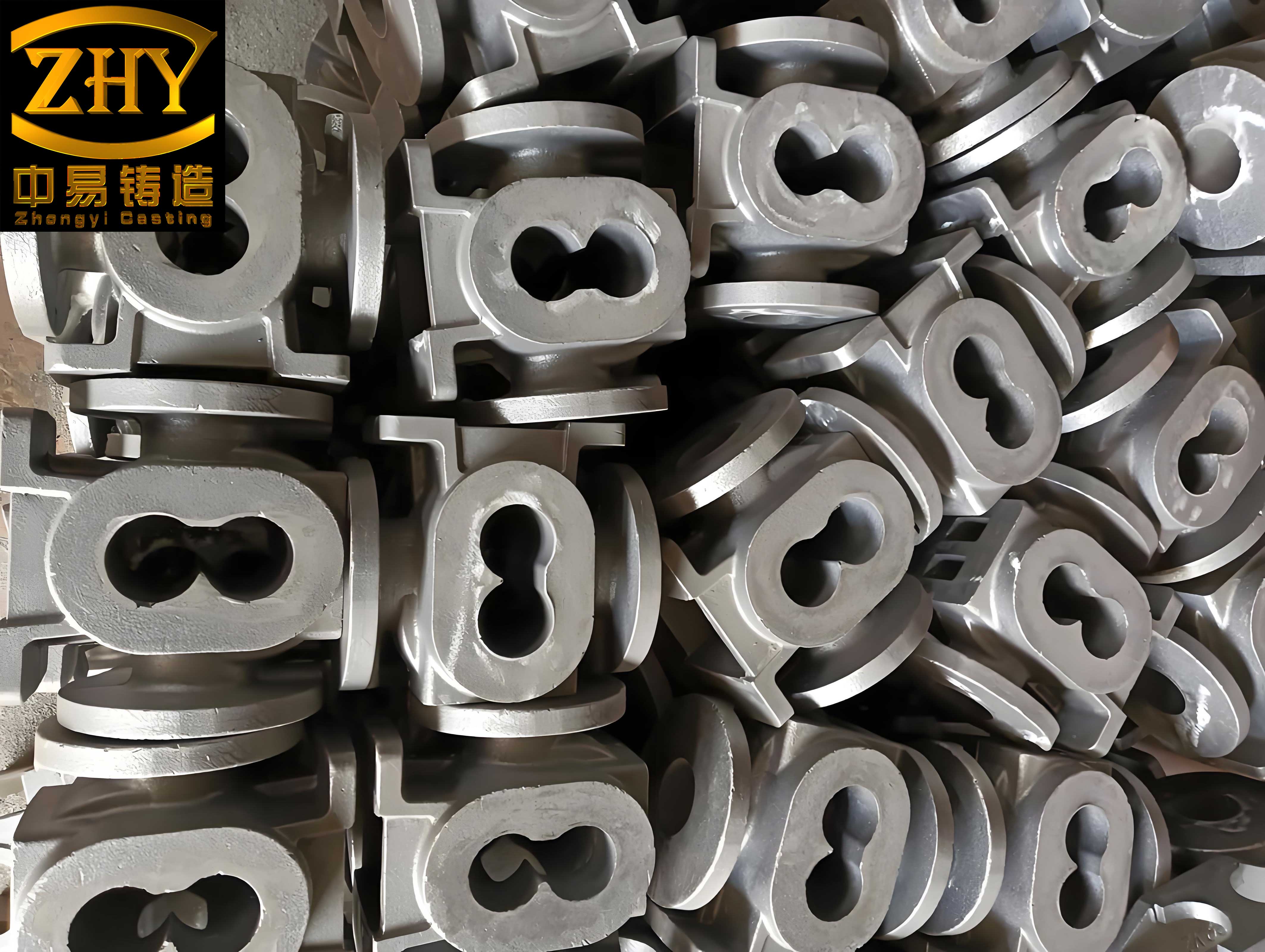
In the Anycasting simulation, pre-processing is conducted via the AnyPRE module, which handles mesh generation and condition setting. I imported all “.stl” files into AnyPRE, defining attributes for each entity, setting the mold, and establishing the default solution domain. To prevent distortion during simulation, the wall thickness parameter was configured to be less than the minimum wall thickness of the nodular cast iron component. A uniform mesh division method was applied; due to the relatively simple structure of the pump body, the mesh count remained manageable. For task specification, given the sand casting process, I selected non-permanent mold casting as the method and set the analysis type to “mold filling followed by heat transfer and solidification.” Key casting parameters and boundary conditions were defined as follows: material properties were assigned from the AnyDBASE library, adhering to relevant standards for nodular cast iron. The initial and boundary conditions included preheating the mold and surrounding air to 200°C to maintain dryness and improve casting quality. The pouring temperature was set at 1350°C, with a constant pouring speed of 0.1 m/s. Gravity was activated using default parameters. Termination conditions and output states were set to default for filling and solidification. After saving the file, the AnySOLVER solver executed the computational analysis, generating “.rlt” data files for post-processing.
The post-processing phase, handled by AnyPOST, provides robust visualization and data analysis capabilities. By importing “.rlt” files into AnyPOST, I extracted graphical and tabular results to intuitively interpret simulation outcomes. For this nodular cast iron pump body—a large-volume rotational component—the filling time approximated 173 seconds. With a bottom-gating system, molten metal at 1350°C flowed through a vertical sprue well, horizontal runners for slag trapping, and ingates, entering the mold cavity in a dispersed manner. The bottom-up filling process gradually reduced pouring temperature and slowed velocity, resulting in minimal temperature disparity across the casting upon complete filling. Riser temperatures were slightly lower than the casting, adhering to expected filling sequence patterns.
Solidification from filling completion to full solidity extended approximately 7430 seconds, progressing from the edges towards the center. Due to limited feeding distances from side risers, uneven solidification occurred in the lower flange regions, particularly at “L”-shaped junctions where isolated hot spots formed. These areas, lacking a robust shell, hindered self-feeding and posed risks of shrinkage porosity or cavities, potentially compromising dynamic balance. To analyze trends, I sectioned the symmetric structure and placed sensors at key points to collect data over time, revealing insights into temperature, pressure, and velocity fields.
From the temperature field curves, during filling, the mold sections contacted by 1350°C molten metal rapidly heated to around 1300°C, followed by a prolonged solidification phase. Compared to other points, the top measurement point, with the thinnest wall, cooled quickly, reaching about 1030°C before solidifying abruptly, indicating a lack of transition and potential defects. Over time, heat exchange between the metal and environment equilibrated, slowing temperature decline until cooling ended. The pressure field curves showed exponential pressure increase with filling rate, peaking after complete filling. The bottom measurement point exhibited the highest peak pressure, suggesting denser microstructure formation and better casting quality there. Velocity field curves indicated similar trends across points: initial fluctuations due to high-speed entry caused sand erosion and turbulence, stabilizing as the metal level rose and pressure increased. However, speed fluctuations recurred at the top due to significant wall thickness variations.
Based on Anycasting simulation and defect prediction criteria, defects were more probable in the gating system during filling, while solidification defects could occur in the gating system or top surfaces. This implies the original design generally met production requirements but left room for optimization. To mitigate quality defects, I proposed an improved scheme: implementing larger blind side risers at the bottom flange edges, placing chills near hot spots, adding vent holes at upper bosses, and elongating ingates. The new gating system was modeled and simulated under identical conditions via AnyPRE and AnySOLVER.
Results indicated that the optimized design enhanced structural integrity. Filling proceeded smoothly with reduced splashing and turbulence, thanks to adjusted pouring speeds. Solidification simulation confirmed that riser solidification times exceeded casting times, ensuring effective feeding and eliminating local hot spots. Defect probability maps showed that filling defects remained concentrated in the gating system, with minimal occurrence on the casting itself. Solidification defects on top surfaces were significantly reduced, and any residual issues could be addressed by allowing adequate machining allowances. Thus, the new gating system design effectively eliminated slag hole defects and improved overall quality.
In summary, as a medium-to-large thick-walled nodular cast iron component, the automotive pump body benefits from an open bottom-gating system with appropriately sized gates, cores, and layouts. Incorporating risers and chills at critical sections ensures casting quality. Using Anycasting software for simulation—through parameter setting, finite element meshing, and analysis of filling and solidification—allows scientific validation of original designs and efficient optimization. This methodology minimizes trial casting costs and enhances enterprise competitiveness. The study underscores the value of CAE tools in advancing nodular cast iron applications, promoting sustainable manufacturing practices.
To elaborate on the technical aspects, I incorporate tables and formulas to summarize key parameters and physical principles. The heat transfer during solidification of nodular cast iron can be described by the Fourier equation, considering phase change:
$$ \rho C_p \frac{\partial T}{\partial t} = \nabla \cdot (k \nabla T) + L \frac{\partial f_s}{\partial t} $$
where \( \rho \) is density, \( C_p \) is specific heat, \( T \) is temperature, \( t \) is time, \( k \) is thermal conductivity, \( L \) is latent heat, and \( f_s \) is solid fraction. For nodular cast iron, these properties vary with temperature and microstructure, influencing simulation accuracy. Below is a table of typical material properties used in the simulation for nodular cast iron (e.g., grade QT400-18):
| Property | Value | Unit |
|---|---|---|
| Density (ρ) | 7100 | kg/m³ |
| Specific Heat (Cp) | 460 | J/(kg·K) |
| Thermal Conductivity (k) | 40 | W/(m·K) |
| Latent Heat (L) | 270,000 | J/kg |
| Liquidus Temperature | 1150 | °C |
| Solidus Temperature | 1050 | °C |
In the simulation, the filling process is governed by the Navier-Stokes equations for incompressible flow, coupled with energy conservation. The velocity field \( \mathbf{v} \) and pressure \( p \) satisfy:
$$ \nabla \cdot \mathbf{v} = 0 $$
$$ \rho \left( \frac{\partial \mathbf{v}}{\partial t} + \mathbf{v} \cdot \nabla \mathbf{v} \right) = -\nabla p + \mu \nabla^2 \mathbf{v} + \rho \mathbf{g} $$
where \( \mu \) is dynamic viscosity and \( \mathbf{g} \) is gravitational acceleration. For nodular cast iron, the viscosity depends on temperature and composition, affecting flow behavior. The simulation parameters are summarized in the following table:
| Parameter | Original Design | Optimized Design |
|---|---|---|
| Pouring Temperature | 1350°C | 1350°C |
| Pouring Speed | 0.1 m/s | 0.08 m/s |
| Mold Preheating Temperature | 200°C | 200°C |
| Mesh Size | 2 mm | 1.5 mm |
| Number of Risers | 2 | 4 |
| Chill Placement | None | At hot spots |
The defect prediction in nodular cast iron often relies on criteria like the Niyama criterion for shrinkage porosity, which relates thermal gradients and solidification time:
$$ G / \sqrt{T} < C $$
where \( G \) is temperature gradient, \( T \) is local solidification time, and \( C \) is a material constant. In this study, Anycasting uses similar algorithms to identify potential defects. The improvement in the optimized design is evident from comparative analysis: the original design showed high defect probability in top regions, while the optimized design reduced this significantly. This aligns with industry standards for nodular cast iron components, where minimizing porosity enhances mechanical properties like ductility and fatigue resistance.
Furthermore, the economic impact of simulation-based optimization is substantial. By reducing the need for physical prototypes, foundries can save on material and energy costs, especially for nodular cast iron, which requires precise control to maintain nodular graphite structure. The integration of CAE tools like Anycasting fosters innovation in manufacturing processes, supporting the development of lightweight and high-performance automotive parts. As global trends emphasize sustainability, such digital approaches contribute to greener production by minimizing waste and improving resource efficiency.
In conclusion, this research demonstrates the efficacy of Anycasting software in optimizing the casting process for nodular cast iron pump bodies. Through detailed simulation of filling and solidification, I identified and addressed potential defects, leading to an improved gating system design. The use of tables and formulas underscores the technical rigor involved. Future work could explore advanced modeling techniques, such as coupling microstructure prediction with macroscopic simulations, to further enhance the quality of nodular cast iron castings. This study serves as a theoretical basis for designing and optimizing gating systems in practical foundry operations, ultimately advancing the field of casting technology.