
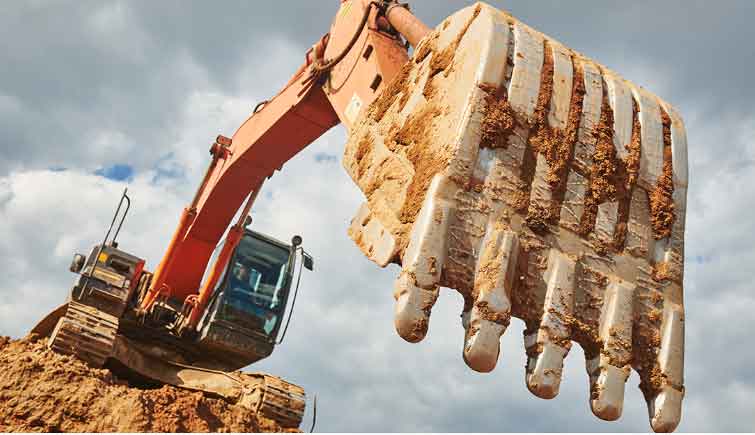
Excavator bucket teeth, critical wear components in mining and construction, endure extreme abrasive conditions. These excavator casting parts consist of a tooth point and adapter (see Fig. 1), connected via pins. When the tooth point wears, only this excavator casting part requires replacement. To withstand rock/coal impacts, these excavator casting parts must exhibit high impact toughness (≥5.0 J/cm²), base hardness of 180–229 HBW after water toughening, work-hardening capability, and absence of casting defects like cracks or inclusions. Three primary manufacturing methods exist: sand casting, forging, and investment casting. While sand casting remains cost-effective, it frequently encounters sand adhesion defects in excavator casting parts, compromising surface quality and dimensional accuracy.
1. Sand Adhesion Mechanisms in Excavator Casting Parts
Sand adhesion manifests as a sintered layer of metal/oxides bonded to mold materials on excavator casting part surfaces. For low-alloy wear-resistant steels (e.g., ZGMn18VTiMo), adhesion arises from:
- Chemical adhesion: High pouring temperatures (1560–1620°C) trigger reactions between molten steel and silica sand (SiO₂):
$$ \text{2Fe} + \text{O}_2 \rightarrow \text{2FeO} $$
$$ \text{2FeO} + \text{SiO}_2 \rightarrow \text{Fe}_2\text{SiO}_4 $$
The low-melting-point fayalite (Fe₂SiO₄) penetrates sand gaps. - Mechanical penetration: Metallostatic pressure forces metal into sand interstices. Penetration depth correlates with pressure head and sand permeability:
$$ P = \rho g h $$
where \( P \) = metallostatic pressure, \( \rho \) = steel density, \( h \) = height of metal column. - Erosive melting: Silica sand’s low melting point (1713°C) and thermal conductivity cause localized fusion when enveloped by steel.
2. Countermeasures for Sand Adhesion Prevention
2.1 Molding Material Optimization
Controlling sand properties is critical for defect-free excavator casting parts. Key parameters include:
| Parameter | Requirement | Rationale |
|---|---|---|
| SiO₂ Content | >96% (thick sections: >98%) | Higher refractoriness reduces reactivity |
| Sand Grain Size | 0.10–0.20 mm (75–150 mesh) | Finer grains limit metal penetration |
| Bentonite Type | Activated or natural sodium bentonite | Enhances hot strength and anti-scabbing |
| Moisture Content | 4–5% | Minimizes gas evolution and metal oxidation |
| Permeability | ≤120 (system sand); ≤80 (facing sand) | Restricts metal infiltration |
For cores in excavator casting parts, substitute silica with zircon sand (ZrSiO₄) due to its higher refractoriness (2200°C) and lower thermal expansion. Core sand formulations include:
- Zircon sand (100%) + Bentonite (2.5%) + Water (3.75%): Wet compression strength = 20–30 kPa
- Zircon sand (100%) + Sodium silicate (6%) + Water (3.1%): Dry tensile strength ≥800 kPa
2.2 Mold Compaction and Design
Inadequate compaction enables metal penetration. For excavator casting parts:
- Maintain mold hardness ≥85 (B-scale)
- Uniformly compact corners/features using specialized tools
- Avoid core repairs causing local density variations
Gating/risering must prevent localized overheating:
- Position gates to avoid direct impingement on mold walls
- Use step-gating for tall excavator casting parts
- Employ high-alumina pouring tubes to minimize slag
2.3 Pouring Parameter Control
Optimize pouring conditions using:
- Reduced pouring temperature: Minimum required for filling (typically 1540–1580°C)
- Lowered pouring height: Decreases dynamic pressure:
$$ P_{\text{dynamic}} = \frac{1}{2} \rho v^2 $$
where \( v \) = flow velocity. - Slower pouring rates: Less thermal shock to molds
2.4 Anti-Adhesion Coatings
Apply refractory coatings (0.75–1.0 mm dry thickness) to mold surfaces:
- Zircon-based: Zircon flour (48%) + Sodium bentonite (4.5%) + Sodium silicate (4.5%) + Aluminum sulfate (0.65%) + Water
- Additives: Add ≤2% Fe₂O₃ to promote sintered layer formation for easy removal
3. Supplementary Process Controls
Sulfur reduction enhances steel purity, indirectly minimizing adhesion in excavator casting parts by improving fluidity and reducing oxides. LF refining achieves significant desulfurization:
$$ \text{Desulfurization Rate (\%)} = \frac{\text{S}_{\text{before}} – \text{S}_{\text{after}}}{\text{S}_{\text{before}}}} \times 100\% $$
| Heat No. | S Before Refining (wt%) | S After Refining (wt%) | Desulfurization Rate (%) |
|---|---|---|---|
| 1 | 0.015 | 0.006 | 60.0 |
| 2 | 0.011 | 0.005 | 54.5 |
| 3 | 0.012 | 0.005 | 58.3 |
| 4 | 0.013 | 0.005 | 53.9 |
| 5 | 0.012 | 0.005 | 58.3 |
| 6 | 0.011 | 0.005 | 54.5 |
| 7 | 0.012 | 0.005 | 58.3 |
| 8 | 0.009 | 0.005 | 44.4 |
| Average | 0.0119 | 0.0051 | 55.3 |
Additional measures:
- Early shakeout (≤500°C) prevents solid-state adhesion
- Limit sand reclamation: ≤20% to avoid fine/dust accumulation
- Maintain pattern/core box surface smoothness (Ra ≤6.3 μm)
4. Conclusion
Preventing sand adhesion in excavator casting parts demands integrated solutions: High-purity fine sands increase refractoriness; mold compaction >85 restricts penetration; zircon coatings create barriers; and controlled pouring parameters reduce thermal/mechanical mold damage. Implementing these measures ensures defect-free excavator casting parts with optimal surface quality and dimensional precision, even in cost-sensitive sand casting operations.