
In my experience as a materials engineer specializing in foundry processes, I have often encountered the challenge of identifying and addressing sand casting defects. Among these, slag inclusion and sand holes are particularly prevalent in green sand casting, a widely used method for producing gray iron castings due to its cost-effectiveness and efficiency. This article delves into a comprehensive comparison of these two defects, exploring their characteristics, discrimination methods, and preventive measures, with a focus on enhancing quality control in casting production. Throughout this discussion, I will emphasize the importance of understanding sand casting defects to improve manufacturing outcomes.
Green sand casting, which utilizes moist clay-bonded sand molds, offers numerous advantages such as low material costs, high availability of raw materials, clear mold contours, ease of shaping, no need for drying, short production cycles, and easy shakeout. However, it also presents drawbacks, including low mold strength and the presence of moisture, which can lead to defects like gas holes, slag inclusions, and sand holes. In practice, slag inclusion and sand holes are often confused due to their superficial similarities, making accurate identification crucial for effective remediation. As I analyze these sand casting defects, I aim to provide a detailed guide that spans from basic visual inspection to advanced analytical techniques.
To begin, let me outline the fundamental characteristics of slag inclusion and sand holes. Slag inclusion refers to non-metallic impurities trapped within or on the surface of a casting, appearing as irregular, uneven cavities that are often dull and lack a smooth interior. These defects typically arise from unclean molten metal or slag entrapment during pouring. In contrast, sand holes are cavities formed by the entrapment of sand grains in the casting, resulting in irregular shapes with sharp edges. The key distinctions lie in their color, adhesion, and response to cleaning processes. Below, I present a comparative table summarizing these features, which highlights the nuances of these sand casting defects.
| Defect Type | Color | Shape | Surface Texture | Adhesion to Casting | Response to Shot Blasting |
|---|---|---|---|---|---|
| Slag Inclusion | Brownish-white or white, similar to slag systems | Irregular, with uneven contours | Rough, often with angular features | Strongly bonded; difficult to remove | Resists cleaning; slag remains attached |
| Sand Holes | Brownish-black,接近金属颜色 | Irregular, with sharp edges | Gritty, due to embedded sand | Weakly bonded; sand can be dislodged | Easily cleaned; sand removed to reveal metal |
From this table, it is evident that while both sand casting defects manifest as cavities, their properties differ significantly. Slag inclusion tends to be lighter in color and more adherent, whereas sand holes are darker and allow for sand removal upon cleaning. These distinctions form the basis for initial discrimination, but as I have observed in many foundries, visual inspection alone can be insufficient, especially for subtle cases. Therefore, I recommend a multi-step approach to accurately identify these sand casting defects.
The first method involves experienced technicians who rely on visual examination and process knowledge. By closely inspecting the defect’s color and morphology, and correlating it with production parameters, one can often make a preliminary judgment. For instance, slag inclusion may appear more oxidized, while sand holes might show traces of sand particles. However, this method is subjective and requires extensive expertise, which underscores the need for more objective techniques in addressing sand casting defects.
The second method employs shot blasting or similar cleaning processes. As indicated in Table 1, sand holes typically respond well to cleaning, with the embedded sand being ejected to expose the underlying metal. In contrast, slag inclusion resists such efforts, retaining its slaggy material. This practical test can quickly differentiate between the two sand casting defects in many scenarios. To quantify this, consider the adhesion force $$F_a$$ required to remove a defect particle, which can be modeled as:
$$F_a = \mu \cdot \sigma_b \cdot A$$
where $$\mu$$ is the coefficient of friction between the defect and metal, $$\sigma_b$$ is the bond strength, and $$A$$ is the contact area. For slag inclusion, $$\sigma_b$$ is high due to chemical bonding, leading to larger $$F_a$$, whereas for sand holes, $$\sigma_b$$ is lower, resulting in easier removal. This equation helps explain why shot blasting is effective for sand holes but not for slag inclusion, a key point in managing sand casting defects.
For cases where visual inspection and cleaning tests are inconclusive, I turn to advanced analytical methods, such as scanning electron microscopy (SEM) and energy-dispersive X-ray spectroscopy (EDS). These techniques provide microscopic insights into the defect’s morphology and composition, enabling definitive identification. In a typical analysis, I prepare a sample from the defective area, examine it under SEM to observe surface features, and use EDS to determine elemental composition. This approach is particularly useful for complex sand casting defects that involve multiple factors.
To illustrate, let me describe a generalized case study. In a green sand casting operation for gray iron components, a recurring defect appeared as small, irregular cavities on the casting surface. Initial opinions varied between slag inclusion and sand holes, even after shot blasting. To resolve this, samples were analyzed using SEM and EDS. The SEM images revealed irregular polygons with rough interiors and aggregated particles, while backscattered electron images showed gradations in contrast from the matrix to the defect zone. EDS analysis further confirmed the defect type: points on the matrix showed elements like Fe, C, Si, and Mn, whereas points within the defect exhibited high oxygen content, indicating oxide-based slag inclusion. This process underscores the value of modern tools in diagnosing sand casting defects.
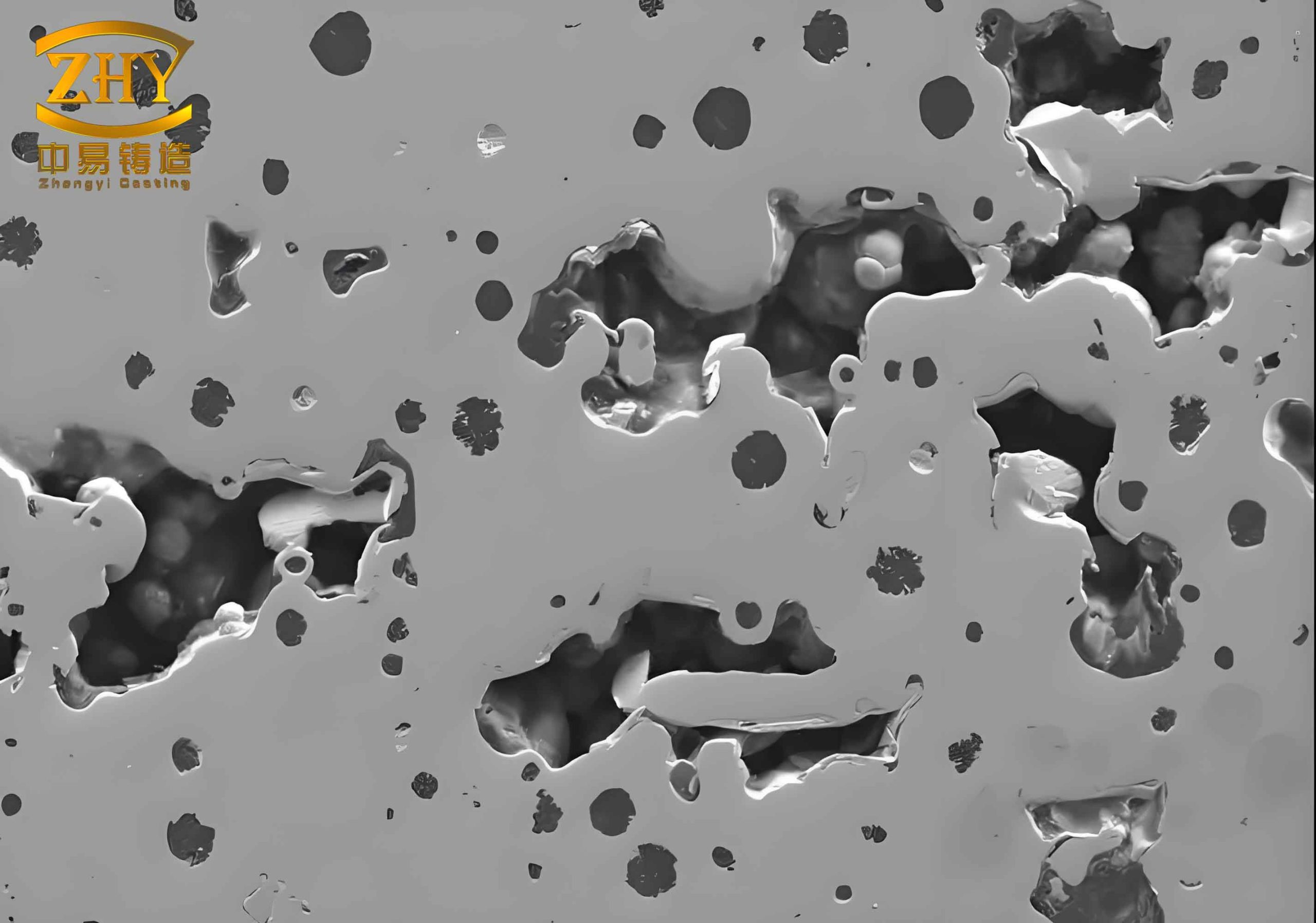
The image above provides a visual reference for such defects, though I refrain from detailed descriptions to avoid bias. Through SEM and EDS, I can quantify the composition differences. For example, the oxygen content in slag inclusion can be expressed as a weight percentage $$O_{\%}$$ from EDS data:
$$O_{\%} = \frac{W_O}{W_{\text{total}}} \times 100\%$$
where $$W_O$$ is the weight of oxygen and $$W_{\text{total}}$$ is the total weight of the analyzed area. In slag inclusion, $$O_{\%}$$ often exceeds 30%, as seen in cases where iron oxides dominate, whereas sand holes typically show minimal oxygen unless contaminated. This quantitative analysis solidifies the discrimination between these sand casting defects.
Beyond identification, preventing sand casting defects is paramount for enhancing production efficiency and product quality. Based on my practical involvement, I have compiled preventive strategies for both slag inclusion and sand holes. These measures address root causes in the casting process, from mold preparation to metal treatment. Below, I present a detailed table outlining these actions, which can serve as a guide for foundry engineers tackling sand casting defects.
| Defect Type | Preventive Measures | Rationale |
|---|---|---|
| Sand Holes | Enhance mold surface strength by using high-quality clay or binders like industrial flour in sand mixes. | Improves sand cohesion, reducing grain dislodgment during pouring. |
| Regularly inspect and calibrate molding machine accuracy to ensure proper mold closure. | Prevents misalignment that can cause sand erosion and inclusion. | |
| Perform routine maintenance on tooling and equipment. | Minimizes wear that might introduce sand into molds. | |
| Clean molds thoroughly before closing to remove loose sand from cavities and gating systems. | Eliminates potential sources of sand entrapment. | |
| Inspect sand cores for surface quality before placement; reject defective ones. | Prevents core breakdown and sand release into the metal. | |
| Design adequate clearances for core setting to avoid sand rubbing. | Reduces mechanical disturbance that can generate sand particles. | |
| Slag Inclusion | Install filters in gating systems to trap slag from molten metal. | Acts as a barrier to non-metallic inclusions entering the mold. |
| Control charge materials to minimize impurity introduction. | Reduces slag formation at source during melting. | |
| Allow molten metal to settle sufficiently after melting to promote slag flotation. | Utilizes density differences for slag separation; the settling time $$t_s$$ can be estimated using Stokes’ law: $$t_s = \frac{18 \eta h}{(\rho_s – \rho_m) g d^2}$$, where $$\eta$$ is viscosity, $$h$$ is depth, $$\rho_s$$ and $$\rho_m$$ are slag and metal densities, $$g$$ is gravity, and $$d$$ is particle diameter. | |
| Keep ladles clean and add slag removers before pouring. | Enhances slag extraction from the metal surface prior to casting. |
These preventive measures are grounded in process optimization. For instance, improving mold strength can be quantified by the green compression strength $$\sigma_g$$ of the sand, which depends on clay content and moisture. A common formula is:
$$\sigma_g = k \cdot C^a \cdot M^b$$
where $$k$$ is a constant, $$C$$ is clay content, $$M$$ is moisture content, and $$a$$ and $$b$$ are exponents derived from empirical data. By maximizing $$\sigma_g$$, the incidence of sand holes can be reduced, directly addressing one of the key sand casting defects. Similarly, for slag inclusion, the efficiency of a filter can be modeled using capture efficiency $$E$$:
$$E = 1 – \exp\left(-\frac{A_f \cdot v \cdot t}{V}\right)$$
where $$A_f$$ is the filter area, $$v$$ is flow velocity, $$t$$ is time, and $$V$$ is volume of metal. This highlights how engineering controls mitigate sand casting defects.
In my work, I have also found that integrating statistical process control (SPC) can further minimize sand casting defects. By monitoring variables such as sand properties, metal temperature, and pouring rates, foundries can detect trends and implement corrective actions proactively. For example, control charts for defect rates can signal when processes deviate, allowing for timely interventions. This systematic approach complements the technical measures listed above, reinforcing the fight against sand casting defects.
To deepen the analysis, let me discuss the formation mechanisms of these sand casting defects. Slag inclusion primarily results from oxidation reactions during melting and pouring, where impurities like silica and alumina form slag that gets entrapped. The kinetics of slag formation can be described by the Arrhenius equation:
$$k = A \exp\left(-\frac{E_a}{RT}\right)$$
where $$k$$ is the rate constant, $$A$$ is the pre-exponential factor, $$E_a$$ is activation energy, $$R$$ is the gas constant, and $$T$$ is temperature. By controlling temperature and atmosphere, slag formation can be suppressed. On the other hand, sand holes arise from mold erosion or sand detachment, often influenced by fluid dynamics. The Reynolds number $$Re$$ for molten metal flow in gating systems:
$$Re = \frac{\rho v D}{\mu}$$
where $$\rho$$ is density, $$v$$ is velocity, $$D$$ is hydraulic diameter, and $$\mu$$ is viscosity, indicates flow regime; turbulent flow ($$Re > 4000$$) can exacerbate sand erosion, leading to sand holes. Thus, optimizing gating design to maintain laminar flow is crucial in preventing sand casting defects.
Furthermore, material science principles play a role in addressing sand casting defects. For gray iron castings, the carbon equivalent $$CE$$ affects fluidity and shrinkage, which can influence defect formation. $$CE$$ is calculated as:
$$CE = \%C + \frac{\%Si + \%P}{3}$$
Maintaining $$CE$$ within an optimal range (typically 3.9-4.3) enhances metal quality and reduces susceptibility to defects like slag inclusion and sand holes. This interplay between composition and process underscores the complexity of managing sand casting defects.
In conclusion, my extensive involvement in foundry operations has taught me that distinguishing between slag inclusion and sand holes requires a multifaceted approach, from simple observations to sophisticated analyses. By understanding their characteristics, employing discrimination methods, and implementing targeted preventive measures, manufacturers can significantly reduce the occurrence of these sand casting defects. The integration of tables and formulas, as presented here, offers a structured framework for decision-making. As casting technologies evolve, continuous learning and adaptation will remain essential in combating sand casting defects, ensuring higher quality and efficiency in production. Through this detailed exploration, I hope to contribute to the broader knowledge base on sand casting defects, empowering engineers to achieve excellence in their craft.