
As a researcher in the field of manufacturing, I have observed the rapid evolution of casting technologies, which serve as the backbone of industrial production. Casting processes directly influence product performance, quality, stability, and durability, making them critical in the broader context of engineering. Among the various methods, lost foam casting and sand casting stand out as two predominant techniques, each with distinct advantages and limitations. In this article, I will delve into a detailed comparison of these processes, focusing on their principles, effectiveness, and future directions. The goal is to highlight how both methods can be refined and optimized to enhance their contributions to the casting industry. Throughout this discussion, I will emphasize the role of sand casting, as it remains a widely used method, and incorporate tables and mathematical formulations to summarize key points effectively.
Lost foam casting, also known as evaporative pattern casting, was invented by an American researcher and patented in 1958. Initially applied to artistic castings, it was later adopted for industrial components in Germany. This process involves using a foam pattern that is embedded in unbonded sand and subjected to vibration for compaction. During pouring, the foam vaporizes due to the heat of the molten metal, leaving behind a cavity that forms the final casting. Key characteristics include the absence of cores, no need for mold removal, and simplified sand handling. The quality of the casting is closely tied to the foam pattern’s precision, which can achieve results comparable to investment casting, thereby reducing machining requirements. Additionally, lost foam casting offers significant benefits in automation, energy savings, and cost reduction, with sand reclamation rates exceeding 90%, energy consumption reduced by approximately 15%, and overall costs lowered by around 30%. However, challenges persist, such as the development of better pattern materials to avoid defects like surface wrinkling and carbon pickup, especially in steel castings. Research is ongoing to improve materials like EPS and EPMMA, as well as to enhance coatings and dry sand vibration techniques.
In contrast, sand casting is a traditional method comprising steps such as molding, core making, drying, assembly, pouring, shakeout, and cleaning. It involves creating a mold from sand mixed with binders, into which molten metal is poured to form the component. Sand casting is versatile, suitable for small to large production runs, and accommodates various alloy types. Its advantages include a broad range of mold material options, low tooling costs, and mold operating conditions below 300°C and 1.5 MPa. However, it suffers from issues like dimensional instability due to cumulative errors in complex molds, rough surface finishes, and defects such as sand inclusions, shrinkage, and gas porosity. These limitations arise from factors like mold inaccuracies, improper gating systems, and installation deviations. Despite these challenges, advancements in high-compaction methods, such as high-pressure and impulse molding, are improving dimensional accuracy and surface quality. Research on sand rebound and compaction dynamics is crucial for further progress, though static measurement approaches currently limit insights.
To quantitatively compare these processes, I will present formulas and tables that encapsulate their key parameters. For instance, the recycling efficiency in lost foam casting can be expressed as: $$ \text{Recycling Rate} = \frac{\text{Reclaimed Sand}}{\text{Total Sand Used}} \times 100\% $$ Similarly, cost savings can be modeled as: $$ \text{Cost Reduction} = \frac{C_{\text{traditional}} – C_{\text{new}}}{C_{\text{traditional}}} \times 100\% $$ where $C_{\text{traditional}}$ and $C_{\text{new}}$ represent the costs of sand casting and lost foam casting, respectively. These equations help illustrate the economic and environmental benefits, reinforcing the need for continuous improvement in both techniques.
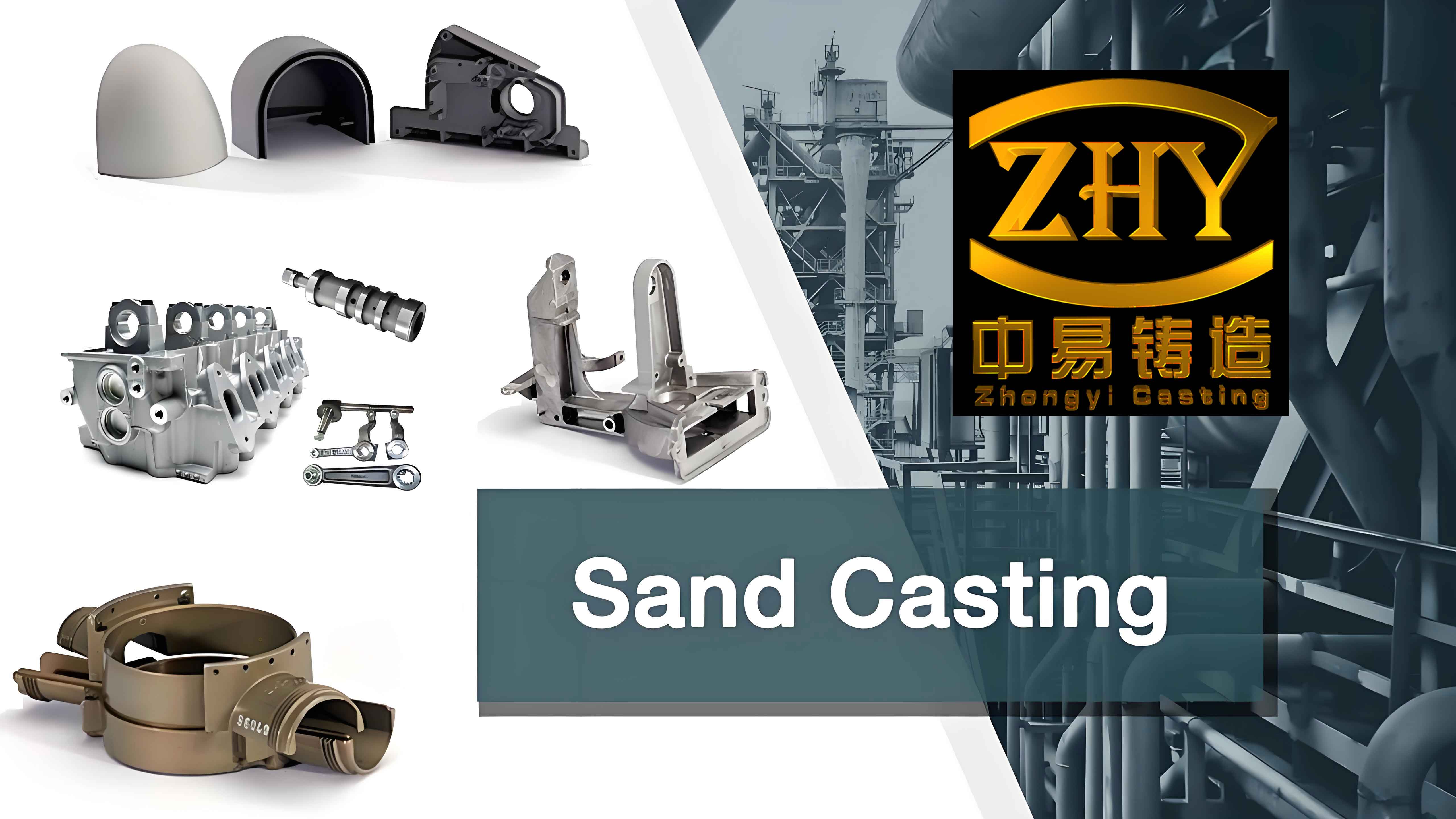
The image above showcases typical components produced through sand casting, highlighting its application in creating diverse parts. This visual reinforces the practicality of sand casting, which remains a cornerstone in foundries worldwide. As I analyze these processes, it is evident that sand casting’s adaptability makes it indispensable, but its drawbacks necessitate ongoing research. For example, the high-compaction sand casting methods aim to reduce rebound effects, which can be described by the relationship: $$ R = k \cdot P $$ where $R$ is the rebound magnitude, $k$ is a material constant, and $P$ is the compaction pressure. Understanding such dynamics is vital for enhancing precision in sand casting.
Now, let’s explore the specific characteristics of lost foam casting in greater depth. The process begins with pattern making, where foam materials are shaped and assembled. The choice of material is critical; for instance, EPS (expanded polystyrene) is common but prone to defects in ferrous castings, while EPMMA (polymethyl methacrylate) offers better performance at a higher cost. The decomposition of foam during pouring can be modeled using kinetic equations: $$ \frac{dm}{dt} = -A e^{-E/RT} $$ where $m$ is the mass of foam, $t$ is time, $A$ is a pre-exponential factor, $E$ is activation energy, $R$ is the gas constant, and $T$ is temperature. This equation helps predict gas evolution and its impact on casting quality. Additionally, the vibration compaction in lost foam casting ensures uniform sand density, which can be quantified by the vibration frequency and amplitude. The benefits of this process include reduced labor, minimal sand preparation, and lower environmental impact due to the absence of binders. However, the reliance on dry sand requires advanced vibration systems, as seen in Japanese and American innovations, which my research suggests should be adopted more widely.
Turning to sand casting, its multi-step nature introduces variability. The mold strength and permeability are crucial factors, often governed by the sand mixture composition. A typical sand mixture for sand casting includes silica sand, clay, and water, with properties like green strength expressed as: $$ \sigma_g = f(C, W) $$ where $\sigma_g$ is the green strength, $C$ is the clay content, and $W$ is the water content. Defects in sand casting, such as gas holes or shrinkage, can be analyzed using quality control metrics. For instance, the defect rate $D$ might be related to mold quality $Q_m$ by: $$ D = \alpha (1 – Q_m) $$ where $\alpha$ is a proportionality constant. This highlights the importance of mold integrity in sand casting. Moreover, the high-compaction methods in sand casting, like high-pressure molding, improve density but require careful control to avoid rebound, which I have studied through empirical data. The future of sand casting lies in optimizing these parameters to achieve near-net-shape castings with minimal post-processing.
To facilitate a direct comparison, I have compiled a table summarizing key aspects of both processes. This includes dimensional accuracy, surface finish, cost factors, environmental impact, and typical applications. The table will be presented later, but for now, it is essential to note that sand casting excels in flexibility and low tooling costs, while lost foam casting offers better precision and automation potential. In terms of research directions, lost foam casting requires advancements in pattern materials and coatings, whereas sand casting needs improvements in compaction techniques and defect reduction. Both processes benefit from mathematical modeling, such as finite element analysis for thermal stresses during solidification: $$ \rho C_p \frac{\partial T}{\partial t} = \nabla \cdot (k \nabla T) + Q $$ where $\rho$ is density, $C_p$ is specific heat, $k$ is thermal conductivity, $T$ is temperature, $t$ is time, and $Q$ is heat source term. Such models aid in predicting casting quality and optimizing parameters.
In the context of sustainability, lost foam casting demonstrates superior sand reclamation, which aligns with circular economy principles. The reclamation rate can be integrated into life cycle assessments, providing a holistic view of environmental impact. For sand casting, the use of bonded sand necessitates recycling processes that are less efficient, often involving thermal or mechanical reclamation. The energy consumption in sand casting can be approximated by: $$ E_{\text{total}} = E_{\text{molding}} + E_{\text{pouring}} + E_{\text{cleaning}} $$ where each term represents energy in respective stages. Comparatively, lost foam casting simplifies these stages, leading to lower $E_{\text{total}}$. This underscores the importance of process selection based on specific project requirements, where sand casting might be preferred for its versatility, and lost foam casting for its efficiency.
As I reflect on the industry’s trajectory, it is clear that both lost foam casting and sand casting will continue to evolve. Innovations in materials science, such as developing biodegradable foams for lost foam casting or enhanced binders for sand casting, could address current limitations. Additionally, automation and digital twins—virtual representations of physical processes—can optimize parameters in real-time. For example, in sand casting, monitoring mold hardness and moisture content through sensors can reduce defects. The mathematical representation of such systems might involve control theory: $$ G(s) = \frac{Y(s)}{U(s)} $$ where $G(s)$ is the transfer function, $Y(s)$ is the output (e.g., casting quality), and $U(s)$ is the input (e.g., process parameters). This approach enables predictive maintenance and quality assurance.
In conclusion, the comparison between lost foam casting and sand casting reveals a dynamic landscape where each method has unique strengths. Sand casting, with its long history and adaptability, remains vital for many applications, but it requires continuous refinement to overcome issues like dimensional inaccuracies and surface roughness. Lost foam casting, though newer, offers significant advantages in simplification and cost reduction, but it depends on material advancements and process control. Through rigorous research and the application of engineering principles, both processes can be enhanced to meet the demands of modern manufacturing. The following tables and formulas summarize the core aspects of this discussion, providing a reference for further exploration and innovation in the casting industry.
| Parameter | Lost Foam Casting | Sand Casting |
|---|---|---|
| Dimensional Accuracy | High (depends on pattern precision) | Moderate (subject to cumulative errors) |
| Surface Finish | Smooth (similar to investment casting) | Rough (requires finishing operations) |
| Process Complexity | Low (no cores, no mold removal) | High (multiple steps: molding, core making, etc.) |
| Cost Efficiency | High (cost reduction up to 30%) | Moderate (tooling costs low, but labor intensive) |
| Sand Reclamation Rate | >90% (dry sand, no binders) | Variable (depends on binder type and reclamation method) |
| Common Defects | Surface wrinkling, carbon pickup | Sand inclusions, shrinkage, gas porosity |
| Automation Potential | High (easily automated) | Moderate (requires complex systems) |
| Environmental Impact | Lower (reduced waste and energy) | Higher (binders and higher energy use) |
The economic impact of these processes can be further analyzed using cost-benefit formulas. For instance, the total cost $C_{\text{total}}$ for sand casting includes material, labor, and energy components: $$ C_{\text{total}} = C_m + C_l + C_e $$ where $C_m$ is material cost, $C_l$ is labor cost, and $C_e$ is energy cost. In lost foam casting, $C_l$ and $C_e$ are typically lower, leading to overall savings. Additionally, the quality yield $Y$ can be defined as: $$ Y = \frac{N_{\text{good}}}{N_{\text{total}}} \times 100\% $$ where $N_{\text{good}}$ is the number of defect-free castings and $N_{\text{total}}$ is the total produced. Research shows that lost foam casting often achieves higher $Y$ values due to reduced handling, whereas sand casting may require more inspections.
Looking ahead, the integration of Industry 4.0 technologies, such as IoT and AI, will revolutionize both lost foam casting and sand casting. For example, in sand casting, real-time monitoring of mold parameters can optimize compaction and reduce rebound effects. The rebound in high-compaction sand casting can be modeled as: $$ \Delta L = \beta \cdot P^n $$ where $\Delta L$ is the length change due to rebound, $\beta$ is a constant, $P$ is pressure, and $n$ is an exponent. Such models help in designing better equipment. Similarly, in lost foam casting, advanced coatings with tailored permeability can be developed using computational fluid dynamics: $$ \frac{\partial u}{\partial t} + (u \cdot \nabla) u = -\frac{1}{\rho} \nabla p + \nu \nabla^2 u $$ where $u$ is velocity, $p$ is pressure, $\rho$ is density, and $\nu$ is kinematic viscosity. This equation describes gas flow during decomposition, aiding in coating design.
In summary, the journey of improving casting processes is ongoing, with sand casting maintaining its relevance due to its versatility and lost foam casting emerging as a efficient alternative. By leveraging mathematical models, empirical data, and technological innovations, we can address the challenges in both methods. The repeated emphasis on sand casting in this discussion underscores its enduring role, while also highlighting areas for enhancement. As we move forward, collaborative research and knowledge sharing will be key to unlocking the full potential of these casting techniques, ensuring they meet the evolving demands of global industry.