
In my extensive experience within the foundry industry, lost foam casting has consistently stood out as a transformative technology, offering significant advantages such as reduced investment, lower energy consumption, improved working conditions, high production efficiency, and minimal environmental pollution. These benefits have led to its widespread adoption, particularly for mass-producing high-precision, complex castings. However, like all casting methodologies, it is not without its limitations. Among the most persistent and challenging issues is the occurrence of slag inclusion defects. This problem can severely compromise product quality, leading to high rejection rates, increased costs, and disrupted production schedules. I recall a specific, critical instance where the production of brake caliper housings using lost foam technology was plagued by severe slag inclusion, resulting in a scrap rate of approximately 40%. This prompted a deep, methodical investigation to identify the root causes and develop effective countermeasures. The following account details my first-hand analysis, experimental journey, and the solutions derived to conquer the pervasive challenge of slag inclusion.
The brake caliper housing in question was a relatively simple, high-demand component made of HT250 iron, weighing 14.5 kg. Its functional requirements mandated full machining of its top and bottom faces and internal cylindrical bore, with absolutely no tolerance for defects like slag inclusion or gas porosity. The transition to lost foam production for this part was initially promising but soon became problematic due to the frequent appearance of slag inclusions precisely on these critical machined surfaces. The defects were irregular in morphology, contained unidentified inclusions, and typically penetrated about 2 mm into the casting surface. This was not a minor issue; it was a major bottleneck threatening the viability of lost foam for this high-volume application.
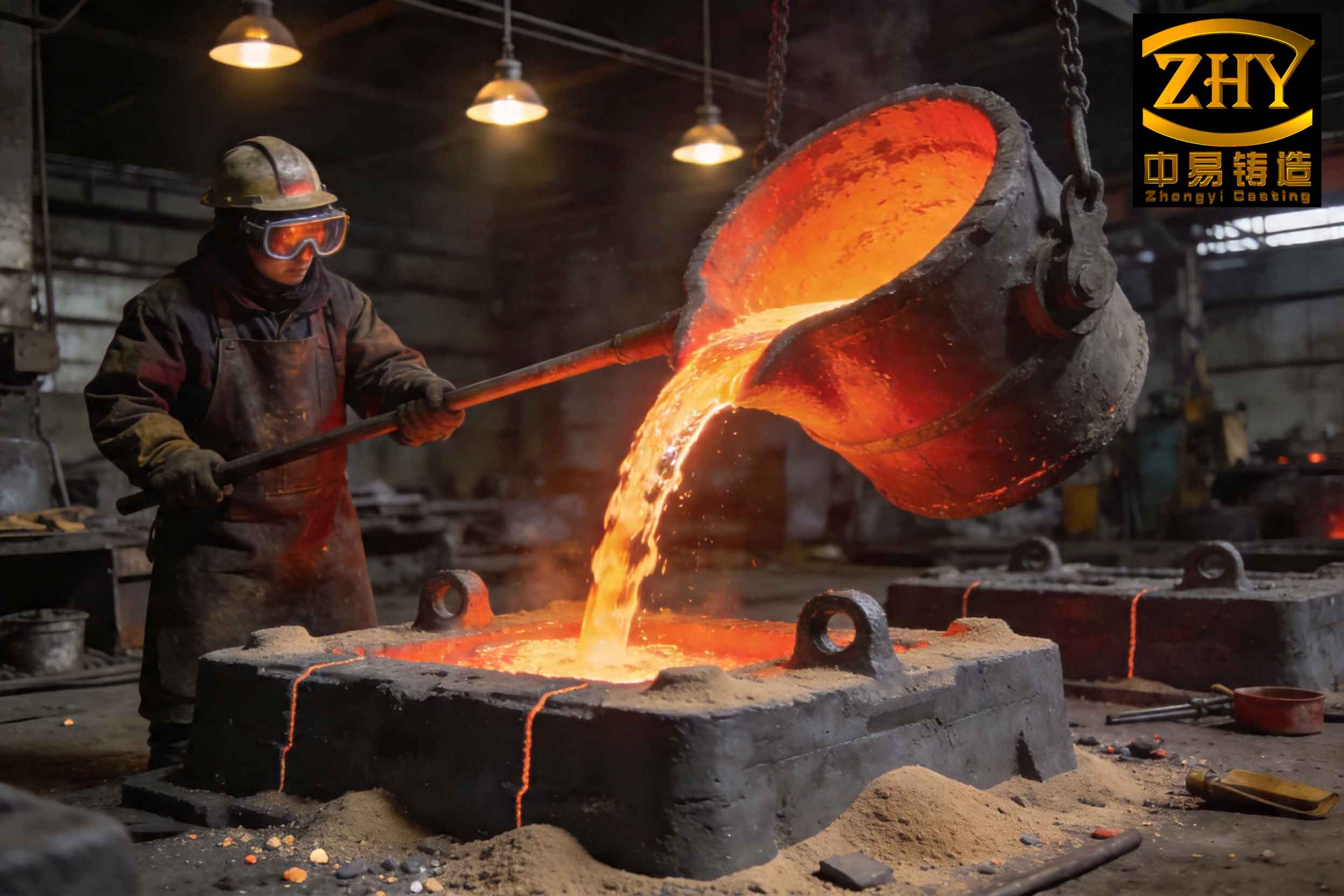
The initial production process, refined through several trials, utilized STMMA foam patterns with a density of 22–24 g/L. The gating system consisted of a sprue (Ø40 mm x 400 mm), a horizontal runner with a cross-section of 30 mm x 45 mm, and an ingate of 8 mm x 40 mm. A slag trap was incorporated into the system. The coating was a water-based, high-alumina type, applied in three layers to achieve a thickness of 1.2–1.5 mm. Pouring temperatures were maintained between 1480°C and 1510°C. Despite these optimized parameters, the slag inclusion problem persisted at an unacceptable level.
To move beyond empirical guesses, a scientific diagnostic approach was essential. We extracted samples from the slag inclusion sites on multiple defective castings for detailed microscopic examination using scanning electron microscopy (SEM) and energy-dispersive X-ray spectroscopy (EDX). The results were illuminating. The affected areas showed significantly elevated levels of silicon, aluminum, and manganese compared to the base iron matrix. Particularly striking was the presence of spherical particles where aluminum content soared to over 32%, indicating the formation of aluminum compounds. Manganese content was 3 to 5 times higher than in the unaffected base metal. The high-alumina coating was immediately suspect, as Al₂O₃ is its primary constituent. Furthermore, the diameter of these spherical particles (40–60 μm) closely matched the grain size of the coating’s refractory aggregate (40–75 μm). This correlation strongly suggested that the coating material itself was dislodging, entering the molten metal stream, and solidifying as entrapped slag inclusions. The fundamental issue appeared to be either insufficient coating strength or, more likely, inadequate refractoriness for the employed pouring temperatures.
This hypothesis required rigorous validation through controlled experiments. We designed a two-phase test plan. The first phase aimed to isolate the coating variable. Two groups of molds were prepared using identical pattern assemblies and cluster layouts. Group A used a new, alternative high-quality iron casting coating from a different supplier, while Group B retained the original coating. All other process parameters—pouring temperature (1490°C), pouring time (20-23 s), vacuum level (-0.05 MPa), and holding time (10 min)—were kept constant, using iron from the same melt.
| Group | Coating Used | Number of Castings | Castings with Slag Inclusion | Slag Inclusion Rate | Notes |
|---|---|---|---|---|---|
| A | New Coating | 18 | 3 | 16.7% | One defect was from unclean gating; others were minor. |
| B | Original Coating | 12 | 6 | 50.0% | Defects were severe and typical of the production problem. |
The results were clear. While not completely eliminating the issue, the new coating drastically reduced the incidence and severity of slag inclusion. This confirmed that the coating was a primary contributor to the slag inclusion defect. However, the question remained: was the coating inherently poor, or were the process conditions too harsh for it? This led to the second phase of experimentation, where we investigated the role of pouring temperature. We hypothesized that the original pouring temperature range (1480-1510°C) might be exceeding the thermal stability limit of the coating.
For the second test, we adjusted the key parameter: pouring temperature was lowered and tightly controlled at 1420°C ± 10°C. Again, Group A used the new coating, and Group B used the original. All other parameters remained unchanged.
| Group | Coating Used | Pouring Temperature | Number of Castings | Castings with Slag Inclusion | Slag Inclusion Rate |
|---|---|---|---|---|---|
| A | New Coating | 1420°C ± 10°C | 18 | 0 | 0% |
| B | Original Coating | 1420°C ± 10°C | 18 | 1 | 5.6% |
The outcome was decisive. Group A achieved a 100% success rate with no slag inclusion defects. Even Group B, using the original coating, showed a remarkable improvement, with only a single, minor slag inclusion occurrence. This series of experiments conclusively proved that the core of the slag inclusion problem was a combination of a coating with marginally low refractoriness and a pouring temperature that pushed it beyond its operational limits. The high-temperature metal flow was eroding or thermally shocking the coating, causing particles to spall off and become entrapped as slag inclusions.
The mechanism of slag inclusion formation in lost foam casting is complex and can be described by considering the forces at play during pouring. The velocity of the molten metal, \( v \), as it flows through the gating system and over the coated pattern, exerts a shear stress, \( \tau \), on the coating layer. This stress must be counteracted by the coating’s adhesive strength to the foam and its cohesive internal strength. If the thermal degradation weakens the coating at temperature \( T \), the effective strength \( S(T) \) decreases. Slag inclusion occurs when the following condition is met:
$$ \tau(v, \rho, \mu) > S(T, t) $$
where \( \rho \) is the metal density, \( \mu \) is its dynamic viscosity, and \( t \) is the time of exposure. The probability of slag inclusion, \( P_{slag} \), can be conceptually modeled as a function of multiple variables:
$$ P_{slag} = f(T_{pour}, v_{metal}, \zeta_{coating}, \delta_{coating}, \rho_{foam}) $$
Here, \( T_{pour} \) is pouring temperature, \( v_{metal} \) is metal velocity, \( \zeta_{coating} \) represents coating refractoriness and strength properties, \( \delta_{coating} \) is coating thickness, and \( \rho_{foam} \) is foam pattern density. Our investigation found that for the given system, \( T_{pour} \) and \( \zeta_{coating} \) were the dominant factors causing a high \( P_{slag} \).
Based on this root cause analysis, a multi-pronged improvement strategy was implemented to prevent slag inclusion:
- Optimized Pouring Temperature: The pouring temperature was strictly lowered and controlled within the range of 1410°C to 1430°C. This reduction decreased the thermal load on the coating, bringing it back within its safe operating window and significantly reducing the driving force for erosion and spalling.
- Upgraded Coating Material: The original coating was replaced with a premium-grade, high-refractoriness lost foam coating specifically formulated for iron castings. Key properties like high-temperature strength, thermal shock resistance, and adhesion were verified prior to full-scale adoption.
- Enhanced Pattern Quality: The specification for foam pattern density was slightly increased. A denser pattern (e.g., 24-26 g/L) results in smoother surfaces with fewer and smaller inter-bead gaps. This minimizes the penetration of coating slurry into the foam structure during dipping, leading to a more uniform and potentially stronger coating layer that is less prone to localized weakness and subsequent slag inclusion generation.
The synergistic effect of these measures was transformative. In sustained production, the scrap rate due to slag inclusion plummeted from the original 40% to well below 3%. The brake caliper housing project became a stable, cost-effective success in lost foam production.
This case study underscores a critical, broader principle in foundry engineering: the prevention of slag inclusion is not about addressing a single factor but about understanding and balancing a system. To further elucidate the factors influencing slag inclusion, consider the following comprehensive table summarizing key parameters and their effects:
| Parameter | Effect on Slag Inclusion Risk | Optimization Strategy | Mechanistic Rationale |
|---|---|---|---|
| Pouring Temperature (\( T_{pour} \)) | Directly proportional. High \( T_{pour} \) increases thermal attack on coating. | Use the lowest temperature that ensures complete filling and avoids cold defects. | Reduces coating degradation rate \( k \) in Arrhenius equation: \( k = A e^{-E_a/(RT)} \). |
| Coating Refractoriness (\( \zeta \)) | Inversely proportional. Higher refractoriness lowers risk. | Select coatings with appropriate Pyrometric Cone Equivalent (PCE) for alloy. | Determines the softening point and chemical stability against molten metal. |
| Coating Adhesion/Strength | Inversely proportional. Stronger adhesion resists erosion. | Optimize binder system, drying process, and coating thickness. | Must withstand shear stress \( \tau \) from metal flow and gas pressure during decomposition. |
| Metal Pouring Velocity (\( v \)) | Directly proportional. Turbulent flow increases shear stress. | Design gating for laminar, controlled filling (e.g., use of filters, tapered sprue). | Shear stress \( \tau \propto \rho v^2 \). Lower \( v \) reduces erosive force on coating. |
| Foam Pattern Density (\( \rho_{foam} \)) | Inversely proportional. Denser foam provides smoother substrate. | Use the highest practical density without causing pyrolysis issues. | Reduces surface porosity, limiting coating penetration and creating a more continuous barrier. |
| Vacuum Level (\( P_{vac} \)) | Complex relationship. Very high vacuum can increase metal velocity. | Use minimum necessary vacuum for mold integrity and gas evacuation. | Affects fill velocity and foam decomposition gas removal dynamics. |
Beyond the specific case, the physics of slag inclusion formation can be explored through models of particle entrapment. The likelihood of a dislodged coating particle (size \( d_p \)) being trapped in the solidifying metal front depends on the local solidification velocity \( V_s \) and the particle’s movement in the melt. A simple criterion for pushing/engulfment is given by a critical velocity:
$$ V_{cr} = \frac{\Delta \sigma_{sl} a_0}{6 \pi \mu d_p^2} $$
where \( \Delta \sigma_{sl} \) is the difference in solid-liquid interfacial energies with and without the particle, \( a_0 \) is an atomic distance, and \( \mu \) is viscosity. If the solidification front advances faster than \( V_{cr} \), the particle is engulfed, leading to slag inclusion. Process parameters that increase local cooling rates or disturb the melt (like turbulence from high pouring speed) can promote engulfment events.
Furthermore, the chemical aspect of slag inclusion is vital. The aluminum-rich particles found were likely complex oxides or reaction products. The formation of such inclusions can be described by chemical affinity. For example, the free energy change \( \Delta G \) for the formation of alumina from aluminum in solution is:
$$ \Delta G = \Delta G^\circ + RT \ln \left( \frac{a_{Al_2O_3}}{a_{Al}^2 \cdot a_{O}^3} \right) $$
Where \( a \) denotes activity. Conditions that increase oxygen activity or aluminum activity (e.g., from coating breakdown) can make such formations thermodynamically favorable, stabilizing the slag inclusion within the iron matrix.
In conclusion, the battle against slag inclusion in lost foam casting is won through meticulous attention to the interplay between materials and processes. This experience taught me that a systematic, data-driven approach—combining visual inspection, metallurgical analysis, controlled experimentation, and theoretical understanding—is indispensable for diagnosing and solving such quality issues. The prevention of slag inclusion hinges on selecting a coating system with robust high-temperature properties, tailoring the pouring parameters to minimize thermal and mechanical abuse of that coating, and ensuring excellent pattern quality. By mastering these elements, foundries can harness the full potential of lost foam casting while maintaining high integrity and yield, keeping the costly and disruptive specter of slag inclusion firmly at bay. The continuous pursuit of understanding every facet of slag inclusion formation remains a cornerstone of quality assurance and technological advancement in modern casting operations.