
In my extensive research and practical experience within the foundry industry, the lost foam casting process has emerged as a pivotal advanced manufacturing technique, renowned for its ability to produce complex, near-net-shape components with high dimensional accuracy and minimal environmental impact. This process, often hailed as a “green casting” method for the 21st century, involves creating a foam pattern that is vaporized by molten metal during pouring, leaving behind a precise casting. However, despite its advantages, the lost foam casting process is susceptible to various defects, with sand penetration being a particularly persistent and costly issue in the production of critical parts such as forklift transmission housings. These housings, typically made from HT250 gray iron, feature intricate geometries with thin walls, multiple corners, flanges, and recesses, making them prone to sand adhesion that compromises surface quality and machining precision. Through systematic investigation, I have identified that sand penetration defects in the lost foam casting process primarily manifest as mechanical penetration, where molten metal infiltrates the coating and sand matrix, forming a tenacious “metal-sand” mixture that is difficult to remove post-casting. This article delves into the root causes of these defects and presents optimized control strategies, leveraging data-driven adjustments in process parameters to enhance yield and quality in the lost foam casting process.
The initial production setup for the transmission housing followed a conventional lost foam casting process protocol. The foam patterns were molded using imported copolymer beads, with a pre-expansion density controlled between 24 to 28 g/L, and assembled using cold-set adhesives. A water-based paste coating and an alcohol-based coating (for brushing) were applied via dipping, aiming for a thickness of 1.0 to 1.5 mm. The molding involved unbonded silica sand with a grain size of 30-40 mesh, compacted via three-dimensional vibration. The pouring temperature was set at 1,460–1,480°C, with inoculation using 0.1–0.3% ferrosilicon, and a side-step gating system was employed in a one-pattern-per-mold configuration. The negative pressure during pouring was maintained at 0.05–0.06 MPa. Despite this standardized approach, severe sand penetration occurred, especially on flange surfaces, corners, recesses, and dead angles, leading to a rejection rate of up to 10%. This prompted a detailed analysis to refine the lost foam casting process.
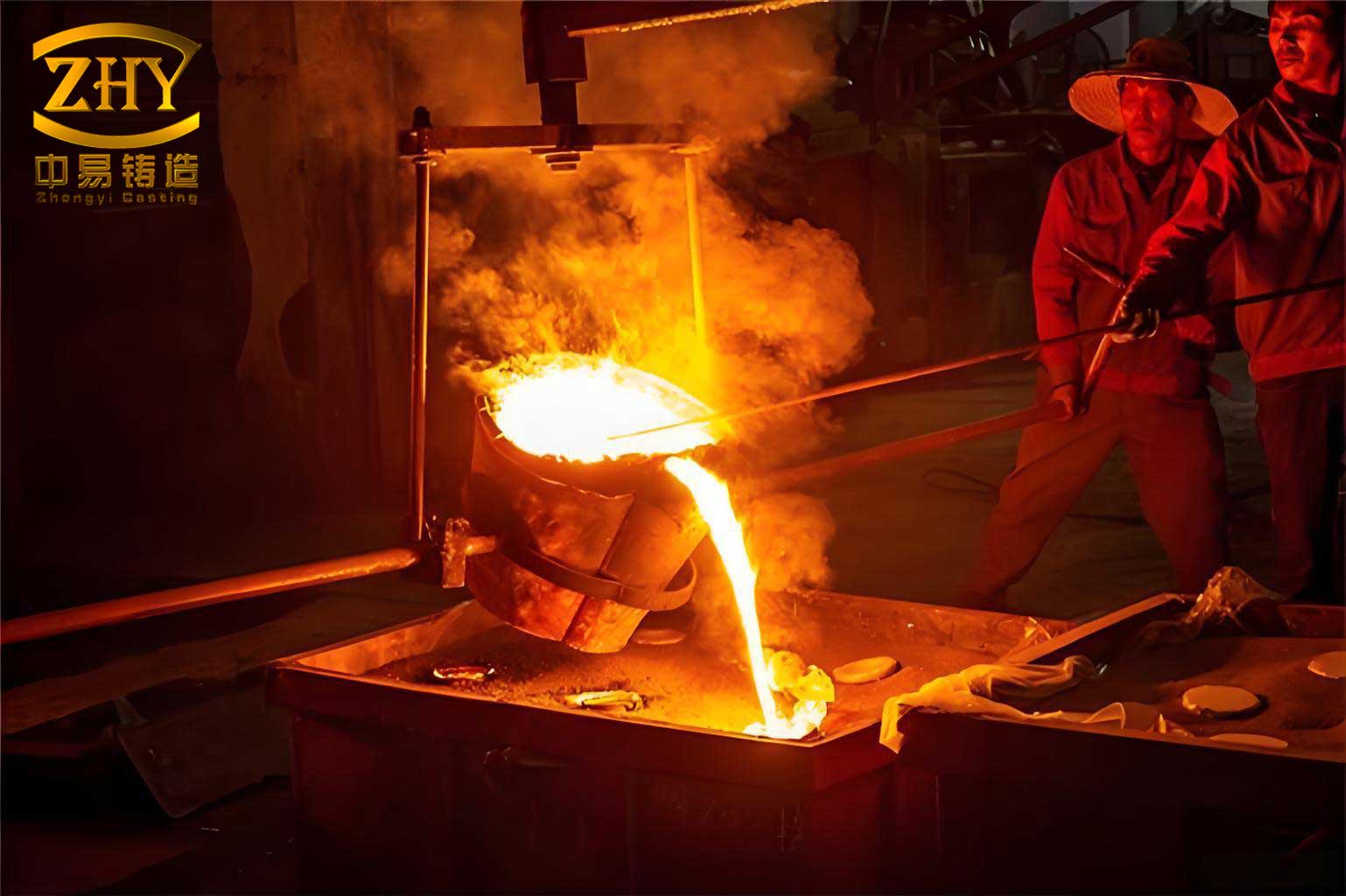
Sand penetration in the lost foam casting process can be classified into mechanical and chemical types. In this case, upon examination, the adhered material was crushed and analyzed magnetically, revealing metallic iron particles from the housing material mixed with silica sand, without evidence of chemical reaction products. This confirms mechanical penetration, where molten metal under pressure intrudes into the interstices of the sand grains through the coating. The mechanism is governed by factors such as metal fluidity, coating integrity, sand compaction, and pressure differentials. In the lost foam casting process, the decomposition of the foam pattern generates gaseous products that increase back-pressure in the mold cavity, elevating the metal’s penetration potential. Moreover, areas like flanges that are directly impinged by the metal stream from the gating system experience prolonged exposure to high-temperature metal, exacerbating penetration. The fundamental equation describing the penetration pressure ($P_p$) in the lost foam casting process can be expressed as:
$$ P_p = P_h + P_g + P_\Delta – P_c $$
where $P_h$ is the hydrostatic pressure from the metal head ($P_h = \rho g h$, with $\rho$ as metal density, $g$ as gravity, and $h$ as height), $P_g$ is the gas pressure from foam decomposition, $P_\Delta$ is the dynamic pressure from pouring, and $P_c$ is the capillary resistance from the sand-coating system. When $P_p$ exceeds the threshold resistance of the coating and sand, mechanical penetration occurs. In the lost foam casting process, high pouring temperatures (above 1,400°C) significantly increase $P_g$ and reduce metal viscosity, facilitating penetration.
To quantify the impact of key parameters in the lost foam casting process, I conducted a series of controlled experiments, varying one factor at a time while monitoring the sand penetration rate (defined as the percentage of castings showing severe adhesion). The baseline data highlighted the sensitivity of the lost foam casting process to operational variables. For instance, pouring temperature exhibited a strong correlation with defect incidence, as summarized in Table 1. Reducing the temperature from the initial range lowered penetration, but excessive reduction introduced other defects like cold shuts and porosity, underscoring the need for balance in the lost foam casting process.
| Pouring Temperature (°C) | Sand Penetration Rate (%) |
|---|---|
| 1,420 | 10 |
| 1,430 | 18 |
| 1,440 | 24 |
| 1,450 | 28 |
| 1,460 | 30 |
| 1,470 | 45 |
| 1,480 | 50 |
Coating thickness is another critical variable in the lost foam casting process. A thicker coating might seem beneficial for barrier strength, but it can crack or detach during drying, creating pathways for metal infiltration. Conversely, a thin coating lacks resilience against thermal and mechanical stresses. Tests with varying thicknesses, while keeping pouring temperature at 1,450°C and negative pressure at 0.06 MPa, yielded the results in Table 2. The optimal range for the lost foam casting process was found to be 0.8–1.0 mm, supplemented by localized brushing in vulnerable areas to ensure uniformity without compromising透气性.
| Coating Thickness (mm) | Sand Penetration Rate (%) |
|---|---|
| 0.5 | 25 |
| 0.7 | 20 |
| 0.9 | 19 |
| 1.1 | 21 |
| 1.3 | 24 |
| 1.5 | 28 |
Negative pressure in the lost foam casting process serves to evacuate decomposition gases and stabilize the mold, but excessive vacuum can increase metal penetration pressure by enhancing flow dynamics. Adjusting negative pressure while fixing pouring temperature at 1,450°C and coating thickness at 0.8 mm revealed a sweet spot, as shown in Table 3. Lower negative pressure reduced penetration but raised risks of mold collapse and slag entrapment, highlighting the delicate interplay in the lost foam casting process.
| Negative Pressure (MPa) | Sand Penetration Rate (%) |
|---|---|
| 0.03 | 10 |
| 0.04 | 12 |
| 0.05 | 16 |
| 0.06 | 19 |
Beyond these primary factors, sand compaction and pouring speed are integral to the lost foam casting process. Inadequate compaction, especially in corners and recesses, lowers capillary resistance, which can be modeled as $P_c = \frac{2\gamma \cos \theta}{r}$, where $\gamma$ is surface tension, $\theta$ is contact angle, and $r$ is pore radius. Loose sand increases $r$, reducing $P_c$ and promoting penetration. Similarly, erratic pouring speeds cause temperature gradients and pressure fluctuations; a controlled, steady pour mitigates this. The overall optimization of the lost foam casting process can be framed as minimizing a defect function $D$:
$$ D = f(T, \delta, P_n, \rho_s, v_p) $$
where $T$ is pouring temperature, $\delta$ is coating thickness, $P_n$ is negative pressure, $\rho_s$ is sand compaction density, and $v_p$ is pouring speed. Through iterative testing, I derived an empirical relationship for the lost foam casting process specific to transmission housings:
$$ D \propto e^{k_1 T} \cdot \delta^{-k_2} \cdot P_n^{k_3} \cdot \rho_s^{-k_4} \cdot v_p^{k_5} $$
with constants $k_1, k_2, k_3, k_4, k_5$ determined from regression analysis of production data. This model underscores the exponential impact of temperature and the inverse relationship with coating thickness and sand compaction in the lost foam casting process.
Based on these insights, I implemented a comprehensive set of preventive measures to refine the lost foam casting process. First, pouring temperature was tightly controlled between 1,440–1,460°C, with seasonal adjustments of ±10°C to account for ambient variations. Second, coating application was standardized: the water-based paste was diluted to a Baume degree of 70–75, ensuring a uniform 0.8–1.0 mm thickness after dipping, followed by manual brushing of alcohol-based coating on flanges, corners, and recesses to reinforce those zones without cracking. Third, negative pressure was set at 0.04–0.05 MPa, with regular maintenance of vacuum lines and screens to prevent clogging. Fourth, sand compaction was enhanced by manual packing in intricate areas and optimizing vibration parameters—frequency and duration—to achieve consistent density without pattern distortion. Fifth, pouring speed was modulated, starting slower for the first mold to avoid thermal shock and gradually increasing for subsequent molds to maintain metal fluidity. These adjustments in the lost foam casting process were monitored through statistical process control, reducing sand penetration from 50% to below 15%, effectively eliminating rejections due to this defect.
The interplay of parameters in the lost foam casting process is further illustrated in Table 4, comparing the initial and optimized settings. This holistic approach demonstrates that success in the lost foam casting process hinges on balancing multiple variables rather than isolating single factors.
| Process Parameter | Before Optimization | After Optimization |
|---|---|---|
| Pouring Temperature (°C) | 1,460–1,480 | 1,440–1,460 |
| Coating Thickness (mm) | 1.0–1.5 | 0.8–1.0 |
| Negative Pressure (MPa) | 0.05–0.06 | 0.04–0.05 |
| Sand Compaction | Standard vibration | Enhanced manual + vibration |
| Pouring Speed | Uniform | Graduated increase |
In conclusion, the lost foam casting process offers immense potential for manufacturing complex components like transmission housings, but its efficacy depends on meticulous control over process-induced defects. Sand penetration, primarily mechanical in nature, can be systematically mitigated through targeted adjustments in pouring temperature, coating thickness, negative pressure, sand compaction, and pouring speed. My findings emphasize that the lost foam casting process is not a static methodology but a dynamic system requiring continuous monitoring and adaptation. By implementing the outlined strategies, production efficiency and casting quality are significantly enhanced, reducing post-processing effort and boosting yield. Future work in the lost foam casting process could explore advanced coatings with nano-additives or real-time sensor-based control to further automate optimization, pushing the boundaries of this green casting technology. Ultimately, mastering the lost foam casting process is key to unlocking its full economic and environmental benefits in foundry operations worldwide.