
As an industry insider with years of experience in foundry operations, I have witnessed firsthand the transformative challenges and opportunities within the sand casting sector. Sand casting parts are ubiquitous in various industries, from automotive to machinery, due to their cost-effectiveness and versatility. However, the environmental footprint of traditional sand casting processes cannot be ignored. The image of billowing black smoke has long been associated with foundries, symbolizing a legacy of pollution that demands urgent redressal. In this article, I will delve into the root causes of pollution in sand casting, explore innovative solutions centered on green materials and technologies, and analyze industry trends to chart a path toward sustainable manufacturing. Throughout this discussion, the term “sand casting parts” will be frequently emphasized to underscore their central role in this ecosystem.
The production of sand casting parts involves multiple stages, each contributing to environmental degradation. Key pollution sources include metal melting, sand mixing and molding, core making, pouring, cooling, shakeout, and finishing processes like cleaning and grinding. Due to the dispersed nature of these pollution sources, end-of-pipe treatments alone are often insufficient. Instead, a paradigm shift toward source reduction through cleaner raw materials is essential. This approach aligns with the global push for green foundry practices, which aim to reconcile industrial output with ecological preservation. Below, I present a table summarizing the primary pollution-generating stages in sand casting and their typical emissions.
| Production Stage | Major Pollutants | Impact on Environment |
|---|---|---|
| Metal Melting | Particulate matter, CO, SO₂, NOₓ | Air pollution, greenhouse gas emissions |
| Sand Mixing and Molding | Dust, volatile organic compounds (VOCs) | Respiratory issues, smog formation |
| Core Making | VOCs, hazardous air pollutants (HAPs) | Toxic emissions, ozone depletion |
| Pouring and Cooling | Fumes, particulate matter | Air quality degradation |
| Shakeout and Cleaning | Dust, noise | Particulate pollution, occupational hazards |
To address these challenges, the adoption of green casting materials has become paramount. These materials focus on three core aspects: energy conservation, reduction of dust and harmful gas emissions, and recycling of waste residues. Let’s examine each in detail, with a particular focus on how they enhance the production of sand casting parts.
First, energy conservation in sand casting primarily occurs during metal melting and heat treatment. By optimizing processes and using advanced materials, significant savings can be achieved. For instance, the use of exothermic insulating risers, metal treatment agents, and ceramic filters can improve the yield rate of sand casting parts. The yield rate, a critical metric, can be expressed as:
$$ \text{Yield Rate} = \frac{\text{Mass of Acceptable Sand Casting Parts}}{\text{Total Mass of Molten Metal Used}} \times 100\% $$
Enhancing this rate directly reduces energy consumption per unit of output. Additionally, process optimization through statistical methods, such as Design of Experiments (DOE), can minimize scrap. A simplified energy balance equation for a melting furnace illustrates this:
$$ Q_{\text{total}} = Q_{\text{melting}} + Q_{\text{losses}} $$
where \( Q_{\text{total}} \) is the total energy input, \( Q_{\text{melting}} \) is the energy required to melt metal for sand casting parts, and \( Q_{\text{losses}} \) represents losses due to inefficiencies. Reducing \( Q_{\text{losses}} \) through better insulation or recuperative burners can lower energy use by up to 30%.
Second, reducing dust and harmful gas emissions is crucial in stages like molding, pouring, and cleaning. The binder used in sand molds and cores is a major source of VOCs and HAPs. Traditionally, organic binders like phenolic urethanes are employed, but they release pollutants during curing and pouring. Switching to inorganic binders (e.g., sodium silicate-based systems) or improving organic binder formulations to reduce usage can cut emissions significantly. For example, the emission factor \( E \) for a binder can be modeled as:
$$ E = k \cdot C \cdot A $$
where \( k \) is a binder-specific constant, \( C \) is the concentration used per ton of sand, and \( A \) is the surface area of sand casting parts produced. By lowering \( C \) through high-performance binders, \( E \) decreases proportionally. Moreover, advanced ventilation and filtration systems can capture particulates. The efficiency \( \eta \) of such systems is given by:
$$ \eta = 1 – \frac{C_{\text{out}}}{C_{\text{in}}} $$
where \( C_{\text{in}} \) and \( C_{\text{out}} \) are inlet and outlet pollutant concentrations, respectively. Aiming for \( \eta > 95\% \) is now industry standard for new foundries producing sand casting parts.
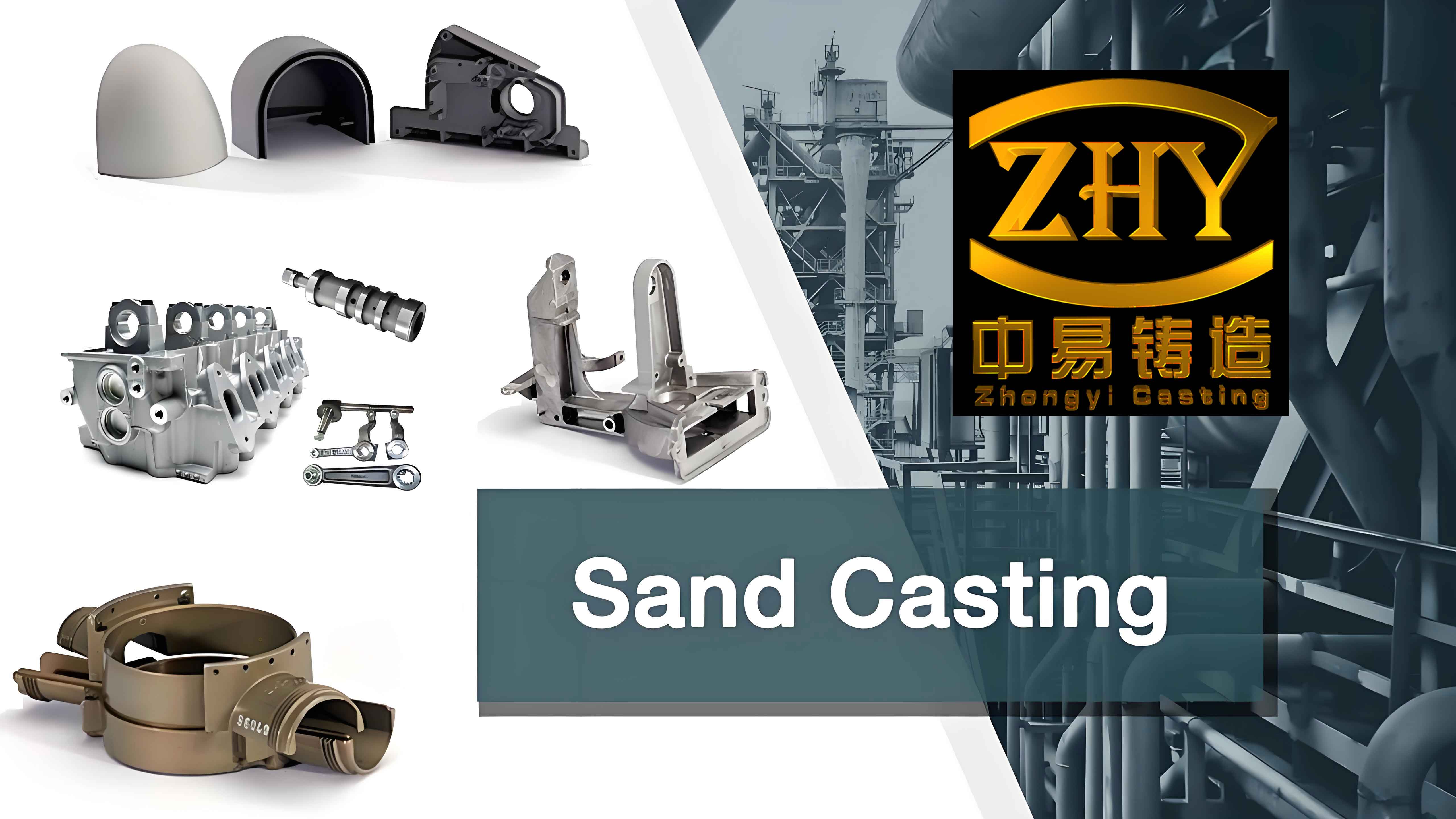
The visual above showcases typical sand casting parts, highlighting their intricate geometries and the importance of precision in manufacturing. Achieving such quality while minimizing environmental impact requires continuous innovation in materials and processes. For instance, the development of low-emission binders has enabled foundries to produce sand casting parts with smoother surfaces and fewer defects, reducing the need for energy-intensive post-processing.
Third, recycling waste materials, especially used sand, is a cornerstone of green sand casting. After producing sand casting parts, large quantities of spent molding sand are generated. Currently, three main regeneration methods are employed: mechanical, thermal, and wet regeneration. The choice depends on sand type and binder system. The regeneration efficiency \( R \) can be calculated as:
$$ R = \frac{M_{\text{reused}}}{M_{\text{total waste}}} \times 100\% $$
where \( M_{\text{reused}} \) is the mass of sand recycled back into production, and \( M_{\text{total waste}} \) is the total waste sand from sand casting parts manufacturing. Advanced regeneration systems can achieve \( R > 90\% \), drastically reducing landfill needs. Additionally, metal scrap from defective sand casting parts is often remelted, closing the material loop. The overall waste reduction potential \( W \) for a foundry is:
$$ W = 1 – \frac{\sum \text{Waste Outputs}}{\sum \text{Raw Material Inputs}} $$
Striving for \( W \to 0 \) through circular economy principles is now a key industry goal.
To contextualize these solutions within the broader industry landscape, let’s examine production data from the machine tool sector, which closely intersects with sand casting for part manufacturing. The following table summarizes key statistics from a recent period, illustrating trends that influence demand for sand casting parts.
| Product Category | May 2018 Production (Units) | Year-on-Year Change (%) | Jan-May 2018 Cumulative Production (Units) | Cumulative Year-on-Year Change (%) |
|---|---|---|---|---|
| Metal Cutting Machine Tools | 52,000 | +6.1 | 232,000 | +5.5 |
| CNC Metal Cutting Machine Tools | 19,000 | +5.6 | 83,000 | +5.1 |
| Metal Forming Machine Tools | 25,000 | 0.0 | 110,000 | +0.9 |
| Metal Cutting Tools (10k pieces) | 4,458.02 | -24.7 | 19,881.51 | -10.9 |
| Casting Machinery | 204,000 | -8.9 | 909,000 | -13.1 |
This data reveals a mixed picture: while machine tool production is growing modestly, casting machinery output has declined, possibly reflecting the industry’s shift toward upgrading equipment for greener practices. For sand casting parts producers, this underscores the need to invest in efficient, low-emission machinery to remain competitive. The correlation between machine tool advancement and sand casting quality can be expressed as:
$$ Q_{\text{cast}} = f(P_{\text{precision}}, E_{\text{efficiency}}, M_{\text{material}}) $$
where \( Q_{\text{cast}} \) is the quality of sand casting parts, \( P_{\text{precision}} \) depends on machine tool accuracy, \( E_{\text{efficiency}} \) on process optimization, and \( M_{\text{material}} \) on green material properties. Improving these factors collectively enhances sustainability.
Looking ahead, the integration of digital technologies like IoT and AI into sand casting holds promise for further pollution reduction. Smart sensors can monitor emissions in real-time, enabling proactive adjustments. For example, a predictive model for VOC emissions during core making might use:
$$ \text{VOC Emission} = \alpha \cdot T^{\beta} \cdot \exp\left(-\frac{\gamma}{R}\right) $$
where \( T \) is temperature, \( R \) is binder reaction rate, and \( \alpha, \beta, \gamma \) are constants derived from empirical data on sand casting parts production. By optimizing \( T \) and \( R \), emissions can be minimized without compromising part integrity.
In conclusion, the journey toward green sand casting is multifaceted, demanding collaboration across material science, process engineering, and policy frameworks. As an industry practitioner, I advocate for widespread adoption of inorganic binders, energy-efficient melting technologies, and robust sand recycling systems. Each step forward not only mitigates pollution but also elevates the quality and marketability of sand casting parts. The data indicates that while challenges persist, the trend is toward cleaner production. By embracing innovation, foundries can transform from pollution sources to pillars of sustainable manufacturing, ensuring that sand casting parts continue to drive industrial progress without compromising our planet’s health.
To summarize key formulas discussed:
Yield Rate: $$ Y = \frac{M_{\text{good}}}{M_{\text{total}}} \times 100\% $$
Energy Balance: $$ Q_{\text{total}} = Q_{\text{melting}} + Q_{\text{losses}} $$
Emission Factor: $$ E = k \cdot C \cdot A $$
Filtration Efficiency: $$ \eta = 1 – \frac{C_{\text{out}}}{C_{\text{in}}} $$
Regeneration Efficiency: $$ R = \frac{M_{\text{reused}}}{M_{\text{total waste}}} \times 100\% $$
Waste Reduction: $$ W = 1 – \frac{\sum \text{Waste Outputs}}{\sum \text{Raw Material Inputs}} $$
These mathematical representations provide a quantitative foundation for optimizing sand casting processes and underscore the importance of continuous improvement in producing high-quality sand casting parts.