
In my extensive experience with the lost foam casting process, I have encountered numerous challenges related to defect control, particularly shrinkage porosity. This article delves into a comprehensive analysis and solution framework for mitigating shrinkage defects, drawing from a detailed case study. The lost foam casting process, known for its ability to produce complex geometries with excellent dimensional accuracy, is nevertheless susceptible to certain inherent issues. Shrinkage porosity, which manifests as internal voids or cavities due to inadequate feeding during solidification, remains a primary concern for foundries utilizing this method. Through systematic investigation, I have identified key factors influencing shrinkage in lost foam castings and implemented effective control measures, significantly improving product quality and yield.
The fundamental principle of the lost foam casting process involves using a foam pattern that vaporizes upon contact with molten metal, leaving a precise cavity to form the casting. While this process offers advantages like reduced machining and design flexibility, the thermal decomposition of the foam and the subsequent metal flow dynamics create unique solidification conditions. Shrinkage defects often occur at thermal junctions or hot spots where material sections are thicker, leading to delayed solidification and insufficient liquid metal supply. My focus here is on elucidating the root causes and presenting a data-driven approach to minimize these defects, with repeated emphasis on optimizing the lost foam casting process parameters.
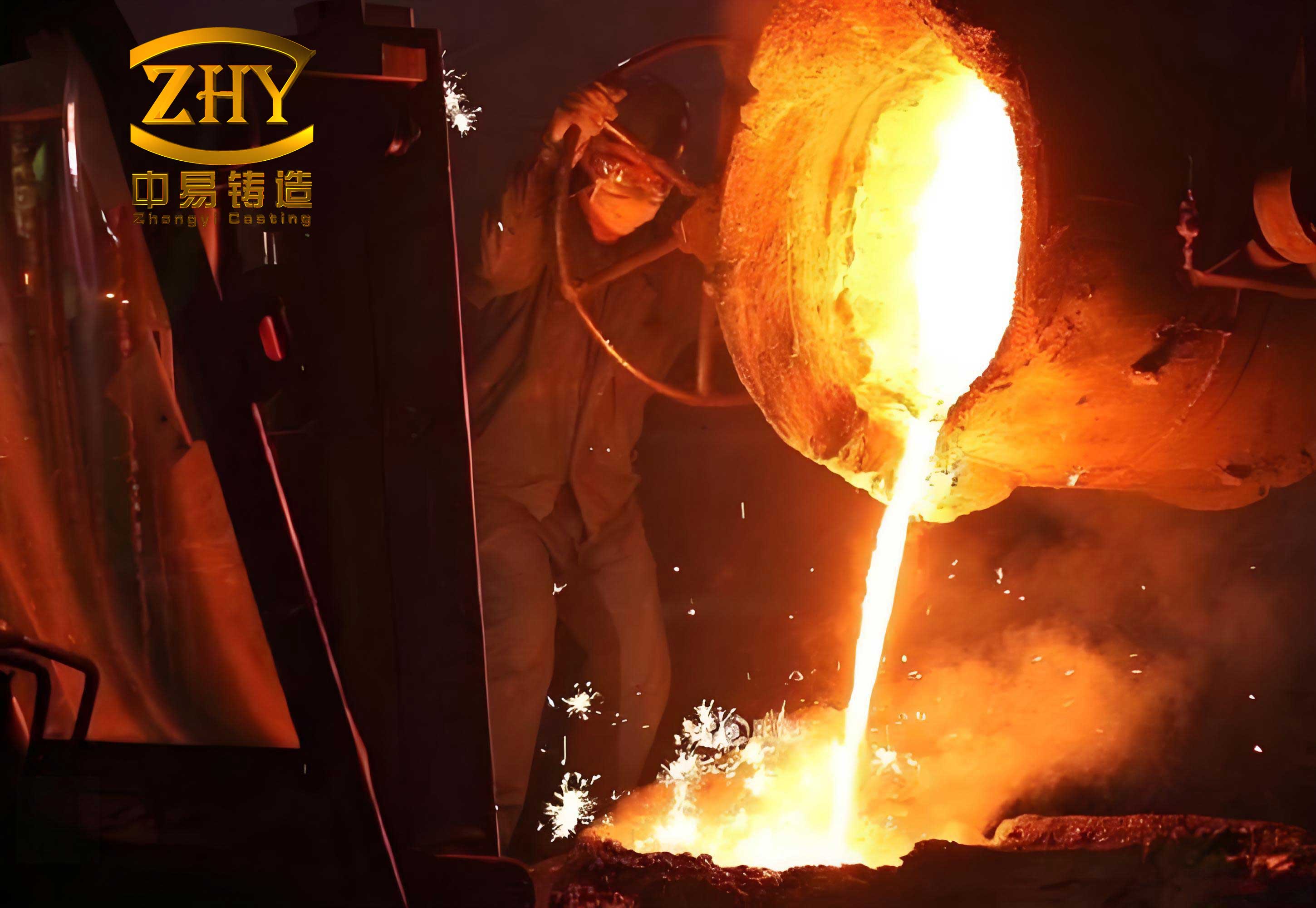
To understand shrinkage formation, we must consider the solidification dynamics. The volume contraction of metals upon cooling is a primary driver, and the feeding ability must compensate for this. In the lost foam casting process, the presence of the foam pattern and the associated gas evolution can alter thermal gradients and feeding paths. The basic shrinkage volume can be approximated by:
$$V_{shrinkage} = \beta \cdot V_{casting}$$
where $V_{shrinkage}$ is the volume of shrinkage porosity, $\beta$ is the volumetric shrinkage coefficient of the metal (typically around 4-6% for cast iron), and $V_{casting}$ is the volume of the casting. However, in practice, the actual shrinkage defect formation depends on localized solidification time differences. The solidification time $t_s$ for a section can be estimated using Chvorinov’s rule:
$$t_s = k \left( \frac{V}{A} \right)^n$$
where $V$ is the volume, $A$ is the surface area, $k$ is a mold constant, and $n$ is an exponent (usually close to 2). In hot spots, the modulus $(V/A)$ is larger, leading to longer solidification times and higher risk of shrinkage if feeding is inadequate.
In the specific case of a clutch housing component produced via the lost foam casting process, the geometry featured a thicker section at the shift fork bore area adjacent to thinner walls. This created a natural hot spot. Initial production data indicated a shrinkage defect rate of approximately 4%, accounting for over half of total rejections. This prompted a thorough investigation to identify and control the contributing factors. The investigation was structured around two main avenues: casting process parameters and raw material quality, both within the context of the lost foam casting process.
First, I analyzed the potential process variables in the lost foam casting process that could influence shrinkage. These included foam pattern aging time, molten metal chemistry, pouring temperature, pouring vacuum pressure, and pressure holding time. A series of controlled experiments were designed to isolate each factor. The experimental matrix and results are summarized in Table 1. Each trial involved a batch of 100 castings, and the number of units exhibiting shrinkage defects was recorded.
| Factor | Experimental Condition | Shrinkage Defects Count | Conclusion |
|---|---|---|---|
| Foam Pattern Aging Time | Increased from 5 days to 10 days | 6 | Not Primary |
| Molten Metal Fluidity (C, Si content) | C: 3.4-3.5%, Si: 2.1-2.2% | 4 | Not Primary |
| Pouring Temperature | Reduced from 1460°C to 1420°C | 5 | Not Primary |
| Pouring Vacuum Pressure | Maintained at -0.03 MPa | 11 | Primary Cause |
| Pressure Holding Time | Extended to 10 minutes | 4 | Not Primary |
The data clearly indicated that low pouring vacuum pressure was the dominant process factor. In the lost foam casting process, vacuum serves multiple critical functions: it removes decomposition gases from the foam, stabilizes the sand mold, and enhances metal feeding by creating a pressure differential. Insufficient vacuum can lead to gas entrapment and reduced metallostatic pressure, impairing the ability to feed shrinkage. The required vacuum pressure $P_v$ can be related to the feeding pressure $P_f$ needed to overcome shrinkage:
$$P_f = \rho g h + P_v – P_{atm} – P_{gas}$$
where $\rho$ is metal density, $g$ is gravity, $h$ is effective feed height, $P_{atm}$ is atmospheric pressure, and $P_{gas}$ is back-pressure from foam decomposition gases. For effective feeding, $P_f$ must be positive and sufficient.
Second, I examined raw material quality, specifically the composition of the pig iron used in the charge. The lost foam casting process for this component utilized a charge consisting of pig iron, internal steel scrap (8620H), and machining returns. Spectroscopic analysis revealed significant variation in titanium (Ti) content between different sources of pig iron, as shown in Table 2.
| Element | Source A | Source B |
|---|---|---|
| C | 4.25 | 4.32 |
| Si | 1.50 | 1.42 |
| Mn | 0.27 | 0.29 |
| P | 0.06 | 0.07 |
| S | 0.03 | 0.03 |
| Ti | 0.06 | 0.16 |
| Others (Cu, Ni, Cr, etc.) | Trace | Trace |
While major elements were within specification, the Ti content from Source B was notably higher. Titanium is a strong carbide former and can influence solidification characteristics. To quantify its effect, I tracked the Ti content in final castings and correlated it with shrinkage occurrence, as presented in Table 3. Samples were taken from fully melted heats, and corresponding batches of 16 castings were inspected.
| Casting Ti Content (wt.%) | Number of Castings Poured | Number with Shrinkage Defects | Defect Rate (%) |
|---|---|---|---|
| 0.049 | 16 | 0 | 0.00 |
| 0.069 | 16 | 0 | 0.00 |
| 0.073 | 16 | 0 | 0.00 |
| 0.081 | 16 | 2 | 12.50 |
| 0.095 | 16 | 5 | 31.25 |
The trend is evident: shrinkage propensity increases markedly as Ti content exceeds approximately 0.07-0.08%. Titanium can form high-melting-point compounds like TiC or Ti(C,N), which may act as nucleation sites but also potentially increase viscosity, reduce fluidity, and alter the solidification sequence. The combined effect within the lost foam casting process is a heightened sensitivity to feeding problems at hot spots. The relationship can be modeled empirically. Let $S$ represent the shrinkage defect probability. A simple logistic model could be:
$$S = \frac{1}{1 + e^{-(a + b \cdot [Ti] + c \cdot \Delta P)}}$$
where $[Ti]$ is the titanium concentration, $\Delta P$ is the deviation from optimal vacuum pressure, and $a, b, c$ are coefficients. The data suggests $b > 0$, indicating increasing risk with higher Ti.
Based on these findings, I implemented targeted control measures focused on the two primary causes: pouring vacuum pressure and pig iron Ti content. For the lost foam casting process, maintaining consistent high vacuum during pouring is critical. The original setup relied on a single vacuum pump. During pouring, the integrity of the sand box seal can be compromised, leading to pressure decay. To address this, I engineered a system upgrade involving the installation of a second vacuum pump. The pumps are now used alternately for consecutive pours, ensuring that each casting box experiences a sustained high vacuum throughout the entire pouring and initial solidification phase. After this modification, the achievable vacuum pressure range stabilized at $-0.04 \text{ MPa}$ to $-0.06 \text{ MPa}$ (i.e., -0.04 to -0.06 MPa below atmospheric). The improvement in pressure consistency can be expressed as a reduction in variance:
$$\sigma_{P_{new}}^2 \ll \sigma_{P_{old}}^2$$
where $\sigma_P^2$ is the variance of the pouring vacuum pressure.
Regarding raw material control, I established a stringent specification for pig iron procurement, limiting the maximum acceptable Ti content to 0.07%. All incoming pig iron batches are subjected to spectroscopic analysis prior to acceptance. Suppliers failing to meet this criterion are disqualified. Furthermore, during production, each heat is monitored via spectral analysis to verify that the final casting chemistry maintains Ti levels below 0.06%. This dual-check system ensures traceability and consistency. The control limit can be defined as:
$$[Ti]_{casting} \leq 0.06\%$$
This proactive sourcing and in-process verification are integral to a robust lost foam casting process.
The efficacy of these interventions was validated through sustained production monitoring. Over a significant period following implementation, the shrinkage defect rate for the clutch housing castings produced via the lost foam casting process dropped dramatically from the original 4% to below 0.8%. This represents a more than 80% reduction in scrap attributed to shrinkage, significantly boosting overall yield and economic efficiency. The results underscore the importance of a holistic approach that combines process engineering and material science within the framework of the lost foam casting process.
To generalize the findings, I propose a comprehensive defect control model for the lost foam casting process. The key parameters can be organized into a response surface. Let the quality function $Q$ (inverse of defect rate) be a function of vacuum pressure $P_v$ and Ti content $[Ti]$:
$$Q(P_v, [Ti]) = \alpha_0 + \alpha_1 P_v + \alpha_2 [Ti] + \alpha_{11} P_v^2 + \alpha_{22} [Ti]^2 + \alpha_{12} P_v [Ti]$$
where coefficients $\alpha$ are determined from experimental data. For high quality (low shrinkage), we require $Q$ to be maximized. The analysis suggests $\alpha_1 > 0$ (higher vacuum improves quality) and $\alpha_2 < 0$ (higher Ti reduces quality). The interaction term $\alpha_{12}$ may also be significant, indicating that the negative effect of high Ti might be exacerbated under low vacuum conditions. This model can guide process windows for other components made via the lost foam casting process.
Beyond the immediate case, these principles have broad applicability in the lost foam casting process. For instance, other thick-section castings or those with complex thermal profiles can benefit from similar scrutiny of vacuum dynamics and trace element control. The lost foam casting process is particularly sensitive to pressure gradients because the foam decomposition creates a transient gas boundary layer. Optimizing vacuum not only aids feeding but also ensures complete pattern elimination and minimizes surface defects. Furthermore, the role of minor elements like Ti, while often overlooked in standard specifications, can be pivotal in high-integrity castings. A systematic material qualification protocol is therefore recommended for any serious practitioner of the lost foam casting process.
In conclusion, through meticulous investigation and controlled experimentation within the lost foam casting process, I have demonstrated that shrinkage defects in components like clutch housings are predominantly governed by two factors: insufficient pouring vacuum pressure and elevated titanium content in the base iron. By implementing technical modifications to ensure a stable high vacuum environment ($-0.04 \text{ to } -0.06 \text{ MPa}$) and enforcing strict limits on raw material Ti content (≤0.06% in casting), a dramatic reduction in shrinkage porosity was achieved. The lost foam casting process, when precisely controlled, can yield high-quality castings with minimal internal defects. This case study highlights the iterative, data-driven approach necessary for continuous improvement in foundry operations, emphasizing that success in the lost foam casting process depends on a deep understanding of both process physics and material interactions. Future work could explore the integration of real-time vacuum monitoring with automated feedback control and further investigate the mechanistic role of titanium and other trace elements on solidification morphology in the lost foam casting process.
The journey of optimizing the lost foam casting process is ongoing. As new materials and pattern technologies emerge, the interaction parameters may shift. However, the foundational principles established here—rigorous parameter validation, root cause analysis, and stringent material control—remain universally valid. I encourage fellow engineers and foundry specialists to adopt a similar systematic framework when tackling defects in the lost foam casting process. By sharing such detailed empirical findings, we collectively advance the reliability and application scope of this versatile casting methodology, ensuring that the lost foam casting process continues to be a competitive manufacturing solution for complex metal components.