
In my experience as a casting engineer, producing high-integrity casting parts for heavy machinery is a complex challenge that demands meticulous attention to detail. The QT400-15 tray, a critical component in coal pulverizing mills used across power, metallurgical, and chemical industries, exemplifies this challenge. These casting parts must endure high torsional, impact, and vibrational loads, necessitating superior strength, toughness, and ductility. The inherent design of these large circular tray casting parts, with their continuous “L”-shaped corners, creates pronounced wall thickness variations and inadequate venting pathways. This often leads to the formation of gas holes and shrinkage porosity, defects that can compromise the entire component and lead to scrappage. This article delves into a comprehensive first-person analysis of these defects, exploring their root causes and detailing the systematic measures implemented to eliminate them, thereby ensuring the reliable production of these essential casting parts.
The tray casting parts discussed here are substantial circular discs. The structural cross-section reveals a significant thermal mass at the “L”-shaped junction where the vertical flange meets the horizontal base. Typical dimensions for these casting parts range from 3,090 mm to 5,000 mm in diameter, with a height of 370 mm. The raw casting weight varies between 5.1 and 9 metric tons, with a minimum wall thickness of 55 mm and peripheral walls reaching 80-100 mm. This geometry inherently creates a isolated thermal node, a prime site for shrinkage defects. The technical specifications are stringent: separately cast test blocks must achieve a tensile strength (Rm) ≥ 400 MPa and an elongation (A) ≥ 15%, while attached test blocks require Rm ≥ 370 MPa and A ≥ 11%.
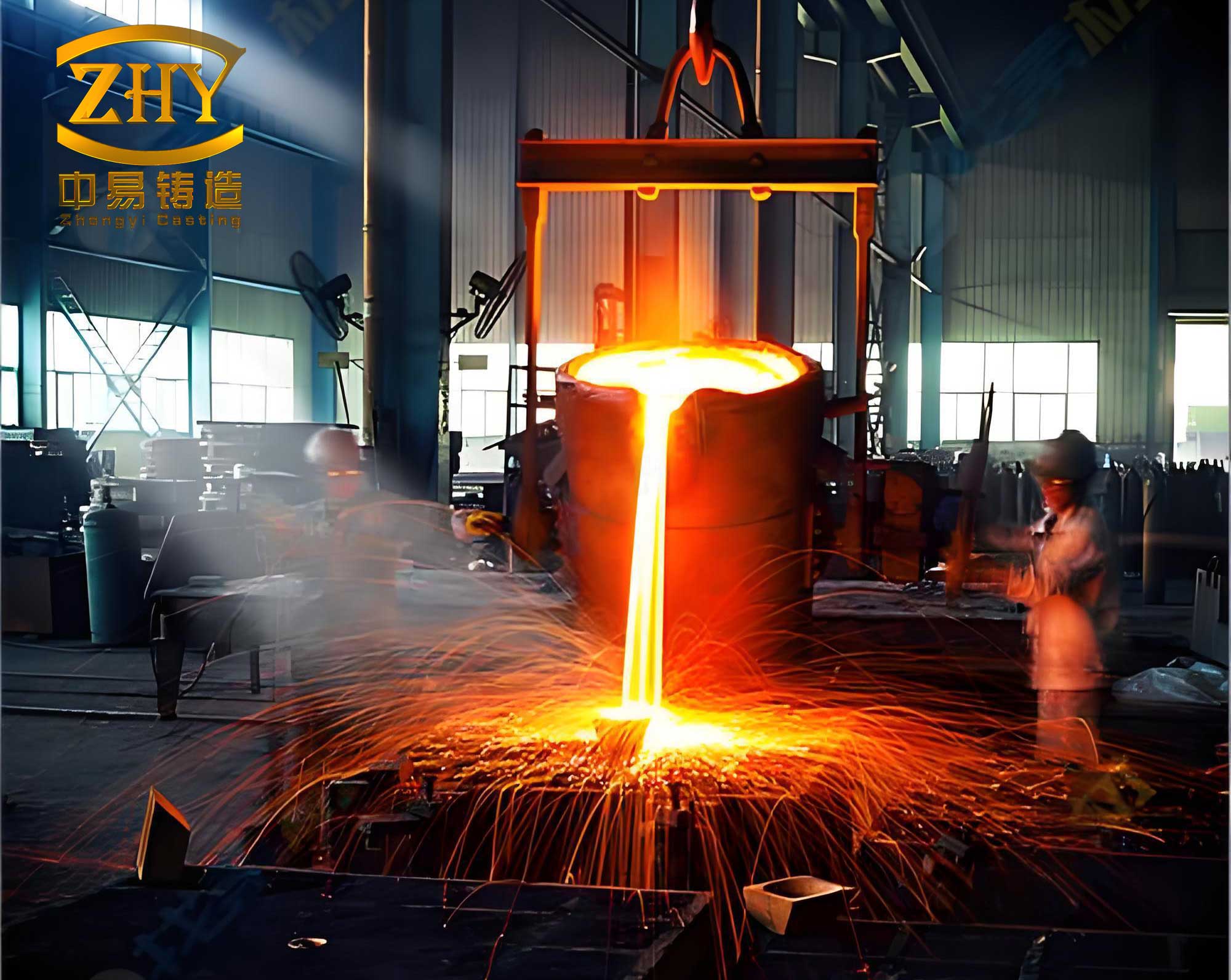
The original manufacturing process for these ductile iron casting parts employed furan resin sand for molding. The parting line was set at the largest diameter plane. The external contour was formed by the mold, while the internal geometry was created using a composite core system consisting of a large annular core and a cylindrical core. A bottom-gating system with a semi-choked design was used to control fill speed and filter slag. The gating ratio was set at ΣSsprue : ΣSrunner : ΣSingate = 1.21 : 1.63 : 1. To harness the graphitization expansion characteristic of ductile iron, open risers with a trapezoidal cross-section (20×50 mm at the bottom, 80×150 mm at the top) were placed on the thicker sections. Additionally, external chill plates were positioned around the annular core to promote directional solidification. The attached test block dimensions were 180 mm x 70 mm x 70 mm.
The melting process utilized a 20-ton medium-frequency induction furnace. Charge materials included steel scrap, Q10 pig iron, 93% carbon raiser, 90% silicon carbide, 75% ferrosilicon, and 65% ferromanganese. The target superheat temperature was 1500–1520°C, with a treatment temperature of 1450–1480°C and a pouring temperature range of 1350–1370°C. Casting parts were cooled in the mold for over 60 hours before shakeout. The typical charge makeup was 60% steel scrap and 40% pig iron. The chemical composition was controlled within the ranges specified in Table 1.
| Element | Carbon (C) | Silicon (Si) | Manganese (Mn) | Phosphorus (P) | Sulfur (S) | Magnesium (Mg) |
|---|---|---|---|---|---|---|
| Content (wt.%) | 3.50–3.80 | 2.2–2.7 | ≤0.40 | ≤0.05 | ≤0.020 | 0.03–0.06 |
Inoculation and nodularization were achieved via the sandwich method in the pouring ladle. The nodulizing agent addition was 1.1–1.3%, and a combined inoculant of barium-bearing and regular ferrosilicon was used, with a total addition of 0.8–1.2%. Despite this controlled process, the initial batches of tray casting parts exhibited severe defects. A band of surface blowholes encircled the outer periphery, and machining of the inner ring revealed subsurface shrinkage porosity clusters precisely at the “L”-shaped corner thermal node.
A fundamental analysis of casting defects is crucial for troubleshooting. Defects in casting parts generally arise from interactions between material properties, process parameters, and design geometry. For these large tray casting parts, the primary issues were identified as invasive gas holes and micro-shrinkage (shrinkage porosity). The formation mechanisms are distinct yet sometimes interrelated.
Gas holes in casting parts are typically classified into three categories: precipitated, reactive, and invasive. The defects observed on the tray’s outer surface featured smooth walls and a sub-surface location, classic hallmarks of invasive gas holes. This occurs when gases generated from the mold or core at the metal-mold interface attain a pressure exceeding the local metallostatic pressure and the strength of the initial metal solidifying skin. The gas then intrudes into the liquid or semi-solid metal, forming bubbles that may become trapped. The governing pressure balance can be expressed by a simplified version of the well-known Bernoulli equation for fluid flow, adapted for gas invasion pressure:
$$ P_{gas} = P_{atm} + \rho_{gas} g h_{core} + \Delta P_{gen} – \frac{\gamma}{r} $$
Where $P_{gas}$ is the gas pressure at the interface, $P_{atm}$ is atmospheric pressure, $\rho_{gas}$ is the gas density, $g$ is gravity, $h_{core}$ is the core height generating head pressure, $\Delta P_{gen}$ is the pressure generated from volatile decomposition (a function of binder type and moisture), $\gamma$ is the surface tension of the liquid metal, and $r$ is the pore radius. Invasion occurs when $P_{gas} > P_{metal} + \sigma_{shell}$, where $P_{metal}$ is the local metallostatic pressure and $\sigma_{shell}$ is the strength of the solidified skin. Investigation revealed that the large annular core could not be placed in the standard mold-drying oven, leading to elevated moisture levels. Measurements showed sand moisture content between 0.5% and 0.6%, significantly above the specified maximum of 0.3% for resin-bonded sands. This excess moisture was the primary source of the voluminous water vapor that led to gas hole formation in these casting parts.
Shrinkage porosity, on the other hand, is a feeding defect intrinsic to the solidification behavior of the alloy. Ductile iron has a wide solidification range due to its graphitic eutectic reaction. While graphite expansion provides substantial “self-feeding,” it is only effective if a rigid mold wall contains the expansion and if the feeding paths remain open until the end of solidification. The defect manifests as dispersed, interconnected small voids, often in isolated thermal centers or hot spots. The basic volumetric condition for shrinkage formation in a casting part is:
$$ \Delta V_{shrinkage} = \epsilon_{liquid} \cdot V_{liquid} + \epsilon_{solidification} \cdot V_{casting} – \epsilon_{graphite} \cdot V_{graphite} $$
Where $\Delta V_{shrinkage}$ is the net volume deficit requiring feeding, $\epsilon_{liquid}$ is the coefficient of liquid thermal contraction, $V_{liquid}$ is the volume of liquid metal, $\epsilon_{solidification}$ is the volumetric contraction upon phase change (liquid to austenite), $V_{casting}$ is the casting volume, and $\epsilon_{graphite}$ is the expansion coefficient due to graphite precipitation (with $V_{graphite}$ being the volume of graphite formed). For ductile iron, $\epsilon_{graphite}$ is significant (~4.2% volume expansion per 1% graphite formed). However, if the thermal gradient is insufficient, the mushy zone at the thermal node can isolate liquid pools, preventing the effective transfer of this expansion pressure for feeding, leading to microporosity. In the tray casting parts, the “L”-shaped corner acted as a severe hot spot. Although external chills were used, their placement and type (originally blind chills) proved inadequate to sufficiently undercool this region and establish a strong directional solidification front toward the riser. Furthermore, the original riser’s size and neck design were likely insufficient to provide adequate liquid feed metal during the critical early stages of solidification before the graphite expansion phase began.
| Defect Type | Observed Location & Morphology | Primary Root Cause | Governing Physical Principle |
|---|---|---|---|
| Invasive Gas Holes | Outer periphery, subsurface, smooth walls | Excessive mold/core moisture (>0.3%) leading to high gas generation | $P_{gas(gen)} > P_{metal} + \sigma_{shell}$ at interface |
| Shrinkage Porosity | “L”-shaped corner hot spot, interdendritic | Inadequate thermal control & feeding; insufficient use of graphite expansion | $\Delta V_{shrinkage} > V_{feed(available)}$ at thermal center |
Addressing these issues in such massive casting parts required a multi-pronged approach targeting both mold environment and solidification control. The corrective actions were developed and implemented sequentially.
Measures to Eliminate Gas Holes: The strategy focused on reducing gas generation and enhancing venting. First, a mandatory drying protocol was established for all large cores and mold sections. Since the massive annular core could not fit into conventional ovens, an in-situ drying method using gas burners was deployed inside the assembled mold cavity to systematically reduce moisture content to below 0.3%. Second, to improve permeability and provide dedicated escape paths for any residual gases, venting was drastically enhanced. Multiple ceramic vent rods and exothermic vent sleeves were strategically inserted into the core and mold at the highest points and near the problematic “L”-shaped geometry. The permeability of the sand mixture was also verified using the standard test, ensuring it met a minimum threshold. The venting requirement can be conceptually framed by Darcy’s law for gas flow through a porous medium:
$$ Q = -\frac{k A}{\mu} \frac{dP}{dx} $$
Where $Q$ is the volumetric gas flow rate, $k$ is the permeability of the sand, $A$ is the cross-sectional area for flow, $\mu$ is the gas viscosity, and $dP/dx$ is the pressure gradient. By increasing the effective vent area $A$ and ensuring high permeability $k$, the pressure gradient driving gas into the casting parts was minimized.
Measures to Eliminate Shrinkage Porosity: The goal was to transform dispersed shrinkage into a manageable, centralized shrinkage pipe within the riser by controlling thermal gradients and optimizing feeding. Three key changes were made. First, the chilling strategy was completely revised. The original blind chills were replaced with pronounced, top-facing open chills placed directly against the “L”-shaped corner in the mold. This maximized heat extraction right at the hot spot, promoting a faster solidification front initiation. The effectiveness of a chill can be estimated by its ability to absorb heat, related to its modulus:
$$ M_{chill} \approx \frac{V_{chill}}{A_{chill-contact}} $$
A lower modulus indicates faster heat absorption. The open chills had a much larger contact area ($A_{chill-contact}$) relative to their volume compared to blind chills, making them more efficient for these casting parts.
Second, the risering system was redesigned. The original open riser (20×50/80×150) was replaced with a much larger one (20×100/170×195). The increased volume ($V_{riser}$) provided a greater reservoir of liquid metal for feeding during the liquid contraction and initial solidification phases. More critically, the riser neck geometry was designed to solidify after the casting hot spot but before the riser body, creating a “feeding gate” that isolates the casting part during the graphite expansion phase, thereby maximizing the use of internal expansion for densification. The necessary riser dimension can be approximated using the modulus method, where the riser modulus $M_R$ should be greater than the casting modulus $M_C$ at the feeding point:
$$ M_R = \frac{V_R}{A_R} > 1.2 \times M_C $$
$$ M_C (at \, hot \, spot) = \frac{V_{hotspot}}{A_{cooling}} $$
The redesign ensured this criterion was met for the tray’s thermal node.
Third, the metallurgical composition was fine-tuned. To enhance the graphitic expansion (“self-feeding”) capacity, the target carbon content was shifted towards the upper end of the specification, aiming for approximately 3.75%. This, combined with a carefully balanced silicon content, resulted in a carbon equivalent (CE) value close to the eutectic point. Carbon equivalent is calculated as:
$$ CE = \%C + \frac{1}{3}(\%Si + \%P) $$
A CE near 4.3–4.5% promotes a higher graphitic eutectic fraction, maximizing the beneficial expansion that compensates for shrinkage in the final stages of solidification for these ductile iron casting parts. Table 3 summarizes the key process changes.
| Process Aspect | Original Practice | Optimized Practice | Intended Effect |
|---|---|---|---|
| Mold/Core Drying | Partial drying; moisture 0.5-0.6% | In-situ forced drying; moisture <0.3% | Minimize gas generation ($\Delta P_{gen}$) |
| Venting | Basic natural venting | Proactive venting with rods/sleeves | Maximize gas escape ($Q$), reduce $P_{gas}$ |
| Chill Design & Placement | Blind chills around core periphery | Open chills directly on “L”-corner hot spot | Increase cooling rate, reduce $M_C$, eliminate thermal node |
| Riser Design | Moderate size open riser | Larger open riser with controlled neck | Increase $V_{feed}$, ensure $M_R > 1.2 M_C$ |
| Chemical Composition | C: 3.5-3.8%, Target CE ~4.3 | C: ~3.75%, Target CE ~4.4-4.5 | Maximize graphitic expansion ($\epsilon_{graphite} V_{graphite}$) |
The implementation of these combined measures yielded transformative results. Subsequent production runs of the identical tray casting parts were completely free from both the peripheral gas holes and the internal shrinkage porosity at the “L”-shaped corner. Non-destructive testing (magnetic particle and ultrasonic) confirmed the integrity of the casting parts. The attached test blocks (70 mm section) from these optimized casting parts consistently demonstrated mechanical properties exceeding specifications: tensile strengths ranged from 409 to 464 MPa, and elongation values were between 13% and 17%. Metallographic analysis confirmed a nodularity grade of 2 (excellent) and a graphite size of 7 (fine), affirming the high quality of the ductile iron matrix achieved in these critical casting parts.
In conclusion, the successful resolution of defects in these large QT400-15 tray casting parts underscores a fundamental principle in foundry engineering: robust casting parts are produced by controlling both the external environment (mold gases) and the internal physics (solidification and feeding). The systematic approach involved diagnosing the specific type of gas hole and shrinkage, understanding their governing physical and metallurgical principles, and implementing targeted, synergistic corrections. Reducing mold moisture and enhancing venting addressed the exogenous gas issue. Redesigning the thermal management system through optimized chills and risers, coupled with a slight compositional shift to leverage the innate properties of ductile iron, successfully eliminated the shrinkage defect. This case study provides a validated framework for producing other large, complex-sectioned ductile iron casting parts that are prone to similar defect formations. The continuous improvement cycle, grounded in scientific analysis, remains essential for advancing the reliability and performance of industrial casting parts across all sectors.
The production of high-quality casting parts, especially large ones like these trays, is a balance of art and science. Every variable, from the sand moisture to the final carbon equivalent, plays a interconnected role. For instance, the effectiveness of graphite expansion in compensating for shrinkage is highly dependent on mold rigidity. A sand mold with adequate strength is crucial to contain this expansion pressure, which can be conceptually modeled as an internal pressure $P_{exp}$ acting on the mold wall. If the mold wall yields, the expansion is wasted, and shrinkage defects can reappear even in well-designed casting parts. The required mold strength $\sigma_{mold}$ must satisfy:
$$ \sigma_{mold} > P_{exp} \approx \frac{E_{iron} \cdot \epsilon_{graphite}}{(1 – 2\nu)} $$
where $E_{iron}$ is Young’s modulus for iron and $\nu$ is Poisson’s ratio. This highlights why a strong resin sand system is chosen for such demanding casting parts.
Furthermore, the pouring temperature plays a critical role in the fluidity and feeding capability of the metal for intricate casting parts. Too low a temperature can lead to mistuns in thin sections, while too high a temperature can exacerbate gas solubility and mold metal reaction. The empirical relationship for fluidity length $L_f$ often follows:
$$ L_f \propto \frac{\Delta H_f}{\eta (T_{pour} – T_{liquidus})} $$
where $\Delta H_f$ is the heat of fusion, $\eta$ is the dynamic viscosity, and $(T_{pour} – T_{liquidus})$ is the superheat. For these tray casting parts, maintaining the 1350–1370°C range provided optimal fill without excessive thermal load on the mold.
In summary, the journey from defective to sound casting parts for the QT400-15 tray involved a deep dive into the causative factors, both chemical and physical. It reinforced that successful manufacturing of heavy-duty ductile iron casting parts is not merely about following a recipe but about actively managing the dynamic processes of gas evolution, heat transfer, and solidification shrinkage. The measures documented here—rigorous drying, enhanced venting, strategic chilling, optimized feeding, and compositional control—form a comprehensive playbook that can be adapted to improve the quality and yield of a wide variety of complex casting parts in the foundry industry.