
In my career as a foundry engineer specializing in sand casting services, I have been involved in numerous projects that require precise metal mold design for producing high-quality cast components. Sand casting services have evolved significantly, transitioning from manual methods to automated high-pressure molding lines, which enhance productivity and consistency. This process remains dominant in industries such as automotive, marine, and power generation due to its flexibility, low cost, and suitability for various alloys. Here, I will share my firsthand experience in designing and manufacturing metal molds for sand casting services, focusing on a timing gear housing for a diesel engine as a practical example. This comprehensive guide will delve into technical details, using tables and formulas to summarize key aspects, and emphasize the critical role of sand casting services in modern manufacturing.
The timing gear housing is a critical component in diesel engines, used widely in generators, vehicles, and machinery. Its production via sand casting services demands meticulous mold design to ensure dimensional accuracy and surface integrity. The casting material is HT200 gray iron, with specifications requiring uniform wall thickness, smooth transitions, and freedom from defects like porosity or inclusions. Hardness must range between 170 to 241 HB, and the part undergoes aging treatment. To achieve this, the mold design must account for factors such as shrinkage, machining allowances, and draft angles—all essential for efficient sand casting services. Below, I outline the entire process from part analysis to mold fabrication, highlighting how advanced CAD tools and manufacturing techniques optimize sand casting services for bulk production.
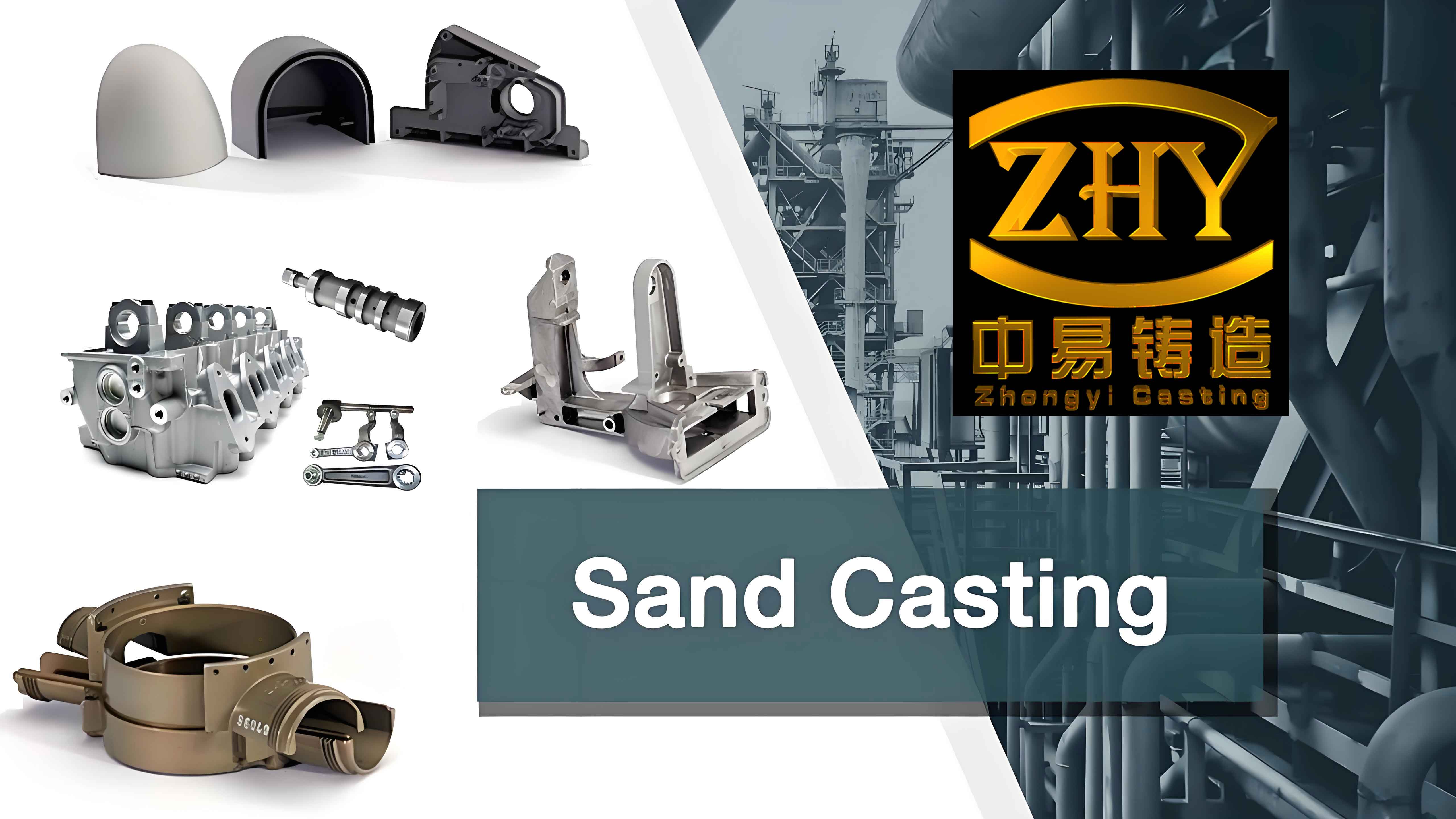
My design journey begins with a thorough analysis of the timing gear housing. This thin-walled casting has complex features, including mounting brackets and threaded holes, which necessitate careful planning for sand casting services. Using CAD software, I created a 3D model of the raw part, incorporating allowances for subsequent machining. The key parameters for this model are summarized in Table 1, which guides the initial design phase for sand casting services. These parameters ensure that the final casting meets technical requirements after processing.
| Parameter | Value | Description |
|---|---|---|
| Material | HT200 | Gray iron casting alloy |
| Shrinkage Rate | 1% | Compensation for solidification contraction |
| Machining Allowance (General) | 3 mm | For holes over φ10 mm and small faces |
| Machining Allowance (Large Face) | 5 mm | For the mating surface to prevent warping |
| Unspecified Draft Angle | 1° to 3° | Facilitates pattern removal in sand casting services |
| Unspecified Fillet Radius | 2-5 mm | Reduces stress concentrations |
| Part Weight | Approx. 25 kg | Influences runner and gating design |
| Wall Thickness | 8 mm (typical) | Ensures uniform cooling |
From this model, I derived the casting dimensions by applying the shrinkage allowance. The relationship between the pattern dimension and final casting dimension is expressed as: $$ D_{\text{mold}} = D_{\text{casting}} \times (1 + S) $$ where \( D_{\text{mold}} \) is the mold dimension, \( D_{\text{casting}} \) is the desired casting dimension, and \( S \) is the shrinkage rate (0.01 for HT200). This formula is fundamental in sand casting services to achieve accurate part sizes. For instance, if a casting length is 500 mm, the mold must be designed at 505 mm to accommodate shrinkage. Additionally, I added machining allowances to critical surfaces, calculated as: $$ A_{\text{mold}} = A_{\text{casting}} + M $$ where \( A_{\text{mold}} \) is the mold area dimension, \( A_{\text{casting}} \) is the final part dimension after machining, and \( M \) is the machining allowance (e.g., 3 mm or 5 mm). These adjustments are vital for sand casting services to produce castings that require secondary operations.
Next, I proceeded to design the sand molds themselves. In sand casting services, the mold consists of two halves—cope and drag—created using metal patterns. For the timing gear housing, the presence of bracket mounts necessitated a stepped parting line to enable proper mold opening. Using CAD’s mold cavity module, I imported the 3D model and created a workpiece representing the sand mold blank. The parting surface was defined based on geometric features, and the workpiece was split into upper and lower sand molds. This step is crucial in sand casting services to ensure defect-free castings with minimal flash. The sand mold dimensions were aligned with standard flask sizes, such as a 800 mm × 600 mm mold plate, to fit automated production lines commonly used in sand casting services.
The gating system design is a core aspect of sand casting services, as it controls metal flow and feeding. For this casting, I designed a runner and ingates based on empirical formulas. The runner cross-sectional area \( A_g \) is determined by the casting weight \( W \) and wall thickness \( t \). An approximate formula used in sand casting services is: $$ A_g = k \cdot W^{2/3} $$ where \( k \) is a coefficient ranging from 0.4 to 0.6 for gray iron. Given \( W = 25 \, \text{kg} \), I calculated \( A_g \approx 875 \, \text{mm}^2 \). The runner was designed as an isosceles trapezoid with dimensions provided in Table 2. This ensures adequate metal delivery during pouring, a key factor for reliable sand casting services.
| Component | Dimensions | Cross-Sectional Area | Function |
|---|---|---|---|
| Runner | Top: 40 mm, Bottom: 30 mm, Height: 25 mm | 875 mm² | Channels metal from sprue to ingates |
| Ingates (2 nos.) | Length: 50 mm, Height: 15 mm | 750 mm² total | Controls flow into mold cavity |
| Pouring Temperature | 1350–1400°C | – | Optimized for HT200 in sand casting services |
With the sand molds designed, I transitioned to creating the metal molds (patterns) used to produce these sand molds in high-volume sand casting services. In CAD, I assembled the lower sand mold and a workpiece, then performed a Boolean subtraction to generate the negative impression for the metal mold. This mold was then supplemented with features like runner cavities, locating pin holes, and a compression seal (flash ridge) to prevent mold mismatch—a common issue in sand casting services. The compression seal, with a width of 3–5 mm and height of 2 mm, ensures tight closure during molding. Similarly, the upper metal mold was designed with identical considerations. The complete mold designs are summarized in Table 3, highlighting critical dimensions for sand casting services.
| Mold Half | Thickness | Key Features | Material |
|---|---|---|---|
| Lower Mold | 60 mm | Includes ingates, locating pins (φ20 mm), and stepped parting surface | Cr-Mo alloy steel |
| Upper Mold | 50 mm | Integrates runner, compression seal, and venting channels | Cr-Mo alloy steel |
The manufacturing phase involves converting these designs into physical molds. I selected Cr-Mo alloy steel for its wear resistance and durability, essential for prolonged use in sand casting services. First, wooden patterns were fabricated with a shrinkage allowance of 1% to cast rough mold blanks via sand casting services—an iterative process that underscores the versatility of sand casting services. These blanks were then machined on a CNC machining center. The CNC programming involved toolpath generation based on the CAD models, with parameters listed in Table 4. This precision machining ensures that the metal molds produce consistent sand molds, thereby enhancing the quality of sand casting services.
| Process | Tool Type | Cutting Speed (m/min) | Feed Rate (mm/rev) | Depth of Cut (mm) |
|---|---|---|---|---|
| Roughing | Flat end mill (φ20 mm) | 120 | 0.15 | 2.5 |
| Finishing | Ball nose mill (φ10 mm) | 180 | 0.08 | 0.5 |
| Drilling | Twist drill (φ20 mm) | 60 | 0.1 | – |
During machining, I applied formulas to optimize parameters. For example, the material removal rate \( \text{MRR} \) is calculated as: $$ \text{MRR} = v \cdot f \cdot d $$ where \( v \) is cutting speed, \( f \) is feed rate, and \( d \) is depth of cut. For roughing, with \( v = 120 \, \text{m/min} \), \( f = 0.15 \, \text{mm/rev} \), and \( d = 2.5 \, \text{mm} \), \( \text{MRR} \approx 45 \, \text{cm}^3/\text{min} \), ensuring efficient production for sand casting services. After machining, the molds were heat-treated to a hardness of 45-50 HRC for enhanced lifespan. This entire process, from design to finished mold, typically takes 2-3 weeks, enabling rapid deployment in sand casting services for batch production.
Quality control is integral to sand casting services. I implemented checks using simulation software to predict solidification and shrinkage defects. The feeding efficiency of the gating system was verified by calculating the modulus \( M \) of critical sections: $$ M = \frac{V}{A} $$ where \( V \) is volume and \( A \) is cooling surface area. For the timing gear housing, the modulus ranged from 0.5 to 1.2 cm, guiding the placement of risers if needed. In this case, the runner system sufficed, but for heavier castings in sand casting services, additional risers might be required. The molds were tested on an automated molding line, producing sand molds that were then poured with molten HT200. The resulting castings met all specifications, demonstrating the effectiveness of the design for sand casting services.
In reflection, the design and manufacturing of metal molds for sand casting services involve a synergy of empirical knowledge and modern technology. My experience shows that attention to detail—such as proper draft angles, accurate shrinkage compensation, and optimized gating—can significantly improve the efficiency of sand casting services. As industries demand higher precision and faster turnaround, sand casting services must evolve with advanced CAD/CAM integration and simulation tools. This case study of the timing gear housing illustrates how tailored mold design can yield high-quality castings, reinforcing the value of sand casting services in mass production. Future trends may include additive manufacturing for mold prototypes, further accelerating development cycles for sand casting services.
To conclude, sand casting services remain a cornerstone of manufacturing, and metal mold design is pivotal to their success. Through this detailed account, I hope to provide insights that help engineers and designers enhance their sand casting services. By leveraging formulas, tables, and systematic approaches, we can overcome challenges and deliver robust solutions. As sand casting services continue to advance, the collaboration between design and manufacturing will drive innovation, ensuring that this ancient technique thrives in the modern industrial landscape.