
In the production of complex aluminum alloy frameworks, sand casting remains a pivotal method, especially for single-piece or small-batch manufacturing. This article delves into the intricate process design and simulation for a U-shaped outer-ring framework, a component characterized by thin walls, intricate internal cavities, and a slender, curved structure. Such sand casting parts pose significant challenges, including susceptibility to defects like cold shuts, shrinkage porosity, oxidation, and slag inclusion due to turbulent flow. My objective is to outline a comprehensive sand casting strategy that ensures high-quality sand casting parts through meticulous design and computational validation. The focus is on optimizing gating systems, core placement, and riser design to achieve sound castings with minimal defects.
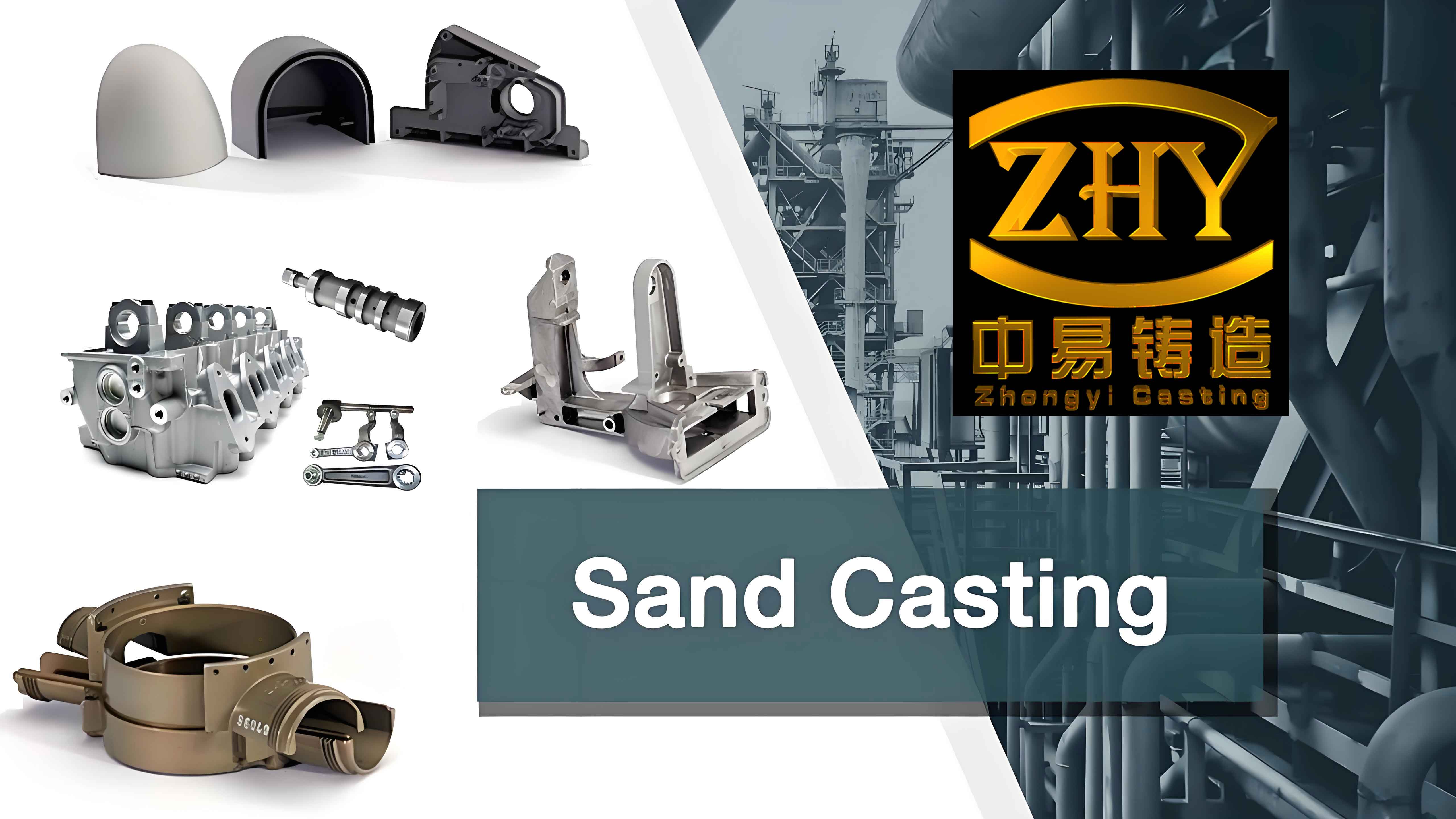
The framework in question is fabricated from ZL114A aluminum alloy, with overall dimensions of 2300 mm in length, 570 mm in width, and 520 mm in height. It serves as a structural support in marine applications, requiring high specific strength, stability, and dimensional accuracy per CT10 tolerance standards. Critical surfaces necessitate machining post-casting, and the entire component undergoes artificial aging to relieve stresses and enhance mechanical properties. The geometry features a central circular section flanked by two elongated arms, forming a U-shape with internal ribs and flat cavities. Producing such sand casting parts demands careful attention to fluid flow and solidification dynamics to avoid common pitfalls in aluminum casting.
To address these challenges, I adopted a two-part molding approach with the parting plane positioned horizontally along the framework’s height centerline. This configuration reduces molding height, simplifies pattern making, and facilitates core assembly—key advantages for crafting complex sand casting parts. The pouring orientation places the longitudinal axis horizontally, ensuring stable mold filling and easier placement of gating elements. Below, a table summarizes the core design strategy, which is central to forming the internal cavities of these sand casting parts.
| Core Designation | Function | Key Features |
|---|---|---|
| X1 | Forms central circular cavity and peripheral holes | Ensures cylindrical accuracy; reduces machining |
| X2 and X3 | Create left and right internal cavities with ribs | Unified cores for alignment; supported by pre-made rods |
| X4 | Forms flake-shaped sprue channels | Simplifies sprue molding; connects to pouring cup |
A novel aspect of this process involves using pre-fabricated aluminum rods of the same alloy, cast integrally into the framework. These rods serve dual purposes: they eliminate thermal hotspots by acting as chills and provide mechanical support for the X2 and X3 cores, preventing displacement during pouring. This innovation is particularly beneficial for slender sand casting parts where core stability is paramount. The rods are roughened to enhance bonding with the sand cores, and their ends form part of the final casting, as illustrated in the design schematics.
The gating system is engineered to ensure smooth, non-turbulent filling—a critical factor for aluminum alloys prone to oxide formation. I implemented a center-poured, open-type system with multiple ingates to distribute metal evenly. The sprue consists of eight flake-shaped channels, each with a cross-sectional area of 2 cm², promoting laminar flow and reducing velocity. The runner and ingate dimensions are calculated based on flow requirements, with area ratios set to minimize turbulence. The total cross-sectional areas are derived as follows:
$$ \sum F_{\text{sprue}} = 8 \times 2 \, \text{cm}^2 = 16 \, \text{cm}^2 $$
$$ \sum F_{\text{runner}} = 4 \times \sum F_{\text{sprue}} = 64 \, \text{cm}^2 $$
$$ \sum F_{\text{ingate}} = 4 \times \sum F_{\text{runner}} = 256 \, \text{cm}^2 $$
These calculations ensure adequate flow rates while maintaining quiescent conditions. To further mitigate slag inclusion, a filter mesh with 0.8 mm thickness and 2 mm diameter holes is installed in the runner. The layout features symmetrical runners branching from the central sprue, each supplying four ingates along the framework’s length. This design prevents localized overheating and promotes thermal balance, essential for consistent quality in sand casting parts.
Riser and chill placement are optimized to induce directional solidification, addressing shrinkage in thicker sections. The modulus method guides riser sizing, with calculations for critical regions:
$$ M_c = \frac{V}{A} $$
where \( M_c \) is the modulus, \( V \) the volume, and \( A \) the cooling surface area. For the side blocks, \( M_{c1} = 1.48 \, \text{cm} \), and for the central circular section, \( M_{c2} = 1.87 \, \text{cm} \). Riser dimensions are proportioned accordingly, supplemented by chills to extend feeding distances. The table below details the riser and chill configuration.
| Location | Riser Type | Dimensions (mm) | Chill Specifications |
|---|---|---|---|
| Side Blocks | Insulated Blind Riser | Custom-shaped, volume-adjusted | 3 chills, 162×52×30 mm each |
| Central Section | Open Riser | Cylindrical, side-attached | 4 conformal chills of varying sizes |
Simulation of filling and solidification processes validates the design efficacy. Using advanced casting software, I analyzed temperature distributions and flow patterns to predict defect formation. The filling sequence shows progressive advancement from the sprue outward, with minimal turbulence. Temperature contours indicate a gradient from lower to upper regions, supporting sequential solidification. Initial pouring temperature is set at 740°C, and the lowest temperature at the end of filling is approximately 610°C, within an acceptable range for aluminum sand casting parts. The filling time is optimized to balance heat loss and flow stability.
Solidification simulations reveal that thin sections cool rapidly, while thicker areas remain liquid longer, aided by risers. The temperature field evolves predictably, with no isolated hotspots that could lead to shrinkage porosity. The complete solidification time is longer than filling but remains within limits for sound sand casting parts. Key parameters from the simulation are summarized below:
| Process Phase | Temperature Range (°C) | Observed Behavior |
|---|---|---|
| Initial Filling | 740–610 | Steady flow, minimal oxide formation |
| Mid Filling | 670–630 | Uniform distribution, no cold shuts |
| Final Solidification | 600–555 | Directional cooling, risers active |
The results confirm that the gating system achieves laminar flow, crucial for defect-free sand casting parts. The flake-shaped sprues reduce velocity peaks, while dispersed ingates prevent excessive heating in any single zone. The core support system via pre-made rods proves effective in maintaining alignment, and the combined riser-chill arrangement ensures adequate feeding. These factors collectively enhance the integrity of aluminum sand casting parts, particularly for frameworks with complex geometries.
Further analysis involves quantifying thermal gradients to optimize chill placement. The temperature difference \( \Delta T \) between adjacent zones drives solidification fronts, computed as:
$$ \Delta T = T_{\text{hot}} – T_{\text{cold}} $$
where \( T_{\text{hot}} \) is the temperature in riser-adjacent areas and \( T_{\text{cold}} \) is in chilled regions. Simulations show \( \Delta T \) values of 50–70°C, sufficient for directional solidification without causing thermal stresses. This balance is vital for producing dimensionally stable sand casting parts that meet machining tolerances.
In practice, the mold assembly proceeds with core placement supported by the rods, followed by gating system installation. The use of sand cores allows for intricate internal features, a hallmark of versatile sand casting parts. After pouring and cooling, the castings are inspected for defects, with the simulation predicting negligible porosity or shrinkage. The process underscores the importance of integrated design and simulation in modern foundries, especially for high-value sand casting parts like aluminum frameworks.
To generalize, the principles applied here—such as flake-shaped sprues, pre-fabricated supports, and simulation-led optimization—can be adapted to other complex sand casting parts. The key lies in tailoring gating and feeding to the alloy’s behavior, as aluminum requires gentle handling to avoid inclusions. Future work could explore alternative riser designs or advanced filter materials to further enhance yield and quality in sand casting parts production.
In conclusion, this study presents a robust sand casting methodology for an aluminum alloy U-shaped framework, demonstrating how thoughtful design and computational validation yield superior sand casting parts. The process mitigates common defects through controlled fluid dynamics and thermal management, ensuring components meet stringent marine specifications. By leveraging simulation tools, foundries can reduce trial-and-error, lower costs, and improve consistency in manufacturing sand casting parts. This approach reaffirms sand casting’s relevance for producing intricate, high-performance components in small batches.