
I have been deeply involved in the research and application of lost foam castings (EPC) for automotive components, particularly for diesel engine cylinder heads. This green casting technology offers significant advantages in mass production, cost reduction, and environmental protection. In this article, I present a systematic design methodology for the lost foam castings pattern of a small single-cylinder diesel engine cylinder head, covering everything from solid modeling to foam pattern segmentation and tooling design. Throughout the process, I emphasize the critical role of lost foam castings in achieving near-net-shape, high-quality castings with minimal post-processing.
1. Fundamentals of Lost Foam Castings for Cylinder Heads
Lost foam castings is a process where a foam pattern, identical in shape to the final casting, is coated with refractory paint, dried, and then embedded in unbonded sand. Under vacuum, molten metal is poured, vaporizing the foam and taking its place. The metal solidifies to form the casting. For complex components like cylinder heads, which feature intricate water jackets, intake and exhaust ports, and bolt holes, lost foam castings provides exceptional design freedom and dimensional accuracy. The key parameters for my cylinder head lost foam castings are summarized in Table 1.
| Parameter | Value | Remarks |
|---|---|---|
| Product dimensions (mm) | 125 × 120 × 60 | Nominal casting size after machining |
| Modeling accuracy (mm) | 0.03 | Tolerance for pattern assembly |
| Draft angle | 1° | To facilitate foam pattern ejection from die |
| Shrinkage allowance (linear) | 1.01 (1%) | Expansion factor to compensate for metal shrinkage |
| Machining allowance (mm) | 1.5 | Added to all machined surfaces |
| Pattern material | Expandable polystyrene (EPS) | Pre-expanded beads with density ~20 g/L |
| Coating type | Water-based zirconia refractory | Permeability 0.8–1.2 ×10⁻⁷ m²/Pa·s |
The primary challenge in lost foam castings for cylinder heads is the complex internal cavity structure. To ensure complete foam gasification and prevent defects like carbon inclusions or gas porosity, I carefully control the pattern density, coating thickness, and pouring parameters. The shrinkage allowance of 1.01 (i.e., 1%) is applied to the CAD model before creating the foam pattern, as expressed by the simple formula:
$$ L_{pattern} = L_{casting} \times (1 + S) $$
where \(L_{pattern}\) is the pattern dimension, \(L_{casting}\) is the final casting dimension, and \(S\) is the shrinkage rate (0.01 in this case). The machining allowance of 1.5 mm is then added on top of the scaled model.
2. Solid Modeling of the Cylinder Head for Lost Foam Castings
I started by constructing a precise 3D CAD model of the cylinder head using parametric software. The model includes all internal passages: intake and exhaust ports, cooling water jacket, injector hole, oil return channel, and bolt holes. For lost foam castings, the pattern must be an exact replica of the casting, but with allowances for shrinkage and machining. I scaled the original model by a factor of 1.013 (101.3%) to account for the linear shrinkage of cast iron (approximately 1%). Then, on the scaled model, I added machining allowance of 1.5 mm to all surfaces that require subsequent machining, such as the deck face, valve seat areas, and bolt bosses. Finally, I incorporated casting fillets and radii to improve metal flow and reduce stress concentration. The final 3D foam pattern model is a solid representation of the expandable polystyrene (EPS) shape ready for die design.
2.1 Mathematical Representation of Scale and Allowances
Let \(M\) be the base CAD model of the finished cylinder head. The pattern model \(P\) is obtained as:
$$ P = (M \times (1+S)) + A $$
where \(S = 0.01\) (shrinkage) and \(A\) is the machining allowance volume. The allowance is typically 1.5 mm normal to the surface. The total volume of the pattern is thus larger than the casting volume by:
$$ V_{pattern} = V_{casting} \times (1+S)^3 + V_{allowance} $$
For a casting with dimensions 125×120×60 mm, the scaled dimensions become approximately 126.625×121.56×60.78 mm before adding machining allowance. After adding 1.5 mm on critical faces, the pattern may reach 129.625×124.56×63.78 mm in certain areas, depending on which faces are machined.
3. Segmentation of the Foam Pattern for Lost Foam Castings
Due to the intricate geometry of the cylinder head, it is impossible to mold the entire foam pattern as a single piece using conventional steam chest molding. The pattern must be divided into segments that can be separately molded and then glued together. I analyzed the cylinder head structure and determined that four separate foam pieces are optimal for this lost foam castings application. The segmentation is based on the following principles:
- Each segment must have a simple parting line to allow easy ejection from the mold.
- The glue joints should be located on flat or gently curved surfaces to minimize mismatch.
- No segment should have undercuts that prevent demolding.
The four segments are labeled A, B, C, and D in the design. Segment A includes the top deck and part of the water jacket; segment B includes the side walls with intake and exhaust ports; segment C covers the bottom face and oil gallery; segment D is the central core piece for the injector boss. After segmentation, each piece is assigned to either the upper or lower die cavity in the foam molding machine.
| Segment ID | Description | Mold half | Glue joint width (mm) |
|---|---|---|---|
| A | Top deck + upper water jacket | Upper die | 2.5 |
| B | Side walls with ports | Lower die | 2.5 |
| C | Bottom face + oil return | Lower die (core) | 2.5 |
| D | Injector boss central | Upper die (insert) | 2.5 |
The glue joint width is critical in lost foam castings: if too narrow, the joint may not hold during handling; if too wide, excess glue can cause a fin on the casting surface. I set the width to 2.5 mm, which is standard for EPS patterns. The glue used is a water-based polyvinyl acetate (PVA) adhesive that vaporizes cleanly during pouring without leaving carbon residue.
4. Die and Tooling Design for Foam Pattern Molding
After cutting the foam pattern into segments, I design the metal dies for each segment. The dies are mounted on steam chests in the foam molding machine. The upper and lower die plates must accommodate the pattern cavities, gas vents, and ejection pins. I follow a systematic procedure:
- Extract the surface geometry from the segment model at the glue joint plane.
- Trim the surface to create a 2.5 mm wide gluing flange (the contact area for assembly).
- Extrude the trimmed surface to form a solid base for the die plate.
- Design the gas venting system: I incorporate vent plugs (porous sintered metal) at locations where trapped steam may cause unfilled beads. The vent hole diameter is chosen as 1.5 mm with a density of 1 vent per 10 cm².
- Add alignment features: guide pins and bushing holes, plus bolt holes for die clamping.
- Incorporate a spray gun support structure for applying mold release agent.
The mathematical sizing of vent holes follows the ideal gas law. For a die cavity volume \(V_c\), the required total vent area \(A_v\) to allow steam escape during pre-expansion is approximated by:
$$ A_v = \frac{V_c \cdot \rho_{steam}}{\Delta P \cdot t_{fill}} $$
where \(\rho_{steam}\) is steam density (0.6 kg/m³ at 120°C), \(\Delta P\) is pressure drop across vents (typically 0.1 bar), and \(t_{fill}\) is fill time (2–3 seconds). For my cylinder head segments, the total vent area calculated is around 120 mm², which translates to about 68 vent holes of 1.5 mm diameter.
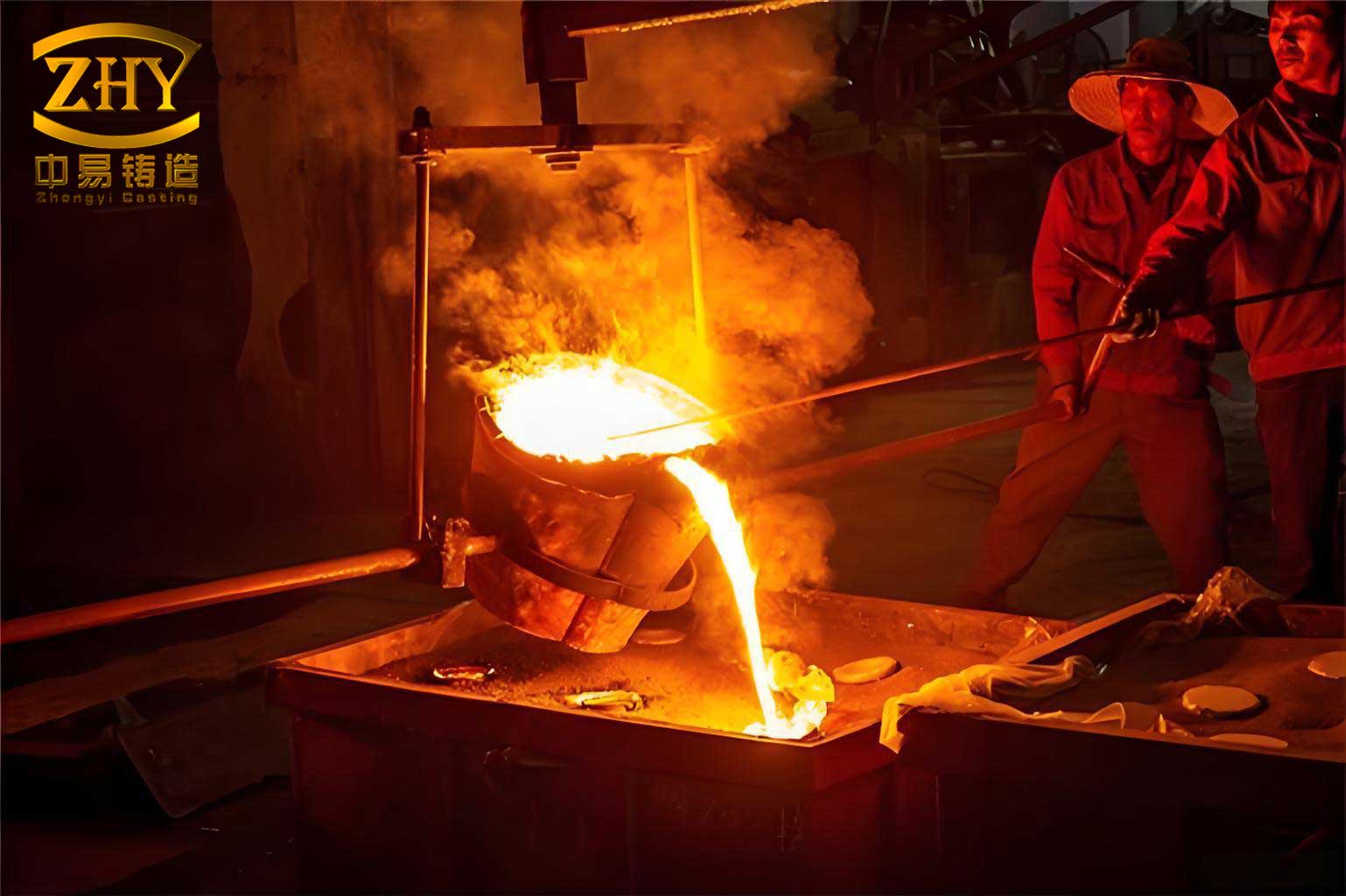
The die material is aluminum alloy (A356) due to its good thermal conductivity and machinability. The die surface is polished to a roughness of Ra 0.8 μm to ensure smooth foam bead fusion. A typical die set for one segment is shown schematically in the figure below, which illustrates the general lost foam castings pattern molding process.
5. Process Modifications for Complex Internal Passages
One of the greatest challenges in lost foam castings for cylinder heads is replicating the intricate internal water jacket and port geometry. Since these features often involve undercuts and narrow channels, I had to make several modifications to the original product design to enable foam pattern molding:
- Water jacket simplification: I added core prints to allow the water jacket to be formed by a separate foam core that is glued into the main pattern. This avoids deep undercuts in the die.
- Port orientation: I adjusted the draft angle of intake and exhaust ports to 2° instead of 1° to ensure smooth ejection of the foam core.
- Blind holes: Oil and bolt holes are drilled after casting; therefore, on the foam pattern I only added small dimples (0.5 mm deep) as location markers, not full protrusions.
- Sand removal openings: I incorporated 6–8 mm diameter holes in the pattern to allow sand to be evacuated from internal cavities after casting. These openings are later sealed by plugs or machining.
The modifications are quantified in the following table:
| Feature | Original design | Modified for EPC | Reason |
|---|---|---|---|
| Water jacket | Closed cavity | Separate foam core bonded in | Avoids die undercut; improves sand filling |
| Intake port | 1° draft | 2° draft | Ensures smooth demolding of core |
| Exhaust port | 1° draft | 2° draft | Same as above |
| M6 bolt holes (8 pcs) | Full thread protrusion | 1 mm dimple only | Threads machined after casting; avoids foam fragility |
| Oil return channel | Rectangular cross-section | Rounded corners, 3 mm radius | Reduces stress concentration; improves foam filling |
6. Assembly and Quality Control of the Foam Pattern
Once all four segments are molded and cooled, I assemble them into a complete foam pattern. The assembly procedure involves:
- Cleaning the glue surfaces with compressed air to remove any foam dust.
- Applying a thin, uniform layer of PVA glue to the 2.5 mm wide flanges using a precision syringe.
- Fixturing the segments together under light pressure (0.2 bar) for 60 seconds to ensure contact.
- Drying the assembly at 40°C for 4 hours to cure the glue.
After assembly, I perform dimensional inspection using a coordinate measuring machine (CMM). The tolerance for lost foam castings patterns is typically ±0.3 mm on critical dimensions. I also check for any gaps >0.2 mm at glue joints; if found, the pattern is rejected. The final pattern weight is measured to ensure foam density remains within 18–22 g/L. The weight \(W\) is related to density \(\rho\) and volume \(V\):
$$ W = \rho \times V $$
For the cylinder head pattern with approximate volume 900 cm³, the target weight is 18–20 grams. If the weight is too low, beads may be under-expanded causing rough surface; if too high, density becomes too high leading to incomplete gasification and carbon defects.
7. Coating and Drying for Lost Foam Castings
Before sand filling, the assembled foam pattern must be coated with a refractory paint that provides a barrier between the pattern and the sand, and allows gas to escape. The coating recipe I use for lost foam castings of iron cylinder heads is given in Table 4.
| Component | Content (wt%) | Function |
|---|---|---|
| Zircon flour (200 mesh) | 75 | High refractoriness, low thermal expansion |
| Colloidal silica binder | 10 | Bonds particles, provides green strength |
| Water | 13 | Vehicle for application |
| Bentonite (suspension agent) | 1.5 | Prevents settling |
| Defoamer (silicon-based) | 0.5 | Eliminates bubbles during mixing |
I apply the coating by dipping the pattern into the slurry, then rotating to ensure uniform coverage. The coating thickness is targeted at 0.3–0.5 mm, measured with a wet film gauge. After coating, the pattern is dried in a controlled oven at 50°C for 6 hours. The drying process removes water while avoiding thermal distortion of the foam. The permeability of the dried coating must be in the range of 0.8–1.2×10⁻⁷ m²/Pa·s to allow proper gas evacuation. I calculate permeability using the formula:
$$ k = \frac{\mu \cdot Q \cdot L}{A \cdot \Delta P} $$
where \(\mu\) is gas viscosity (1.8×10⁻⁵ Pa·s), \(Q\) is flow rate, \(L\) is coating thickness, \(A\) is area, and \(\Delta P\) is pressure drop across coating. For a 0.4 mm thick coating on a cylinder head pattern with total surface area ~0.3 m², the measured permeability is typically 1.0×10⁻⁷ m²/Pa·s, which is acceptable.
8. Sand Filling and Vibration for Lost Foam Castings
The coated pattern is placed in a steel flask and surrounded by dry silica sand (AFS 40–70 grain size). I use a vibration table to compact the sand around the pattern, ensuring even support and preventing pattern distortion. The vibration parameters are: frequency 50 Hz, amplitude 0.5 mm, duration 90 seconds. After filling, a vacuum of 0.05 MPa is applied to the flask to hold the sand in place and assist gas evacuation during pouring.
9. Pouring and Solidification in Lost Foam Castings
I pour gray cast iron (HT250) at 1420°C into the sprue. The negative pressure in the flask is maintained at 0.04–0.06 MPa. The foam pattern vaporizes progressively; the liquid metal front moves at a speed of about 30–50 mm/s. The pouring time for the cylinder head (approximately 8 kg of iron) is 6–8 seconds. The pouring temperature and vacuum level are critical to avoid defects:
- If temperature is too low (<1380°C), the foam may not fully gasify, leading to carbon inclusions.
- If vacuum is too high (>0.07 MPa), sand may be sucked into the metal.
The solidification time \(t_s\) can be estimated using Chvorinov’s rule:
$$ t_s = C \left( \frac{V}{A} \right)^2 $$
where \(V\) is volume of the casting (1.15×10⁶ mm³), \(A\) is surface area (3.6×10⁵ mm²), and \(C\) is a constant for gray iron in sand molds (~2.5 min/cm²). The modulus \(M = V/A = 3.2\) mm, giving \(t_s \approx 25\) minutes. After solidification, the flask is cooled for 2 hours before shakeout.
10. Post-Casting Processing and Defect Analysis
After shakeout, the cylinder head casting is cleaned of sand and coating residue. I then perform non-destructive testing (NDT) including dye penetrant for surface cracks and X-ray for internal porosity. Typical defects in lost foam castings for cylinder heads are carbon defects (lustrous carbon) on the upper surfaces and gas porosity near thin sections. I have minimized these by optimizing coating permeability and pour temperature. The final machining removes the 1.5 mm allowance, and the casting is pressure-tested at 0.6 MPa for water jacket integrity.
In summary, the systematic design approach for lost foam castings of diesel cylinder heads—from mathematical modeling of shrinkage allowances, through segmentation and die design, to process parameter optimization—demonstrates the enormous potential of this technology for automotive applications. The use of lost foam castings reduces machining time, eliminates cores, and provides design freedom that is impossible with conventional sand casting. The tables and formulas presented here serve as a practical guide for engineers implementing lost foam castings for complex engine components.
Conclusion
The comprehensive methodology I have developed for the lost foam castings of diesel cylinder head integrates precise 3D modeling, strategic pattern segmentation, scientific die design, and rigorous process control. The success of this approach relies heavily on understanding the unique behavior of foam patterns under heat and vacuum. With the increasing demand for lightweight, complex, and cost-effective automotive parts, lost foam castings continues to prove itself as a green and efficient manufacturing process. Future work will focus on reducing cycle time and further improving the surface finish of lost foam castings through advanced coating technology.