
In the field of metal casting, the design of vent systems in sand casting plays a critical role in determining the quality and integrity of the final product. As a foundry engineer with extensive experience, I have observed that improper venting can lead to defects such as blowholes, sand burning, boiling, and shrinkage porosity, which significantly impact the mechanical properties and aesthetic appeal of castings. This article delves into the intricacies of vent system design, emphasizing the importance of optimizing both mold cavity and sand core venting to ensure efficient gas expulsion during the pouring and solidification processes. By sharing insights from practical applications, I aim to provide a comprehensive guide that incorporates theoretical calculations, empirical data, and preventive measures to enhance the reliability of sand casting operations.
Sand casting, one of the most widely used manufacturing methods, involves creating molds from sand mixtures to shape molten metal. The vent system, often overlooked in initial design phases, is essential for managing the gases generated from the mold and core materials, as well as those released by the metal itself. Through my work, I have found that a well-designed vent system not only prevents defects but also improves the fluidity of the molten metal, enabling better filling of complex geometries. In this discussion, I will explore the functions, classifications, and design principles of vent systems, supported by tables and formulas to quantify key parameters. Additionally, I will address common pitfalls and propose solutions based on real-world case studies, ensuring that readers can apply these concepts to their own sand casting projects.
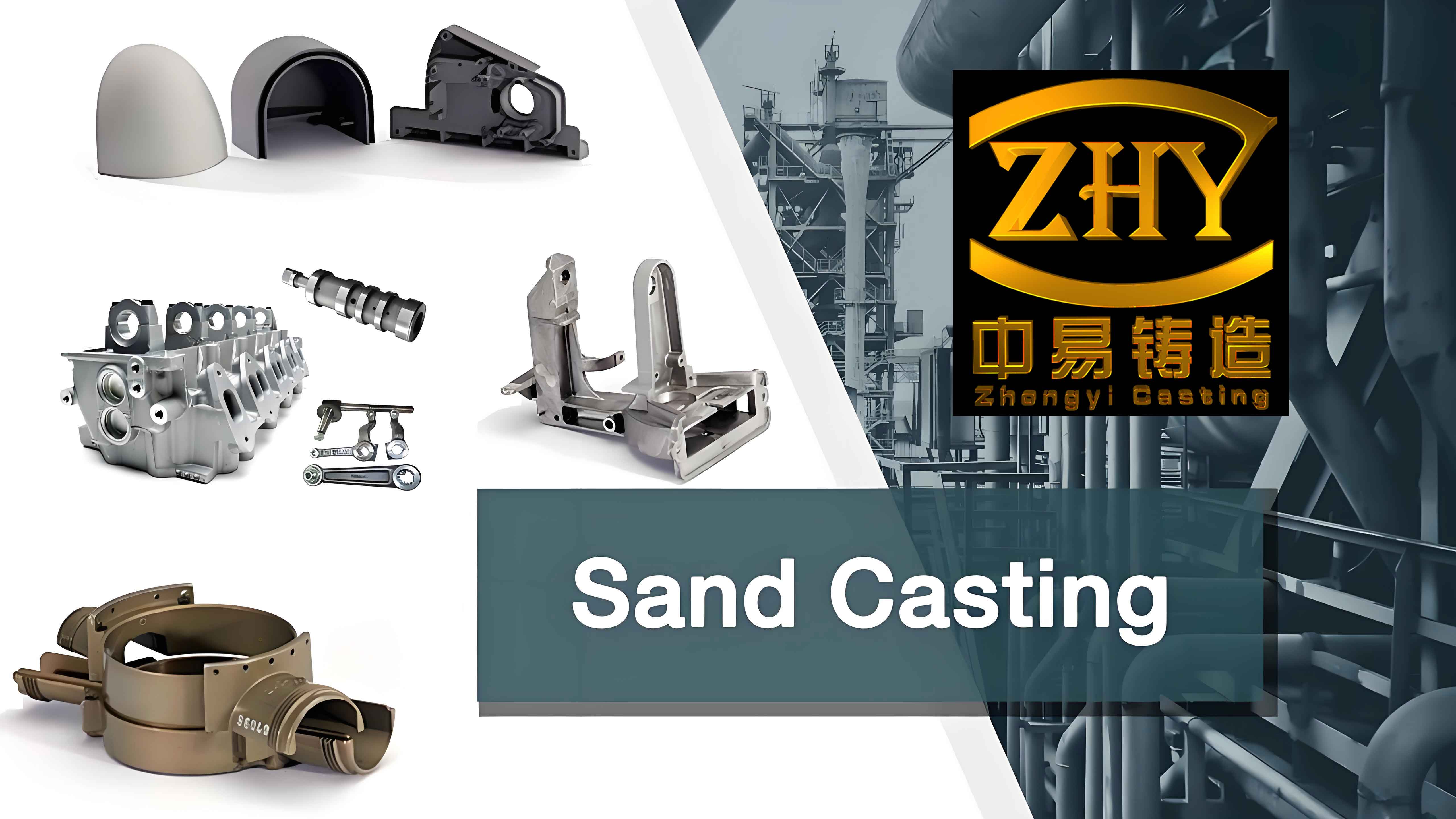
The effectiveness of a vent system in sand casting hinges on its ability to rapidly expel gases without compromising the mold’s structural integrity. From my perspective, this requires a holistic approach that considers the interplay between mold design, material properties, and process parameters. For instance, the choice of sand type—such as clay-bonded sand, resin sand, or water glass sand—affects the gas generation rate and permeability, which in turn influences the venting requirements. By integrating calculations for vent areas and gas flow dynamics, foundry engineers can tailor the system to specific casting geometries, thereby minimizing scrap rates and enhancing productivity. In the following sections, I will break down the components of vent systems, illustrate best practices with examples, and highlight how advanced techniques like 3D printing and computational modeling are revolutionizing sand casting vent design.
Functions and Classification of Vent Systems
Vent systems in sand casting serve multiple functions that are crucial for producing defect-free castings. Primarily, they expel gases from the mold cavity, sand cores, and the molten metal, which accumulate during pouring and solidification. Based on my experience, these gases, if not properly vented, can become trapped and form blowholes or cause metal boiling, leading to rejected parts. Additionally, vent systems reduce the internal pressure within the mold cavity, facilitating smoother metal flow and improving the mold-filling capacity. This is particularly important for thin-walled or intricate castings, where incomplete filling can result in cold shuts or misruns. Moreover, venting allows for the removal of initial cold metal and slag, which tend to accumulate at the top of the cavity, thereby enhancing the overall casting quality.
Vent systems can be broadly classified into two categories: mold cavity venting and sand core venting. Mold cavity venting includes features such as vent holes, vent ropes, vent channels, vent plugs, air vents, vent risers, overflow risers, and ignition venting. These elements are strategically placed to direct gases out of the mold, often through the upper sections or along parting lines. On the other hand, sand core venting involves internal passages within the cores, such as vent holes, vent needles, vent slots, and vent ropes, which channel gases to external outlets. In my practice, I have found that combining these systems ensures comprehensive gas management, especially in complex sand casting operations involving multiple cores. The table below summarizes the key types of vent systems and their typical applications in sand casting.
| Vent System Type | Description | Common Applications |
|---|---|---|
| Mold Cavity Venting | Includes vents integrated into the mold, such as risers and channels, to expel gases from the cavity. | Used in general sand casting for simple to medium complexity parts. |
| Sand Core Venting | Involves internal core passages, like vent holes or ropes, to release gases from cores. | Essential for castings with internal cavities, such as engine blocks in sand casting. |
| Combined Systems | Integrates both mold and core venting for optimal gas expulsion. | Applied in high-performance sand casting for automotive or hydraulic components. |
From a functional standpoint, the vent system must be designed to handle the gas volume generated during the sand casting process. The total gas evolution can be estimated based on the sand type and binding agents. For example, resin-bonded sands in sand casting typically have higher gas evolution rates compared to clay-bonded sands, necessitating larger vent areas. In my work, I use the following formula to approximate the required vent area for mold cavity venting, which helps in initial design phases:
$$ S = k \times \frac{22.6 \times G}{\rho \times t \times h_p \times \mu} $$
Where \( S \) is the total vent area in cm², \( G \) is the mass of the poured metal in kg, \( \rho \) is the density of the metal in kg/cm³, \( t \) is the pouring time in seconds, \( h_p \) is the effective metallostatic head in cm, \( \mu \) is the velocity factor (typically 0.35 to 0.45 for sand casting with or without filters), and \( k \) is a factor ranging from 1.5 to 4, depending on the wall thickness of the casting. For thin-walled sand casting parts, a higher \( k \) value is recommended to ensure sufficient venting.
Design Principles for Vent Systems
When designing vent systems for sand casting, I adhere to several core principles to maximize efficiency and minimize defects. First and foremost, it is essential to separate the venting of mold cavity gases from sand core gases. This prevents cross-contamination and ensures that gases are expelled through dedicated pathways, reducing the risk of blowholes. In my experience, directly venting through the casting itself should be avoided, as it can introduce sand inclusions or weaken the structure. Instead, vents should be positioned at the highest points of the mold cavity, where gases naturally accumulate, or at locations that are last to fill with metal. This approach leverages the natural flow of gases during pouring, enhancing venting effectiveness in sand casting.
Another key principle is to ensure that the total vent area is sufficient to handle the gas load. For sand casting processes without open risers, the minimum vent area at the roots should equal the choke area of the gating system. However, for complex or thin-walled castings, such as those in automotive or turbocharger applications, I often increase this ratio to 1.5–2.5 times the choke area to account for higher gas evolution. This is particularly relevant in resin sand casting, where binder decomposition generates significant gases. The table below outlines recommended vent area ratios for different sand casting scenarios, based on my observations and industry standards.
| Casting Type | Vent Area to Choke Area Ratio | Remarks |
|---|---|---|
| Simple Castings | 1.0 | Adequate for low-gas sands in basic sand casting. |
| Complex Thin-Walled Castings | 1.5–2.5 | Essential for resin sand casting or high-pressure molding. |
| Large Castings with Multiple Cores | 2.0–3.0 | Ensures venting of core gases in heavy-section sand casting. |
Placement of vents is equally critical. I always position vent needles, holes, or slots in areas that do not interfere with the solidification and feeding of the casting. For instance, placing vents near hot spots or thick sections can lead to premature cooling and shrinkage defects. Instead, I use indirect venting methods, such as connecting vents to the cavity via channels, to prevent sand from falling into the mold. In sand casting processes involving high-pressure molding or core shooting, I incorporate vent plugs in the patterns to address “air trapping” issues, which can cause incomplete core formation. Furthermore, for large castings, I design interconnected vent networks within cores, using materials like hollow ropes or preformed foam that burn out during pouring, creating continuous gas pathways. The following formula helps in determining the required vent area for sand cores, which I frequently apply in complex sand casting projects:
$$ a_v = a_{cm} (1 – A) – a_p $$
Where \( a_v \) is the total vent area of the core in cm², \( a_{cm} \) is the contact area between the core and molten metal in cm², \( a_p \) is the cross-sectional area of the core print in cm², and \( A \) is a dimensionless factor given by:
$$ A = \frac{\gamma_1 \cdot H \cdot \rho}{\gamma_2 \cdot K \cdot G \cdot C} $$
Here, \( \gamma_1 \) is the specific gravity of the molten metal in g/cm³, \( \gamma_2 \) is the specific gravity of the core sand in g/cm³, \( H \) is the height from the metal surface to the top of the core in cm, \( \rho \) is the permeability of the core sand in cm⁴/(g·s), \( G \) is the gas evolution of the core mixture in cm³/g, \( C \) is the percentage of gas decomposition, and \( K \) is a conversion factor (approximately 2.166 cm²/s). This calculation ensures that the core venting is adequate to prevent gas-related defects in sand casting.
Common Defects and Cause Analysis
Inadequate vent system design in sand casting often leads to a range of defects that compromise casting quality. From my experience, blowholes are among the most common issues, resulting from trapped gases that cannot escape the mold or core. These defects typically appear as spherical cavities on or near the casting surface and are exacerbated by high gas evolution rates from sands like resin-bonded or cold-box systems. For example, in sand casting using resin sand, if the vent area is insufficient, gases penetrate the solidifying metal, forming blowholes. Similarly, sand burning or boiling occurs when gases react violently with the metal, often due to poor venting that increases internal pressure. This is particularly prevalent in high-density molding processes, where sand compaction reduces permeability, hindering gas escape.
Another defect I frequently encounter is explosive sand sticking, where gases trapped at the mold-metal interface cause localized explosions, embedding sand into the casting. This is common in sand casting with high moisture content or improper drying of molds and cores. Additionally, shrinkage porosity can be indirectly related to venting; if vents are placed incorrectly, they may cool the metal too quickly, disrupting the feeding pattern and creating isolated shrinkage cavities. The table below summarizes common vent-related defects in sand casting, their causes, and typical manifestations, based on my root cause analyses in various foundry settings.
| Defect Type | Primary Causes | Manifestation in Sand Casting |
|---|---|---|
| Blowholes | Insufficient vent area, high sand gas evolution | Surface or subsurface holes in castings |
| Sand Boiling | Rapid gas release, high mold pressure | Rough casting surface with embedded sand |
| Explosive Sticking | Trapped gases igniting, poor core venting | Localized sand fusion on casting |
| Shrinkage Porosity | Improper vent placement affecting solidification | Internal cavities in thick sections |
To quantify the risk of such defects, I often assess the gas pressure buildup in the mold cavity during sand casting. The pressure \( P \) in Pa can be approximated using the ideal gas law, considering the volume of gas generated \( V_g \) in m³ and the vent flow resistance. For a typical sand casting setup, the gas generation rate \( \dot{V_g} \) in m³/s depends on the sand type and temperature, and it can be modeled as:
$$ \dot{V_g} = A_s \cdot G_s \cdot e^{-E/(R T)} $$
Where \( A_s \) is the surface area of sand exposed to metal in m², \( G_s \) is the specific gas evolution rate in m³/(m²·s), \( E \) is the activation energy in J/mol, \( R \) is the gas constant, and \( T \) is the temperature in K. If the vent system cannot accommodate this flow, the pressure rises, leading to defects. In my designs, I ensure that the total vent area \( S \) satisfies \( S \geq \dot{V_g} / v_g \), where \( v_g \) is the allowable gas velocity through vents, typically kept below 10 m/s for sand casting to prevent turbulence.
Rational Design Measures for Vent Systems
To achieve optimal venting in sand casting, I implement a combination of mold cavity and sand core venting strategies, tailored to the specific casting geometry and material. For mold cavity venting, I prioritize the use of risers and overflow systems that serve dual purposes: venting gases and collecting cold metal or slag. In sand casting of large or complex parts, I design risers with insulating or exothermic materials to maintain high temperatures, which delays solidification and allows gases to escape longer. For instance, in sand casting for automotive components, I often employ edge vents or vent filters connected to the cavity via thin channels, preventing sand ingress while facilitating gas flow. Additionally, I incorporate vent plugs in pattern plates for high-pressure molding, which alleviate air trapping during mold formation.
For sand core venting, I focus on creating internal networks that channel gases to external outlets. In simple sand casting cores, I use vent needles or ropes during core making, but for intricate cores, I pre-drill holes or embed combustible materials like foam that vaporize during pouring, forming continuous passages. In my projects involving sand casting with multiple cores, I ensure that core prints are sealed properly to prevent metal leakage into vent paths, using materials like ceramic fibers or sealant tapes. The table below compares different sand core venting methods I have applied, highlighting their suitability for various sand casting applications.
| Venting Method | Description | Best for Sand Casting Types |
|---|---|---|
| Vent Holes | Drilled or formed holes in cores for gas escape | Simple to medium complexity sand casting |
| Vent Ropes | Combustible ropes that burn out, leaving channels | Large cores in heavy-section sand casting |
| Preformed Foam | Embedded foam that gasifies, creating passages | Complex internal cores in precision sand casting |
| 3D-Printed Channels | Additively manufactured vent paths in cores | High-complexity sand casting with custom geometries |
Moreover, I optimize the gating system in sand casting to support venting by using bottom or step gates that promote upward metal flow, reducing turbulence and gas entrapment. The pouring temperature and speed are calibrated to allow sufficient time for gas expulsion before the metal surface forms an oxide film. In sand casting with resin sands, I often increase the pouring temperature slightly to delay oxide formation, but I balance this with the risk of sand burning. The following formula helps me determine the optimal pouring time \( t \) in seconds for sand casting, which influences vent design:
$$ t = k \cdot \sqrt[3]{G} $$
Where \( G \) is the casting mass in kg, and \( k \) is a factor ranging from 1.5 to 2.5 for sand casting, depending on section thickness and complexity. A shorter pouring time may require larger vent areas to handle rapid gas release.
In terms of material selection, I prefer sands with low gas evolution and high permeability for sand casting. For example, water glass-bonded sands exhibit lower gas evolution compared to resin sands, making them suitable for vent-critical applications. I also conduct pre-production tests to measure sand properties, such as gas evolution and permeability, using standard foundry equipment. For vent area verification, I use the formula mentioned earlier, but I adjust it based on empirical data from similar sand casting projects. For instance, in sand casting of turbocharger housings, I have found that a vent area of 2.0 times the choke area consistently prevents defects, whereas for simpler castings, a ratio of 1.0 suffices.
Conclusion
In summary, the design of vent systems in sand casting is a multifaceted process that requires careful consideration of mold and core dynamics, material properties, and process parameters. Through my experiences, I have learned that a proactive approach—integrating venting early in the design phase—can significantly reduce defects and improve casting yield. Key takeaways include the importance of separating mold and core venting, ensuring adequate vent areas, and leveraging advanced materials like vent filters or 3D-printed channels for complex geometries. As sand casting continues to evolve with innovations in binders and digital manufacturing, vent system design must adapt to handle higher gas loads and tighter tolerances.
Looking ahead, I believe that computational fluid dynamics (CFD) simulations will play an increasingly vital role in optimizing vent systems for sand casting, allowing for virtual testing of gas flow and pressure distributions. By combining theoretical models with practical insights, foundry engineers can achieve robust venting solutions that enhance the reliability and efficiency of sand casting processes. Ultimately, a well-designed vent system not only mitigates defects but also contributes to sustainable manufacturing by reducing scrap and energy consumption. I encourage practitioners to continuously evaluate and refine their venting strategies, drawing on collective industry knowledge to advance the art and science of sand casting.