
In the manufacturing of automotive components, the production of reliable and cost-effective brake discs remains a critical engineering challenge. As a key safety component within the vehicle’s braking system, the brake disc must exhibit excellent wear resistance, thermal stability, vibration damping, and consistent mechanical properties. Gray cast iron, particularly grades like HT250, has long been the material of choice due to its inherent castability, good machinability, and favorable tribological characteristics. This article details a comprehensive approach to the design, numerical simulation, and optimization of a wet green sand casting process for manufacturing these essential sand casting parts. The primary objectives were to enhance production efficiency through a multi-cavity mold design and to ensure casting integrity by leveraging advanced simulation tools to predict and mitigate potential defects.
The fundamental advantage of using sand casting for such components lies in its flexibility and scalability for medium to high-volume production. For automotive sand casting parts like brake discs, a well-designed sand casting process can achieve the necessary dimensional accuracy and material properties while keeping unit costs low. The process discussed here utilizes a symmetrical mold design partitioned by sand cores, allowing for the casting of six discs in a single mold cycle. This strategic design significantly boosts productivity compared to single-cavity methods.
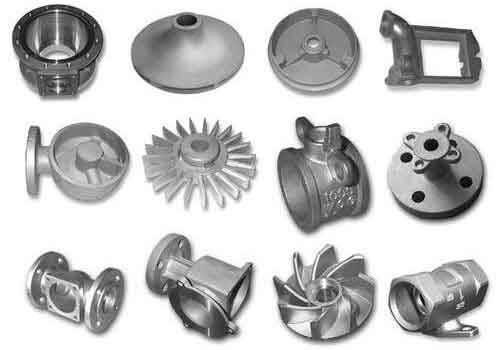
Part Design and Casting Methodology
The first step in creating robust sand casting parts is the translation of the component design into a manufacturable casting design. The brake disc, as a finished part, features detailed geometries such as ventilation ribs and mounting surfaces. For the casting process, certain features were simplified to improve manufacturability and reduce complexity. Specifically, shallow grooves on the back surface (approximately 2.5 mm deep) were designated to be machined post-casting rather than cast directly. This simplification aids in patternmaking, reduces the risk of mold damage during handling, and facilitates easier ejection of the sand core.
The selection of the parting line and gating system is paramount. For this symmetrical part, the parting plane was logically placed at the mid-plane between the two identical sand cores that form the disc’s internal cavities. The casting orientation was set with one face of the disc against the sand core surface. A semi-closed gating system was adopted, characterized by a choke at the ingate to control metal velocity. The cross-sectional area ratios were designed as:
$$ F_{\text{sprue}} : F_{\text{runner}} : F_{\text{ingate}} = 1.2 : 1.4 : 1 $$
This ratio promotes a smoother filling sequence, reduces turbulence and oxide formation, provides some slag-trapping capability in the runner, and minimizes erosion of the mold walls—all critical factors for producing high-quality sand casting parts.
A central question in designing for gray iron is the necessity of feeders (risers). While gray iron benefits from graphite expansion during eutectic solidification, which can counteract shrinkage, liquid contraction during the initial cooling phase still requires compensation. The need for feeders was evaluated through calculation and later validated via simulation. Both top feeders (on the cope side) and side feeders (attached to the runner) were incorporated into the initial design to ensure adequate feed metal is available to critical sections, safeguarding against shrinkage porosity.
Molding, Coremaking, and Metallurgy
The successful production of sand casting parts hinges on consistent and robust mold and core production. For this application, a high-pressure molding machine (e.g., Z3112 multi-pin squeeze type) was selected to produce dense, uniform mold halves. The green sand formulation is critical for achieving good surface finish and minimizing gas-related defects. A typical blend is used, balancing new sand, reclaimed sand, bentonite as a binder, coal dust for a reducing atmosphere and improved surface finish, and controlled moisture.
| Component | Percentage (%) | Function |
|---|---|---|
| New Sand (70/140 mesh) | 30 | Provides refractory base and new grains |
| Reclaimed Sand | 70 | Cost reduction, maintains clay coating |
| Bentonite | 2.5 – 3.5 | Primary clay binder for strength |
| Coal Dust | 0.8 – 1.5 | Creates reducing atmosphere, improves surface finish |
| Water | 4.0 – 5.5 | Activates bentonite bonding |
The complex internal geometry of the brake disc requires precise sand cores. These were produced using a hot-box coremaking process for its fast cycle time and excellent dimensional accuracy. The core sand was based on silica sand with a furan resin binder system. The cores are cured at approximately 220°C for 2-3 minutes in a vertically parted core shooting machine.
The metallurgical preparation targets the HT250 grade gray iron. Charge materials include pig iron, steel scrap, returns, and necessary alloying/conditioning elements like carburizer and ferrosilicon, melted in a medium-frequency induction furnace. The pouring temperature is tightly controlled between 1490°C and 1510°C to ensure sufficient fluidity while minimizing gas dissolution and metal-mold reaction. Inoculation is crucial for achieving the desired fine, type A graphite distribution and preventing undercooled graphite formations (e.g., type D), which can weaken the iron. An in-mold inoculation technique was chosen, where a finely granulated (0.3-0.7 mm) 75% FeSi inoculant is placed in a ceramic foam filter within the runner system. As the iron flows through the filter, it is uniformly inoculated. This method offers significant advantages: minimal inoculation fade, highly effective nucleation, and reduced inoculant consumption (typically 0.15-0.20% of the metal weight). The filter also serves to trap non-metallic inclusions, further enhancing the quality of the final sand casting parts.
Numerical Simulation: A Tool for Virtual Prototyping
Traditional casting design relies heavily on empirical rules and iterative physical trials, which are time-consuming and costly. Numerical simulation provides a powerful alternative by creating a virtual prototype of the entire casting process. We employed the ADSTEFAN casting simulation software, which uses Finite Difference Method (FDM) to solve the governing equations of fluid flow, heat transfer, and solidification. The software’s database provides necessary material properties, and visualization tools allow for detailed analysis of potential issues before any metal is poured. The core equations governing the simulation include the Navier-Stokes equations for fluid flow and the energy equation for heat transfer during solidification.
The conservation of momentum (Navier-Stokes) for incompressible flow with a porous medium approach in the mushy zone can be expressed as:
$$ \rho \left( \frac{\partial \mathbf{u}}{\partial t} + (\mathbf{u} \cdot \nabla) \mathbf{u} \right) = -\nabla p + \mu \nabla^2 \mathbf{u} + \rho \mathbf{g} + \mathbf{S} $$
where $\rho$ is density, $\mathbf{u}$ is velocity, $p$ is pressure, $\mu$ is dynamic viscosity, $\mathbf{g}$ is gravity, and $\mathbf{S}$ is a momentum sink term representing the flow resistance in the solidifying mush, often modeled using the Carman-Kozeny relation:
$$ \mathbf{S} = – \frac{C (1 – f_L)^2}{f_L^3 + \epsilon} \mathbf{u} $$
Here, $C$ is a constant dependent on morphology, $f_L$ is the liquid fraction, and $\epsilon$ is a small number to prevent division by zero.
The energy conservation equation, accounting for the latent heat of fusion, is:
$$ \rho c_p \frac{\partial T}{\partial t} + \rho c_p (\mathbf{u} \cdot \nabla T) = \nabla \cdot (k \nabla T) – \rho L \frac{\partial f_s}{\partial t} $$
where $c_p$ is specific heat, $T$ is temperature, $k$ is thermal conductivity, $L$ is latent heat, and $f_s$ is solid fraction.
To make the simulation computationally efficient while maintaining accuracy, a symmetry model was created. Given the six-cavity layout with rotational symmetry, only one-third of the full mold (containing two disc cavities) was modeled, with adiabatic boundary conditions applied to the cut planes through the sprue. The computational domain was discretized into a mesh with a minimum cell size of 2 mm, resulting in a model with approximately 5.3 million cells. Accurate thermophysical properties for the mold, core, and metal are essential inputs, as summarized in the table below.
| Material / Parameter | Density (g/cm³) | Thermal Conductivity (cal/cm·s·°C) | Specific Heat (cal/g·°C) | Initial Temp. (°C) | Latent Heat (cal/g) | Liquidus Temp. (°C) | Solidus Temp. (°C) |
|---|---|---|---|---|---|---|---|
| Mold (Green Sand) | 1.5 | 0.0030 | 0.27 | 20 | – | – | – |
| Core (Resin Sand) | 1.5 | 0.0028 | 0.27 | 20 | – | – | – |
| Cast Metal (HT250) | 6.9 | 0.0060 (avg) | 0.20 | 1300 | 50 | 1200 | 1145 |
| Air / Environment | – | – | – | 20 | – | – | – |
Simulation Results and Process Optimization
The simulation was conducted to compare two key design variants: a system relying solely on gating for feeding versus a system incorporating dedicated feeders. The analysis focused on several critical outputs: fill pattern and temperature distribution, air entrapment, solidification sequence, and shrinkage prediction.
Filling and Thermal Analysis: The simulation of the filling stage revealed significant differences. The design without feeders showed a cooler and less uniform temperature distribution at the end of fill, particularly in the thin-walled sections and the top region of the disc. This non-uniformity can lead to high thermal stresses during cooling, increasing the risk of hot tearing. Conversely, the design with feeders demonstrated a more uniform temperature field. The feeders acted as thermal reservoirs, keeping the adjacent casting sections hotter for longer and promoting directional solidification towards the feeder, thereby reducing thermal gradients and associated stresses in the critical sand casting parts.
Air Entrapment and Mold Venting: Analyzing the air displacement during filling is crucial for avoiding gas porosity defects. In the no-feeder design, the simulation showed that air trapped at the top of the mold cavity had limited escape paths, leading to areas of high pressure. This could result in incomplete filling (misdruns) in thin sections or gas being forced into the solidifying metal, creating subsurface pores. The feeder design provided a natural escape route for this displaced air. The air was pushed up and out through the feeder, ultimately venting to the atmosphere or causing a small, harmless imperfection at the very top of the feeder itself—a defect that is later removed during machining. This confirms that feeders serve a dual purpose: supplying liquid metal and acting as vents for the mold cavity.
Solidification and Feeding Analysis: Tracking the solid fraction over time is key to understanding feeding requirements. The simulation quantified the point at which different parts of the system become “isolated” and can no longer receive liquid feed metal. In the gating-only design, the junctions of the ingates solidified very early (at a casting solid fraction of only ~14%), cutting off the liquid metal supply prematurely. In the feeder design, the feeders remained active and able to feed the casting until a much later stage (casting solid fraction ~38%). This extended feeding time is vital for compensating for the liquid and solidification shrinkage that occurs before the onset of the graphite expansion phase, which is a unique self-feeding characteristic of gray iron.
Shrinkage Prediction using Niyama Criterion: To quantitatively predict the propensity for shrinkage porosity, the Niyama criterion is a widely used indicator. It is a local thermal parameter derived from the temperature gradient \( G \) and the cooling rate \( R \) at the solidus front, defined as:
$$ Niyama = \frac{G}{\sqrt{R}} $$
Regions with a low Niyama value are prone to forming shrinkage microporosity because they indicate areas where liquid feed metal cannot easily penetrate to compensate for shrinkage. For gray iron, a threshold value in the range of 0.4 to 0.5 °C0.5·min0.5/cm is often used as an indicator. The simulation maps for the no-feeder design showed large, contiguous areas on the top surface and the central web of the disc with Niyama values below this threshold, signaling a high risk of significant shrinkage porosity. The feeder design showed a marked improvement. While some isolated spots with lower values remained (often at junction points or the center of large flat surfaces), the critical areas were largely eliminated, and the values in problematic zones were generally higher, indicating a much-reduced risk. This is visually and quantitatively the most compelling evidence for the necessity of feeders in this specific geometry for producing sound sand casting parts.
| Evaluation Criterion | Design WITHOUT Feeders | Design WITH Feeders | Conclusion/Optimization Direction |
|---|---|---|---|
| End-of-Fill Temperature Uniformity | Poor; large gradients, cold spots on top surface. | Good; more uniform, feeders act as thermal mass. | Feeders improve thermal profile, reduce hot tear risk. |
| Air Entrapment & Venting | High pressure zones in cavity; risk of misruns/gas pores. | Air vented through feeders; minimal cavity pressure. | Feeders provide essential venting path for mold gases. |
| Feeding Path Duration | Ingates freeze at ~14% cast solid. Early feed isolation. | Feeders active until ~38% cast solid. Extended feeding. | Feeders provide critical liquid metal during shrinkage phase. |
| Niyama Criterion Map | Large areas with value < 0.4-0.5 threshold on top and web. | Significant reduction in sub-threshold areas; only small hotspots. | Feeders drastically reduce predicted shrinkage porosity risk. |
| Predicted Defect Location | Concentrated shrinkage on top face and central web. | Minor, dispersed microporosity; possible hot spot at web junction. | Design with feeders is vastly superior. Web junction may need local chilling. |
The simulation not only validated the need for feeders but also pinpointed specific areas requiring attention. For instance, the junction where the central hub meets the friction ring (the “web” area) consistently showed a thermal hotspot, even in the improved design. This knowledge allows for targeted optimization, such as applying local chilling (e.g., chaplets or chill inserts in the sand core) at that specific junction to accelerate solidification and eliminate the isolated liquid pool.
Conclusion
The development of a manufacturing process for gray iron automotive brake discs exemplifies the integration of traditional foundry practice with modern computational engineering. The proposed wet green sand casting process, employing a symmetrical, six-cavity mold with intermediate sand cores, presents a highly efficient and economical solution for mass-producing these critical sand casting parts. The use of high-pressure molding and hot-box coremaking ensures dimensional consistency and mold quality.
Numerical simulation proved to be an indispensable tool in this development cycle. By virtually analyzing filling patterns, solidification sequences, and predicting defect formation using criteria like the Niyama parameter, the simulation provided clear, data-driven evidence for optimizing the casting design. The comparative analysis conclusively demonstrated that incorporating a well-designed feeder system is essential for this component. Feeders significantly improve the thermal gradient, provide necessary venting for mold gases, extend the feeding time to counteract liquid shrinkage, and most importantly, dramatically reduce the risk of shrinkage porosity in the final casting. The simulation also highlighted specific geometric hotspots, guiding further refinements such as strategic chilling.
This holistic approach—combining sound casting principles, controlled metallurgy, and predictive simulation—ensures the production of high-integrity, reliable gray iron brake discs. It underscores how advanced virtual prototyping can reduce development time, minimize costly trial runs, and enhance the quality and yield of complex sand casting parts in a competitive manufacturing environment.