
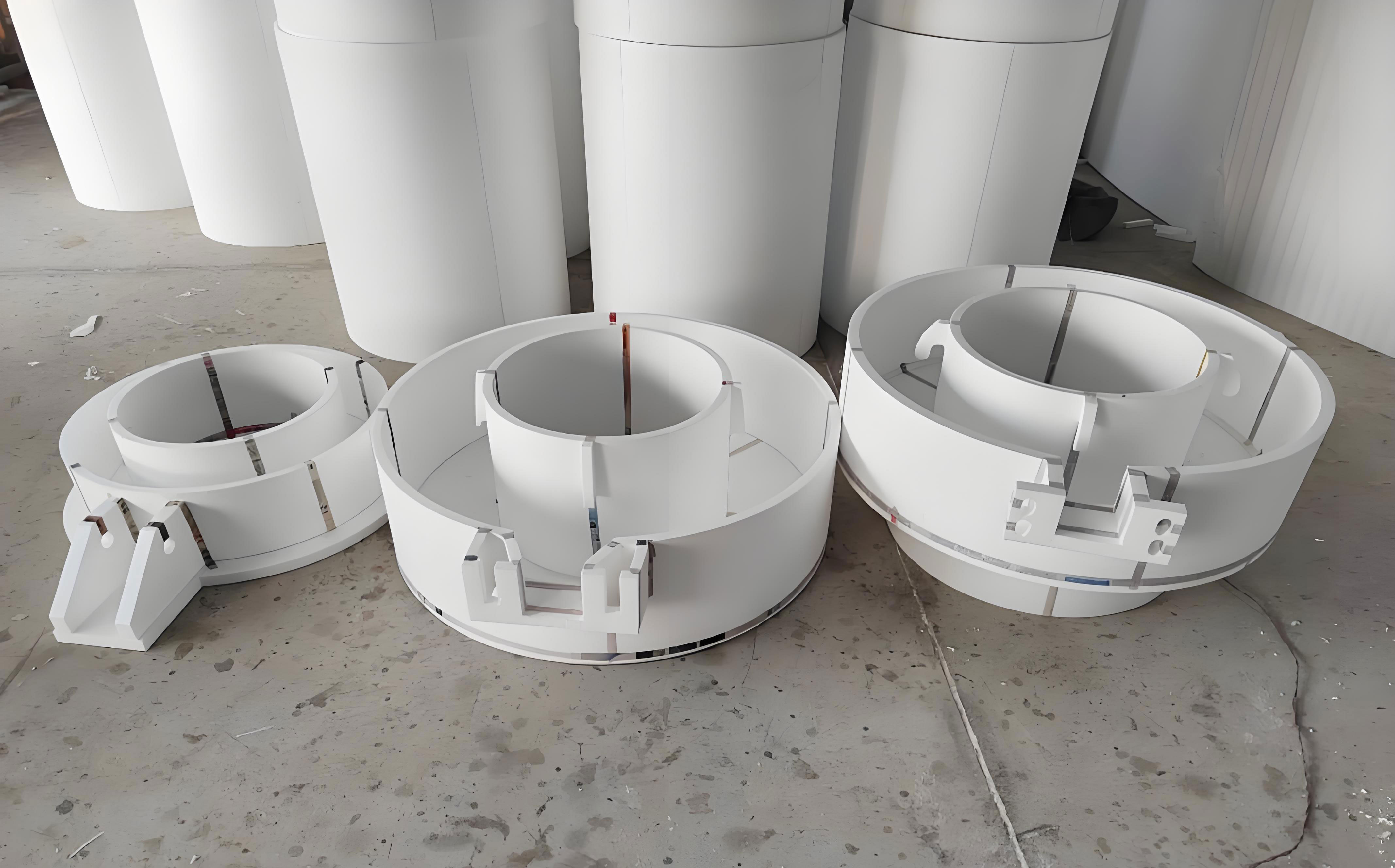
In the rapidly evolving automotive industry, the demand for new vehicle models has intensified competition, driving the need for high-quality stamping dies for body panels. These dies are characterized by their large size, complex structures, and stringent technical requirements, particularly for high-end轿车覆盖件模具铸件. Lost foam casting (EPC) technology, which uses expandable polystyrene (EPS) foam patterns coated with a refractory layer and molded with self-setting resin sand, has become a critical method for producing these components. The coating in EPC plays a pivotal role by facilitating heat transfer, mass transfer, and controlling metal flow during casting. Unlike conventional sand casting coatings, EPC coatings must withstand mechanical impacts during molding,冲刷 from molten metal, and pressure from pattern gasification. Key properties include常温 strength, high-temperature strength, permeability, refractoriness, fast-drying capability, and excellent wettability and brushability. However, existing commercial coatings, whether domestic or imported, often fall short in performance or cost-effectiveness for large-scale automotive die castings. This article details the development of a novel coating for lost foam casting, focusing on material selection, formulation optimization, and process improvements to achieve superior performance while reducing costs.
The development of this coating began with a comprehensive analysis of material requirements for EPC applications. The refractory aggregate, a core component, was selected based on a balance of high-temperature resistance and economic feasibility. High-alumina bauxite clinker and flake graphite powder were chosen as the primary aggregates. High-alumina bauxite offers moderate refractoriness with an Al2O3 content of 80–85%, ensuring adequate performance without excessive cost. Flake graphite, with a carbon content exceeding 87%, enhances high-temperature resistance and crack resistance due to its laminar structure. The combination leverages graphite’s high耐火度 and bauxite’s appropriate properties, optimizing both performance and cost. For suspension, a blend of sodium bentonite powder and a 2% carboxymethyl cellulose钠 (CMC) aqueous solution was employed to achieve excellent thixotropic suspension, preventing sedimentation and improving application consistency. Binders were carefully selected to ensure strength across temperature ranges: a silicone-modified styrene-acrylic建筑乳液 served as the常温 binder, providing low film-forming temperature and fast drying, while a combination of silica sol and sodium hexametaphosphate acted as the high-temperature binder, enhancing烧结 and strength under thermal stress. Additives included Fe2O3 powder for color adjustment and sintering promotion, and亚甲基双荼磺酸钠 (NNO) as a dispersant to reduce water content and improve brushability. Water was chosen as the solvent due to its compatibility with EPS patterns and cost advantages, with total moisture controlled at around 30% to enable rapid drying at low temperatures (<60°C).
To optimize the coating formulation, an orthogonal experimental design was employed, focusing on key factors such as aggregate ratios and additive concentrations. The experiments evaluated multiple performance metrics, including coating surface strength, permeability, suspension stability, drying crack resistance, brushability, density, and solid content. The testing methods adhered to industry standards, as summarized in Table 1. For instance, surface strength was measured using a coating abrasion tester, where samples were dried and subjected to a weighted brush, with lower weight loss indicating higher strength. Permeability was calculated based on the difference in透气性 between coated and uncoated resin sand specimens, using the formula: $$K_{\text{coat}} = \frac{\delta}{[(h + \delta)/K_1 – h/K_0]}$$ where \(K_{\text{coat}}\) is the coating permeability, \(\delta\) is the coating thickness, \(h\) is the sample height, \(K_0\) is the permeability of the uncoated sample, and \(K_1\) is the permeability of the coated sample. Suspension was assessed via a sedimentation test, and brushability was determined using a viscometer to measure viscosity ratios.
| No. | Property | Test Method |
|---|---|---|
| 1 | Coating Surface Strength | Abrasion test with 100 g weight on dried sample; lower mass loss indicates higher strength. |
| 2 | Coating Permeability | Measured using standard specimen with and without coating; calculated via formula above. |
| 3 | Suspension | 100 mL coating settled for 24 h; higher sedimentation height indicates better suspension. |
| 4 | Drying Crack Resistance | Visual inspection for cracks in thick coating areas after drying (no cracks: ○, cracks: ×). |
| 5 | Brushability | Viscosity ratio \(M = \eta_6 / \eta_{60}\) from NDJ-1 viscometer at 6 and 60 r/min. |
| 6 | Density | Measured with densimeter. |
| 7 | Solid Content | 100 g coating dried at 130–150°C for 2 h; residue weight percentage. |
The orthogonal试验 involved eight distinct formulations, with results presented in Table 2. Key observations included surface strength values ranging from 36 to 113 mg, permeability from 126 to 753 × 10−3 cm²·Pa−1·min−1, and suspension stability above 84%. Range and variance analyses were conducted for surface strength, permeability, and suspension. For surface strength, factors such as Fe2O3 powder, silica sol, and建筑乳液 showed significant influence, with range analysis indicating contributions in that order. Permeability was primarily affected by alumina bauxite, as coarse aggregates increase interstitial spaces, enhancing gas escape during lost foam casting. Suspension was influenced by flake graphite, bentonite, and CMC, highlighting the role of additives and aggregate interactions. The variance analysis revealed no single factor had a dominant effect, emphasizing the synergistic nature of the formulation. Based on these findings, the optimal composition was determined: alumina bauxite 50–60%, flake graphite 40–50%, silica sol 4–6%,建筑乳液 4–6%, bentonite powder 1–2%, Fe2O3 powder 1–2%, CMC 3–4%, and NNO 0.5–1.0%.
| Test No. | Surface Strength (mg) | Permeability (×10−3 cm²·Pa−1·min−1) | Suspension (%) | Drying Crack Resistance | Brushability (M) | Density (g/cm³) | Solid Content (%) |
|---|---|---|---|---|---|---|---|
| #1 | 75 | 126 | 98 | ○ | 5.3 | 1.61 | 63 |
| #2 | 73 | 215 | 92 | ○ | 5.6 | 1.60 | 65 |
| #3 | 70 | 141 | 98 | ○ | 5.2 | 1.63 | 63 |
| #4 | 53 | 578 | 98 | ○ | 5.4 | 1.61 | 63 |
| #5 | 40 | 532 | 98 | ○ | 5.3 | 1.61 | 64 |
| #6 | 43 | 547 | 84 | ○ | 5.2 | 1.62 | 63 |
| #7 | 113 | 519 | 96 | ○ | 5.5 | 1.64 | 61 |
| #8 | 36 | 753 | 96 | ○ | 5.1 | 1.58 | 62 |
The preparation method significantly impacts coating performance. Traditional blade-type mixers often lead to inhomogeneous compositions, poor viscosity, and sedimentation, resulting in inadequate suspension and brushability. In contrast, a ball mill process was adopted for this EPC coating, utilizing ceramic balls of 30–50 mm diameter to facilitate grinding and mixing. The ball mill operates through rotational motion, where centrifugal force lifts the balls, which then fall and exert kneading and grinding actions on the materials. This dual mechanism of friction and揉搓 ensures uniform distribution and homogenization, eliminating agglomeration and enhancing suspension stability. Comparative tests between 6-hour and 9-hour ball milling durations showed that 6 hours sufficed for optimal permeability without compromising other properties, establishing an efficient production cycle for lost foam casting applications.
Refractory aggregate particle size distribution is crucial for coating performance in EPC, directly influencing permeability and crack resistance. Coarser aggregates generally increase permeability by creating larger interparticle voids, which facilitate the escape of gaseous decomposition products during foam pattern gasification. However, excessively coarse particles can degrade brushability and surface quality. Conversely, finer particles improve brushability but may reduce permeability and increase cracking tendency. Studies indicate that a monodisperse distribution around 200-mesh optimizes these properties. For this coating, a specific gradation was implemented: high-alumina bauxite with 10–15% residue on a 200-mesh sieve and 20–25% on a 250-mesh sieve, and flake graphite with 70–80% residue on a 200-mesh sieve. This scheme promotes proper particle packing, enhancing both anti-cracking performance and permeability. The inclusion of flake graphite adjusts the thermal expansion coefficient to match that of the resin sand mold, reducing high-temperature cracking risks. The relationship between particle size and permeability can be expressed as: $$P \propto d^2 / \eta$$ where \(P\) is permeability, \(d\) is particle diameter, and \(\eta\) is viscosity. Additionally, the gradation minimizes fine particles blocking voids, ensuring consistent performance in lost foam casting processes.
In practical applications, the developed coating demonstrated exceptional performance in automotive stamping die production. The optimized formulation, combined with ball mill preparation, resulted in a high-rheology fluid with excellent wettability and brushability on EPS patterns. Two coating layers achieved a thickness exceeding 1.5 mm, providing sufficient anti-penetration resistance and handling strength for large castings. The light gray-red color, owing to Fe2O3 addition, improved the working environment compared to traditional black coatings. Field tests confirmed that the coating met the demanding requirements of high-end die castings, with no instances of sticking, cracking, or defects related to inadequate permeability. The cost-effectiveness, due to the strategic use of alumina bauxite and graphite, offered a competitive advantage over imported alternatives, supporting the broader adoption of lost foam casting in the automotive industry.
In conclusion, this research successfully developed a novel coating for lost foam casting (EPC) through systematic material selection, orthogonal experimentation, and process innovation. The use of high-alumina bauxite and flake graphite as aggregates balanced performance and cost, while the ball mill preparation method ensured superior homogeneity and suspension. The particle size gradation scheme enhanced permeability and crack resistance, critical for EPC applications. The coating’s ability to form a thick, durable layer with two brush strokes underscores its practicality for large automotive die castings. This advancement not only addresses the technical challenges of lost foam casting but also contributes to sustainable manufacturing by reducing environmental impact and operational costs. Future work could explore further refinements in additive combinations and scalability for industrial mass production.