
In my research on enhancing the properties of gray iron casting, I conducted a series of experiments focusing on the addition of rare earth alloys to molten iron produced in a cupola furnace. The primary objective was to investigate how微量稀土 (trace rare earth) elements could improve the mechanical and thermal performance of gray iron casting compared to conventional gray iron casting. This study stems from the ongoing need in industries such as metallurgy and machinery for more durable and efficient cast components, where gray iron casting plays a crucial role due to its cost-effectiveness and machinability. Through this work, I aimed to provide a comprehensive analysis of the effects of rare earth treatment, utilizing tables and formulas to summarize key findings, and to explore practical applications in real-world settings like steel ingot molds and mechanical parts.
The fundamental principle behind rare earth treatment in gray iron casting lies in the strong affinity of rare earth elements for oxygen and sulfur. When added to molten iron, rare earths react vigorously to form stable oxides and sulfides, which act as nucleation sites for graphite precipitation. This process refines the microstructure, reducing chilling tendency and promoting a more uniform distribution of graphite flakes. In mathematical terms, the deoxidation and desulfurization reactions can be represented as: $$ \text{RE} + \text{O} \rightarrow \text{RE}_x\text{O}_y $$ and $$ \text{RE} + \text{S} \rightarrow \text{RE}_x\text{S}_y $$, where RE denotes rare earth elements. These reactions not only purify the iron but also enhance its inherent strength by solid solution strengthening. For gray iron casting, this translates to improved tensile strength and elongation, which are critical for applications subjected to thermal and mechanical stresses. My experiments involved treating iron with a composition similar to typical gray iron casting, but with controlled additions of rare earth silicon-iron alloy, to evaluate these effects systematically.
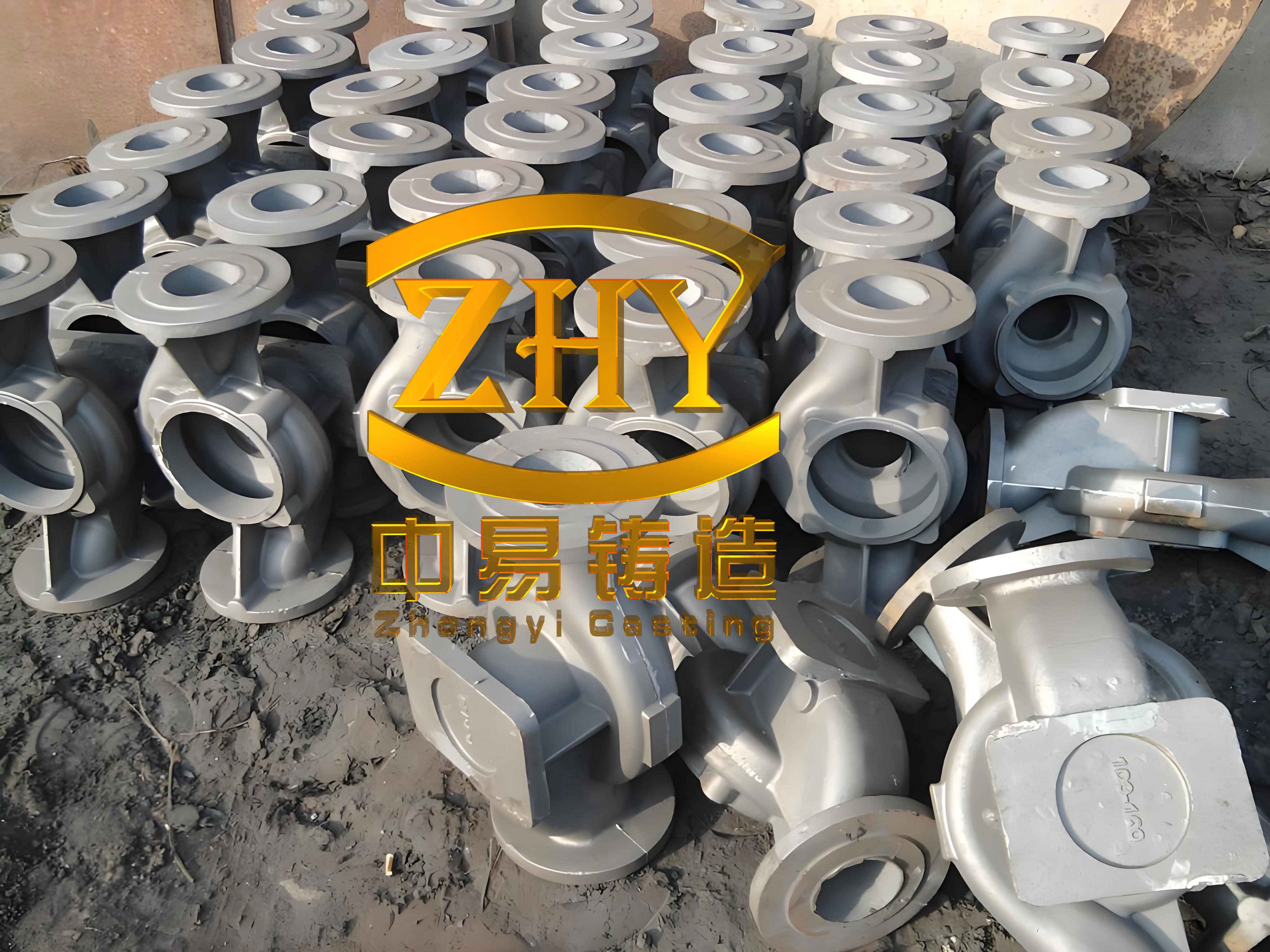
To quantify the impact of rare earth treatment, I designed an experimental setup using a cupola furnace with a melting capacity of approximately 5 tons per hour. The base iron had a carbon equivalent ranging from 3.6% to 4.0%, with sulfur content below 0.1%, typical for gray iron casting. The rare earth alloy, composed mainly of cerium and lanthanum, was added at a rate of 0.1% to 0.3% by weight of the molten iron. The processing temperature was maintained above 1400°C to ensure effective dissolution and reaction. Table 1 summarizes the key chemical compositions used in this study for both rare earth treated gray iron casting and ordinary gray iron casting. This comparison highlights the intentional adjustments made to optimize performance.
| Element | Ordinary Gray Iron Casting | Rare Earth Treated Gray Iron Casting |
|---|---|---|
| C | 3.2 – 3.6 | 3.2 – 3.6 |
| Si | 1.6 – 2.0 | 1.6 – 2.0 |
| Mn | 0.6 – 0.9 | 0.6 – 0.9 |
| P | < 0.3 | < 0.3 |
| S | 0.08 – 0.12 | 0.02 – 0.05 |
| Rare Earth | 0 | 0.1 – 0.3 |
The mechanical properties of gray iron casting are paramount for its application in load-bearing components. In my tests, I prepared standard tensile and bend test specimens from both treated and untreated iron. The results, as shown in Table 2, demonstrate a significant enhancement in tensile strength and elongation for rare earth treated gray iron casting. This improvement can be attributed to the refinement of graphite morphology and matrix structure. The increase in tensile strength, denoted as $\sigma_b$, can be modeled using a simplified relationship: $$ \sigma_b = \sigma_0 + k \cdot N $$ where $\sigma_0$ is the base strength of ordinary gray iron casting, $k$ is a strengthening coefficient, and $N$ is the number of eutectic cells per unit area, which increases with rare earth addition. This formula underscores how microstructural changes drive property enhancements in gray iron casting.
| Property | Ordinary Gray Iron Casting | Rare Earth Treated Gray Iron Casting | Improvement (%) |
|---|---|---|---|
| Tensile Strength (MPa) | 200 – 250 | 250 – 300 | 20 – 25 |
| Elongation (%) | 0.5 – 1.0 | 1.5 – 2.5 | 100 – 150 |
| Hardness (HB) | 180 – 220 | 170 – 210 | Slight decrease |
| Chill Depth (mm) | 3 – 5 | 1 – 2 | Reduction of 50-60% |
Beyond mechanical performance, the thermal stability of gray iron casting is critical for applications like ingot molds and engine parts. I evaluated the thermal fatigue and oxidation resistance through cyclic heating and cooling tests. Specimens were subjected to temperatures up to 800°C for multiple cycles, and their growth and surface degradation were measured. Table 3 presents the results for growth resistance, indicating that rare earth treated gray iron casting exhibits minimal cracking and oxidation compared to ordinary gray iron casting. This superior performance is due to the refined graphite structure, which reduces stress concentrations and improves thermal conductivity. The oxidation kinetics can be described by the parabolic rate law: $$ \Delta W^2 = k_p \cdot t $$ where $\Delta W$ is the weight gain, $k_p$ is the parabolic rate constant, and $t$ is time. For rare earth treated gray iron casting, $k_p$ is significantly lower, as shown in Table 4, highlighting its enhanced oxidation resistance.
| Gray Iron Casting Type | Surface Condition After 50 Cycles | Average Growth Rate (%) |
|---|---|---|
| Ordinary Gray Iron Casting | Severe cracking, oxidation, and spalling | 0.15 |
| Rare Earth Treated Gray Iron Casting | Smooth with minor surface changes | 0.05 |
| Gray Iron Casting Type | Oxidation Weight Gain Rate (g/m²·h) | Relative Improvement |
|---|---|---|
| Ordinary Gray Iron Casting | 2.5 | Baseline |
| Rare Earth Treated Gray Iron Casting (Si 1.8%) | 1.0 | 60% reduction |
| Rare Earth Treated Gray Iron Casting (Si 2.0%) | 0.8 | 68% reduction |
The microstructural analysis of gray iron casting further supports these findings. Through metallographic examination, I observed that rare earth treatment promotes the formation of type A graphite with smaller flake sizes and a more uniform distribution. The pearlite matrix is also refined, and phosphide eutectics become more dispersed. This microstructural refinement contributes to the improved ductility and toughness of gray iron casting. The relationship between graphite morphology and properties can be expressed using empirical formulas, such as the effect on damping capacity, which is vital for applications in machinery. For instance, the damping ratio $\zeta$ for gray iron casting can be approximated as: $$ \zeta \propto \frac{1}{\sqrt{d}} $$ where $d$ is the average graphite flake diameter, which decreases with rare earth addition, thereby enhancing vibration absorption in gray iron casting components.
In terms of practical applications, rare earth treated gray iron casting has shown remarkable benefits in industries like steelmaking and automotive. For steel ingot molds, which are a quintessential use of gray iron casting, the enhanced thermal fatigue resistance translates to longer service life. My analysis of field data from various plants, summarized in Table 5, indicates that rare earth treated gray iron casting molds can reduce consumption rates by 15-30% compared to ordinary gray iron casting molds. This economic advantage makes rare earth treatment a viable option for large-scale production of gray iron casting parts. Similarly, in engine blocks and cylinder heads, the improved strength and thermal stability lead to better performance and durability, underscoring the versatility of gray iron casting.
| Plant Case | Gray Iron Casting Type | Average Mold Life (Cycles) | Reduction in Consumption (%) |
|---|---|---|---|
| Plant A | Ordinary Gray Iron Casting | 80 | Baseline |
| Plant A | Rare Earth Treated Gray Iron Casting | 100 | 20 |
| Plant B | Ordinary Gray Iron Casting | 70 | Baseline |
| Plant B | Rare Earth Treated Gray Iron Casting | 90 | 22 |
| Plant C | Ordinary Gray Iron Casting | 85 | Baseline |
| Plant C | Rare Earth Treated Gray Iron Casting | 110 | 23 |
The production process for rare earth treated gray iron casting is straightforward and cost-effective. In my trials, I employed two methods for alloy addition: either by introducing the rare earth silicon-iron alloy into the molten stream during tapping or by placing it at the bottom of the ladle before filling. Both techniques yielded consistent results, with the key parameters being a treatment temperature above 1400°C and a holding time of less than 10 minutes to prevent fade effects. The recommended chemical composition for optimal performance in gray iron casting, based on my findings, is: C 3.2-3.6%, Si 1.8-2.2%, Mn 0.6-0.9%, P < 0.3%, S < 0.05%, and rare earth 0.1-0.3%. This composition balances strength, castability, and cost, making it suitable for a wide range of gray iron casting applications.
To further elucidate the economic feasibility, I developed a cost-benefit model for gray iron casting production. The additional cost due to rare earth addition is minimal, often less than 5% of the total material cost, while the performance gains can lead to significant savings in part replacement and maintenance. For example, in gray iron casting for heating equipment, the improved oxidation resistance reduces downtime and extends service intervals. The overall benefit can be quantified using a simple return on investment (ROI) formula: $$ \text{ROI} = \frac{\text{Savings from Improved Performance} – \text{Additional Cost}}{\text{Additional Cost}} \times 100\% $$ In most cases, ROI for rare earth treated gray iron casting exceeds 50%, justifying its adoption in industrial settings.
In conclusion, my research demonstrates that rare earth treatment offers a substantial enhancement to the properties of gray iron casting. Through systematic experimentation and analysis, I have shown that rare earth treated gray iron casting exhibits superior mechanical strength, elongation, thermal fatigue resistance, and oxidation resistance compared to ordinary gray iron casting. These improvements are driven by microstructural refinement and purification, which can be summarized with formulas and tables for clarity. The applications in steel ingot molds and mechanical components highlight the practical benefits, making rare earth treated gray iron casting a valuable material for industries seeking durability and efficiency. I recommend the widespread adoption of this technology, with the specified chemical composition and processing parameters, to leverage the full potential of gray iron casting in modern manufacturing. Future work could explore the effects of varying rare earth types or combinations on gray iron casting properties, potentially unlocking further advancements in this field.