
The pursuit of reliable, high-performance casting parts for heavy machinery is a constant challenge in foundry engineering. This account details our first-person experience and methodology in successfully developing a large, as-cast QT700-2 eccentric body—a critical component in mechanical press drive systems. The part’s function is to translate the rotary motion of a main gear into the linear motion of a slide. Our initial approach of using heat treatment to achieve the required properties resulted in an unacceptably high scrap rate due to deformation and cracking. This failure made the development of a sound as-cast variant our primary technical mission.
The specifications for these high-integrity casting parts were stringent: Dimensional accuracy needed to meet CT10 to ensure operational balance; high strength and wear resistance were mandatory, with a specified minimum surface hardness of 220 HB on the eccentric section; and the internal microstructure had to be dense and uniform, free from shrinkage porosity, sand inclusions, slag, and cracks.
The geometry of these casting parts presented the first layer of complexity. With a major contour dimension of Ø2140 mm × 1300 mm and a significant variation in wall thickness—from a minimum of 50 mm to a maximum of 320 mm at the eccentric lobe—achieving uniform solidification and soundness was non-trivial. Such geometry inherently leads to differential cooling rates, fostering risks like slag entrapment, shrinkage defects, and cracking at abrupt section changes. The most formidable challenge resided in the 320-mm-thick eccentric section. The prolonged solidification time in this massive region creates a perfect environment for metallurgical degradation: nodular graphite can degenerate into undesirable forms like chunky graphite, while spheroidization and inoculation fade can occur, leading to coarse microstructure and severely degraded mechanical properties. Simultaneously, we had to achieve a high pearlite fraction for strength and a surface hardness exceeding 220 HB, all in the as-cast condition.
Foundry Process Design for Complex Casting Parts
Designing a robust process for these massive casting parts required a holistic approach targeting controlled filling, directional solidification, and accelerated cooling in critical areas. Our strategy integrated a gating system, risers, and chills.
We implemented a two-tier gating system. The lower system was placed on the large bottom flange, and the upper system fed directly into the eccentric lobe area. Both were designed as choked (pressurized) systems to ensure the runners remained full during pouring, promoting slag flotation to the top of the runners. The ingates were distributed around the casting to ensure a uniform temperature field and avoid localized overheating, which is crucial for the soundness of large casting parts.
Although the casting’s modulus (Mc) was greater than 2.5 cm, theoretically allowing for a riserless design, the process window for such an approach is narrow and highly sensitive to melt quality and pouring parameters. For production stability, we opted to use insulating risers. A riser with a diameter of 200 mm was placed on top of the eccentric lobe and another on the highest point of the casting. Their primary function was to provide liquid feed metal during the initial stages of solidification. The subsequent secondary contraction (shrinkage) was intended to be compensated by the graphitic expansion from the precipitation of nodular graphite, a phenomenon central to the soundness of ductile iron casting parts. This hybrid approach significantly enhanced process reliability.
To combat the issues associated with the slow cooling of the 320-mm section—primarily graphite degeneration and floating—we employed external chills. The chill thickness is critical; too thick, and it risks creating carbides (chill); too thin, and it may fuse with the casting. We selected a chill thickness of approximately one-third of the local casting wall thickness.
$$ \text{Chill Thickness (T}_{\text{chill}}) \approx \frac{1}{3} \times \text{Local Casting Wall Thickness (T}_{\text{cast}}) $$
For our eccentric lobe: $$ T_{\text{chill}} \approx \frac{1}{3} \times 320 \text{ mm} \approx 70 \text{ mm} $$
Solidification modeling confirmed the efficacy of this design, showing a significant reduction in the predicted shrinkage porosity risk in the heavy sections, validating our integrated approach of using risers and chills for these demanding casting parts.
Metallurgical Control: The Heart of As-Cast Performance
The cornerstone of producing high-integrity, as-cast QT700-2 casting parts lies in precise metallurgical control. Every element in the chemical composition plays a targeted role, and the processing must counteract the inherent衰退 tendencies of heavy sections.
Chemical Composition Design
Our target chemistry was a careful balance aimed at promoting graphite nucleation, ensuring a high pearlite matrix, and minimizing harmful elements. The table below summarizes our controlled ranges for these critical casting parts.
| Element | Target Range (wt.%) | Rationale for Casting Parts |
|---|---|---|
| C | 3.6 – 3.7 | High carbon improves fluidity, feeds graphitic expansion, and reduces shrinkage tendency. |
| Si | 2.2 – 2.4 | Promotes ferrite; controlled level is needed for strength but must be limited to avoid embrittlement. | CE | 4.4 – 4.7 | Balanced carbon equivalent ensures good castability and graphite formation while avoiding floating graphite. |
| Mn | 0.4 – 0.6 | Stabilizes and refines pearlite, but is controlled to limit carbide formation and segregation. |
| P | ≤ 0.06 | Minimized to prevent the formation of brittle phosphide eutectic at grain boundaries. |
| S | ≤ 0.02 | Severely restricted as it is a potent anti-spheroidizing element. |
Alloying Strategy for Matrix Control
Achieving a predominantly pearlitic matrix with high strength in the as-cast state, especially in thick casting parts, requires alloying. We employed a multi-element approach:
- Copper (Cu): 0.7–0.9%. A strong pearlite promoter that refines the matrix and improves hardness uniformity across sections. Its effect on strength can be approximated as a strengthening contribution.
- Chromium (Cr): 0.10–0.15%. A potent carbide former that increases hardenability and stabilizes pearlite. Its addition must be precise to avoid excessive hard spots in casting parts.
- Tin (Sn): 0.04–0.05%. An extremely efficient pearlite stabilizer. A small amount effectively suppresses the formation of ferrite halos around graphite nodules.
The combined effect of these alloys can be considered in a simplified performance predictor for such casting parts:
$$ \text{Estimated Tensile Strength} \propto (\%\text{Pearlite}) + k_1[Cu] + k_2[Cr] + k_3[Sn] $$
Where \( k_1, k_2, k_3 \) are strengthening coefficients specific to the base iron chemistry.
Melting and Treatment for Heavy-Section Casting Parts
The prolonged processing time for large casting parts demands robust and fade-resistant treatments.
1. Spheroidization: We used a low-rare-earth (Low-RE) magnesium ferrosilicon alloy. High rare earths can promote graphite degeneration (chunky graphite) in heavy sections. The treated residual levels were tightly controlled:
$$ \text{Mg}_{\text{res}} = 0.04\% – 0.06\% $$
$$ \text{RE}_{\text{res}} \leq 0.03\% $$
The alloy was added to the well of the pouring ladle at a rate of 1.4–1.6%, covered with a pre-inoculant, and treated via the sandwich method.
2. Inoculation: To combat fading and ensure a high nodule count with round graphite, we used a multiple inoculation practice:
- Primary Inoculation: A blend of 50% FeSi75 and 50% Si-Ba-Ca inoculant was added during tapping.
- Late Inoculation: The critical step for these casting parts was stream inoculation during pouring using a powerful Si-Mn-Zr-based inoculant at 0.10% of the stream weight. This maximizes nucleation sites just before solidification.
The effectiveness of inoculation in preventing undercooled graphite structures is paramount. The nodule count (N) is a key quality indicator for such casting parts:
$$ N_v \propto \frac{\text{Inoculation Efficiency}}{\text{Solidification Time}} $$
For thick sections, a high-potency, fade-resistant inoculant is essential to maintain a high \( N_v \).
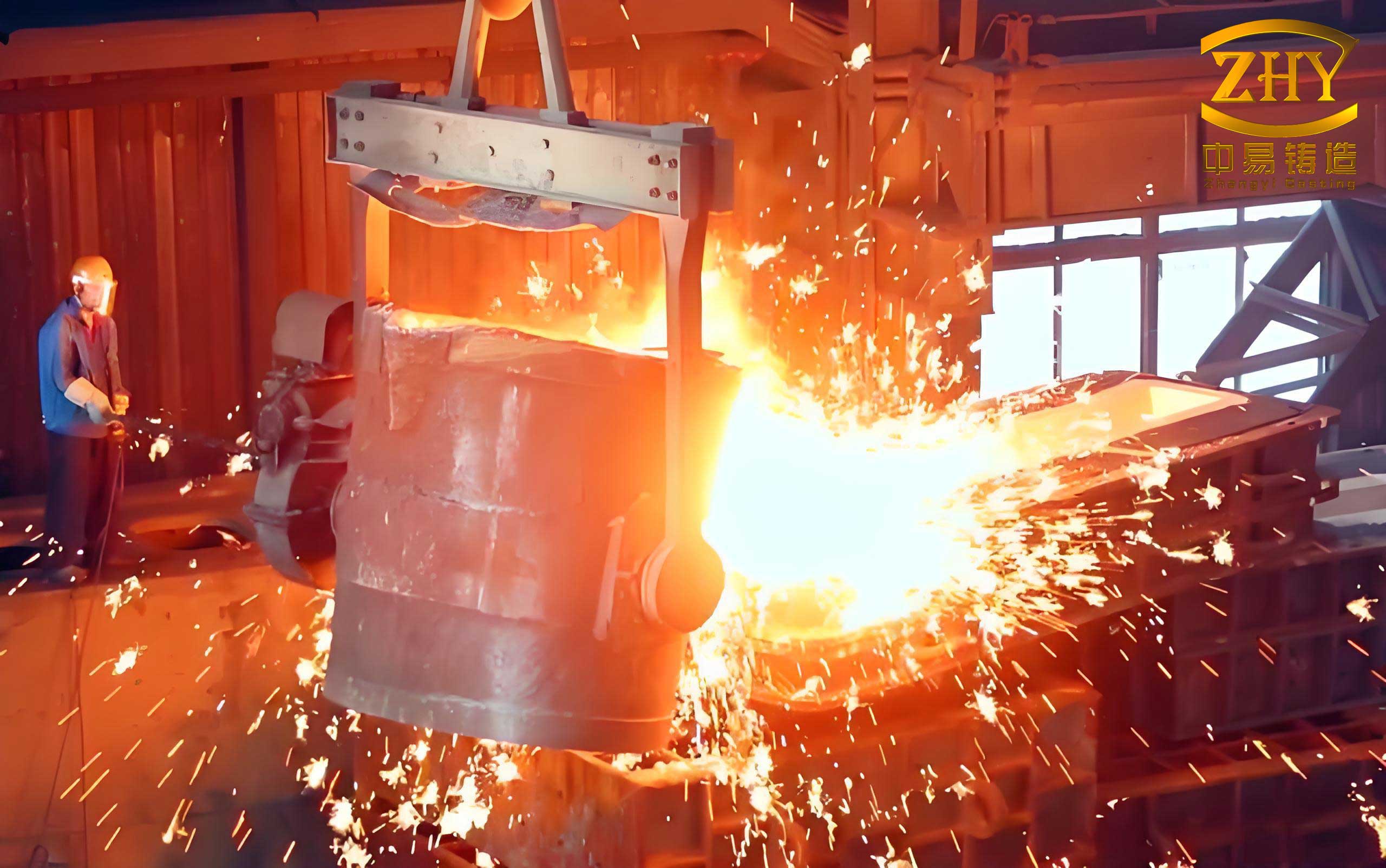
3. Pouring Practice: A high-temperature, rapid pour was employed (1360–1390°C) to improve fluidity and reduce dross formation, despite a slightly increased shrinkage risk—a risk mitigated by our process design. The sprue was kept full, and the risers were topped up twice after the main pour to ensure adequate feeding.
Validation and Results for the Produced Casting Parts
The implementation of the above integrated process yielded successful casting parts. The mechanical properties were evaluated using separately cast test blocks (Y-blocks) poured from the same ladle as the eccentric body. The results consistently met the QT700-2 specification in the as-cast condition.
| Property | Specification (QT700-2) | Average Result from Produced Casting Parts |
|---|---|---|
| Tensile Strength, Rm | > 700 MPa | 723 MPa |
| Elongation, A | > 2% | 3.1% |
| Hardness (Eccentric Lobe Surface) | > 220 HB | 225-240 HB |
Metallographic examination of samples taken from the heavy eccentric lobe of the casting parts revealed a microstructure characteristic of well-controlled production: a high nodule count of small, well-formed (Type I) graphite nodules evenly dispersed in a matrix consisting of over 85% fine pearlite, with the remainder being ferrite surrounding the nodules. Crucially, no evidence of chunky graphite, significant carbides, or micro-shrinkage was found, confirming the effectiveness of the chill and metallurgical controls.
Conclusion and Learned Principles
The successful development of these as-cast QT700-2 eccentric body casting parts hinged on a systems-engineering approach that intertwined robust foundry practice with precise metallurgy. The key learnings can be distilled into principles applicable to other heavy-section ductile iron casting parts:
- Process Design for Thermal Management: For complex casting parts with varying sections, a combination of controlled filling (gating), liquid feeding (insulating risers), and localized cooling (chills) is essential to promote soundness and a favorable solidification pattern.
- Chemistry as a Foundation: A moderate carbon equivalent (CE ~4.5-4.7%) provides the best compromise between castability, graphitic expansion, and avoiding floating graphite in massive casting parts.
- Strategic Alloying for As-Cast Properties: The synergistic use of pearlite promoters like Cu, Sn, and controlled Cr is indispensable for achieving high strength and hardness in the as-cast state without resorting to heat treatment.
- Fade-Resistant Treatment: For casting parts with long processing times, using a low-RE spheroidizer and, most critically, employing a powerful, late-stage inoculation (e.g., stream inoculation) are non-negotiable for maintaining a high, uniform nodule count and preventing degenerate graphite forms.
- The Central Role of Graphitic Expansion: The entire process must be designed to harness the internal pressure generated from graphite precipitation. This natural self-feeding mechanism is what ultimately seals shrinkage and ensures density in properly designed and melted ductile iron casting parts.
By adhering to these principles, we transitioned the production of these critical eccentric bodies from a problematic, heat-treatment-dependent process to a reliable, cost-effective, and high-yield as-cast operation, delivering casting parts that fully met the rigorous demands of performance in service.