
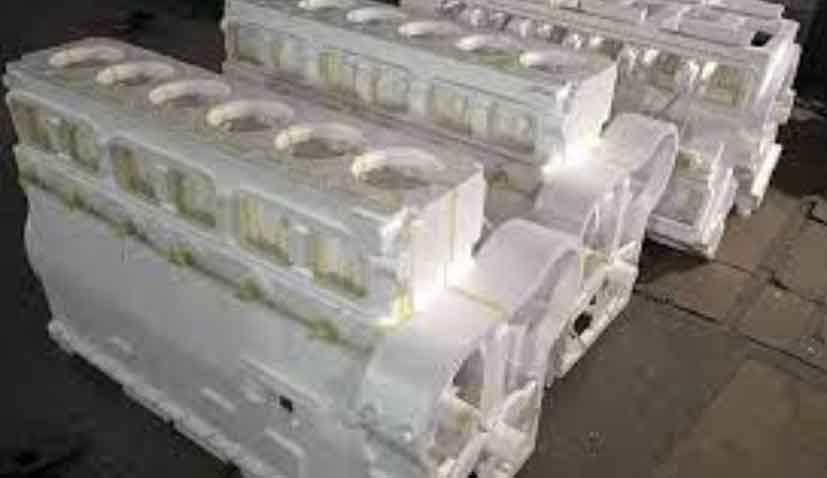
In the production of engineering machinery side frame sleeves (jackets), quality defects such as slag holes and gas porosity persistently affected product reliability. Through systematic process optimization, we developed a vacuum negative pressure shell mold technique that synergizes lost foam casting with investment casting advantages. This paper details the methodology, thermodynamic principles, and implementation results of this innovative approach.
1. Process Challenges in Conventional Lost Foam Casting
The original lost foam casting process using EPS patterns exhibited critical limitations:
| Defect Type | Frequency (%) | Root Cause |
|---|---|---|
| Slag inclusion | 18-25 | EPS decomposition byproducts |
| Gas porosity | 12-20 | Foam pyrolysis gases |
| Surface carbonization | 8-15 | C-Fe micro-interaction |
The gas generation during EPS decomposition follows Arrhenius-type kinetics:
$$Q_{gas} = A \cdot e^{(-E_a/RT)} \cdot t^n$$
Where:
$Q_{gas}$ = Total gas volume
$A$ = Pre-exponential factor (3.2×10⁷ cm³/g)
$E_a$ = Activation energy (92 kJ/mol)
$R$ = Gas constant
$T$ = Temperature (K)
$t$ = Time (s)
2. Comparative Analysis of EPS Removal Methods
Three alternative approaches were evaluated for EPS elimination:
| Method | EPS Removal (%) | Process Complexity | Defect Reduction |
|---|---|---|---|
| Pre-ignition | 40-60 | Low | 35% |
| Oxygen-assisted combustion | 75-85 | Medium | 60% |
| Shell mold process | 100 | High | 92% |
The vacuum negative pressure shell mold process demonstrated superior performance through complete EPS elimination before metal pouring. The vacuum parameter optimization follows:
$$P_{opt} = \frac{\rho \cdot g \cdot h}{\ln(\frac{T_m}{T_0})}$$
Where:
$P_{opt}$ = Optimal vacuum pressure (Pa)
$\rho$ = Metal density (kg/m³)
$g$ = Gravitational acceleration
$h$ = Mold height (m)
$T_m$ = Metal temperature (K)
$T_0$ = Ambient temperature (K)
3. Shell Mold Process Implementation
The developed shell mold process integrates four critical phases:
3.1 Pattern Preparation
High-density EPS patterns (28-32 kg/m³) were molded with dimensional accuracy control:
$$\delta = \alpha \cdot L \cdot \Delta T + \beta \cdot t_{cool}$$
Where:
$\delta$ = Pattern dimensional deviation (mm)
$\alpha$ = EPS thermal expansion coefficient
$L$ = Feature length (mm)
$\Delta T$ = Temperature differential (°C)
$\beta$ = Cooling shrinkage factor
$t_{cool}$ = Cooling time (min)
3.2 Shell Building Process
| Layer | Material | Thickness (mm) | Drying Temp (°C) |
|---|---|---|---|
| Primary | Zircon-based slurry | 0.8-1.2 | 45±5 |
| Secondary | Aluminosilicate | 1.5-2.0 | 55±5 |
| Tertiary | Colloidal silica | 2.0-2.5 | 65±5 |
3.3 Thermal Degradation Cycle
The multi-stage pyrolysis protocol ensures complete EPS removal:
$$t_{total} = \sum_{i=1}^{n} \frac{m^{2/3}}{\lambda_i} \cdot \ln\left(\frac{T_{max,i} – T_0}{T_{final,i} – T_0}\right)$$
Where:
$t_{total}$ = Total degradation time (min)
$m$ = Pattern mass (g)
$\lambda_i$ = Thermal conductivity at stage i
$T_{max,i}$ = Maximum temperature at stage i (°C)
$T_{final,i}$ = Final temperature at stage i (°C)
4. Vacuum Casting Parameters
Optimized process conditions for ductile iron QT550-06:
| Parameter | Value | Unit |
|---|---|---|
| Vacuum pressure | 0.04-0.06 | MPa |
| Pouring temperature | 1380-1420 | °C |
| Cooling rate | 25-30 | °C/min |
| Shell preheat | 180-220 | °C |
5. Quality Improvement Metrics
Implementation results from 12-month production data:
| Quality Indicator | Baseline | Improved | Enhancement |
|---|---|---|---|
| Slag inclusion rate | 22.7% | 0.9% | 96% |
| Gas porosity | 18.3% | 1.2% | 93% |
| Surface roughness | Ra 12.5 | Ra 6.3 | 50% |
| Dimensional accuracy | CT12 | CT8 | 33% |
The developed vacuum lost foam casting process demonstrates significant advantages in thin-wall ductile iron casting production. By combining shell mold precision with vacuum feeding capabilities, the methodology successfully resolves long-standing quality challenges while maintaining the inherent benefits of lost foam casting technology. Future work will focus on automated shell building systems and real-time vacuum control algorithms for further process optimization.