
In the evolving landscape of manufacturing, the casting industry faces persistent challenges in producing complex, large-scale components efficiently. Traditional sand casting methods often struggle with intricate internal geometries, leading to extended lead times, high costs, and quality inconsistencies. As a researcher immersed in this field, I have explored how digital technologies, particularly 3D printing of sand molds, can revolutionize sand castings. This article delves into the integration of digital design, simulation, and additive manufacturing to enhance the production of sand castings, focusing on key aspects such as three-dimensional process design, hybrid molding techniques, and large-scale sand mold fabrication. By leveraging these advancements, we aim to address limitations like slow response, low flexibility, and poor dimensional stability inherent in conventional sand castings.
The foundation of modern casting lies in computer-aided design and simulation, which propel the industry from experience-based practices to scientifically guided production. Traditional sand castings rely heavily on wooden patterns or sweep templates for mold creation, but these methods become cumbersome for parts with complex internal structures and large sizes. For instance, fabricating a wooden pattern for a cylindrical casting of Φ1000 mm × 400 mm can take up to three days, and non-cylindrical shapes demand even longer cycles. Moreover, two-dimensional process designs are slow and inflexible, often failing to capture intricate details, while dimensional inaccuracies arise from pattern wear, deformation, and manual molding errors. In contrast, digital casting technology, centered on 3D printing of sand molds, offers a transformative approach. It involves direct process design on 3D part models, followed by sand mold production via 3D printers, complemented by casting simulation to minimize defects. This methodology boasts advantages like rapid response, high flexibility, precision, and process stability, making it ideal for complex sand castings with short production runs.
To quantify the benefits, consider the following comparison between traditional and digital sand castings:
| Aspect | Traditional Sand Castings | Digital Sand Castings |
|---|---|---|
| Pattern/Mold Making Time | 3-7 days for complex parts | 1-2 days via 3D printing |
| Design Flexibility | Limited by 2D drawings | High, with 3D models and simulations |
| Dimensional Stability | Prone to errors from pattern wear and manual operations | High, due to precise digital molds |
| Response to Design Changes | Slow, requiring new patterns | Fast, with digital model updates |
| Suitability for Complex Geometries | Low, especially for non-machined internal surfaces | High, enabling intricate sand castings |
This table underscores the inefficiencies in traditional approaches and highlights how digital methods streamline sand castings production. The core of this shift lies in three-dimensional process design, which I will elaborate on next.
In digital three-dimensional casting process design, we start with a 3D model of the part, such as a large sand casting with a diameter of Φ727 mm and height of 810 mm, made from ZL101 alloy. Instead of relying on 2D blueprints, we directly optimize the casting structure in software, adding features like reinforcement ribs to prevent deformation in window areas. For sand castings, this means minimizing machining allowances—only external surfaces and critical flanges are machined, while internal cavities remain as-cast, reducing post-processing efforts. The gating system is designed digitally using gravity pouring principles, with features like split runners to buffer metal flow and reduce turbulence-related defects like gas entrapment and slag inclusion. Chills are placed at the bottom to enhance cooling in thick sections, ensuring denser sand castings. Simulation tools, such as AnyCasting, model solidification behavior to predict shrinkage porosity, allowing iterative refinements before physical production. The gating ratio, a critical parameter in sand castings, can be expressed mathematically to optimize flow dynamics. For example, the choke area \( A_c \) is calculated based on the pouring time \( t \) and metal density \( \rho \):
$$ A_c = \frac{V}{\rho \cdot t \cdot v} $$
where \( V \) is the casting volume, and \( v \) is the flow velocity. This formula helps ensure proper filling in sand castings, reducing defects. The simulation output, visualized as shrinkage percentage maps, guides the placement of risers and chills, enhancing the integrity of sand castings. By integrating these digital steps, the development cycle for new sand castings shrinks from weeks to days, with improved accuracy and repeatability.
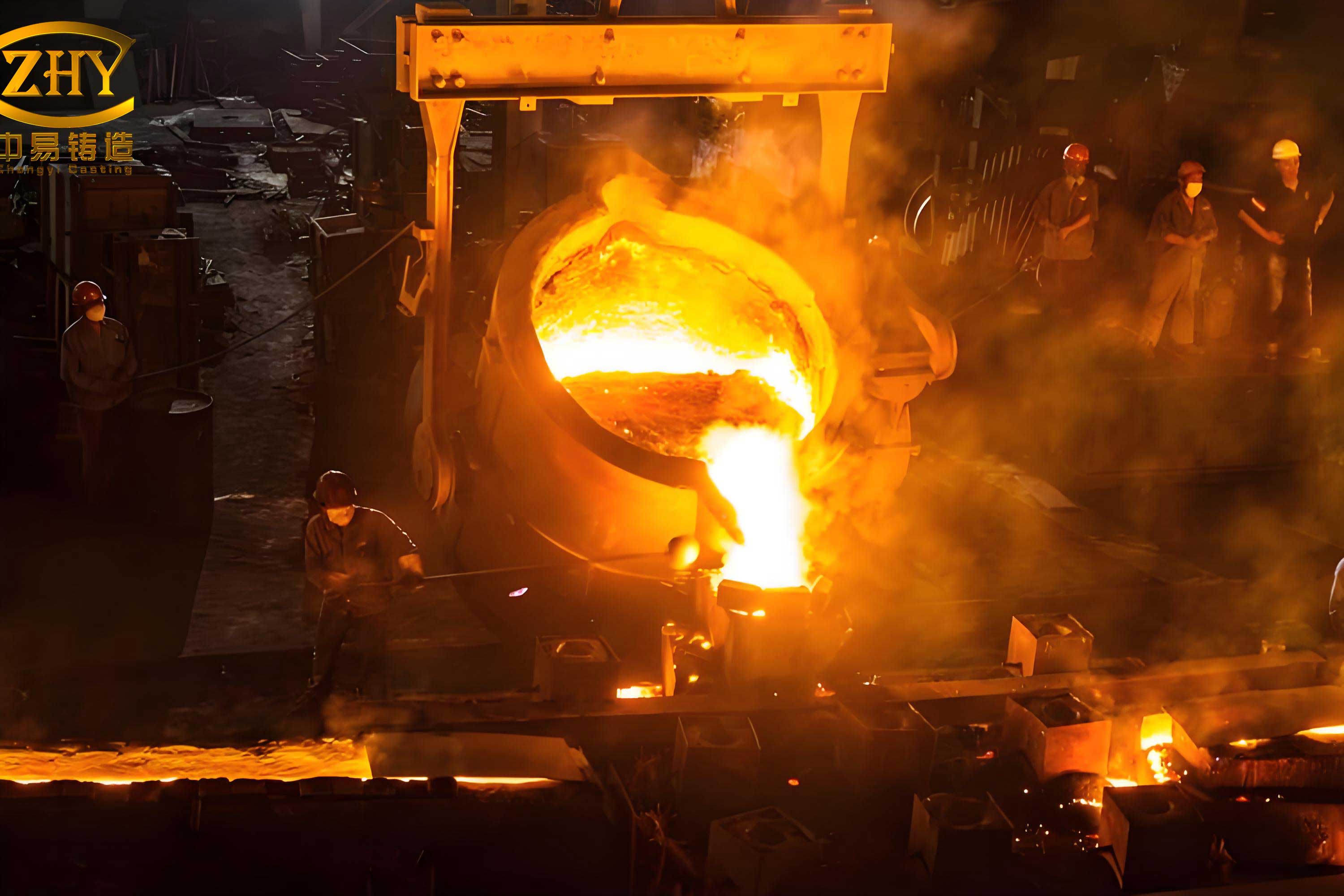
The image above exemplifies the intricate geometries achievable in sand castings through digital methods, showcasing components produced via 3D-printed sand molds. This visual underscores the precision and complexity enabled by this technology, which is further enhanced by hybrid molding techniques.
Hybrid molding with dual materials addresses the trade-offs between complexity, precision, and efficiency in sand castings. In this approach, we combine different molding materials and methods based on the casting’s requirements. For a large sand casting with a simple exterior but complex, non-machined interior, the outer mold can be made manually using resin-bonded sand, while the inner core is produced via 3D printing of sand. This leverages the speed of manual molding for less critical areas and the accuracy of additive manufacturing for intricate features, resolving conflicts between dimensional stability and production time in sand castings. A key aspect is the interface between the two materials; we design 3D-printed core prints with precise slots that embed into the manually molded sections, ensuring accurate alignment. This coupling eliminates the need for core boxes, slashing mold-making time. The technique’s efficiency can be summarized in a formula for total mold-making time \( T_m \):
$$ T_m = T_{manual} + T_{print} – T_{overlap} $$
where \( T_{manual} \) is time for manual molding, \( T_{print} \) for 3D printing, and \( T_{overlap} \) represents time saved through integration. For sand castings, this hybrid method reduces \( T_m \) by up to 50%, as manual work focuses on bulk areas, and printing handles fine details. Additionally, it enhances process stability because 3D-printed cores maintain consistent dimensions, unlike wooden patterns that degrade. This is particularly beneficial for sand castings requiring high internal accuracy, as it mitigates variations from manual operations.
When dealing with large sand castings, 3D printing of sand molds presents unique challenges due to equipment size limitations and handling issues. To overcome these, we develop advanced sand mold design strategies, including block partitioning and lifting mechanisms. Since printers have finite build volumes, large sand molds must be divided into smaller blocks for printing and later assembled. A staggered block scheme is employed: horizontal splits at critical planes facilitate chill placement and cleaning, while vertical splits are layered alternately to prevent metal leakage during pouring. This method balances printability and assembly integrity for sand castings. To further mitigate leakage risks, we incorporate anti-runout grooves at longitudinal joints, which are filled with clay-bonded or resin sand after assembly, virtually eliminating runout. Alignment is ensured via cylindrical locating pins and layer-specific markings, speeding up assembly and reducing errors. The block design can be optimized using a formula for maximum block size \( L_{max} \):
$$ L_{max} = \sqrt[3]{\frac{V_{printer}}{N_{blocks}}}} $$
where \( V_{printer} \) is the printer’s build volume, and \( N_{blocks} \) is the number of blocks. For sand castings, this ensures efficient use of printer capacity while maintaining structural strength.
Lifting and handling of large 3D-printed sand molds are critical, as they lack the support of traditional flasks. We design integrated lifting features: for lighter sand molds, handles are printed directly into the mold for manual or sling lifting; for heavier ones, lifting holes are incorporated, and metal bars are inserted to serve as lifting points. This approach supports sand castings up to 400 kg, with scalability for larger weights. The lifting force \( F_{lift} \) required can be calculated as:
$$ F_{lift} = m \cdot g \cdot k $$
where \( m \) is the mold mass, \( g \) is gravity, and \( k \) is a safety factor (typically 1.5 for sand castings). These designs also aid in core venting during pouring, enhancing the quality of sand castings by reducing gas defects. Below is a table summarizing key design parameters for large 3D-printed sand molds in sand castings:
| Design Parameter | Typical Value for Large Sand Castings | Purpose |
|---|---|---|
| Block Size (max dimension) | 500-800 mm, depending on printer | To fit printer volume and ease handling |
| Anti-runout Groove Width | 10-20 mm | To prevent metal leakage at joints |
| Lifting Hole Diameter | 30-50 mm for metal bars | To ensure secure lifting of heavy sand molds |
| Locating Pin Diameter | 20-30 mm | To achieve precise assembly alignment |
| Layer Staggering Offset | 50-100 mm | To enhance joint strength and leak resistance |
These parameters are derived from empirical studies on sand castings and ensure robust mold performance. By integrating block partitioning and lifting solutions, we enable the production of massive sand castings with complex internal features, previously unattainable with traditional methods.
Simulation plays a pivotal role in optimizing sand castings, particularly for predicting and mitigating defects. Using finite element analysis, we model thermal gradients during solidification, which influence shrinkage and porosity in sand castings. The Niyama criterion, often applied in sand castings, helps predict shrinkage porosity based on local thermal parameters:
$$ NY = \frac{G}{\sqrt{T}}} $$
where \( G \) is the temperature gradient, and \( T \) is the cooling rate. Regions with \( NY \) below a threshold (e.g., 1 °C\(^{1/2}\)·s\(^{1/2}\) for aluminum sand castings) indicate potential shrinkage defects. By adjusting chill placement or riser design in the digital model, we iteratively improve these parameters, enhancing the soundness of sand castings. Simulation also aids in optimizing pouring times for sand castings, using the Bernoulli equation for fluid flow:
$$ v = \sqrt{2gh} $$
where \( v \) is the metal velocity at the gate, \( g \) is gravity, and \( h \) is the sprue height. This ensures smooth filling without excessive turbulence in sand castings. Combined with digital process design, simulation reduces trial-and-error, cutting development cycles for new sand castings by over 30%.
The economic impact of digital sand casting technology is substantial. By reducing reliance on physical patterns and manual labor, it lowers costs for low-volume or custom sand castings. A cost model for sand castings can be expressed as:
$$ C_{total} = C_{material} + C_{labor} + C_{equipment} + C_{overhead} $$
With digital methods, \( C_{labor} \) and \( C_{overhead} \) decrease due to automation and faster cycles, while \( C_{material} \) remains similar. For sand castings, this translates to a 20-40% cost saving for complex parts. Moreover, the environmental footprint of sand castings is reduced through minimized waste and energy use, as 3D printing consolidates steps and uses recyclable sand. This aligns with sustainable manufacturing goals for the sand castings industry.
In conclusion, digital casting technology based on sand printing represents a paradigm shift for producing advanced sand castings. Through three-dimensional process design, we achieve rapid, flexible, and precise planning for sand castings, slashing development time from weeks to days. Hybrid molding techniques blend manual and automated methods, optimizing efficiency and stability for sand castings with mixed complexity. For large-scale sand castings, innovative block partitioning and lifting designs overcome size and handling barriers, ensuring leak-free assemblies. Simulation tools further refine processes, minimizing defects in sand castings. As this technology matures, it promises to expand the frontiers of sand castings, enabling more intricate, reliable, and cost-effective components across aerospace, automotive, and energy sectors. The journey from traditional to digital sand castings is not just an evolution but a revolution, driven by additive manufacturing and computational power, and I am excited to contribute to this transformative era in foundry practice.