
In the realm of modern foundry practices, the lost foam casting process, particularly under vacuum conditions, has emerged as a predominant method for producing ferrous alloy castings, notably iron castings. This technique offers advantages such as reduced machining allowances and the ability to create complex geometries. However, dimensional stability remains a persistent challenge throughout the entire lost foam casting process. Unlike conventional sand casting, where mold dimensions largely dictate final part size, the lost foam casting process introduces multiple stages where the expendable polystyrene pattern is susceptible to distortion. These stages include pattern fabrication, coating, drying, assembly, vibration compaction, and pouring. For large, thin-walled castings like machine tool beds weighing around 1000 kg, controlling dimensional accuracy is critical to meet stringent tolerances and avoid defects like warping, bending, and thickness variation. This article, from a practitioner’s perspective, delves into a comprehensive analysis of dimensional deformation causes and outlines a systematic framework for dimensional control across the entire lost foam casting process workflow.
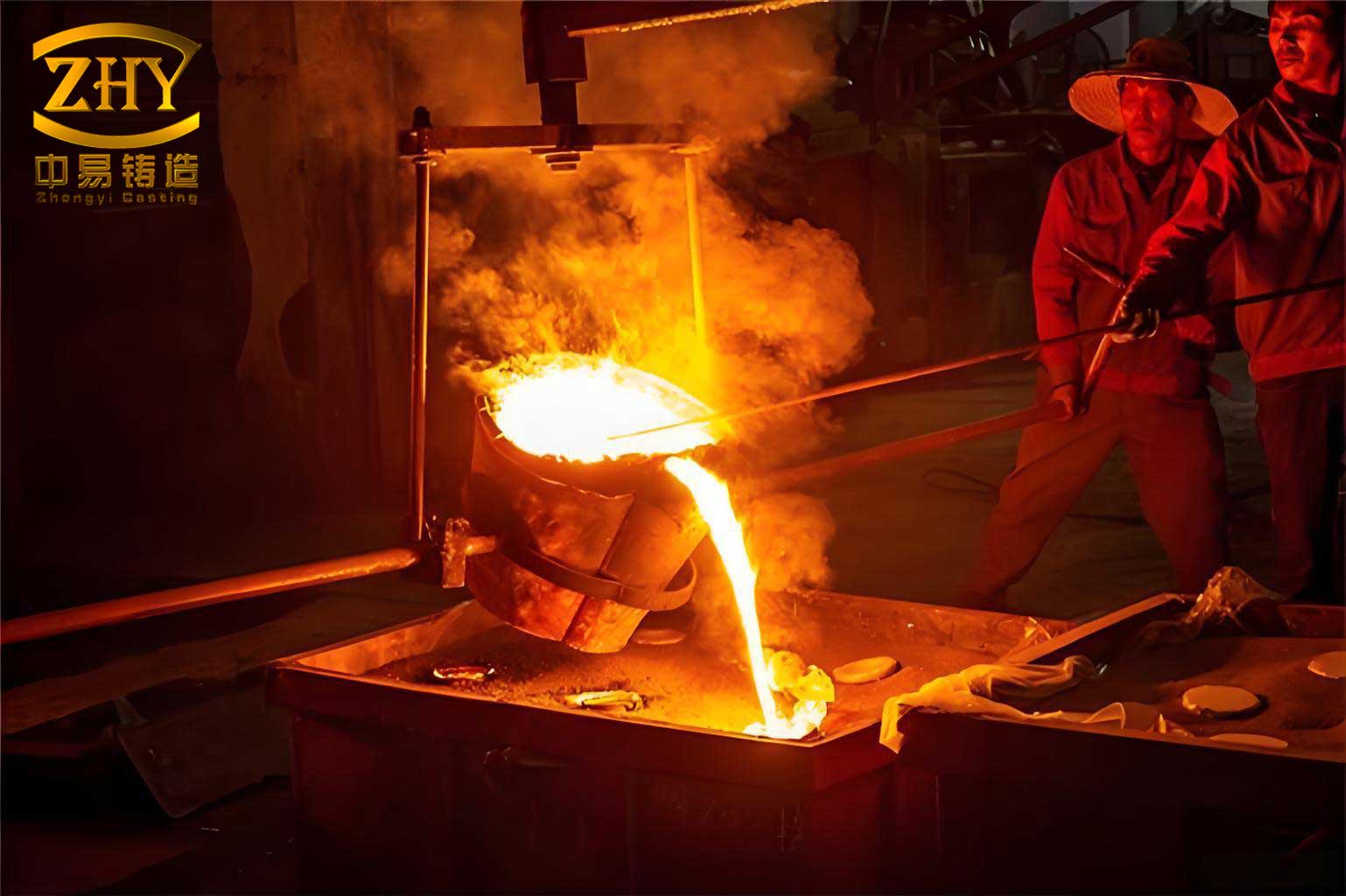
The core issue in the lost foam casting process is that deformation can originate from both intrinsic and extrinsic factors. Intrinsic factors are related to the metallurgical behavior of the metal. During solidification and cooling, the metal undergoes volumetric and linear shrinkage, described by the shrinkage coefficient. The associated thermal stresses, when coupled with the resistance offered by the compacted sand mold, can lead to dimensional distortion or even cracking in the final casting. The fundamental stress-strain relationship during constrained cooling can be expressed as:
$$ \sigma_{thermal} = E \cdot \alpha \cdot \Delta T $$
where $\sigma_{thermal}$ is the induced thermal stress, $E$ is the Young’s modulus of the casting material, $\alpha$ is the coefficient of thermal expansion, and $\Delta T$ is the temperature change during cooling. In the lost foam casting process, this is complicated by the decomposition of the foam pattern, which alters the heat transfer dynamics at the metal-front interface.
Extrinsic factors are far more numerous and are embedded in every operational step of the lost foam casting process. A failure in any single step—be it pattern making, coating, or pouring—can propagate and magnify dimensional errors. Therefore, controlling the lost foam casting process requires a holistic, process-wide quality management system rather than isolated corrections. We have developed and implemented such a system focused on dimensional control, which will be detailed in the following sections.
Deformation Analysis Across the Lost Foam Casting Process Sequence
To effectively control dimensions, one must first understand where and why deformation occurs. The following table summarizes the primary deformation risks at each stage of the lost foam casting process.
| Process Stage | Deformation Mechanism | Key Influencing Factors |
|---|---|---|
| Pattern (Foam) Fabrication | Physical distortion during demolding or machining; improper shrinkage allowance. | Foam bead/board properties, molding parameters (steam pressure, time), demolding technique, machining fixtures and parameters, aging cycle of boards. |
| Pattern Assembly | Misalignment and stress from adhesive bonding; accumulation of sub-component errors. | Accuracy of sub-components, adhesive application and curing, assembly jigs and sequence, correction of pre-existing distortions. |
| Coating Application & Drying | Pattern sagging or bending due to uneven coating weight or improper support during drying. | Coating rheology (density, viscosity), application method (dipping, flowing), drainage, support structure in drying oven, drying temperature/time profile. |
| Pattern Preparation (Black Pattern) | Distortion from pre-filled sand cores in deep cavities creating localized high rigidity. | Design of pre-filled sections, method of core placement, timing of support after filling. |
| Mold Compaction (Vibration) | Pattern deformation due to non-uniform sand bed support and dynamic loads during vibration. | Sand bed preparation (cradle shaping), vibration parameters (amplitude, frequency, time, 3D sequence), gating system rigidity. |
| Pouring & Solidification | Distortion from metallostatic pressure, foam decomposition forces, and inappropriate vacuum level. | Vacuum pressure profile, pouring temperature and rate, foam density, gating design. |
Each stage in the lost foam casting process warrants deeper examination. In pattern fabrication, two primary methods exist: expandable bead molding and machining from foam boards. In bead molding, the expansion and fusion of polystyrene beads inside an aluminum tool is governed by the Clausius-Clapeyron relation for phase change during steaming. The final pattern density $\rho_{foam}$ is critical and must be consistent. Demolding induces stress; if the pattern geometry has undercuts or thin sections, the pressure difference during mold opening can cause tensile deformation. The force during demolding can be approximated by the pressure difference and the projected area:
$$ F_{demold} = (P_{atm} – P_{cavity}) \cdot A_{projected} $$
For machined patterns, residual stresses from the foam board extrusion or expansion process can relax during machining, especially if the board has not been properly aged. The cutting tools also impart thermal and mechanical stress. Incorrect fixturing leads to deflection under cutting forces $F_c$, which can be modeled for simple beams as:
$$ \delta_{mach} = \frac{F_c \cdot L^3}{3 \cdot E_{foam} \cdot I} $$
where $\delta_{mach}$ is the deflection, $L$ is the overhang length, $E_{foam}$ is the foam’s modulus, and $I$ is the area moment of inertia. This highlights the need for adequate support during machining in the lost foam casting process.
Pattern assembly is arguably the most critical stage for dimensional error accumulation. When multiple foam segments are bonded, any initial deviation in a segment is transferred to the final assembly. The adhesive, typically a fast-curing polymer, undergoes volumetric shrinkage during curing, which can pull adjacent sections. We control this by using calibrated assembly fixtures and performing intermediate dimensional checks. The total accumulated error $\epsilon_{total}$ in an assembly of $n$ parts can be expressed as a root-sum-square of individual errors $\epsilon_i$, considering both systematic and random errors:
$$ \epsilon_{total} = \sqrt{\sum_{i=1}^{n} \epsilon_i^2} $$
Coating application in the lost foam casting process is another vulnerability. The coating slurry, with a typical density of 1.6-2.0 g/cm³, applies a significant load on the low-strength foam pattern. During flow coating, if the pattern has large horizontal planes, the coating thickness $t_c$ may vary due to drainage, leading to a non-uniform weight distribution. The resulting bending moment $M_b$ on a flat plate of width $w$ and length $l$ due to a differential coating weight $\Delta W$ can be estimated as:
$$ M_b \approx \frac{\Delta W \cdot l}{8} $$
This moment can cause sagging if the pattern is inadequately supported. During drying, convective and radiative heat transfer causes the foam to expand slightly before the coating dries and restricts movement. If the support points are not coplanar, permanent warpage occurs. We design dedicated drying support fixtures that contour the pattern’s geometry to provide uniform, full-area support, drastically reducing drying-induced distortion in the lost foam casting process.
The preparation of the “black pattern” (coated pattern) for molding involves placing resin-bonded sand cores into deep cavities or undercuts to ensure proper sand compaction later. This step, if not managed, introduces localized stiff zones. When the rest of the pattern is soft foam, the differential rigidity can cause bending toward the stiffer side. The effect is analogous to a bimetallic strip, where curvature $\kappa$ is proportional to the difference in effective stiffness:
$$ \kappa \propto (D_{core} – D_{foam}) $$
where $D$ represents the flexural rigidity of the core and foam sections. Therefore, we immediately apply counter-supports to the opposite side of the pattern after core placement to balance the forces.
Mold compaction via three-dimensional vibration is a defining step in the lost foam casting process. The pattern rests on a prepared sand bed. If the sand bed is not sculpted to match the pattern’s underside (a “cradle”), the pattern will bridge unsupported areas. When sand is rained and vibration starts, the dynamic pressure from the sand stream and the inertia forces act on the pattern. The pattern, with its low elastic modulus, deflects into the unsupported voids. The vibration transmits energy through the sand, causing the pattern to settle. The acceleration $a$ during vibration should be optimized; too high an acceleration can cause excessive pattern compression. The relationship between vibration parameters and sand compaction density $\rho_{sand}$ is complex, but a key factor is the vibration intensity $I_v$:
$$ I_v = A \cdot f $$
where $A$ is amplitude and $f$ is frequency. An optimal $I_v$ ensures sand flows into all cavities without deforming the pattern. We use a step-by-step filling and vibration sequence, often starting with low amplitude for filling and increasing for compaction, always monitoring critical dimensions with in-process checks.
Finally, the pouring stage under vacuum completes the lost foam casting process. Vacuum serves two main purposes: it removes foam decomposition gases and stabilizes the sand mold by creating a pressure differential across the mold wall. However, the vacuum level $P_{vac}$ is a double-edged sword. If it is too low ($P_{vac}$ too high relative to atmospheric), the sand may not be sufficiently stabilized, leading to mold wall movement, increased wall thickness, or even collapse. If it is too high ($P_{vac}$ too low), the increased pressure difference can cause metal to penetrate into coating cracks, create sharp edges, or prevent metal from filling thin sections due to excessive restraint. The net pressure on the liquid metal front overcoming the foam degradation products is given by:
$$ P_{net} = \rho_{metal} \cdot g \cdot h + (P_{atm} – P_{vac}) – P_{gas} $$
where $h$ is the metallostatic height and $P_{gas}$ is the counter-pressure from foam pyrolysis gases. An imbalance here affects fill profile and final dimensions. We employ a dynamic vacuum control system that modulates $P_{vac}$ during different phases of pouring and solidification to balance these forces.
A Systematic Framework for Dimensional Control in the Lost Foam Casting Process
Addressing the multifaceted deformation sources requires a structured quality system spanning the entire lost foam casting process sequence. Our approach is built on three pillars: (1) a closed-loop dimensional inspection workflow, (2) standardized measurement and analysis protocols, and (3) targeted corrective actions for each process stage. This system transforms the lost foam casting process from a series of isolated steps into an integrated, controlled manufacturing chain.
The cornerstone is the dimensional inspection workflow, which integrates feedback loops at every major milestone. This workflow ensures that dimensional errors are detected early and corrected at their source, preventing defect propagation. The flowchart below outlines the key decision points and control gates.
| Control Stage | Activity | Acceptance Criteria | Corrective Action Path |
|---|---|---|---|
| Tooling & Pattern Design | Issue product design & shrinkage allowances. | Compliance with lost foam casting process design standards. | Modify design; evaluate mold repair or scrap. |
| Raw Foam Pattern (White Pattern) | 3D optical scanning for full geometry. | Dimensions: 0 to +1 mm from nominal (for machining allowance). | If fail: analyze foam material, molding/machining parameters; repair or scrap tooling. |
| Coated Pattern (Black Pattern) | 3D optical scanning post-coating and drying. | Dimensions: ±1 mm from nominal. | If fail: analyze coating process, drying support; implement anti-distortion fixtures. |
| Process Preparation (CTQ Checks) | Manual measurement of Critical-To-Quality points before molding. | Key dimensions within pre-defined limits. | If fail: adjust core placement, support; review molding setup procedures. |
| Molding Process | In-process checks during sand bed preparation and pattern placement. | Pattern sits flush on contoured sand cradle; no visible gaps. | If fail: re-prepare sand bed; adjust vibration parameters. |
| Final Casting | Comprehensive dimensional inspection after cleaning and rough machining. | Compliance with final part drawing specifications. | If fail: perform root-cause analysis across entire lost foam casting process; update process parameters, allowances, or tooling. |
Standardization of measurement and analysis is vital. We employ non-contact 3D optical scanning (photogrammetry or structured light) for foam patterns and castings. This generates a dense point cloud compared directly to the CAD nominal model. The deviation map is quantified using standard metrics like root-mean-square error (RMSE):
$$ RMSE = \sqrt{\frac{1}{N} \sum_{i=1}^{N} (d_i)^2 } $$
where $d_i$ is the deviation at the $i^{th}$ measured point and $N$ is the total number of points. For process control, we define simplified control limits as noted in Table 2. Key documentation includes the White Pattern Dimensional Report, Black Pattern Dimensional Report, CTQ In-Process Measurement Log, and the Casting/Tooling Dimensional Correlation Analysis Sheet. This last document is crucial for long-term process improvement in the lost foam casting process. It correlates casting dimensions with pattern dimensions and the original design allowance. For example, if a machined surface was designed with a 9 mm allowance, the white pattern measured +0.8 mm (i.e., 9.8 mm total), but the final casting after rough machining measures only 6 mm, then the effective metal shrinkage or process deformation consumed more than anticipated. The allowance $A_{effective}$ can be derived as:
$$ A_{effective} = D_{pattern} – D_{casting} $$
where $D$ represents the dimension at the same location. This data feeds back into the design standards for future parts, continuously refining the predictive models for the lost foam casting process.
The third pillar involves implementing specific anti-distortion measures at each vulnerable step, based on the analysis from the inspection system. For pattern fabrication, we optimize bead molding cycles using designed experiments (DOE) to minimize internal stress. For machining, we mandate a minimum aging period for foam boards, described by a relaxation time constant $\tau$, and use vacuum chucks for fixturing to distribute holding force evenly. During assembly, we use precision-located assembly jigs and specify adhesive application patterns to minimize shrinkage distortion. The adhesive volume $V_{adhesive}$ is controlled per joint length $L_j$:
$$ V_{adhesive} = k \cdot L_j \cdot t_{joint} $$
where $k$ is a process constant and $t_{joint}$ is the gap thickness.
For coating and drying, the most effective measure has been the design of custom drying fixtures. For a large machine bed pattern, we create a negative contour support made from perforated metal or wire mesh that follows the entire pattern geometry, providing uniform upward support. This prevents sagging of large planes. The required support force $F_{support}$ must at least equal the weight of the coated pattern $W_{pattern}$ distributed over the support area $A_{support}$, considering a safety factor $SF$:
$$ F_{support} \geq SF \cdot \frac{W_{pattern}}{A_{support}} $$
In mold preparation and vibration, we have standardized the procedure for creating the sand cradle. Before placing the black pattern, a layer of sand is compacted and then sculpted using a reverse template or a CNC-controlled scraper to within ±2 mm of the pattern’s bottom profile. This ensures full-area support. During vibration, we employ a multi-stage strategy. The first stage with low amplitude and high frequency helps sand flow into cavities. Subsequent stages with higher amplitude in specific directions compact the sand. The vibration time $t_{vib}$ for each stage is determined empirically but can be related to the achieved sand density $\rho_{sand}$ by a logarithmic decay model:
$$ \rho_{sand}(t) = \rho_{max} – (\rho_{max} – \rho_0) \cdot e^{-t / \lambda} $$
where $\rho_0$ is initial density, $\rho_{max}$ is maximum achievable density, and $\lambda$ is a time constant dependent on sand properties and vibration parameters.
For pouring, we control the vacuum profile as a function of time $P_{vac}(t)$. A typical profile starts with a higher vacuum (lower absolute pressure) to ensure mold stability at the start of pouring, then slightly reduces during metal rise to avoid excessive restraint on thin sections, and maintains a steady level during solidification. This profile is optimized through simulation and trial runs for each family of castings in the lost foam casting process.
To consolidate the control measures, we maintain a process control plan that lists all Critical-To-Quality (CTQ) characteristics, their measurement methods, control limits, and responsible actions. A sample extract for a machine bed casting is shown below.
| Process Step | CTQ Characteristic | Measurement Method | Control Limit | Monitoring Frequency |
|---|---|---|---|---|
| Foam Board Aging | Dimensional stability after 48 hrs | Dial gauge on a reference slab | ≤ 0.1 mm/m drift | Per batch |
| Pattern Assembly | Flatness of mounting rail surface | Straightedge and feeler gauge | ≤ 0.5 mm over 1 m | 100% |
| Coating Drying | Surface temperature during drying | Infrared thermometer | 60°C ± 5°C | Per cycle |
| Sand Bed Preparation | Contour deviation from template | Depth gauge at grid points | ± 2 mm | Per mold |
| Vibration Compaction | Acceleration at mold flask corner | Accelerometer | 2.5 – 3.5 G | Per mold cycle |
| Pouring | Vacuum pressure in mold chamber | Pressure transducer | 0.04 – 0.05 MPa (abs) | Continuous, logged |
The integration of these three pillars—workflow, standardization, and targeted actions—creates a robust system for dimensional control. It is important to note that this system is dynamic. Data from the Casting/Tooling Dimensional Correlation Analysis Sheet is regularly reviewed to update the shrinkage allowances and process parameters. This continuous improvement loop is embedded within the lost foam casting process management. For instance, the linear shrinkage allowance $S_a$ for a given dimension is not a fixed value but a function of part geometry, wall thickness $t_w$, and process stability metrics:
$$ S_a = f(t_w, \text{process capability index } C_{pk}) $$
We have observed that by implementing this full-process control system, the dimensional reject rate for complex thin-wall iron castings produced via the lost foam casting process has been reduced significantly. The capability index $C_{pk}$ for critical dimensions has improved, demonstrating reduced variation and better centering of the process mean relative to specification limits.
Conclusion
Dimensional control in the lost foam casting process is a complex challenge that cannot be addressed by focusing on a single stage. Deformation risks are inherent from pattern creation through to solidification. Through a systematic analysis of deformation mechanisms at each step—pattern fabrication, assembly, coating, preparation, compaction, and pouring—we have identified the key extrinsic factors. By establishing a comprehensive dimensional control system comprising a closed-loop inspection workflow, standardized measurement and analysis protocols, and stage-specific anti-distortion measures, it is possible to achieve stable and predictable dimensional accuracy. This holistic approach transforms the lost foam casting process from an art to a controlled science, enabling the reliable production of high-quality, complex castings. The continuous feedback of dimensional data ensures the system is self-improving, adapting allowances and parameters based on actual performance. For foundries aiming to master the lost foam casting process, investing in such a full-process control framework is not merely beneficial but essential for competitiveness in precision casting markets.