
In the realm of advanced manufacturing, rapid prototyping technologies have revolutionized how we design and produce components, particularly in the context of sand casting parts. Sand casting parts are integral to various industries, from automotive to aerospace, due to their versatility and cost-effectiveness for medium to high-volume production. However, traditional methods for creating metal molds for sand casting parts often involve lengthy processes, high material waste, and limited design flexibility. As a researcher deeply involved in laser-based manufacturing, I have explored the potential of laser cladding technology as a direct rapid manufacturing method for producing metal molds used in sand casting. This article delves into the principles, advantages, challenges, and future prospects of using laser cladding to directly fabricate molds for sand casting parts, aiming to highlight how this approach can reduce costs, shorten lead times, and enhance performance.
Laser cladding, also known as laser engineered net shaping (LENS) or directed light fabrication, is a layer-by-layer additive manufacturing process that melts metal powder using a high-power laser beam, depositing it onto a substrate or previous layers to build three-dimensional structures. The process begins with a CAD model of the desired component, such as a mold for sand casting parts, which is sliced into layers. Each layer is then scanned by the laser while metal powder is delivered coaxially or laterally into the melt pool. The rapid solidification of the molten metal results in dense, functional parts with refined microstructures. This technology stands out for its ability to produce near-net-shape components directly from digital designs, minimizing post-processing steps. For sand casting parts, which require precise and durable molds, laser cladding offers a promising alternative to conventional methods like casting or machining.
The core principle of laser cladding can be mathematically described using parameters that influence the melt pool dynamics and deposition quality. Key variables include laser power ( \( P \) ), scanning speed ( \( v \) ), powder feed rate ( \( \dot{m} \) ), and beam diameter ( \( d \) ). The energy density ( \( E \) ) delivered to the material is given by:
$$ E = \frac{P}{v \cdot d} $$
This equation highlights how adjustments in these parameters affect the melt pool size and penetration depth, crucial for achieving dimensional accuracy in molds for sand casting parts. Additionally, the cooling rate ( \( \frac{dT}{dt} \) ) during solidification, which impacts microstructure and properties, can be approximated by:
$$ \frac{dT}{dt} \propto \frac{P \cdot \alpha}{v \cdot \rho \cdot C_p} $$
where \( \alpha \) is the absorptivity, \( \rho \) is the density, and \( C_p \) is the specific heat of the material. Optimizing these parameters is essential for producing high-quality sand casting parts with minimal defects.
Laser cladding technology offers several distinct advantages over traditional manufacturing methods, particularly for applications involving sand casting parts. First, it enables structural optimization through layer-wise fabrication, allowing for complex internal geometries like conformal cooling channels in molds. This can significantly improve the thermal management during the casting process, leading to better quality sand casting parts. Second, the rapid cooling rates associated with laser cladding result in fine-grained microstructures, enhancing mechanical properties such as hardness and wear resistance—critical for molds that endure abrasive sand interactions. Third, the technology supports functional gradation by varying powder composition during deposition, enabling tailored surface properties for different regions of the mold. Fourth, material utilization is high, reducing waste and cost, especially when using expensive alloys for sand casting parts. The following table summarizes a comparative analysis of laser cladding with conventional techniques for manufacturing molds for sand casting parts:
| Manufacturing Method | Material Utilization | Design Modification Time | Production Cycle | Typical Defect Rate | Relative Cost |
|---|---|---|---|---|---|
| Laser Cladding | High (up to 80%) | 1-2 days | 1-2 weeks | Low | Low |
| Traditional Casting | Low (around 20%) | 3-6 months | 3-12 months | High | Medium |
| CNC Machining | Medium (40-60%) | 1-2 months | 1-3 months | Low | High |
From this table, it is evident that laser cladding excels in efficiency and flexibility, making it suitable for rapid prototyping and production of molds for sand casting parts. However, challenges remain, primarily in achieving consistent dimensional accuracy and surface finish. Current systems may achieve in-plane accuracies around 0.1 mm and vertical accuracies of 0.5 mm, which may not suffice for all sand casting parts requiring tight tolerances. Additionally, overhanging structures without supports are difficult to fabricate due to gravity effects, a limitation that must be addressed when designing molds for sand casting parts.
Despite these challenges, the structural and operational characteristics of molds for sand casting parts align well with laser cladding capabilities. Sand casting molds typically feature draft angles to facilitate pattern removal from the sand, and these angles naturally accommodate the layer-wise buildup in laser cladding, minimizing stair-stepping effects. The process inherently produces rounded edges due to melt pool fluidity, which matches the fillet radii required in sand casting parts to reduce stress concentrations. Moreover, complex geometries in sand casting parts, such as cores and loose pieces, can be integrated into the mold design or fabricated separately using laser cladding, avoiding undercuts that are problematic for traditional methods. The working conditions of these molds involve exposure to abrasive sand, necessitating high surface wear resistance—a property that laser cladding can enhance through material selection or gradient deposition. For instance, using tool steel powders on the mold surface while employing lighter alloys for the bulk can improve durability without compromising weight.
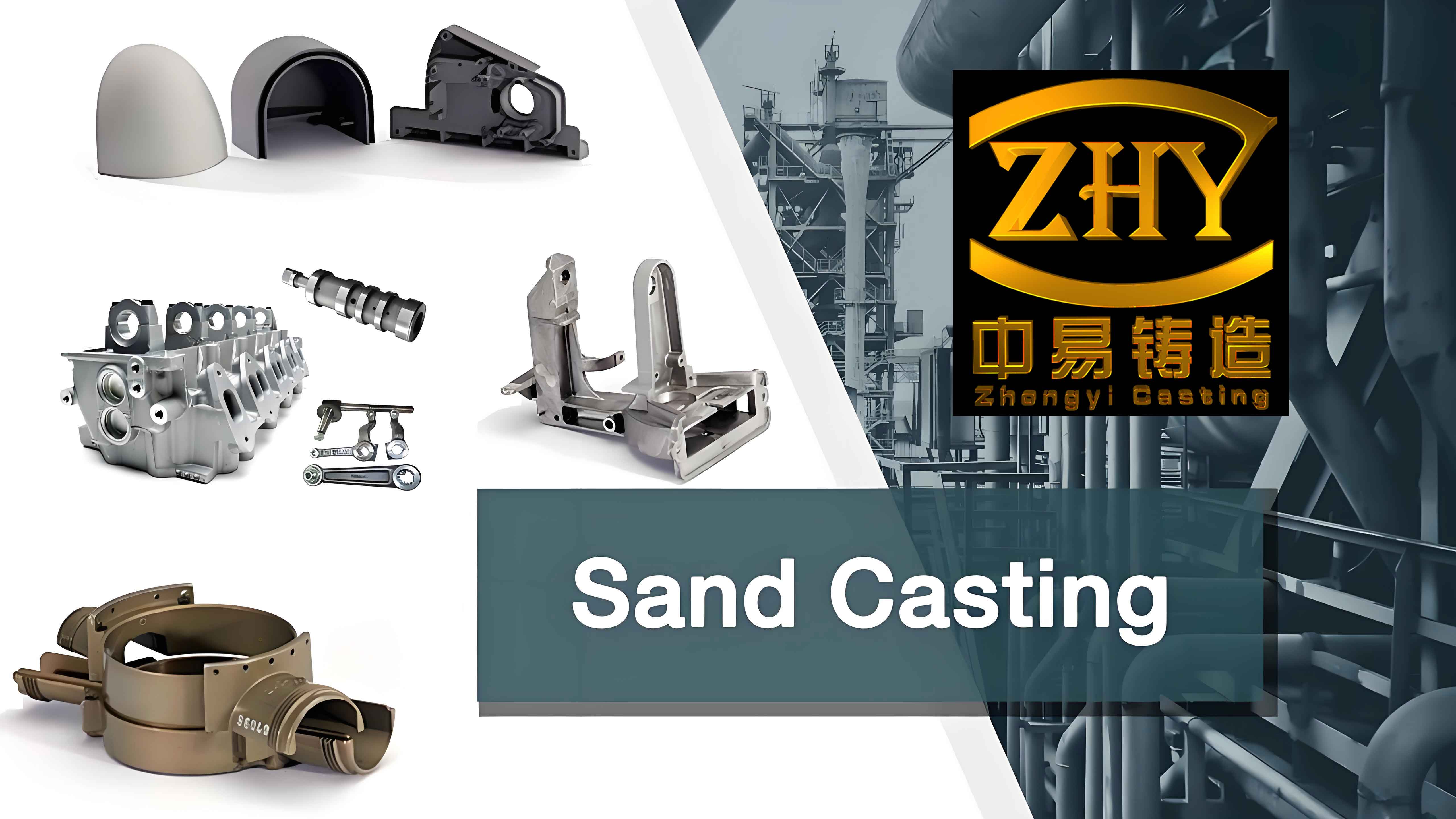
The image above illustrates typical sand casting parts, highlighting the intricate shapes and surfaces that molds must replicate. Laser cladding technology can directly manufacture such molds by depositing metal layer by layer, ensuring precise conformity to these designs. This direct approach eliminates intermediate steps like pattern making or electrode fabrication, streamlining the production of sand casting parts. Furthermore, the ability to incorporate cooling channels within the mold structure during cladding can optimize solidification rates in sand casting parts, reducing porosity and improving mechanical properties. As sand casting parts often vary in size and complexity, laser cladding’s flexibility allows for rapid adaptation to design changes, supporting just-in-time manufacturing paradigms.
To further advance the application of laser cladding for sand casting parts, several improvements are necessary to achieve lightweight and low-consumption outcomes. First, enhancing process efficiency while maintaining accuracy is crucial. Real-time monitoring systems using acoustic or optical sensors can provide feedback on melt pool conditions, enabling dynamic control of parameters like laser power and scan speed. This can be modeled using control theory equations, such as:
$$ \Delta P = k_p \cdot e(t) + k_i \int e(t) dt + k_d \frac{de(t)}{dt} $$
where \( \Delta P \) is the adjustment in laser power, \( e(t) \) is the error between desired and actual melt pool dimensions, and \( k_p \), \( k_i \), and \( k_d \) are proportional, integral, and derivative gains, respectively. Implementing such closed-loop control can stabilize deposition, reducing material waste and energy consumption for sand casting parts. Second, the use of lightweight metals, such as aluminum or titanium alloys, for molds can reduce overall weight, but their high reflectivity to common lasers like CO₂ poses efficiency challenges. Optimizing powder composition with absorptive additives or using alternative laser sources (e.g., fiber lasers) can mitigate this, as described by the Beer-Lambert law for energy absorption:
$$ I(z) = I_0 e^{-\alpha z} $$
where \( I(z) \) is the intensity at depth \( z \), \( I_0 \) is the incident intensity, and \( \alpha \) is the absorption coefficient tailored through material engineering. Third, reducing the volume of deposited material by designing hollow or lattice structures within the mold body can lower material usage and production time. This involves computational topology optimization to determine optimal internal geometries that maintain structural integrity for sand casting parts. The stiffness-to-weight ratio can be maximized using formulas like:
$$ \text{Stiffness} = \frac{E \cdot A}{L} $$
where \( E \) is Young’s modulus, \( A \) is cross-sectional area, and \( L \) is length, guiding the design of lightweight molds for sand casting parts. However, fabricating such internal cavities requires multi-axis deposition systems or sacrificial supports, areas needing further research.
The integration of laser cladding with other digital technologies, such as AI-driven design simulation and robotic manipulation, promises to overcome current limitations. For example, machine learning algorithms can predict optimal cladding parameters for specific sand casting parts based on historical data, reducing trial-and-error. A predictive model might use regression equations like:
$$ \text{Quality Score} = \beta_0 + \beta_1 P + \beta_2 v + \beta_3 \dot{m} + \epsilon $$
where \( \beta \) coefficients are learned from datasets, and \( \epsilon \) is the error term. Additionally, hybrid machines combining cladding with milling can achieve superior surface finishes in a single setup, essential for the precise cavities needed in sand casting parts. The economic and environmental benefits are substantial: reduced material waste lowers raw material costs, and shorter production cycles decrease energy consumption, aligning with sustainable manufacturing goals for sand casting parts.
In practice, the direct manufacturing of molds for sand casting parts via laser cladding has been demonstrated in prototyping scenarios, though widespread industrial adoption requires addressing scalability and cost barriers. The table below outlines key performance metrics for laser-cladded molds used in producing sand casting parts, based on experimental studies:
| Metric | Laser-Cladded Mold | Traditional Cast Iron Mold | Improvement |
|---|---|---|---|
| Surface Hardness (HRC) | 55-60 | 40-45 | ~30% increase |
| Wear Resistance (volume loss mm³) | 0.05-0.1 | 0.2-0.3 | 50-70% reduction |
| Production Time (days) | 5-10 | 30-90 | 70-90% shorter |
| Material Cost per Mold ($) | 500-1000 | 1500-3000 | 50-70% lower |
| Dimensional Accuracy (mm) | ±0.1-0.2 | ±0.5-1.0 | 2-5x better |
These metrics underscore the potential of laser cladding to revolutionize mold making for sand casting parts. However, ongoing research must focus on standardizing processes, especially for large-scale sand casting parts where thermal distortion and residual stresses become significant. Finite element analysis (FEA) simulations can model heat accumulation during cladding, using the heat conduction equation:
$$ \rho C_p \frac{\partial T}{\partial t} = \nabla \cdot (k \nabla T) + Q $$
where \( k \) is thermal conductivity, and \( Q \) is the heat source from the laser. By simulating temperature fields, strategies like intermittent deposition or preheating can be devised to minimize distortions in molds for sand casting parts.
Looking ahead, the convergence of laser cladding with advancements in material science, robotics, and digital twins will enable fully automated, efficient production lines for sand casting parts. Lightweight molds with embedded sensors for real-time monitoring during casting could further enhance quality control. For instance, thermocouples deposited within the mold during cladding could provide data on temperature gradients, optimizing pouring parameters for sand casting parts. The ultimate goal is to achieve a closed-loop manufacturing ecosystem where sand casting parts are produced with minimal human intervention, high precision, and near-zero waste.
In conclusion, laser cladding technology presents a transformative approach to directly manufacturing metal molds for sand casting parts. Its advantages in design freedom, material efficiency, and performance enhancement align perfectly with the demands of modern foundries. While challenges in accuracy and overhang fabrication persist, ongoing technological integrations promise to overcome these hurdles. By leveraging real-time control, lightweight materials, and optimized structures, laser cladding can drive the production of sand casting parts toward greater sustainability and cost-effectiveness. As research progresses, I anticipate that this method will become a cornerstone in agile manufacturing, enabling rapid response to market needs for diverse sand casting parts. The future of sand casting parts production lies in embracing such additive techniques, where innovation meets practicality to redefine industry standards.