
In the field of advanced materials engineering, we have been increasingly focusing on enhancing the performance of ductile iron casting, particularly for critical components like crankshafts in automotive engines. Ductile iron casting offers a unique combination of high strength, good ductility, and cost-effectiveness, making it a preferred material over forged steel in many applications. However, as demands for higher power and durability in engines grow, there is a pressing need to further improve the mechanical properties of ductile iron casting. This has led us to explore innovative solidification control techniques, among which ultrasonic melt treatment stands out due to its non-polluting, efficient, and straightforward operation. In this study, we investigate the impact of ultrasonic treatment on the microstructure and mechanical properties of ductile iron casting, with a specific emphasis on crankshaft applications. By applying high-intensity ultrasound to the melt, we aim to refine the solidification structure, reduce defects, and ultimately enhance the strength and toughness of ductile iron casting. The findings from this research could pave the way for broader adoption of ultrasonic technology in industrial foundry processes, contributing to the production of superior ductile iron casting components.
The fundamental principle behind ultrasonic treatment lies in the propagation of high-frequency sound waves through the molten metal. When ultrasound is applied, it induces several effects, including cavitation, acoustic streaming, and mechanical vibration. Cavitation refers to the formation, growth, and implosive collapse of microbubbles in the melt, generating localized high pressure and temperature spikes. This phenomenon can significantly increase nucleation rates by disrupting clusters and promoting heterogeneous nucleation sites. Acoustic streaming, on the other hand, enhances convective flow within the melt, which helps in homogenizing temperature and composition, thereby reducing segregation. The mechanical vibrations can break dendrites and inhibit grain growth. Together, these effects contribute to a refined microstructure in ductile iron casting, which is crucial for achieving better mechanical performance. In our experiments, we focused on how these ultrasonic effects influence key microstructural features such as graphite nodule size and pearlite lamellar spacing in ductile iron casting.
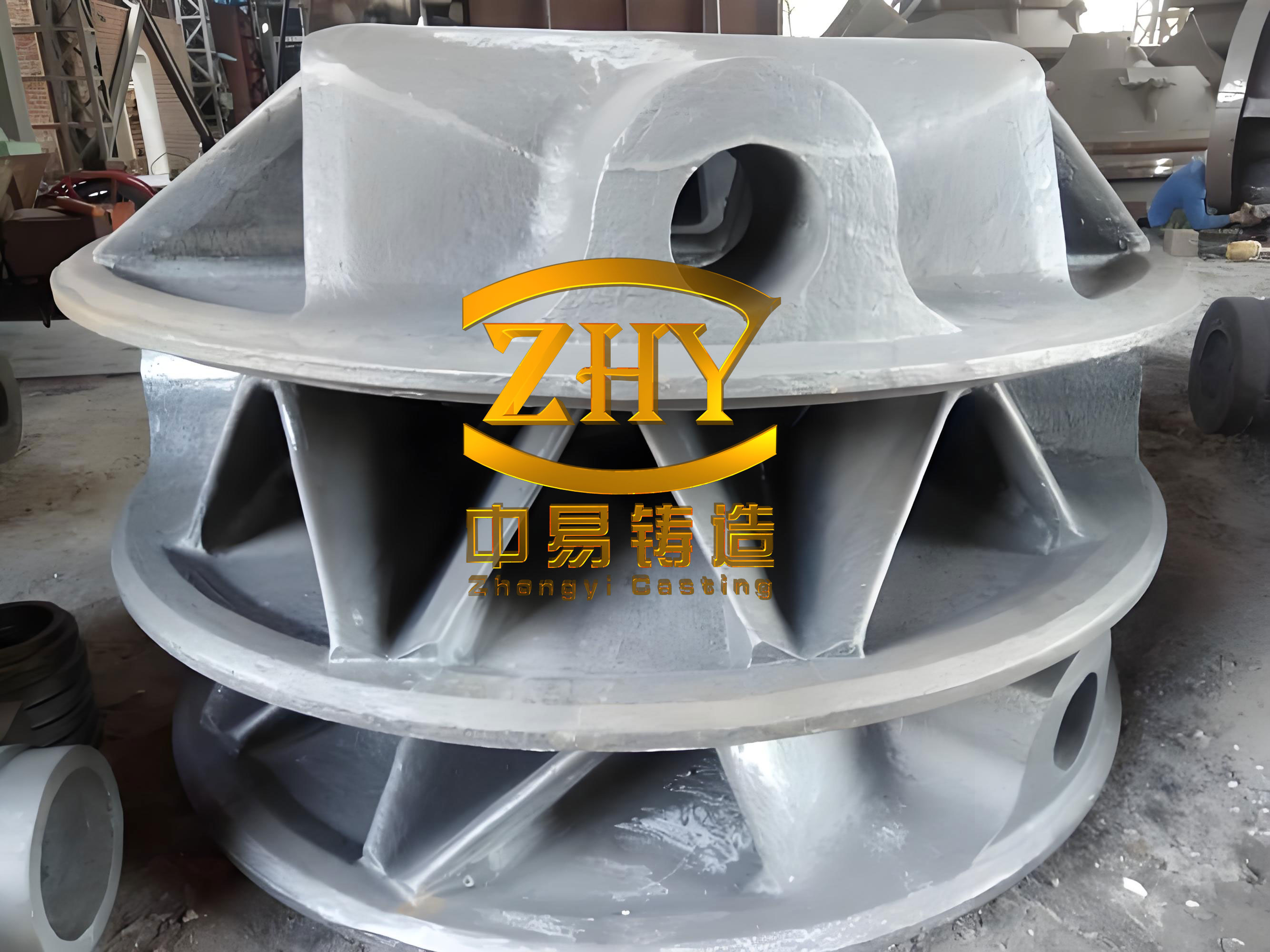
To conduct our study on ductile iron casting, we employed a standard melting and casting process. The charge materials primarily consisted of synthetic iron produced from scrap steel with carbon addition, along with low-sulfur pig iron. Melting was carried out in an induction furnace, where alloying elements were adjusted in the furnace itself. For the production of ductile iron casting, we used a rare earth-magnesium composite nodularizer for spheroidization and 75% ferrosilicon as an inoculant. The casting method involved a sand-coated iron mold process, which is common for crankshaft manufacturing. The chemical composition of the ductile iron casting was carefully controlled, as summarized in Table 1. This composition ensures a balanced matrix suitable for high-strength applications.
| Element | C | Si | Mn | Cu | Mg | P | S |
|---|---|---|---|---|---|---|---|
| Content | 3.7 | 2.0 | 0.4 | 0.6 | 0.05 | 0.05 | 0.02 |
For ultrasonic treatment, we utilized a CYCS-1000TJ fully adjustable digital ultrasonic processing system. The probe was made of graphite, with a length of 340 mm and diameter of 30 mm. The molten ductile iron casting was tapped at 1450°C and transferred to a preheated ladle at 800°C for treatment. The pouring temperature was maintained at 1437°C. Approximately 800 kg of molten iron was treated in the ladle. After adding the nodularizer at 1% of the melt weight and inoculating at a rate of 8 g/s, we immersed the ultrasonic probe to a depth of 150 mm below the melt surface. The ultrasonic parameters varied across experiments, as detailed in Table 2. We conducted three trials with different output currents, each lasting 3 minutes, to evaluate the effect of ultrasonic intensity on ductile iron casting. For comparison, we also produced a reference crankshaft without any ultrasonic treatment, labeled as Sample 0.
| Trial No. | Ultrasonic Frequency (kHz) | Output Current (A) | Duration (min) |
|---|---|---|---|
| 1 | 19.59 | 0.5 | 3 |
| 2 | 20.12 | 1.5 | 3 |
| 3 | 20.3 | 2.5 | 3 |
The cast crankshafts, with dimensions of about 420 mm in length and 140 mm in diameter, were machined to extract tensile and impact test specimens. Sampling positions were standardized from the crankpin region to ensure consistency. We performed microstructural analysis using optical microscopy and scanning electron microscopy (SEM). The specimens were etched with 4% nital solution to reveal the matrix structure. Image analysis software was employed to measure graphite nodule size and pearlite lamellar spacing. Mechanical testing included tensile tests on a 50 kN capacity universal testing machine with specimens of 6 mm diameter and 30 mm gauge length, and impact tests using unnotched Charpy specimens of 10×10×55 mm on a pendulum impact tester. Hardness was measured on the Brinell scale. All tests were conducted in triplicate to ensure reliability.
Our results clearly demonstrate that ultrasonic treatment significantly improves the mechanical properties of ductile iron casting. The tensile strength and elongation of the crankshaft samples are presented in Table 3. Without ultrasonic treatment, the ductile iron casting exhibited a tensile strength of 787 MPa and an elongation of 4.7%. With ultrasonic application, these values increased progressively with higher output currents. At 0.5 A, strength rose to 869 MPa and elongation to 5.5%; at 1.5 A, to 878 MPa and 5.8%; and at 2.5 A, to 892 MPa and 6.6%. This represents an improvement of up to 13.3% in strength and 40.4% in elongation compared to the untreated ductile iron casting. Similarly, impact toughness and hardness showed enhancements, indicating a comprehensive benefit from ultrasonic processing for ductile iron casting.
| Sample ID | Tensile Strength (MPa) | Elongation (%) | Impact Toughness (J/cm²) | Hardness (HBS) |
|---|---|---|---|---|
| 0 (No ultrasound) | 787 | 4.7 | 34 | 267 |
| 1 (0.5 A) | 869 | 5.5 | 41 | 259 |
| 2 (1.5 A) | 878 | 5.8 | 36 | 278 |
| 3 (2.5 A) | 892 | 6.6 | 46 | 281 |
Microstructural observations revealed profound changes in the ductile iron casting due to ultrasonic treatment. The untreated sample displayed a typical “bull’s-eye” structure, where ferrite surrounds graphite nodules in a pearlitic matrix. After ultrasonic treatment, the ferrite content decreased, and pearlite became more predominant. This shift is beneficial because pearlite has higher strength than ferrite, contributing to the improved performance of ductile iron casting. Moreover, we analyzed the graphite nodules in detail. As shown in Table 4, the number of large graphite nodules (with area >100 μm²) and the maximum nodule area decreased with increasing ultrasonic current. This refinement in graphite size is critical, as larger graphite nodules can act as stress concentrators, reducing strength. The relationship between graphite size and strength can be described by a modified Griffith-type equation, where the stress intensity factor is influenced by nodule diameter. For ductile iron casting, we can express this as: $$ \sigma_f \propto \frac{K_{IC}}{\sqrt{\pi a}} $$ where $\sigma_f$ is the fracture stress, $K_{IC}$ is the fracture toughness, and $a$ is the effective flaw size, often related to graphite nodule radius. By reducing $a$ through ultrasonic refinement, $\sigma_f$ increases, enhancing the tensile strength of ductile iron casting.
| Ultrasonic Current (A) | Number of Graphite Nodules (>100 μm²) | Maximum Nodule Area (μm²) | Total Area of Nodules >100 μm² (μm²) |
|---|---|---|---|
| 0.5 | 196 | 2333 | 84084 |
| 1.5 | 174 | 2041 | 61422 |
| 2.5 | 153 | 1822 | 51225 |
The mechanism behind graphite refinement in ductile iron casting involves the cavitation and acoustic streaming effects of ultrasound. Cavitation bubbles collapse violently, generating shock waves that disperse the nodularizing agents more uniformly throughout the melt. This increases the number of effective nucleation sites for graphite, leading to a higher nodule count and smaller individual nodules. Additionally, acoustic stirring prevents agglomeration and promotes homogeneous distribution. The enhanced nucleation rate $N$ can be modeled as: $$ N = N_0 \exp\left(-\frac{\Delta G^*}{kT}\right) $$ where $N_0$ is a pre-exponential factor, $\Delta G^*$ is the activation energy for nucleation, $k$ is Boltzmann’s constant, and $T$ is temperature. Ultrasonic treatment reduces $\Delta G^*$ by providing extra energy through cavitation, thereby increasing $N$. For ductile iron casting, this results in a finer graphite structure, which directly improves mechanical properties.
Another key microstructural feature affected by ultrasonic treatment in ductile iron casting is the pearlite lamellar spacing. Using SEM analysis, we measured the interlamellar spacing of pearlite in different samples. The untreated ductile iron casting had an average spacing of 0.242 μm. With ultrasonic treatment at 2.5 A, the spacing decreased to 0.218 μm and 0.163 μm in different regions, representing reductions of 9.9% and 32.6%, respectively. This refinement is attributed to the ultrasonic energy altering the diffusion kinetics of carbon during the pearlite transformation. The relationship between pearlite lamellar spacing $S$ and yield strength $\sigma_y$ can be described by the Hall-Petch-like equation: $$ \sigma_y = \sigma_0 + k S^{-1/2} $$ where $\sigma_0$ is the friction stress and $k$ is a strengthening coefficient. A smaller $S$ leads to higher $\sigma_y$, explaining the strength improvement in ductile iron casting. Furthermore, reduced lamellar spacing enhances ductility by allowing more uniform deformation across multiple lamellae, which aligns with our observed increase in elongation.
To quantify the overall effect of ultrasonic treatment on ductile iron casting, we can derive a comprehensive model combining graphite and pearlite contributions. The tensile strength $\sigma_t$ of ductile iron casting may be expressed as: $$ \sigma_t = \sigma_{matrix} + \Delta\sigma_{graphite} + \Delta\sigma_{pearlite} $$ where $\sigma_{matrix}$ is the base strength of the iron matrix, $\Delta\sigma_{graphite}$ is the strengthening (or weakening) due to graphite nodules, and $\Delta\sigma_{pearlite}$ is the contribution from pearlite refinement. $\Delta\sigma_{graphite}$ is inversely proportional to graphite nodule diameter $d_g$, such that $\Delta\sigma_{graphite} \propto d_g^{-1}$, while $\Delta\sigma_{pearlite} \propto S^{-1/2}$ as above. Ultrasonic treatment reduces both $d_g$ and $S$, leading to synergistic strengthening. For ductile iron casting, this model highlights how microstructure control via ultrasound can optimize performance.
Fracture surface analysis of tensile specimens provided further insights into the behavior of ductile iron casting. Without ultrasound, the fracture exhibited relatively flat surfaces characteristic of cleavage failure, indicating brittle tendencies. In contrast, ultrasonically treated samples showed rougher fracture surfaces with more deflection of crack paths. This suggests that ultrasonic refinement induced a tougher microstructure, where cracks encounter more obstacles like finer graphite nodules and closer pearlite lamellae, thereby consuming more energy during propagation. The fracture toughness $K_{IC}$ can be related to the work of fracture $\gamma_f$ through: $$ K_{IC} = \sqrt{2E\gamma_f} $$ where $E$ is Young’s modulus. By improving $\gamma_f$ via microstructural refinement, ultrasonic treatment enhances the fracture resistance of ductile iron casting, contributing to better impact toughness as observed.
In addition to mechanical properties, we considered the practical implications of ultrasonic treatment for industrial ductile iron casting production. The process parameters, such as frequency, current, and treatment time, can be optimized based on melt volume and casting geometry. Our experiments used a fixed frequency around 20 kHz and varied current; we found that higher currents (up to 2.5 A) yielded the best results for ductile iron casting. However, excessive power might lead to undesirable effects like excessive turbulence or probe erosion. Therefore, we recommend a balanced approach where ultrasonic intensity is tailored to the specific ductile iron casting application. Moreover, the efficiency of ultrasonic treatment depends on probe design and immersion depth, which should be standardized for consistency.
From a thermodynamic perspective, ultrasonic treatment influences the solidification of ductile iron casting by modifying the undercooling and growth conditions. The acoustic pressure $P_a$ generated by ultrasound can be described by: $$ P_a = P_0 \sin(2\pi ft) $$ where $P_0$ is the pressure amplitude, $f$ is frequency, and $t$ is time. This pressure affects the Gibbs free energy change $\Delta G$ for nucleation, making it more favorable. For ductile iron casting, this promotes finer grains and fewer defects. Additionally, the cooling curve of the melt is altered due to enhanced convection, which can be modeled using heat transfer equations with an added acoustic energy term. Such analysis helps in predicting the microstructure of ductile iron casting under various ultrasonic conditions.
Comparing our findings with prior research, we note that ultrasonic treatment has been applied to other metals, but its effectiveness in ductile iron casting is particularly pronounced due to the dual-phase nature of the material. The refinement of both graphite and pearlite phases sets ductile iron casting apart from single-phase alloys. Future studies could explore the combination of ultrasonic treatment with other alloying elements or heat treatments to further push the limits of ductile iron casting performance. For instance, adding elements like copper or nickel might synergize with ultrasound to achieve even higher strength and wear resistance in ductile iron casting.
In conclusion, our investigation demonstrates that ultrasonic treatment is a highly effective method for enhancing the microstructure and mechanical properties of ductile iron casting. By applying ultrasound to the melt, we achieved significant refinement of graphite nodules and pearlite lamellae, leading to improvements in tensile strength, elongation, impact toughness, and hardness. The optimal results were obtained at an ultrasonic output current of 2.5 A, where ductile iron casting exhibited a tensile strength of 892 MPa and elongation of 6.6%, representing increases of 13.3% and 40.4% over untreated material. These enhancements are attributed to the cavitation and acoustic streaming effects of ultrasound, which promote nucleation, reduce segregation, and refine microstructural features. For industrial applications, ultrasonic treatment offers a clean, efficient, and scalable solution for producing high-performance ductile iron casting components, such as crankshafts, that meet the escalating demands of modern engineering. We believe that wider adoption of this technology will revolutionize the production of ductile iron casting, paving the way for lighter, stronger, and more durable automotive and machinery parts.
To summarize the key relationships in ductile iron casting after ultrasonic treatment, we can present the following formula that encapsulates the strength contribution from microstructural features: $$ \sigma_{total} = \sigma_0 + \alpha \cdot d_g^{-1} + \beta \cdot S^{-1/2} + \gamma \cdot \rho^{1/2} $$ where $\sigma_{total}$ is the overall strength, $\sigma_0$ is the intrinsic strength, $d_g$ is the average graphite nodule diameter, $S$ is the pearlite lamellar spacing, $\rho$ is the dislocation density (which may also be affected by ultrasound), and $\alpha$, $\beta$, $\gamma$ are material constants. This equation highlights how ultrasonic treatment simultaneously optimizes multiple factors in ductile iron casting for superior performance. As research progresses, we anticipate further refinements in ultrasonic protocols that will unlock even greater potential for ductile iron casting in advanced engineering applications.