
As a metallurgical engineer specializing in cast iron technologies, I have spent years investigating the complexities of heavy-section nodular cast iron castings. These components, characterized by their large dimensions and thick walls, present unique challenges due to their high thermal mass and slow solidification rates. In my experience, issues such as shrinkage porosity, inverse chill, graphite degeneration, and element segregation are common in heavy-section nodular cast iron, often leading to degraded mechanical properties, particularly in the core regions. The key to overcoming these challenges lies in a meticulous understanding and precise control of the elemental composition. In this comprehensive analysis, I will delve into the roles of various elements, categorizing them into basic elements, alloying elements, and trace elements, and illustrate their effects through tables and mathematical models. The widespread use of nodular cast iron in industries like power generation and wind energy underscores the importance of this material, and optimizing its composition is crucial for performance and reliability.
The production of heavy-section nodular cast iron castings involves a delicate balance of chemistry. The slow cooling associated with thick sections amplifies the effects of elemental segregation and can lead to the formation of irregular graphite structures, such as exploded graphite or chunk graphite, in the core. This directly impacts tensile strength, ductility, and impact toughness. Therefore, my approach always starts with a fundamental analysis of the iron melt’s composition. The elements can be broadly classified, and their interactions must be carefully managed to achieve the desired matrix structure—be it ferritic, pearlitic, or a tempered matrix—and to ensure a high count of well-formed graphite nodules.
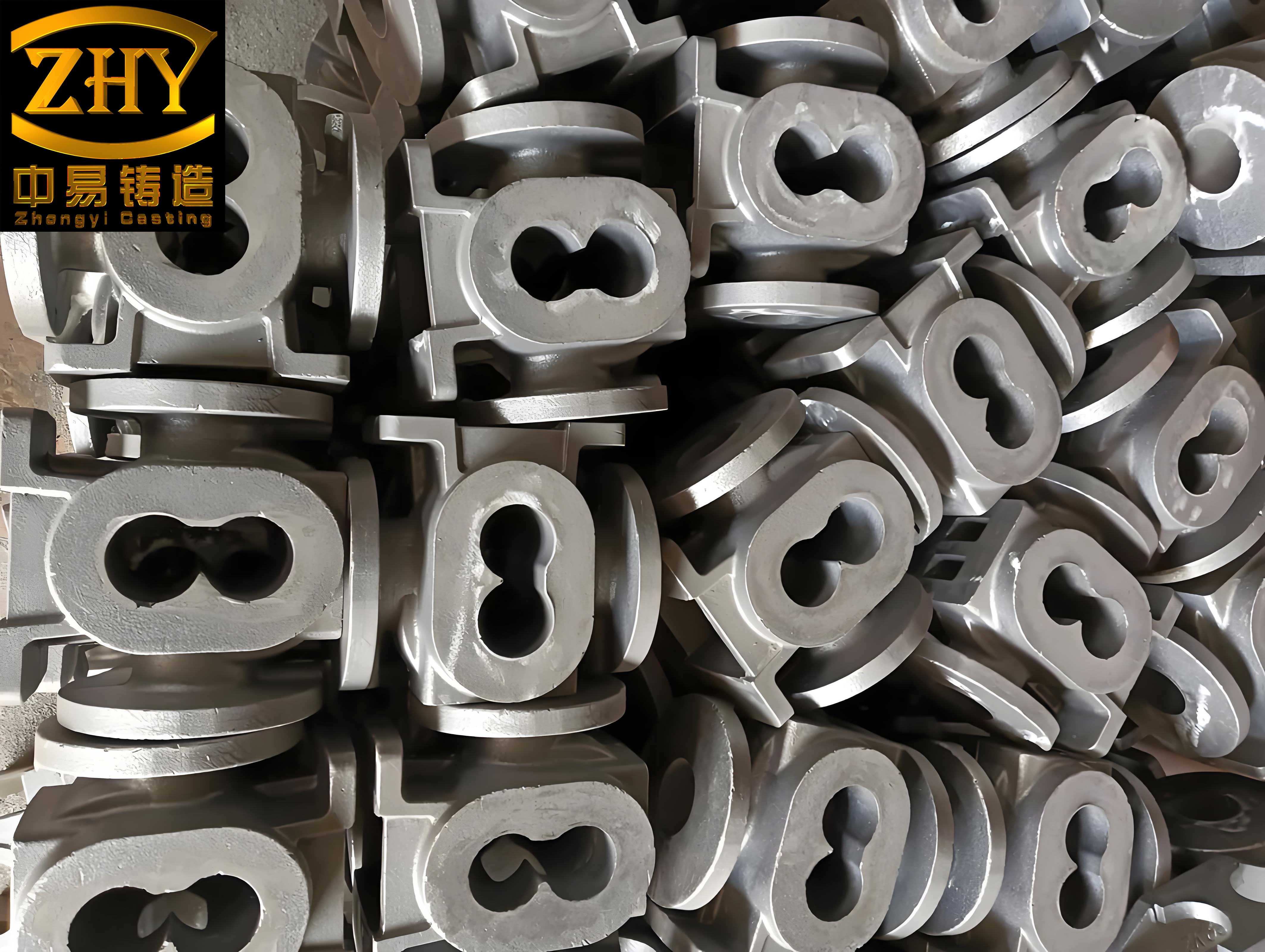
Let me begin with the basic elements, which form the foundation of any nodular cast iron. These include carbon (C), silicon (Si), manganese (Mn), sulfur (S), phosphorus (P), rare earths (RE, primarily cerium), and magnesium (Mg). Their primary functions and optimal ranges for heavy-section castings are summarized in the table below.
| Element | Primary Role in Nodular Cast Iron | Influence on Heavy-Section Castings | Recommended Range (wt.%) |
|---|---|---|---|
| Carbon (C) | Graphitizer, affects fluidity and shrinkage. | High carbon equivalent promotes graphite formation, reduces chilling tendency. Critical for nodule count and shape. | 3.4 – 3.7 |
| Silicon (Si) | Strong graphitizer, ferrite strengthener. | Promotes ferrite, increases strength and ductility. Excess can embrittle and promote oxide slag. Si/C ratio is key. | 1.8 – 2.2 (lower for thicker sections) |
| Manganese (Mn) | Pearlite stabilizer, mild carbide former. | Prone to segregation in thick sections, can reduce toughness. Kept low for ferritic grades. | 0.1 – 0.4 (≤0.3 for ferritic) |
| Sulfur (S) | Anti-nodularizing element. | Consumes nodularizing agents (Mg, RE). Very low levels can reduce nucleation sites. | 0.01 – 0.03 (in base iron) |
| Phosphorus (P) | Impurity, forms phosphide eutectic. | Strong segregation tendency, severely embrittles grain boundaries. Must be minimized. | < 0.02 |
| Rare Earths (RE) | Nodularizing agent, desulfurizer. | Improves nodularization, counteracts trace element interference. Excess can cause carbides. | Residual: RE/S ratio ~1.5-2.0 |
| Magnesium (Mg) | Primary nodularizing agent. | Essential for graphite spheroidization. Excess expands freezing range, promotes microshrinkage. | Residual: 0.04 – 0.06 |
Carbon and silicon are the most critical. The carbon equivalent (CE) is a fundamental parameter for assessing the castability and graphitization potential of nodular cast iron. For heavy-section nodular cast iron, I often use the formula:
$$ CE = C + \frac{Si}{3} + \frac{P}{3} $$
For optimum properties in thick sections, the CE should be close to the eutectic point, typically around 4.2–4.3%. Silicon has a dual role: it is a potent ferrite strengthener but can induce embrittlement at higher levels. The silicon-to-carbon ratio (Si/C) significantly affects mechanical properties. Empirically, I have found that a Si/C ratio between 0.5 and 0.7 often yields the best combination of strength and ductility in heavy-section nodular cast iron. The residual magnesium and rare earth levels are equally vital. The nodularizing reaction can be conceptualized by the following equilibrium, which highlights the necessity to control sulfur:
$$ Mg + S \rightarrow MgS $$
The residual magnesium content, \(Mg_{res}\), must be sufficient to ensure nodularization but not so high as to cause defects. For heavy-section nodular cast iron, I typically aim for \(Mg_{res}\) between 0.04% and 0.06%, with the rare earth residual to sulfur residual ratio maintained above 1.5.
Moving on to alloying elements, these are intentionally added to modify the matrix structure and enhance specific properties. Common alloying elements in heavy-section nodular cast iron include nickel (Ni), chromium (Cr), copper (Cu), molybdenum (Mo), and vanadium (V). Their effects are summarized in the following table.
| Alloying Element | Effect on Matrix | Benefit in Heavy-Section Nodular Cast Iron | Typical Addition Range (wt.%) |
|---|---|---|---|
| Nickel (Ni) | Austenite stabilizer, mild graphitizer. | Improves low-temperature impact toughness, refines pearlite, reduces chilling. | 0.1 – 1.0 |
| Chromium (Cr) | Strong carbide former, pearlite promoter. | Enhances hardenability and wear resistance. Use with caution due to segregation risk. | < 0.05 (to avoid network carbides) |
| Copper (Cu) | Pearlite promoter, strengthens ferrite. | Improves nodule shape and count in pure melts, enhances hardenability. | < 0.5 |
| Molybdenum (Mo) | Carbide former, solid solution strengthener. | Improves high-temperature strength, suppresses temper brittleness, refines structure. | 0.1 – 0.3 |
| Vanadium (V) | Very strong carbide former. | Increases hardness and wear resistance but severely reduces ductility. | < 0.1 |
Nickel is particularly valuable for heavy-section nodular cast iron components intended for low-temperature service, such as wind turbine hubs. It lowers the ductile-to-brittle transition temperature (DBTT). The strengthening effect of nickel in ferritic nodular cast iron can be approximated by a linear relationship for yield strength increase:
$$ \Delta \sigma_{y} \approx k_{Ni} \cdot [Ni] $$
where \(k_{Ni}\) is approximately 18 MPa per 0.5% Ni addition. Molybdenum and copper are excellent for promoting a pearlitic matrix or improving strength at elevated temperatures. However, one must always be wary of segregation. The segregation tendency of an element \(i\) in nodular cast iron during solidification can be described by the partition coefficient \(k_i = C_s / C_l\), where \(C_s\) and \(C_l\) are concentrations in solid and liquid, respectively. Elements with \(k_i < 1\), like phosphorus and molybdenum, tend to segregate to the last-solidifying regions, which are often the intercellular areas in heavy sections. This segregation can be modeled using the Scheil equation for non-equilibrium solidification:
$$ C_s = k_i C_0 (1 – f_s)^{k_i – 1} $$
where \(C_0\) is the initial concentration and \(f_s\) is the solid fraction. This highlights why elements like phosphorus must be kept extremely low in heavy-section nodular cast iron to avoid the formation of brittle phosphide networks at grain boundaries.
Finally, we come to trace elements, which are often present as impurities or are added in minute quantities to influence graphite morphology. These include antimony (Sb), bismuth (Bi), lead (Pb), tin (Sn), and tellurium (Te). Their impact, while small in quantity, is profound on the graphite structure of heavy-section nodular cast iron.
| Trace Element | Effect on Graphite | Interaction & Mechanism | Recommended Limit (wt.%) |
|---|---|---|---|
| Antimony (Sb) | Anti-nodularizing, but can improve nodularity with RE present. | Segregates to graphite surface, stabilizes austenite shell, increases nodule count. | 0.006 – 0.010 |
| Bismuth (Bi) | Anti-nodularizing alone, beneficial with RE. | Forms stable nucleation sites with RE, improves nodule roundness and count. | 0.008 – 0.010 (with RE) |
| Lead (Pb) | Strong anti-nodularizer. | Detrimental to nodularity; even small amounts can cause graphite degeneration. | < 0.004 |
| Tin (Sn) | Pearlite promoter, mild effect on graphite. | In small amounts, can improve nodule count by stabilizing austenite shell. | < 0.08 |
| Tellurium (Te) | Graphite degenerator, but can refine microstructure. | Added in very small amounts to resist graphite distortion in thick sections. | < 0.003 |
The role of trace elements is complex and often synergistic. For instance, in the production of heavy-section nodular cast iron, I have found that a combination of rare earths and bismuth can significantly enhance the nucleation potential. The beneficial effect occurs when the residual rare earth to bismuth ratio is between 1.4 and 1.9. The mechanism can be thought of as the formation of complex (RE,Bi) compounds that act as potent substrates for graphite nucleation. The growth of a graphite nodule in nodular cast iron is influenced by the interfacial energy between graphite and the melt, which is altered by the adsorption of surface-active elements like antimony or tin. The change in interfacial energy \(\gamma\) due to adsorption can be described by the Gibbs adsorption isotherm:
$$ d\gamma = -RT \Gamma_i d\ln a_i $$
where \(R\) is the gas constant, \(T\) is temperature, \(\Gamma_i\) is the surface excess of element \(i\), and \(a_i\) is its activity. A decrease in \(\gamma\) can facilitate graphite growth, but excessive adsorption of certain elements can destabilize the spherical growth interface, leading to degenerated graphite forms. This is especially critical in the slow solidification conditions of heavy-section nodular cast iron.
Now, let’s discuss the application of this knowledge in industrial contexts. Heavy-section nodular cast iron castings are indispensable in demanding sectors like thermal power and wind energy. In my work, I’ve been involved in projects for steam turbine intermediate-pressure outer casings. These castings are massive, with wall thicknesses ranging from 60 mm to over 300 mm. The specifications are stringent: a minimum nodularity grade of 3, graphite size of 5-8, pearlite content ≥10%, and they must pass 100% magnetic particle and ultrasonic testing. For such components, the chemistry is tailored to prevent inverse chill and shrinkage. We employ a high carbon equivalent (around 4.3%) with controlled silicon (≈2.0%), very low phosphorus (<0.02%), and manganese (<0.3%). The nodularizing treatment uses a low-rare earth magnesium ferroalloy, followed by intensive inoculation. The pouring temperature is carefully controlled between 1340°C and 1360°C to ensure proper feeding and structure.
In the wind energy sector, components like hubs, bedplates, and gearbox housings are typically made from ferritic grade heavy-section nodular cast iron, requiring excellent low-temperature impact properties. Here, nickel additions (0.5-1.0%) are common to suppress the DBTT. The key is to achieve a fully ferritic matrix with a high nodule count and small, uniform graphite nodules. The impact toughness \(K\) at low temperatures can be correlated with the matrix purity and nodule characteristics. An empirical relation I often consider is:
$$ K(T) = K_0 \exp\left(-\frac{Q}{RT}\right) \cdot f(N_d, \bar{d}) $$
where \(K_0\) is a material constant, \(Q\) is an activation energy, \(T\) is temperature, \(N_d\) is the nodule count per unit area, and \(\bar{d}\) is the average nodule diameter. A high \(N_d\) and small \(\bar{d}\), achieved through proper inoculation and trace element control, generally lead to better toughness in heavy-section nodular cast iron.
The production process itself must be designed around the chemistry. For instance, the gating system for a heavy-section nodular cast iron casting is often bottom-gated with open risers to promote directional solidification. The reaction kinetics of the nodularizing process can be described by first-order decay models for magnesium fade:
$$ [Mg]_t = [Mg]_0 \exp(-kt) $$
where \([Mg]_t\) is the residual magnesium at time \(t\), \([Mg]_0\) is the initial post-treatment magnesium, and \(k\) is a rate constant dependent on temperature and sulfur content. This underscores the need for rapid pouring after treatment to maintain adequate \(Mg_{res}\) for effective nodularization throughout the heavy section.
Furthermore, the solidification modeling of heavy-section nodular cast iron involves solving the heat transfer equation with a source term for latent heat release:
$$ \rho c_p \frac{\partial T}{\partial t} = \nabla \cdot (k \nabla T) + \rho L \frac{\partial f_s}{\partial t} $$
where \(\rho\) is density, \(c_p\) is specific heat, \(k\) is thermal conductivity, \(L\) is latent heat, and \(f_s\) is solid fraction. The evolution of \(f_s\) is linked to the undercooling and the nucleation/growth of graphite and austenite. The long solidification time in heavy sections allows for significant solute redistribution, as described earlier, making the initial composition choices even more critical.
In conclusion, the successful production of high-integrity heavy-section nodular cast iron castings hinges on a deep, integrated understanding of elemental composition. From the basic elements that define the foundation, through the alloying elements that tailor the matrix, down to the trace elements that fine-tune the graphite morphology, each plays a pivotal role. The interactions are complex, often non-linear, and highly dependent on the section size. My experience has shown that there is no universal recipe; the optimal chemistry for a heavy-section nodular cast iron component must be developed considering the specific casting geometry, desired mechanical properties, and the foundry’s production conditions. However, the principles outlined here—maintaining a high carbon equivalent, minimizing detrimental elements like phosphorus and lead, controlling residual magnesium and rare earths, and carefully employing alloying and trace elements—form a reliable framework. As the demand for large, high-performance components in energy and transportation grows, the role of meticulously engineered nodular cast iron will only become more prominent. Continued research and practical refinement of these compositional guidelines are essential to push the boundaries of what heavy-section nodular cast iron can achieve.