
In the field of metal casting, thick-section ductile iron castings, typically defined as those with wall thicknesses exceeding 100 mm, present unique challenges due to their prolonged solidification times and complex metallurgical behaviors. As a researcher and practitioner in this area, I have extensively studied how chemical composition fundamentally influences the quality and performance of these castings. This article aims to provide a comprehensive review, from my perspective, on the role of various elements in thick-section ductile iron, supported by data, tables, and formulas. The design of chemical composition is not merely a matter of meeting specifications; it is a delicate balance that dictates graphite morphology, matrix structure, and ultimately, the mechanical properties and integrity of the ductile iron casting. Throughout this discussion, the term ‘ductile iron casting’ will be frequently emphasized to underscore its centrality in industrial applications.
The production of high-quality thick-section ductile iron castings relies heavily on three key metallurgical factors: chemical composition, melt purity, and temperature control. Among these, chemical composition is the most controllable variable that directly affects nucleation, growth, and stability of graphite nodules, as well as the prevention of defects such as shrinkage porosity, carbide formation, and degenerate graphite. In my experience, even slight deviations in elemental content can lead to significant variations in the final ductile iron casting properties, especially in heavy sections where segregation tendencies are amplified. Therefore, a deep understanding of each element’s function is paramount.
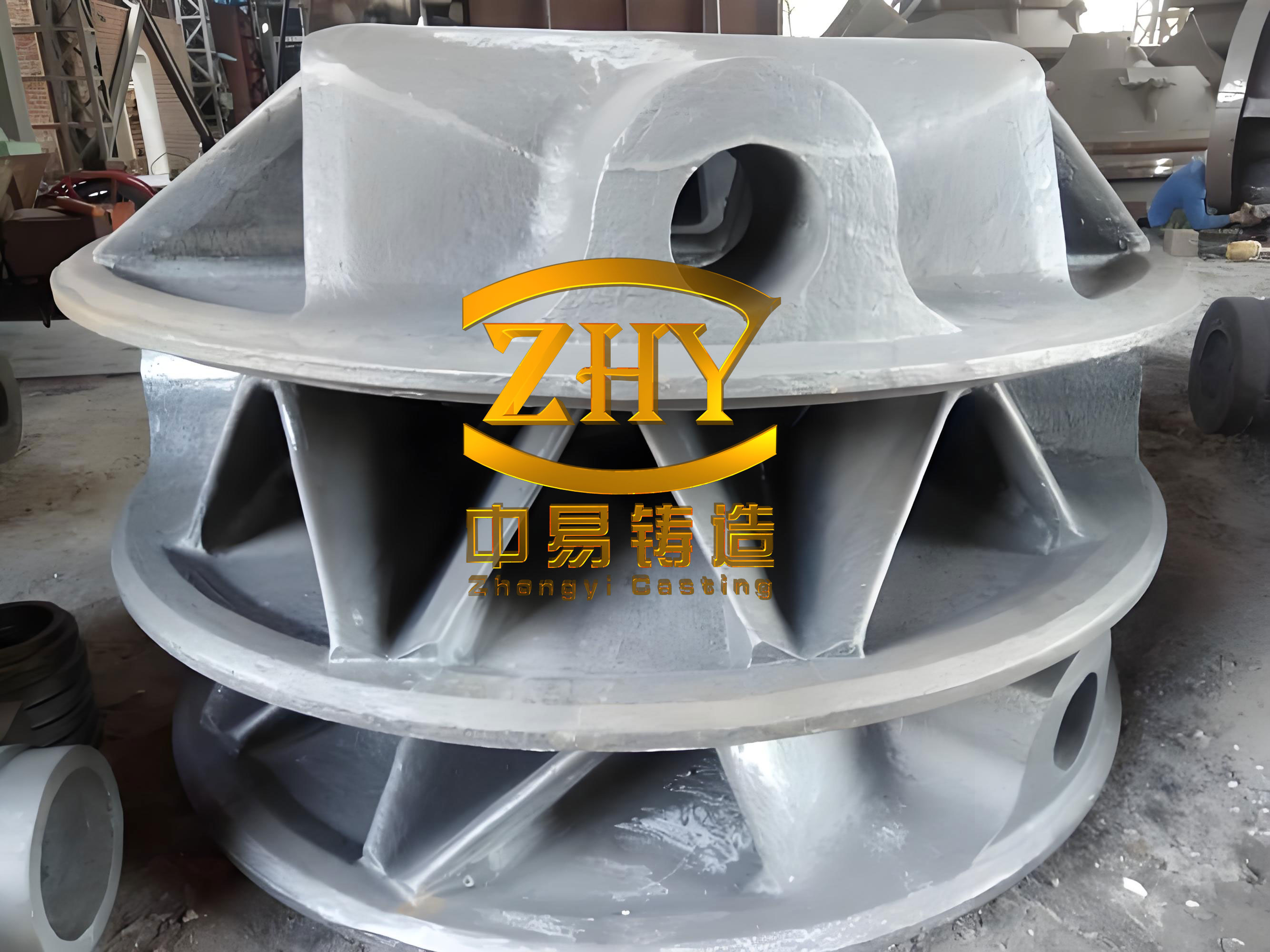
To begin, let’s consider the primary chemical elements in ductile iron castings. Carbon (C) and silicon (Si) are the foremost graphite-forming elements. The combined effect is often expressed via the carbon equivalent (CE) formula, which is crucial for predicting graphite formation and avoiding chill in thick sections. The CE is calculated as: $$CE = C + \frac{Si}{3} + \frac{P}{3}$$ For thick-section ductile iron castings, I have found that maintaining a CE between 4.2% and 4.3% is optimal to ensure adequate graphite precipitation without excessive expansion or shrinkage issues. Silicon, while promoting graphitization, must be carefully controlled; higher levels can embrittle the matrix. In thick-section ductile iron castings, the silicon content is typically limited to 1.8%–2.2%, with lower values for larger wall thicknesses to prevent the deterioration of toughness.
Manganese (Mn) is another key element. It tends to segregate in thick sections, stabilizing pearlite and increasing hardenability, but at the cost of reduced ductility. For ferritic grades of ductile iron casting, I recommend keeping Mn below 0.3%, while for pearlitic grades, it should not exceed 0.5%. Sulfur (S) and phosphorus (P) are detrimental impurities. Sulfur reacts with nodularizing agents like magnesium, consuming them and potentially leading to fading. A minimal residual sulfur level, around 0.01%–0.03% in the base iron, is advisable. Phosphorus, due to its severe segregation, forms brittle phosphide eutectics at grain boundaries, drastically impairing mechanical properties. In thick-section ductile iron castings, phosphorus should be kept below 0.02% to avoid cold cracking and shrinkage defects.
The nodularizing elements, magnesium (Mg) and rare earths (RE), are critical for graphite spheroidization. Their residuals must be precisely controlled. Excessive Mg residual (above 0.05%) can widen the solidification range, promoting shrinkage porosity and slag inclusion. Conversely, insufficient Mg leads to poor nodularity. Based on my observations, an optimal Mg residual range of 0.04%–0.06% and RE residual of 0.01%–0.03% generally yield good graphite nodule count and shape in thick-section ductile iron castings. The ratio of RE residual to S residual is also important; a ratio of 1.5–2.0 is often effective in counteracting trace element interference.
To summarize the effects of primary elements, I have compiled Table 1, which outlines their typical ranges and influences in thick-section ductile iron castings.
| Element | Typical Range (wt%) | Main Influence in Thick-Section Ductile Iron Casting |
|---|---|---|
| C | 3.4–3.7 | Graphite formation, carbon equivalent control |
| Si | 1.8–2.2 | Graphitizer, but reduces toughness at high levels |
| Mn | 0.1–0.4 | Pearlite stabilizer, segregates, affects hardenability |
| S | ≤0.03 | Consumes nodularizers, should be minimized |
| P | ≤0.02 | Forms brittle eutectics, promotes segregation |
| Mgres | 0.04–0.06 | Essential for nodularity, excess causes defects |
| REres | 0.01–0.03 | Aids nodularization, counteracts trace elements |
Moving on to alloying elements, these are intentionally added to enhance specific properties of the ductile iron casting. Nickel (Ni) is a graphitizing element that improves strength and low-temperature toughness without promoting carbides. For thick-section ferritic ductile iron castings requiring high impact resistance at low temperatures, I often add 0.1%–1.0% Ni. Copper (Cu) is another mild graphitizer that strengthens the matrix and increases pearlite content. However, in thick-section ductile iron castings, Cu content is usually kept below 0.5% to avoid excessive hardening and segregation. Molybdenum (Mo) is valuable for improving high-temperature strength and uniformity of microstructure in heavy sections. Additions of 0.1%–0.3% Mo can refine eutectic cells and inhibit temper embrittlement. Chromium (Cr) and vanadium (V) are strong carbide formers; their use must be cautious. While Cr can enhance hardness and wear resistance, it tends to form network carbides at grain boundaries in thick sections if exceeding 0.05%. Similarly, V additions above 0.1% may lead to carbide precipitation and increased shrinkage tendency.
The interaction of these alloying elements can be complex. For instance, the combined effect of Ni and Mo on the hardenability of ductile iron casting can be approximated by formulas such as the ideal critical diameter, but in practice, empirical adjustments are necessary for thick sections. Table 2 provides a concise overview of common alloying elements in thick-section ductile iron castings.
| Alloying Element | Typical Range (wt%) | Primary Benefit in Thick-Section Ductile Iron Casting | Potential Risk |
|---|---|---|---|
| Ni | 0.1–1.0 | Improves toughness, low-temperature properties | Cost increase |
| Cu | <0.5 | Strengthens matrix, promotes pearlite | May increase brittleness |
| Mo | 0.1–0.3 | Enhances high-temperature strength, refines structure | Can promote carbides at high levels |
| Cr | <0.05 | Increases hardness and wear resistance | Risk of network carbides, segregation |
| V | <0.1 | Strengthens matrix, may improve nodule count | Carbide formation, shrinkage |
Trace elements, though present in minute quantities, wield significant influence over the graphite morphology in thick-section ductile iron castings. Antimony (Sb), bismuth (Bi), lead (Pb), tin (Sn), and tellurium (Te) are often discussed. In the presence of rare earths, elements like Bi and Sb can act as inoculants, enhancing graphite nodule count and roundness. For example, a Bi addition of 0.008%–0.010% with a controlled RE/Bi ratio of 1.4–1.9 can stabilize austenite shells around graphite nodules, preventing degenerate growth in thick-section ductile iron castings. However, these elements are double-edged swords; exceeding critical limits leads to graphite distortion and embrittlement. Tin, even at levels as low as 0.08%, can fully suppress ferrite formation, making it useful for pearlitic grades but detrimental to ductility. Tellurium is a powerful carbide stabilizer; traces (below 0.003%) can refine grains and reduce porosity, but higher amounts cause severe brittleness.
The mechanism of trace element action can be modeled using segregation coefficients and interfacial energy theories. For instance, the effect of Sb on graphite spheroid stability might be related to its adsorption at the graphite-liquid interface, altering the interfacial energy $\gamma_{GL}$. A simplified relation could be: $$\Delta \gamma_{GL} = k \cdot C_{Sb}$$ where $k$ is a constant and $C_{Sb}$ is the antimony concentration. However, in practical thick-section ductile iron casting production, such theoretical models are complemented by extensive experimentation.
To illustrate the practical application of these principles, I will recount several production examples of thick-section ductile iron castings. The first case involves a large injection molding machine plate, weighing 55 tons, with a maximum wall thickness of 480 mm. The material specification was akin to QT500-7A, requiring a hardness of 180–220 HB. The chemical composition was meticulously designed with C at 3.5%, Si at 2.0%, Mn at 0.25%, P and S below 0.02%, and Mg residual around 0.045%. A combination of light and heavy rare-earth nodularizers was used. The resulting ductile iron casting exhibited a nodularity of 90% and met all mechanical requirements, demonstrating how balanced chemistry ensures consistency in massive sections.
Another example is a hydraulic cylinder body, weighing 13.5 tons with a 330 mm wall thickness, made of QT600-3. Key demands included pressure tightness and a hardness of 200–250 HB after honing. The composition featured C at 3.6%, Si at 2.1%, Cu at 0.35%, and Mo at 0.15%, with stringent control of P and S. After processing, the ductile iron casting passed hydrostatic tests and magnetic particle inspection without defects, showcasing how alloying elements like Cu and Mo, when properly managed, contribute to the performance of thick-section ductile iron castings under stress.
A third instance is a bearing seat for a mill, weighing 16 tons with sections over 300 mm thick, requiring high elongation (>12%) and full non-destructive testing. The chemistry emphasized low Mn (0.2%), controlled Si (2.0%), and minimal impurities. Inoculation was performed via wire feeding during pouring. The final ductile iron casting achieved over 90% nodularity and satisfied all stringent criteria, emphasizing that even in complex geometries, precise elemental control yields reliable thick-section ductile iron castings.
These examples underscore that successful production of thick-section ductile iron castings hinges on tailoring the chemical composition to the specific casting geometry, wall thickness, process parameters, and technical specifications. It is not enough to follow generic guidelines; one must consider the synergistic effects of all elements. For instance, the carbon equivalent must be adjusted based on the cooling rate, which varies with section size. A modified CE formula for thick-section ductile iron castings might incorporate a cooling rate factor $\alpha$: $$CE_{eff} = C + \frac{Si}{3} + \frac{P}{3} – \alpha \cdot (Mn + Cr)$$ where $\alpha$ is empirically determined. Such adaptations are part of the art and science behind producing superior ductile iron castings.
In conclusion, from my extensive involvement in this field, I assert that selecting an appropriate chemical composition is the foundational step for manufacturing high-quality thick-section ductile iron castings. Every element, from major constituents to trace impurities, plays a role that is magnified in heavy sections due to prolonged solidification and segregation tendencies. The design must align with the material grade, structural complexity, wall thickness, production methodology, and performance requirements of the ductile iron casting. Only by meticulously designing the chemistry and process can we fully unlock the material’s potential, ensure consistent quality, and maintain cost-effectiveness. This holistic approach remains the perpetual goal for producers and researchers dedicated to advancing thick-section ductile iron casting technology. Future work may involve computational modeling to predict elemental effects more accurately, but for now, empirical wisdom combined with scientific principles guides the way forward in this vital sector of metal casting.