
In my long-term research and practical exploration of sand casting defects, I have dedicated substantial effort to understanding and eliminating gas porosity in aluminum alloy castings produced by sand casting. Aluminum alloys are widely used in automotive, shipbuilding, aerospace, and other manufacturing industries due to their excellent mechanical properties, high specific strength and stiffness, and good castability. However, the quality requirements for aluminum alloy castings are increasingly stringent. In addition to ensuring chemical composition, mechanical properties, and dimensional accuracy, defects such as shrinkage cavities, microporosity, gas porosity, and slag inclusions must be avoided. Among these, gas porosity is one of the most frequent sand casting defects encountered in production, especially in large thick sections of aluminum castings, as well as in the riser roots and machined surfaces of medium and small castings. The formation of gas porosity is closely related not only to the moisture content and permeability of the molding sand but also to the melting quality and raw materials of the alloy. In this article, I will share my systematic investigation into the mechanisms of gas porosity formation and the effective measures to eliminate such sand casting defects.
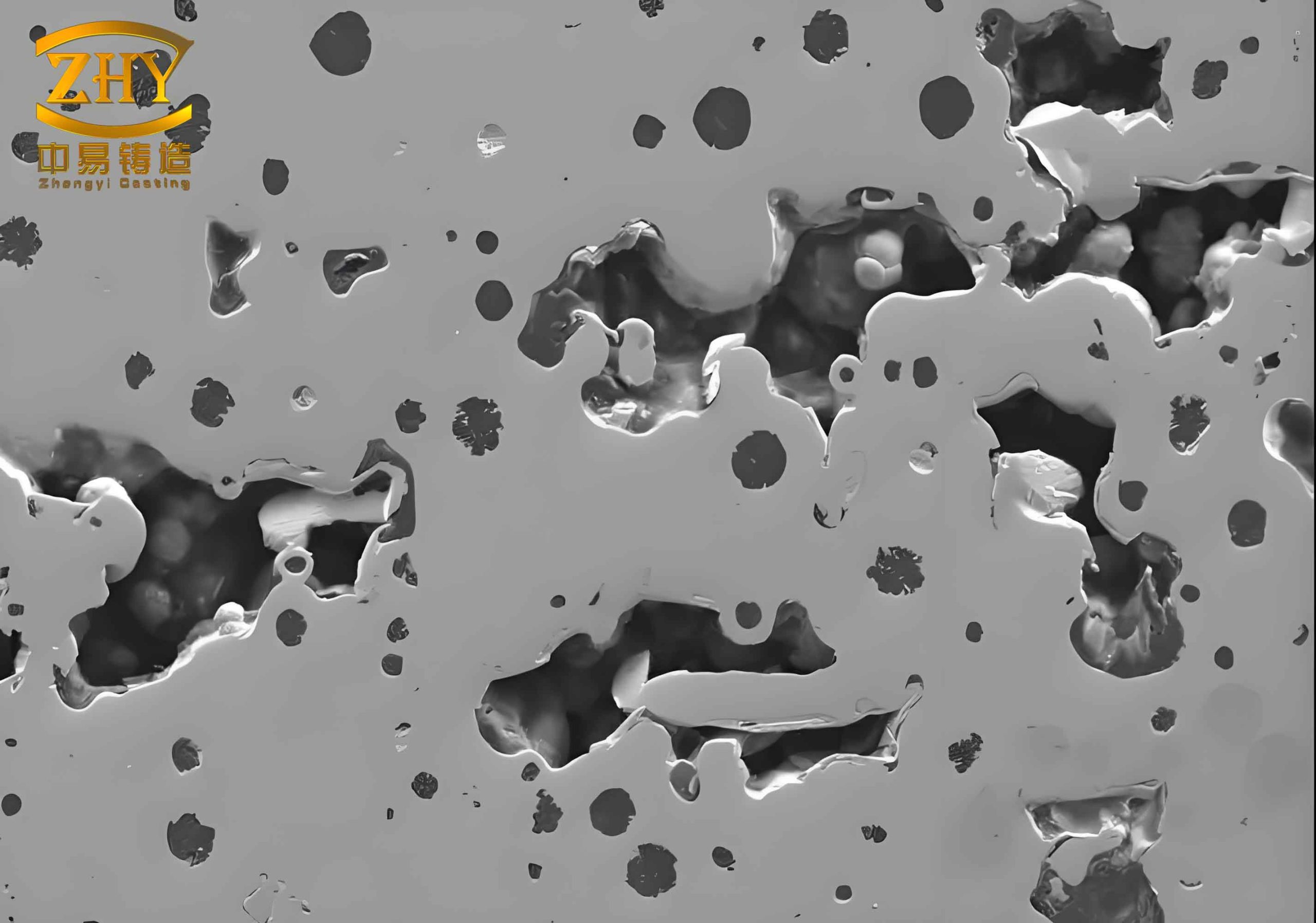
Mechanism of Gas Porosity Formation in Aluminum Alloy Castings
From my extensive analysis, the primary cause of gas porosity in aluminum alloy castings is the excessive hydrogen content dissolved in the molten alloy. Hydrogen constitutes more than 85% of the total gas content in aluminum melts, with the remainder being nitrogen, oxygen, and carbon dioxide. The source of hydrogen is mainly moisture from the atmosphere, raw materials, fluxes, and coatings. At high temperatures, water vapor decomposes according to the reversible reaction:
$$ 2H_2O \rightleftharpoons 2H_2 + O_2 $$
The oxygen released readily reacts with aluminum to form Al₂O₃, promoting further decomposition of water vapor and continuous diffusion of hydrogen ions into the melt. Hydrogen exists in two forms in molten aluminum: about 10–20% is dissolved as atomic hydrogen (solution type), while the rest is adsorbed as molecular hydrogen bubbles on the surfaces or within crevices of inclusions (adsorption type). The solubility of hydrogen in aluminum increases with temperature, as shown by the well-known Sieverts’ law. During solidification, the temperature drops, and the outer layer of the casting solidifies first. Although the solubility of hydrogen decreases, the increasing viscosity of the remaining liquid makes it difficult for hydrogen to escape, leading to the formation of gas porosity.
The solubility of hydrogen in liquid aluminum follows Sieverts’ law, which I have frequently applied to quantify the relationship:
$$ [H] = K \sqrt{P_{H_2}} $$
where \([H]\) is the hydrogen concentration, \(K\) is the solubility coefficient, and \(P_{H_2}\) is the partial pressure of hydrogen above the melt. The coefficient \(K\) is temperature-dependent and can be expressed as:
$$ K = K_0 \exp\left(-\frac{\Delta H}{RT}\right) $$
with \(\Delta H\) being the enthalpy of solution, \(R\) the gas constant, and \(T\) the absolute temperature. In addition, the critical hydrogen content for bubble nucleation can be expressed by the following formula for the critical bubble radius:
$$ r_{crit} = \frac{2\sigma}{\Delta P} $$
where \(\sigma\) is the surface tension of the melt and \(\Delta P\) is the pressure difference. These equations form the theoretical basis for my understanding of how temperature and pressure control can mitigate sand casting defects related to gas porosity.
Factors Influencing Hydrogen Solubility
I have summarized the key factors affecting hydrogen solubility in the following table, which I use to guide process optimization:
| Factor | Effect on Solubility | Practical Implication |
|---|---|---|
| Temperature | Solubility increases with temperature (exponential relationship) | Keep melting temperature below 750°C to reduce absorption |
| Hydrogen partial pressure | Solubility ∝ √(P_H₂) (Sieverts’ law) | Reduce atmospheric moisture; use dry fluxes and tools |
| Alloy composition (Si, Cu) | Si and Cu decrease solubility | Hypoeutectic Al-Si alloys have higher hydrogen pickup |
| Alloy composition (Mg) | Mg increases solubility | Special care needed for Al-Mg alloys |
| Holding time | Longer holding → more gas absorption | Minimize melting and holding time |
| Oxide film condition | Intact film reduces hydrogen entry | Avoid disturbing the surface during melting and pouring |
In my experiments, I have observed that for hypoeutectic Al-Si alloys (e.g., A356), the hydrogen absorption is maximum near the eutectic composition. Therefore, careful control of alloy composition is essential to avoid these sand casting defects.
Effective Measures to Eliminate Gas Porosity Defects
To eliminate gas porosity in sand casting defects, I have developed a comprehensive strategy that addresses raw material preparation, melting practice, mold properties, and pouring techniques. The following table summarizes the key measures I recommend:
| Category | Specific Measure | Rationale |
|---|---|---|
| Raw materials | Remove rust, oil, and flux from all charge materials; preheat crucibles and tools to dark red (about 600°C) | Remove moisture and hydrated oxides; low-temperature drying (200–300°C) only removes free water, while 500°C+ removes crystalline water |
| Melting practice | Keep melting temperature ≤ 750°C; use thermocouple control; minimize holding time | Hydrogen solubility increases sharply above 750°C; longer holding gives more absorption |
| Degassing | Perform thorough degassing using rotary degasser or nitrogen/argon bubbling; use fluxes correctly | Reduce dissolved hydrogen; careful stirring below the surface to avoid entraining oxide films |
| Mold permeability | Control sand permeability between 80–120 (AFS units); adjust moisture content to 4–5% | Too high permeability causes metal penetration; too low traps gases and causes porosity |
| Venting | Drill vent holes in cope and drag; ensure vent tips are 8–15 mm from mold wall; for large castings, raise the mold on sand bed | Allow gases to escape during pouring |
| Core venting | Set up core vents, wax wires, or fill cores with coke/ slag; use asbestos rope at core prints to prevent metal blockage | Binders in cores generate gas; adequate venting reduces back pressure |
| Pouring technique | Pour gently and uniformly; keep minimum vertical distance between ladle and sprue; avoid disrupting oxide film | Reduce turbulence and gas entrapment |
| Chill design | Use chills with vent grooves and refractory coatings | Improve directional solidification while allowing gas escape |
Detailed Discussion of Key Measures
In my practice, the most critical step is controlling the moisture content in all materials contacting the melt. For sand casting defects, moisture from the mold itself is a major contributor. I strictly control the sand moisture between 4% and 5% by weight. If the moisture exceeds 5%, the risk of gas porosity increases dramatically. Additionally, when repairing mold cavities, I limit the amount of water brushed onto the damaged area. The pouring floor should be kept dry to avoid humidity.
For the molding sand, I ensure the permeability is in the range of 80–120 AFS. The facing sand should have slightly lower permeability and hardness to prevent metal penetration, while the backing sand needs higher permeability and hardness for easier handling and better overall gas evacuation. I also drill vent holes in both the cope and drag halves of the mold. The distance from the tip of the vent to the mold cavity wall is typically 8–15 mm; too large a distance reduces venting efficiency. For large castings, additional bottom vents are essential. I sometimes place the entire mold on a raised sand bed to improve bottom venting.
Core venting is another area where I have seen many sand casting defects originate. Binders such as linseed oil and dextrin generate significant gas when heated. I limit the addition of linseed oil to 3–5% and dextrin to 1–2% of the sand weight. The cores are thoroughly baked and cooled before being placed into the mold. For large cores, I embed coke or slag chunks to create internal channels for gas escape, and I use wax wires or drilled holes. At the core prints, I wrap asbestos rope around the core to prevent molten metal from blocking the exhaust path. During pouring, I light the gases escaping from the vents to create a flame that reduces the back pressure and helps gas removal.
Pouring Temperature and Riser Design
For thick-walled aluminum castings prone to sand casting defects, I adopt the principle of balanced solidification. The pouring temperature is controlled between 700–720°C. After filling, I perform a short additional pouring (top-up) to compensate for shrinkage. The casting is allowed to cool for at least 8–12 hours before shakeout to ensure complete solidification and minimize thermal stress. I use blind or open risers with dimensions calculated according to the modulus method. For a given casting wall thickness \(t\), the riser neck diameter \(d_n\) is determined as:
$$ d_n = t \times \left(1.2 \text{ to } 1.5\right) $$
And the riser height is typically 1.5 to 2 times its diameter. For blind risers, I use a formula for the critical neck diameter to ensure feeding without premature freezing:
$$ d_{neck} = 2 \sqrt{\frac{2\sigma}{\rho g h}} $$
where \(\rho\) is the melt density, \(g\) gravity, and \(h\) the metallostatic head. These calculations help me achieve directional solidification and reduce shrinkage-related sand casting defects.
Conclusion
Through systematic investigation and application of the measures described above, I have successfully reduced gas porosity defects in sand casting of aluminum alloys to below 1% rejection rate in my production environment. The key is to integrate material control, melting discipline, mold design, and pouring practice into a coherent process. My experience confirms that sand casting defects related to gas porosity are not inevitable—they can be eliminated by rigorous adherence to the principles of hydrogen solubility control, effective venting, and proper thermal management. I have summarized my approach in a comprehensive flowchart, which I recommend to all practitioners dealing with sand casting defects.
In conclusion, controlling sand casting defects requires a multi-faceted approach. No single measure is sufficient. I emphasize that careful attention to raw material drying, degassing, mold permeability, core venting, and pouring technique, combined with the use of rules like Sieverts’ law and modulus calculations, leads to high-quality aluminum castings free from gas porosity.