
As a practitioner and researcher deeply involved in the field of precision metal casting, I have dedicated significant effort to addressing the persistent issue of shrinkage porosity in investment casting processes. Investment casting, a method renowned for its ability to produce complex, near-net-shape components with excellent surface finish and dimensional accuracy, is nonetheless susceptible to internal defects like shrinkage porosity and micro-shrinkage. These defects arise primarily from the volumetric contraction of molten metal during solidification when adequate liquid feed metal is unavailable to compensate. In my extensive work with investment casting, particularly for flange-type components, I have developed and refined a methodology that leverages numerical simulation, localized cooling, and strategic insulation to enforce a directional solidification sequence, thereby mitigating or entirely eliminating shrinkage-related flaws. This article presents a comprehensive, first-person account of this approach, detailing the analytical framework, practical implementation, and validation through both simulation and physical trials in the context of investment casting.
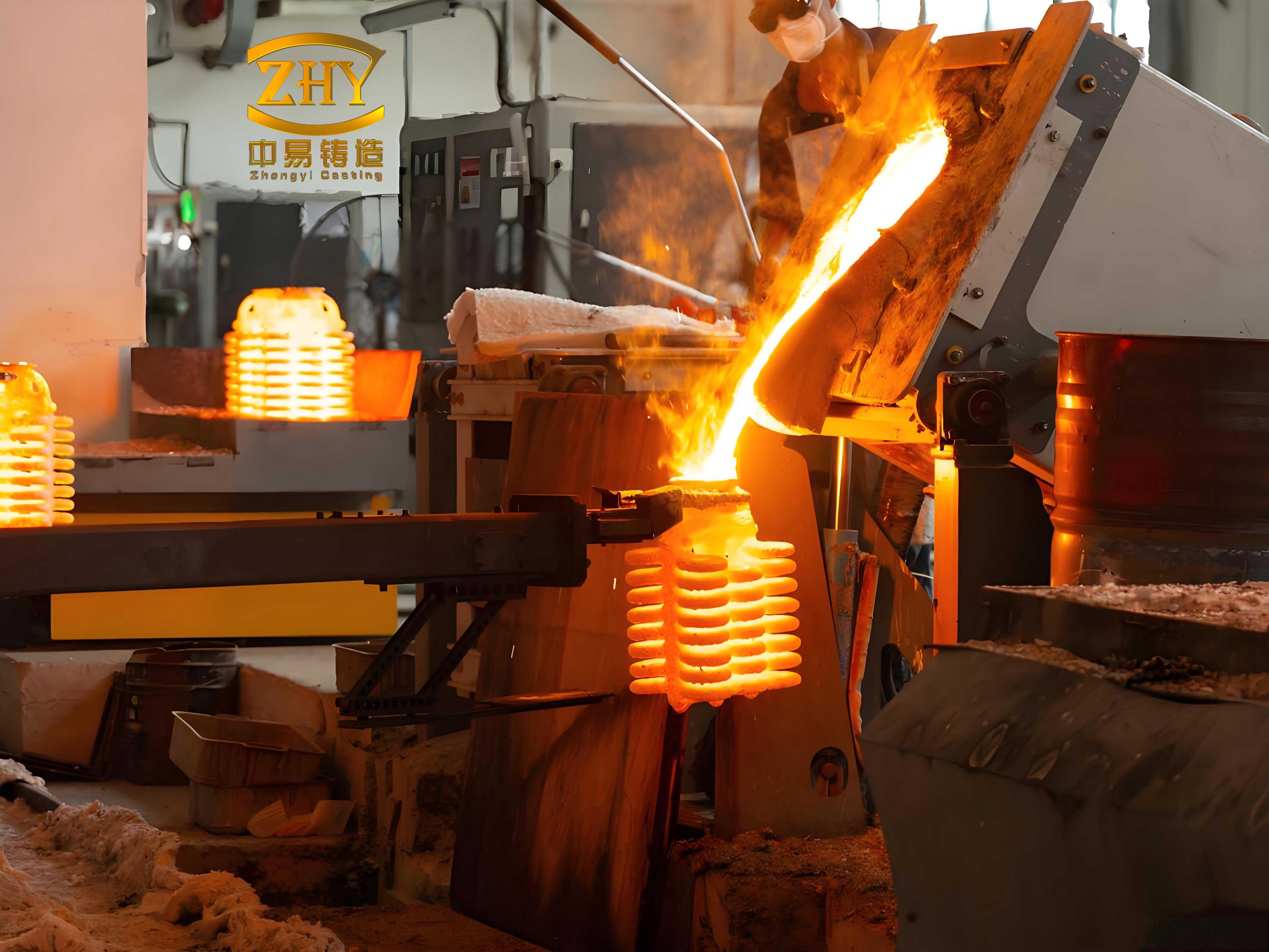
The fundamental challenge in investment casting is controlling the solidification pattern within the ceramic shell mold. Unlike sand casting where chills and risers can be more freely applied, the geometry and shell characteristics in investment casting often restrict conventional feeding solutions. For components like flanges with isolated hot spots and constrained feeding paths, achieving directional solidification—where the section farthest from the feed metal solidifies first, progressing toward the feeder—is critical. My investigation began with a detailed analysis of a specific flange component produced via investment casting, which exhibited severe shrinkage porosity in its thick sections after machining, leading to unacceptable scrap rates. Utilizing advanced Computer-Aided Engineering (CAE) software for solidification simulation, I modeled the initial investment casting process. The simulation clearly revealed that the inherent geometry created thermal bottlenecks, isolating the hot spots from the feeding channels. The liquid metal in these hot spots solidified last, trapping shrinkage porosity due to inadequate metal feed. This confirmed that the root cause was not merely the presence of a hot spot, but the disruption of a continuous thermal gradient necessary for sequential feeding in the investment casting process.
To quantify the thermal behavior, the heat transfer during solidification in investment casting can be described by the general heat conduction equation. For a three-dimensional system, the transient temperature field \( T(x, y, z, t) \) is governed by:
$$
\rho c_p \frac{\partial T}{\partial t} = \nabla \cdot (k \nabla T) + \dot{q}
$$
where \( \rho \) is the density, \( c_p \) is the specific heat capacity, \( k \) is the thermal conductivity, and \( \dot{q} \) is the internal heat generation rate (which includes the latent heat of fusion released during phase change). In investment casting simulations, this equation is solved numerically with boundary conditions accounting for heat loss to the mold and environment. The fraction of solid \( f_s \) evolution, crucial for predicting shrinkage formation, is often modeled using a relationship like:
$$
f_s = \frac{1}{1 – \phi} \left( \frac{T_L – T}{T_L – T_S} \right)
$$
for a simple binary alloy, where \( T_L \) and \( T_S \) are the liquidus and solidus temperatures, and \( \phi \) is a constant. More sophisticated models integrate the cooling curve to account for the release of latent heat. The goal of my process modification was to manipulate these thermal parameters locally to create a favorable \( \nabla T \) direction.
| Parameter | Symbol | Value / Description | Role in Solidification Control |
|---|---|---|---|
| Alloy Type | – | Low-alloy Steel | Determines solidification range and shrinkage tendency. |
| Ceramic Shell Thermal Conductivity | \( k_{shell} \) | ~1.5 W/(m·K) (at high temperature) | Baseline mold material property affecting cooling rate. |
| Insulation Material | – | Aluminosilicate Fiber | Applied locally to retard cooling in feeding channels. |
| Insulation Density | \( \rho_{ins} \) | 180-220 kg/m³ | Lower density enhances insulating effect. |
| Insulation Thermal Conductivity | \( k_{ins} \) | 0.152 W/(m·K) at 800°C | Critical parameter for creating thermal barriers. |
| Insulation Thickness | \( \delta_{ins} \) | 30 mm | Optimized thickness for effective heat retention. |
| Cooling Method for Hot Spot | – | Water Quenching of Shell | Forced convection to dramatically increase local heat extraction. |
| Pouring Temperature | \( T_{pour} \) | ~1550°C | Initial condition for thermal simulation. |
The initial simulation of the standard investment casting process for the flange component showed shrinkage porosity concentrated in two primary hot spots. Merely modifying the gating to a top-pour system, which is often beneficial for directional solidification in investment casting, was insufficient because the flange’s geometry physically blocked the feeding path from the main feeder. My first design iteration involved adding small sacrificial feed ribs or “padding” to the casting geometry near the hot spots, effectively thickening the section to act as an extended feeding channel. This is a common tactic in investment casting to improve feedability. While subsequent simulation showed a reduction and slight relocation of porosity into these ribs, a significant defect level remained, indicating that the thermal gradient was still not optimal. The solidification time difference between the hot spot and the intended feed path was inadequate. This led to the core innovation: the simultaneous application of localized cooling and localized insulation within the same investment casting shell assembly.
The proposed solution is grounded in the principle of creating a strong, controlled thermal gradient. The methodology involves two concurrent actions on the investment casting mold: 1) Applying insulation material to specific regions intended to remain hot and act as feeding channels, and 2) Applying intensive cooling to the thick sections (hot spots) that need to solidify first. This seemingly paradoxical approach—cooling the hot spot while heating the path to it—is what forcibly establishes a true directional solidification sequence in an otherwise problematic investment casting geometry. The insulation, typically a low-density, low-thermal-conductivity ceramic fiber blanket like aluminosilicate, is wrapped around the exterior of the ceramic shell in the designated channel areas. Its effect can be approximated by modifying the boundary condition in that region. The heat flux \( q” \) across the shell-insulation interface can be modeled as:
$$
q” = \frac{T_{shell, outer} – T_{\infty}}{R_{total}}
$$
where the total thermal resistance \( R_{total} \) is significantly increased by the insulation:
$$
R_{total} = \frac{\delta_{shell}}{k_{shell}} + \frac{\delta_{ins}}{k_{ins}} + \frac{1}{h}
$$
Here, \( \delta \) denotes thickness, \( k \) thermal conductivity, and \( h \) the convective heat transfer coefficient to the ambient. By increasing \( R_{total} \) through a high \( \delta_{ins}/k_{ins} \) term, the heat loss from the feeding channel is drastically reduced, slowing its solidification.
| Parameter | Initial Process (Defective) | Modified Process (With Cooling & Insulation) | Implication for Shrinkage |
|---|---|---|---|
| Solidification Sequence | Simultaneous solidification of hot spot and feed channel. | Clear directional sequence: hot spot solidifies first, then feed channel. | Directional solidification enables continuous liquid feed to the hot spot. |
| Thermal Gradient at Hot Spot (℃/mm) | Low (<5) | High (>15) | A steep gradient drives liquid metal toward the solidifying front. |
| Local Cooling Rate at Hot Spot (℃/s) | ~0.5-1.0 | ~3.0-5.0 (estimated from quenching) | Rapid solidification reduces the time window for pore formation. |
| Niyama Criterion Value (G/√R) | Below critical threshold in hot spot. | Above critical threshold throughout casting body. | Predicts absence of shrinkage porosity; G is thermal gradient, R is cooling rate. |
| Feed Path Liquid Availability Time (s) | Shorter than hot spot solidification time. | Longer than hot spot solidification time. | Liquid metal remains available in the path to compensate for shrinkage. |
| Final Defect Location (Simulation) | Internal to casting, in functional areas. | Transferred entirely to the feeder/riser. | Defects are relegated to non-critical sacrificial material. |
Conversely, for the critical hot spot region, the goal is to maximize heat extraction immediately after pouring. In my implementation for this investment casting, this was achieved by water quenching the exterior of the pre-heated ceramic shell in the specific lower region corresponding to the hot spot, just prior to metal pour. This technique induces a very high effective heat transfer coefficient \( h_{quench} \) on that localized shell surface. The heat flux from the casting into the shell at that point becomes extremely high, governed by:
$$
q”_{quench} = h_{quench} (T_{shell, outer} – T_{water})
$$
where \( T_{water} \) is near room temperature. This rapid heat extraction forces the metal in the hot spot to nucleate and grow solid phases much faster than the surrounding areas. The combination of these two local interventions—insulation and quenching—creates a powerful thermal differential. The hot spot cools rapidly and solidifies first, while the insulated feed path remains liquid for a longer duration, effectively opening a “thermal channel” for liquid metal to flow from the feeder or gating system into the solidifying region to feed the volumetric shrinkage. This is the essence of engineering a robust directional solidification environment in a challenging investment casting scenario.
The validation of this approach was conducted in two stages: computational and physical. I performed a new solidification simulation incorporating the modified boundary conditions. The model assigned a high heat transfer coefficient (simulating quenching) to the elements on the shell surface at the hot spot location, and a very low heat transfer coefficient (simulating insulation) to the elements along the feed path. The results were striking. The simulated solidification progression showed a clear front moving from the quenched hot spot upward through the insulated channel toward the feeder. The isolated liquid pools disappeared, and the final porosity indicator, such as the Niyama criterion \( G/\sqrt{R} \), showed values above the critical threshold throughout the casting body, predicting soundness. All predicted shrinkage was successfully moved into the feeder head, which is later removed. This computational proof was compelling, but the true test lies in the foundry. We prepared investment casting shells according to the new design: applying 30mm thick aluminosilicate fiber blankets to the designated feed channel areas on the assembled shell, and establishing a procedure to quickly water-quench the lower shell section post-burnout and pre-pour. After pouring with the same alloy and parameters, the castings were inspected radiographically and sectioned. The results confirmed the simulation: no internal shrinkage porosity was detected in the functional areas of the flange castings. The previously persistent defect was eliminated, reducing the relevant scrap rate for this investment casting component to near zero.
The success of this method hinges on precise application and understanding its scope. It is particularly effective for investment castings that are top-gated and possess isolated thermal centers or hot spots that cannot be directly fed by a conventional riser due to geometrical constraints. The process actively manipulates the local thermal environment of the investment casting shell to impose a solidification sequence that nature would not otherwise follow. To generalize the methodology for other investment casting applications, one can establish a decision framework. First, use numerical simulation to identify the last-to-solidify regions and the potential feeding paths. Second, evaluate the thermal modulus (Volume/Surface Area ratio) of these regions. The required intensity of cooling or insulation can be related to the difference in thermal moduli. A simple guide can be derived: the cooling rate enhancement factor \( F_{cool} \) needed at the hot spot relative to the feed path can be estimated by the inverse ratio of their solidification times, which is related to their moduli squared (Chvorinov’s rule):
$$
\frac{t_{feed}}{t_{hotspot}} \approx \left( \frac{M_{feed}}{M_{hotspot}} \right)^2
$$
where \( M = V/A \). To make \( t_{hotspot} < t_{feed} \), we need to artificially increase the cooling rate at the hotspot. The quenching process aims to achieve this.
| Step | Action | Tool/Method | Key Consideration in Investment Casting |
|---|---|---|---|
| 1. Problem Identification | Locate shrinkage defects via NDT or simulation. | X-ray inspection, Solidification CAE software. | Accurate defect mapping is crucial for targeted intervention. |
| 2. Thermal Analysis | Determine solidification sequence and feeding paths. | Numerical simulation of temperature field and liquid fraction. | Identify which areas need to be cooled (solidify first) and which need to be kept liquid longer (insulated). |
| 3. Insulation Design | Select and apply material to feeding channels. | Ceramic fiber blankets, sleeves, or custom inserts. | Material must withstand shell baking temperatures and not contaminate the investment casting process. |
| 4. Cooling Design | Plan method to intensify heat extraction from hot spots. | Water/air jet quenching of shell, embedded chill materials in mold (if feasible). | Timing is critical—cooling must be applied just before/during pour. Avoid thermal shock cracking of the ceramic shell. |
| 5. Process Integration | Incorporate steps into standard investment casting workflow. | Define sequence: shell preparation -> insulation attachment -> burnout -> localized quenching -> immediate pouring. | Maintain repeatability and safety in a production investment casting environment. |
| 6. Validation & Control | Verify results and establish quality controls. | Statistical process control (SPC) on defect rates, periodic simulation checks for new geometries. | Ensures the solution remains effective across batches in investment casting production. |
Beyond the specific case, this approach has broader implications for the investment casting industry. It represents a shift from passive geometric design (adding feed ribs, enlarging risers) to active thermal management of the mold-shell system. For investment casting of high-performance alloys used in aerospace or medical implants, where internal soundness is paramount, such precise control over solidification can be a key differentiator. Furthermore, it can lead to more efficient investment casting designs by reducing the reliance on excessive feeder metal, improving yield. The method does require additional steps and materials, such as the insulation and quenching setup, which add to process complexity and cost. Therefore, its application is justified for high-value castings or those with chronic defect issues. It also underscores the indispensable role of numerical simulation in modern investment casting. Without the ability to virtually test different cooling and insulation scenarios, developing such a targeted solution would be largely based on trial-and-error, which is time-consuming and costly.
In conclusion, my experience demonstrates that shrinkage porosity in investment castings, particularly in geometrically challenging components like flanges, can be effectively eliminated by engineering a forced directional solidification environment. This is achieved through the synergistic application of localized cooling to accelerate solidification at the problem hot spot and localized insulation to retard solidification along the intended feeding channel. This dual-action strategy, validated through both advanced numerical simulation and practical foundry trials, creates the necessary thermal gradient for sequential solidification, ensuring that liquid metal remains available to feed shrinkage until the final moment. While this method is especially suited for top-gated investment castings with isolated thermal centers, the underlying principle of active thermal gradient control is a powerful tool for enhancing the integrity and quality of a wide range of investment casting products. As investment casting technology continues to advance towards more complex and critical applications, such intelligent manipulation of the solidification process will remain at the forefront of defect mitigation strategies.