
In the contemporary manufacturing landscape, the production of high-integrity, dimensionally accurate sand casting parts remains fundamentally dependent on the quality and sophistication of the mold tooling. Despite significant advancements in machining capabilities and materials over the years, a persistent gap often exists between theoretical mold design and practical foundry requirements. This discrepancy frequently stems from a disconnection between mold design engineering and deep-seated foundry process knowledge. Many mold designs, while geometrically precise, fail to adequately account for the dynamic realities of metal flow, solidification, and the interaction with sand molds, leading to costly post-delivery modifications, scrap, and production delays for sand casting parts.
Therefore, achieving excellence in producing sand casting parts necessitates a paradigm where mold design is treated as an integral extension of the casting process engineering itself. This article, drawing from extensive foundry experience, details a comprehensive approach to sand casting mold design, emphasizing process integration, analytical validation, and material science.
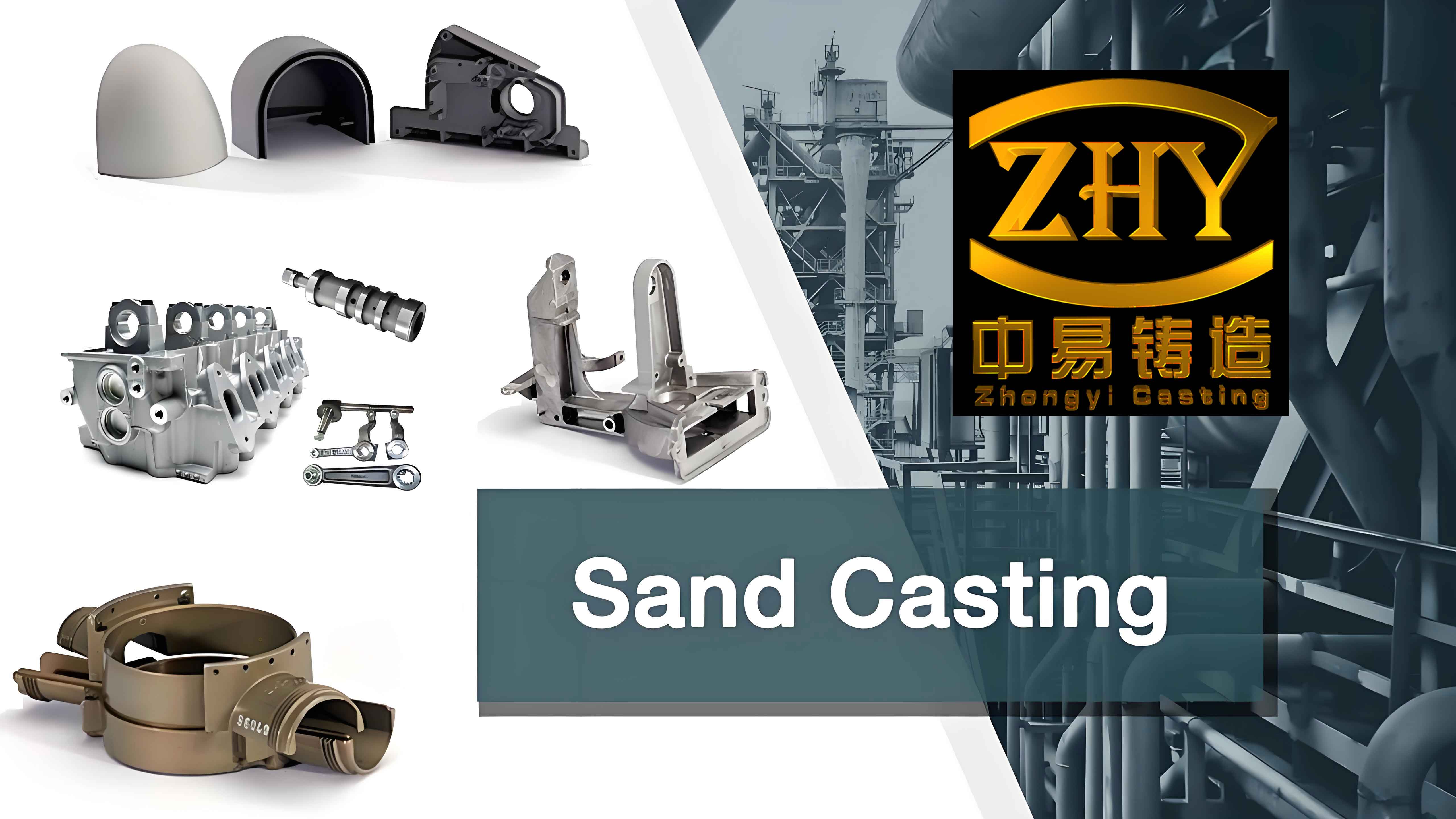
The visual representation above underscores the complexity and variety achievable through sand casting, ultimately realized through meticulously designed molds. To bridge the knowledge gap, it is imperative for foundries to foster or acquire in-house expertise where casting process engineers are intimately involved in, or directly responsible for, the mold design process. This synergy ensures that the tooling is conceived with a full understanding of its life within the foundry environment, directly impacting the quality and yield of sand casting parts.
1. The Imperative of Integrated Process and Mold Design
Outsourcing mold design entirely, while reducing short-term resource allocation, introduces significant long-term risk. Foundries must cultivate internal competency in mold design, ideally by cross-training casting process engineers. This fusion of skills ensures the mold is not merely a shape replicator but a process delivery system. The core of this system is the casting process design embedded within the mold.
2. Foundational Elements of Casting Process Design for Molds
This phase dictates the manufacturability of the intended sand casting parts. Key decisions made here are irrevocably cast into the tooling steel and must be correct before machining begins.
2.1. Parting Line Definition
The parting line is the critical interface between cope and drag mold halves. Its selection is a primary determinant of mold complexity, core necessity, and ease of molding. For automated molding lines, the selection criteria are rigorous and can be summarized algorithmically. The primary objective function is to minimize cost and defect potential, subject to geometric and process constraints.
$$ \text{Minimize } f(P) = w_1 \cdot C_{core}(P) + w_2 \cdot D_{mismatch}(P) + w_3 \cdot L_{fin}(P) $$
$$ \text{Subject to: } g_1(P) \text{ ensures draft, } g_2(P) \text{ allows core placement, } g_3(P) \text{ facilitates venting.} $$
Where \( P \) represents the parting line selection, \( C_{core} \) is core cost/complexity, \( D_{mismatch} \) is potential for misalignment, \( L_{fin} \) is flash length/cleanup cost, and \( w_i \) are weighting factors.
| Selection Criterion | Primary Consideration | Impact on sand casting parts |
|---|---|---|
| Maximize Part in One Half | Place the majority of the casting geometry in either the cope or drag. | Reduces misalignment defects (shift) and minimizes parting-line flash on critical features. |
| Prefer Flat Primary Parting | Use a flat plane as the main parting surface wherever possible. | Simplifies mold machining, improves sealing, and enhances reliability on automatic molding lines. |
| Facilitate Core & Vent Placement | Choose a line that allows stable core prints and unobstructed gas evacuation paths. | Prevents core lift/float and reduces gas-related defects like blows or pinholes. |
| Avoid Functional Surfaces | Do not run the parting line across machined, sealing, or high-stress areas. | Avoids mismatch or flash on surfaces critical to the part’s function or finish. |
2.2. Pattern Allowance (Shrinkage)
Patterns must be oversized to compensate for the contraction of metal from solidus to room temperature. The total linear contraction, or shrinkage allowance, is a function of multiple variables and is unique to each alloy and casting geometry. It can be expressed as a percentage of the nominal dimension:
$$ L_{pattern} = L_{drawing} \times (1 + \alpha_{total}) $$
Where \( \alpha_{total} \) is the total shrinkage factor. This factor is not purely material-based; it is influenced by mold restraint. For instance, ductile iron experiences graphitic expansion which can counteract much of the thermal contraction. The effective shrinkage can be modeled as:
$$ \alpha_{effective} = \alpha_{thermal} – \beta_{expansion} + \gamma_{restraint} $$
A generalized guide for sand casting is:
| Alloy Family | Typical Shrinkage Allowance Range (%) | Key Influencing Factor |
|---|---|---|
| Grey Cast Iron | 0.5 – 1.0 | Section size, cooling rate, carbon equivalent. |
| Ductile (Nodular) Iron | 0.3 – 0.7 | Significant graphite expansion; highly dependent on mold rigidity. |
| Carbon & Low-Alloy Steels | 1.5 – 2.2 | High thermal contraction; consistent across geometries. |
| Aluminum Alloys | 1.0 – 1.3 | Specific alloy (e.g., Si content), pouring temperature. |
| Copper-Based Alloys | 1.2 – 1.8 | Alloy type (Brass vs. Bronze), tin content. |
2.3. Gating and Feeding System Engineering
The gating system is the hydraulic circuit that delivers molten metal to the mold cavity. Its design is paramount for the quality of the final sand casting parts. The goals are to achieve: laminar filling to minimize turbulence, controlled flow velocity, effective slag trapping, and directional solidification towards feeders (risers). Key principles govern this design:
- Minimize Flow Distance & Fill Time: The system should be compact. The fill time \( t_f \) can be approximated using Bernoulli’s and continuity equations, considering the effective head pressure and the total cross-sectional area of the gates \( A_g \):
$$ t_f \approx \frac{V_{cavity}}{A_g \cdot v_g} $$
where \( v_g \) is the gate velocity, ideally kept below a critical threshold (e.g., 0.5 m/s for aluminum, 1.0 m/s for iron) to prevent mold erosion and turbulence. - Choke Area Control: In a pressurized system, the smallest cross-sectional area (the choke) controls the flow rate. The choke area \( A_c \) can be estimated from the required pour weight \( W \) (kg) and pour time \( t \) (s), and fluid density \( \rho \) (kg/m³):
$$ A_c \approx \frac{W}{\rho \cdot t \cdot C_d \cdot \sqrt{2 g H}} $$
where \( C_d \) is the discharge coefficient (~0.8), \( g \) is gravity, and \( H \) is the effective metallostatic head. - Sequential Filling & Venting: The system should be designed to fill the cavity progressively from the bottom or far end, allowing air to escape through strategically placed vents. The volume of venting required must exceed the volume of air displaced.
- Feeder (Riser) Design: Risers are reservoirs of liquid metal to compensate for shrinkage during solidification. For a simple cylindrical top riser, the necessary modulus (Volume/Surface Area ratio) must exceed that of the region it feeds. Chvorinov’s Rule states solidification time \( t_s \) is proportional to the square of the modulus \( M \):
$$ t_s = k \cdot M^n $$
where \( k \) is the mold constant and \( n \approx 2 \). A riser must satisfy \( M_{riser} > 1.2 \times M_{casting} \).
The choice between gating types involves trade-offs:
| Gating System Type | Pressure State | Advantages for sand casting parts | Disadvantages |
|---|---|---|---|
| Pressurized | Choke at bottom of sprue; back-pressure in system. | Fast fill, minimizes oxide formation, self-skimming potential. | High velocity can cause erosion; turbulent entry into cavity. |
| Non-Pressurized (Open) | Choke at sprue base; increasing area to gates. | Laminar flow into cavity, low velocity, less erosion. | Larger system volume (low yield), potential for air aspiration. |
| Step Gating | Multiple gates at different heights. | Excellent for tall castings, promotes bottom-up filling. | Complex pattern, higher machining cost. |
3. Virtual Validation through Casting Simulation
Prior to metal being cut for the mold, the designed process must be validated. Numerical simulation software (e.g., MAGMASOFT®, ProCAST, FLOW-3D® CAST) solves the fundamental equations of fluid flow, heat transfer, and stress to predict the outcome. This allows for virtual prototyping, where the design can be optimized iteratively without physical cost.
The simulation workflow typically solves the Navier-Stokes equations for fluid flow and the Fourier equation for heat transfer:
$$ \rho \left( \frac{\partial \mathbf{v}}{\partial t} + \mathbf{v} \cdot \nabla \mathbf{v} \right) = -\nabla p + \mu \nabla^2 \mathbf{v} + \rho \mathbf{g} $$
$$ \rho C_p \frac{\partial T}{\partial t} = \nabla \cdot (k \nabla T) + \dot{q} $$
where \( \rho \) is density, \( \mathbf{v} \) is velocity, \( p \) is pressure, \( \mu \) is viscosity, \( T \) is temperature, \( C_p \) is specific heat, \( k \) is thermal conductivity, and \( \dot{q} \) is latent heat release.
Engineers analyze results for fill patterns (avoiding jetting, vortices), temperature gradients, shrinkage porosity hotspots, and residual stresses. This step is non-negotiable for first-time-right production of complex or high-value sand casting parts, turning mold design from an art into a predictive science.
4. Strategic Material Selection for Mold Components
The mold is not a monolithic entity but an assembly of components, each serving a distinct function under specific thermal and mechanical loads. Optimal material selection for each component is critical for durability, accuracy, and the consistent production of quality sand casting parts.
| Mold Component | Primary Function & Stressors | Recommended Material & Treatment | Key Material Property Requirements |
|---|---|---|---|
| Pattern Plate | Structural backbone; provides mounting to molding machine; experiences cyclic clamping and modest heating (30-70°C). | High-grade Cast Iron (e.g., GG25/Grey Iron 250). Machined to flatness tolerance. | High stiffness, good damping capacity, dimensional stability under moderate heat, machinability. |
| Pattern Inserts / Cavity Blocks | Forms the actual cavity shape; subjected to abrasive sand impact, thermal cycling, and clamping pressure. | Pre-hardened Tool Steel (e.g., P20, 1.2311) or hardened Stainless Steel (e.g., 420, 1.2083). Often inserted into the pattern plate. | High wear resistance, good polishability, high compressive strength, resistance to thermal fatigue. |
| Gating System Components | Channels high-velocity, abrasive sand during blow-fill; needs to be lightweight for handling. | High-strength Aluminum Alloy (e.g., 7075-T6) or Steel with wear-resistant coating (Hard Chrome, Ni-PTFE). | Wear resistance, low density, good strength-to-weight ratio, corrosion resistance. |
| Core Box (Cold) | Forms sand cores; withstands abrasive sand blasting during shooting, clamping forces, and minor impact. | Machined Cast Iron or Aluminum. Critical wear areas may have steel inserts. | Good machinability, adequate strength, dimensional stability. |
| Core Box (Hot) | Forms cores with heated resin binders; operates at 200-300°C with continuous thermal cycling. | Hot Work Tool Steel (e.g., H13, 1.2344). Must be heat treated (hardened & tempered). | High tempering resistance, thermal fatigue strength, good thermal conductivity, resistance to heat checking. |
| Ejector Pins / Core Box Pins | Ejects cores from box; tip experiences high localized wear and compression. | Tool Steel (e.g., A2, D2) or High-Carbon High-Chromium Steel. Heat treated to high hardness. | High surface hardness (55-62 HRC), high compressive strength, good toughness to prevent breakage. |
| Alignment Bushings & Pins | Ensures precise alignment of mold halves; experiences frequent sliding contact and impact. | Case-hardened Steel (e.g., 8620) or Through-hardened Bearing Steel (e.g., GCr15/52100). | Hard, wear-resistant surface (58+ HRC), tough core to resist shear, excellent dimensional stability. |
5. Conclusion: A Systems Approach to Mold Excellence
The journey to producing flawless, cost-effective sand casting parts begins long before the first mold half is machined. It originates in a holistic design philosophy that unites foundry process mastery with precision tooling design. By internalizing mold design competency, leveraging physics-based simulation for virtual validation, and applying a strategic, component-specific material science approach, foundries can transform their mold tooling from a recurring source of trouble into a reliable engine of quality and profitability. The mold is the crucible where design intent meets physical reality; its design, therefore, must be treated with the rigorous, analytical, and integrated approach it demands, ensuring every batch of sand casting parts meets the highest standards of integrity and performance.