
In industrial applications, ductile iron casting is widely used for components such as glass molds, engine parts, and machinery due to its excellent castability, mechanical properties, and cost-effectiveness. However, under harsh working conditions involving high friction, elevated temperatures, and oxidative environments, the surface of ductile iron casting can suffer from severe wear and degradation, leading to reduced service life and reliability. To address these challenges, surface modification techniques like laser cladding have emerged as effective methods to deposit protective coatings that enhance performance. In this study, we focus on improving the tribological and high-temperature oxidation resistance of ductile iron casting by fabricating ZrB2-reinforced Ni-based composite coatings using laser cladding technology. The objective is to explore how the addition of ZrB2 ceramics influences the microstructure, hardness, friction behavior, and oxidation kinetics, thereby extending the applicability of ductile iron casting in demanding environments.
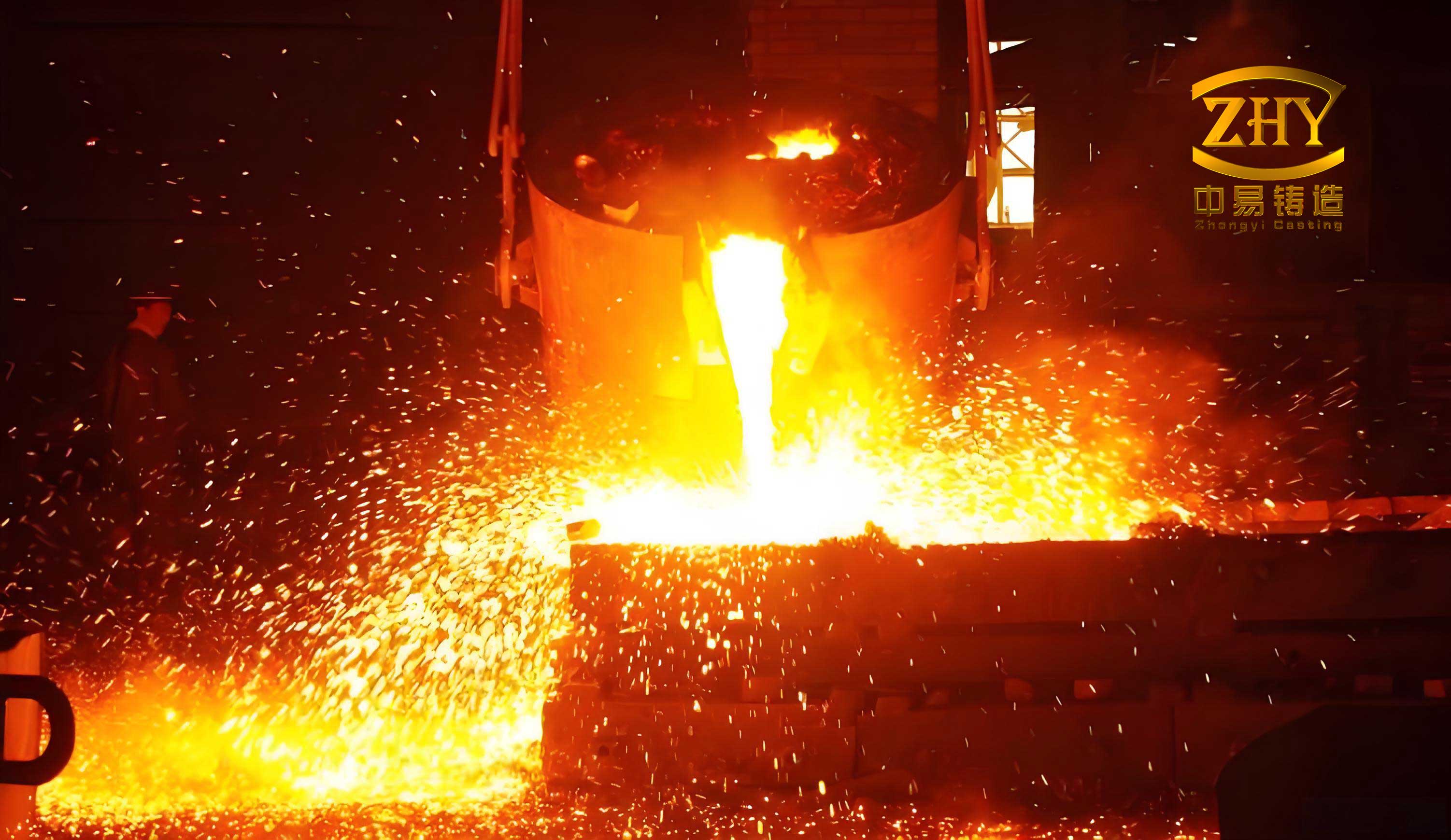
Ductile iron casting, particularly grades like QT500-7, offers a balance of strength and ductility, but its surface properties often require enhancement for long-term operation. Laser cladding, a rapid solidification process, allows for the deposition of metallic and ceramic-reinforced coatings with minimal dilution and fine microstructures. Nickel-based alloys, such as NiCrBSi, are commonly used due to their good wettability, self-fluxing characteristics, and compatibility with iron substrates. However, to further boost wear and oxidation resistance, ceramic particles like ZrB2 are incorporated as reinforcement phases. ZrB2 is known for its high hardness, melting point, and stability at high temperatures, making it an ideal candidate for composite coatings. This research investigates the synergistic effects of ZrB2 and Ni-based matrices on ductile iron casting, providing insights into coating design for improved durability.
The base material used in this study was QT500-7 ductile iron casting, with a composition primarily consisting of iron, carbon, silicon, and magnesium to achieve a spherical graphite structure. The ductile iron casting samples were machined into discs and prepared by grinding and cleaning to ensure proper adhesion. For the coatings, two powder blends were prepared: pure NiCrBSi alloy powder and a composite powder with 10 wt.% ZrB2 added to the NiCrBSi matrix. The NiCrBSi powder had a nominal composition, as summarized in Table 1, while the ZrB2 powder was fine-grained to promote uniform distribution. The powders were mixed thoroughly and dried to prevent moisture-related defects.
| Element | B | C | Cr | Fe | Si | Ni |
|---|---|---|---|---|---|---|
| Content | 1.1–1.5 | 0–0.1 | 0–0.5 | 0–1.0 | 2.3–3.5 | Balance |
Laser cladding was performed using a semiconductor laser system with coaxial powder feeding. The process parameters were optimized to achieve dense and defect-free coatings on the ductile iron casting substrate. Key parameters included a laser power of 2900 W, scan speed of 5 mm/s, powder feed rate of 0.51 g/s, and an argon shielding gas flow. Multiple tracks were deposited with overlap to cover the surface uniformly. The high cooling rates associated with laser cladding led to fine microstructures and strong metallurgical bonding with the ductile iron casting.
After cladding, the coatings were characterized using X-ray diffraction (XRD), scanning electron microscopy (SEM), and energy-dispersive spectroscopy (EDS) to analyze phase formation, microstructure, and elemental distribution. Microhardness was measured across the coating cross-section using a Vickers hardness tester with a 200 g load. Tribological tests were conducted on a ball-on-disc friction wear tester under dry sliding conditions against a silicon nitride counterpart, with a load of 20 N, frequency of 3 Hz, and duration of 30 minutes. The wear rate was calculated using the formula:
$$W_r = \frac{\Delta M}{F \times L}$$
where \(W_r\) is the wear rate in g/(N·m), \(\Delta M\) is the mass loss in g, \(F\) is the applied load in N, and \(L\) is the total sliding distance in m. For high-temperature oxidation resistance, isothermal oxidation tests were carried out at 800°C in air for up to 100 hours, with periodic weighing to determine mass gain per unit area. The oxidation kinetics were analyzed to evaluate the protective nature of the coatings on ductile iron casting.
The XRD patterns revealed distinct phases in the coatings. For the pure NiCrBSi coating, the primary phases were γ-Ni solid solution and NiCx carbides. In contrast, the ZrB2-Ni composite coating showed additional phases, including Ni3B, Ni2Si, Ni3Zr, and Zr5Si4, as summarized in Table 2. These intermetallic and ceramic phases contributed to enhanced mechanical properties. The formation of these phases can be described by reactions during laser melting, such as:
$$ \text{ZrB}_2 + \text{Ni} \rightarrow \text{Ni}_3\text{Zr} + \text{B-rich phases} $$
and
$$ \text{Si} + \text{Zr} \rightarrow \text{Zr}_5\text{Si}_4 $$
The rapid solidification promoted metastable phase formation, which is beneficial for strengthening the ductile iron casting surface.
| Coating Type | Major Phases Identified |
|---|---|
| NiCrBSi Coating | γ-Ni, NiCx |
| 10% ZrB2-Ni Composite Coating | γ-Ni, NiCx, Ni3B, Ni2Si, Ni3Zr, Zr5Si4 |
SEM micrographs showed that the ZrB2-Ni composite coating had a uniform and dense microstructure with minimal porosity compared to the pure NiCrBSi coating. The incorporation of ZrB2 led to grain refinement due to pinning effects at grain boundaries, and partially undissolved ZrB2 particles acted as reinforcement. EDS analysis confirmed the distribution of elements, with Zr-rich regions corresponding to ZrB2 and reaction products. The coating thickness was slightly reduced in the composite due to changes in powder flowability and energy absorption, but the dilution from the ductile iron casting substrate increased, enhancing interfacial bonding. The microstructure evolution can be modeled using solidification theory, where the cooling rate \(R\) influences grain size \(d\) according to:
$$ d = k R^{-n} $$
with \(k\) and \(n\) as material constants. For ductile iron casting, the high cooling rates during laser cladding resulted in fine grains, improving hardness and wear resistance.
Microhardness profiles across the coating cross-sections are presented in Table 3. The average hardness of the ductile iron casting substrate was 240 HV0.2. The NiCrBSi coating increased this to 333 HV0.2, while the ZrB2-Ni composite coating achieved 448 HV0.2, representing an 87% improvement. The hardness enhancement can be attributed to multiple strengthening mechanisms: grain refinement (Hall-Petch effect), solid solution strengthening from Fe and C diffusion from the ductile iron casting, dispersion strengthening by hard phases like NiCx and ZrB2, and pinning by undissolved particles. The hardness \(H\) can be expressed as a sum of contributions:
$$ H = H_0 + \Delta H_{\text{grain}} + \Delta H_{\text{solid}} + \Delta H_{\text{dispersion}} $$
where \(H_0\) is the base hardness of the ductile iron casting. In the heat-affected zone (HAZ), a sharp increase in hardness was observed due to phase transformations, such as the formation of martensite and ledeburite from carbon enrichment, which is common when coating ductile iron casting.
| Material | Average Hardness (HV0.2) | Wear Mass Loss (mg) | Wear Rate (×10−6 g/(N·m)) | Average Friction Coefficient |
|---|---|---|---|---|
| Ductile Iron Casting Substrate | 240 | 1.60 | 2.96 | 0.76 |
| NiCrBSi Coating | 333 | 1.20 | 2.34 | 0.68 |
| 10% ZrB2-Ni Composite Coating | 448 | 0.75 | 1.38 | 0.54 |
Tribological tests demonstrated significant improvements in wear resistance for the coated ductile iron casting. The friction coefficient curves showed an initial run-in period followed by steady-state behavior. The composite coating had the lowest average friction coefficient of 0.54, compared to 0.76 for the substrate and 0.68 for the NiCrBSi coating. Wear mass loss and wear rate were reduced by approximately 56% for the composite coating relative to the ductile iron casting substrate, as calculated using the wear rate formula. Wear track analysis indicated that the substrate exhibited abrasive wear with deep grooves and delamination, while the coatings showed shallower grooves and the formation of oxide tribolayers. The wear mechanism involved a combination of abrasive and adhesive wear, with the hard ZrB2 particles providing load-bearing capacity and reducing plastic deformation. The wear volume \(V\) can be related to hardness \(H\) and load \(F\) through the Archard equation:
$$ V = k \frac{F \cdot L}{H} $$
where \(k\) is a wear coefficient. For ductile iron casting with composite coatings, the increased hardness led to lower wear volume, confirming enhanced durability.
High-temperature oxidation tests at 800°C revealed that the ZrB2-Ni composite coating substantially improved oxidation resistance of the ductile iron casting. The mass gain per unit area after 100 hours was only 6 mg/cm2 for the coated sample, compared to 17 mg/cm2 for the uncoated ductile iron casting, a reduction of about 65%. The oxidation kinetics followed a parabolic law, indicative of diffusion-controlled oxide growth:
$$ (\Delta m)^2 = k_p t $$
where \(\Delta m\) is the mass gain, \(k_p\) is the parabolic rate constant, and \(t\) is time. For the ductile iron casting substrate, the oxide scale consisted mainly of Fe2O3 and was prone to cracking and spallation. In contrast, the composite coating formed a protective layer rich in B2O3 and SiO2, which acted as barriers to oxygen diffusion. The presence of ZrB2 contributed to the formation of stable zirconium oxides and silicates, further enhancing oxidation resistance. The oxidation behavior can be modeled using the Wagner theory, where the rate constant depends on ionic diffusivities in the oxide scale. For ductile iron casting applications in high-temperature environments, such coatings are crucial to prevent degradation.
In summary, laser cladding of ZrB2-Ni composite coatings on ductile iron casting effectively enhances surface properties. The microstructure is refined with the formation of hard phases, leading to significant improvements in hardness, wear resistance, and oxidation resistance. The wear rate reduction and friction coefficient lowering demonstrate the coating’s efficacy in tribological applications, while the parabolic oxidation kinetics confirm long-term stability at high temperatures. These findings underscore the potential of ceramic-reinforced coatings for extending the service life of ductile iron casting components in demanding industrial settings. Future work could explore varying ZrB2 content, optimizing laser parameters, or testing under different environmental conditions to further tailor coatings for specific ductile iron casting applications.
The success of this approach hinges on the synergy between the ductile iron casting substrate and the composite coating. The ductile iron casting provides a robust base with good thermal conductivity, while the coating adds surface resilience. For industries relying on ductile iron casting, such as automotive, manufacturing, and tooling, adopting laser cladding with ZrB2-Ni composites could lead to cost savings and improved performance. Additionally, the environmental benefits of prolonging component life align with sustainable manufacturing practices. Further research might integrate computational modeling to predict coating behavior on ductile iron casting under multi-physical loads, enabling smarter design and application.
In conclusion, ductile iron casting remains a vital material in engineering, and surface enhancement via laser cladding offers a promising route to overcome its limitations. The ZrB2-Ni composite coating developed in this study exemplifies how advanced materials can be leveraged to boost the functionality of ductile iron casting, ensuring reliability in harsh operating conditions. As technology advances, such coatings may become standard for protecting ductile iron casting across diverse sectors, paving the way for more durable and efficient industrial components.