
In my research, I focus on the performance of metallic materials under harsh service conditions. White cast iron is recognized as a pivotal wear-resistant material, widely utilized to replace components traditionally made from high manganese steel or low alloy steels. Based on its development history, white cast iron can be categorized into generations: the first is plain white cast iron, the second is Ni-Hard cast iron, and the third is high-chromium white cast iron. Furthermore, various countries have developed new types based on local resources, such as boron-containing white cast iron. While substantial literature exists on the general abrasion resistance of white cast iron, its behavior under combined abrasion and corrosion, known as sand-erosion or slurry erosion, is less explored. For components operating in corrosive and abrasive environments—like slurry pump parts or corrosion-resistant pump elements—the dominant failure mechanism is this synergistic sand-erosion wear, where material loss is significantly accelerated. Therefore, a comparative investigation into the sand-erosion resistance of different white cast irons is essential.
1. Research Methodology and Material Selection
To conduct a comparative study, I selected four typical types of white cast iron: plain white cast iron, Ni-Hard cast iron, high-chromium white cast iron, and boron-containing white cast iron. The comparison was made under their standard, practically applied heat treatment conditions. The primary chemical compositions and corresponding heat treatment states are summarized in Table 1.
| Material | C | Si | Mn | Cr | Ni | B | Heat Treatment State |
|---|---|---|---|---|---|---|---|
| Plain White Cast Iron | 2.8-3.1 | 0.4-0.7 | 0.4-0.7 | – | – | – | As-cast |
| Ni-Hard Cast Iron | 2.9-3.2 | 0.4-0.7 | 0.4-0.7 | 1.8-2.2 | 3.8-4.2 | – | As-cast + Tempering |
| High-Chromium White Cast Iron | 2.8-3.0 | 0.4-0.8 | 0.6-0.9 | 14-16 | – | – | Air Quenched (980°C) + Tempering |
| Boron-Containing White Cast Iron | 2.7-3.0 | 0.4-0.8 | 0.6-0.9 | 4-6 | – | 0.5-1.0 | Oil Quenched (950°C) + Tempering |
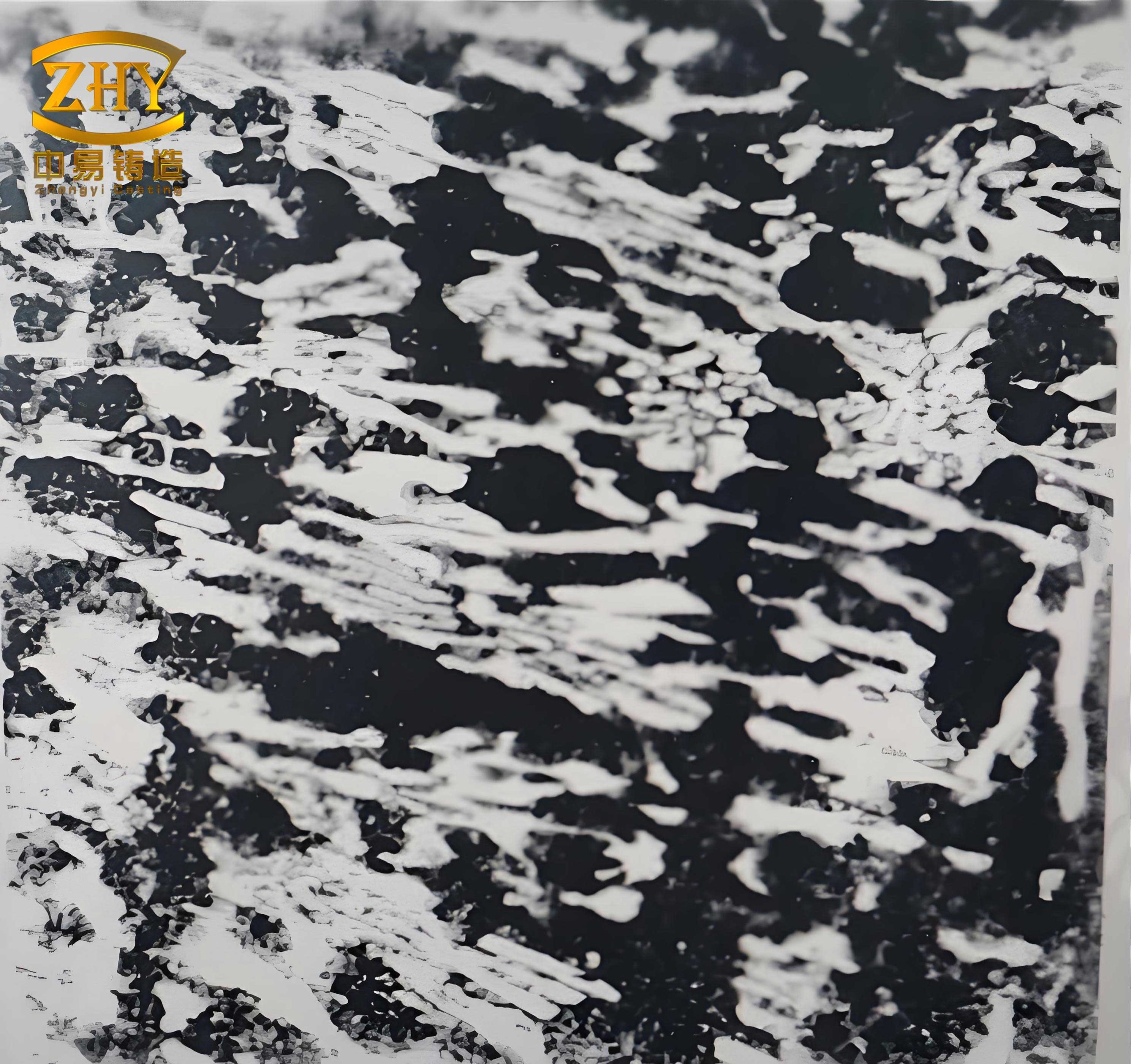
The performance tests included sand-erosion wear tests and electrochemical measurements (anodic polarization curves). Additionally, microstructural analysis, micro-area composition analysis via electron probe micro-analyzer (EPMA), and identification of carbide structure types via X-ray diffraction (XRD) were performed to understand the underlying factors affecting sand-erosion resistance.
2. Experimental Results
2.1 Sand-Erosion Wear Test Results
The sand-erosion wear tests were conducted in a slurry with varying pH levels to simulate different corrosive intensities. The volume loss results are presented in Table 2.
| pH Value | Plain White Cast Iron | Ni-Hard Cast Iron | Boron White Cast Iron | High-Chromium White Cast Iron |
|---|---|---|---|---|
| 1 | 158 | 142 | 95 | 68 |
| 3 | 145 | 132 | 88 | 62 |
| 7 | 135 | 125 | 83 | 60 |
| 10 | 130 | 122 | 82 | 59 |
From the data, it is evident that wear loss increases as the pH decreases (i.e., acidity increases). For any given pH, high-chromium white cast iron exhibits the smallest wear loss, followed by boron-containing white cast iron. The ranking for sand-erosion resistance is: High-Chromium White Cast Iron > Boron-Containing White Cast Iron > Ni-Hard Cast Iron > Plain White Cast Iron.
The relationship between wear volume loss \( W \) and pH can be modeled. The fitting results for the four materials are as follows:
Plain White Cast Iron:
$$ W = 157.8 – 2.78 \text{pH} $$
Ni-Hard Cast Iron:
$$ W = 141.5 – 1.93 \text{pH} $$
Boron White Cast Iron:
$$ W = 95.3 – 1.33 \text{pH} $$
High-Chromium White Cast Iron:
$$ W = 68.1 – 0.9 \text{pH} $$
From these models, two key conclusions can be drawn. First, at a constant pH, the inequality for wear loss is: \( W_{\text{plain}} > W_{\text{Ni-Hard}} > W_{\text{boron}} > W_{\text{high-Cr}} \). Second, the slope of the wear loss vs. pH line indicates the sensitivity to acidity: Plain white cast iron is most sensitive, while high-chromium white cast iron is least affected. This underscores the superior performance advantage of high-chromium and boron-containing white cast irons in highly acidic environments.
2.2 Electrochemical Test Results
Electrode potential indicates the thermodynamic stability of a metal, but corrosion rate is a kinetic parameter obtained from polarization curves. I measured the anodic polarization curves for all four white cast irons in a standard corrosive electrolyte. The mathematical models derived from the data (where \( \eta \) is overpotential and \( i \) is current density) are:
Plain White Cast Iron:
$$ \eta = -0.129 + 0.232 \ln i – 0.010 (\ln i)^2 $$
Ni-Hard Cast Iron:
$$ \eta = -0.118 + 0.245 \ln i – 0.012 (\ln i)^2 $$
Boron White Cast Iron:
$$ \eta = -0.088 + 0.280 \ln i – 0.015 (\ln i)^2 $$
High-Chromium White Cast Iron:
$$ \eta = -0.102 + 0.295 \ln i – 0.018 (\ln i)^2 $$
At the corrosion potential (\( \eta = 0 \)), solving these equations gives the exchange current densities \( i_0 \). The sequence is \( i_{0,\text{plain}} > i_{0,\text{Ni-Hard}} > i_{0,\text{high-Cr}} > i_{0,\text{boron}} \). From a thermodynamic perspective, this suggests boron-containing white cast iron has the highest stability (lowest corrosion tendency), and plain white cast iron the lowest.
More importantly, the polarization resistance \( R_p \), which is inversely proportional to corrosion current, can be assessed from the slope of the polarization curve near the corrosion potential. For a typical current density, the polarization resistance follows: \( R_{p,\text{high-Cr}} > R_{p,\text{boron}} > R_{p,\text{Ni-Hard}} > R_{p,\text{plain}} \). A higher \( R_p \) indicates better polarization behavior and slower electrochemical reaction kinetics. Thus, from a kinetic viewpoint, high-chromium white cast iron exhibits the best corrosion resistance, followed by boron-containing white cast iron.
3. Analysis and Discussion: The Role of Carbide Structure
The properties of white cast iron are dictated by its microstructure, primarily consisting of hard carbides embedded in a metallic matrix. Corrosion in white cast iron typically occurs via micro-galvanic cells formed between the carbides (cathode) and the matrix (anode). Since the matrix potential is relatively similar across different white cast irons, the key differentiating factor is the electrochemical nature of the carbides, which is fundamentally governed by their crystal structure and composition.
3.1 Carbide Structure Type Analysis via XRD
- Plain White Cast Iron: XRD data matched with cementite, (Fe, Mn)3C.
- Ni-Hard Cast Iron: XRD data indicated the presence of (Fe, Cr)3C. The lattice parameter was slightly larger than plain cementite, suggesting dissolution of alloying elements. EPMA analysis (Table 3) confirmed chromium’s high distribution coefficient between carbide and matrix, leading to the formation of alloyed cementite (Fe, Cr)3C.
- High-Chromium White Cast Iron: XRD data unequivocally identified the carbides as (Cr, Fe)7C3. This M7C3-type carbide has a different crystal structure and electrochemical behavior compared to M3C.
- Boron-Containing White Cast Iron: XRD analysis revealed a complex carbide structure. Besides (Fe, Cr)3C, peaks corresponding to (Fe, Cr)23(C, B)6 and (Fe, Cr)2B were identified. EPMA and secondary ion mass spectrometry (SIMS) analysis (Table 4) showed that both boron and chromium segregate strongly to the carbides. Boron, with its small atomic radius, likely occupies interstitial sites, forming these complex borocarbides.
| Element | Content in Matrix (wt.%) | Content in Carbide (wt.%) | Distribution Coefficient (Carbide/Matrix) |
|---|---|---|---|
| Fe | ~92.5 | ~84.0 | ~0.91 |
| Cr | ~0.8 | ~8.5 | ~10.6 |
| Ni | ~4.0 | ~0.5 | ~0.125 |
| Element | Content in Matrix (wt.%) | Content in Carbide (wt.%) | Distribution Coefficient (Carbide/Matrix) |
|---|---|---|---|
| Fe | ~90.2 | ~80.1 | ~0.89 |
| Cr | ~1.5 | ~12.8 | ~8.5 |
| B | < 0.1 | ~2.5 | > 25 |
3.2 Linking Carbide Structure to Sand-Erosion Performance
The sand-erosion process is governed by both electrochemical corrosion and mechanical abrasion. The overall corrosion rate in an active state can be described by a simplified form of the mixed-potential theory:
$$ I_{corr} = K \frac{E_c – E_a}{P_c + P_a + R} $$
where \( I_{corr} \) is the corrosion current (proportional to corrosion rate), \( E_c – E_a \) is the difference between the cathode and anode equilibrium potentials (the thermodynamic driving force), \( P_c \) and \( P_a \) are the polarization resistances of the cathodic and anodic reactions, and \( R \) is the solution resistance.
In white cast iron, \( E_c \) is primarily determined by the carbide phase. Literature indicates that in acidic media, the electrode potentials of common carbides follow this order: \( E_{(M_7C_3)} > E_{(M_3C)} > E_{(\text{matrix})} \). Therefore, the galvanic driving force \( E_c – E_a \) is larger for microstructures containing M7C3 carbides (high-chromium white cast iron) and complex borocarbides compared to those with only M3C (plain and Ni-Hard). A larger driving force, from a purely thermodynamic standpoint, suggests a greater corrosion tendency.
However, the kinetic parameters \( P_c \) and \( P_a \) are decisive. The high-chromium white cast iron, with its (Cr, Fe)7C3 carbides, exhibits the highest polarization resistance (\( R_p \)), as confirmed by the anodic polarization curves. This is because chromium-rich carbides and the surrounding chromium-depleted matrix can promote the formation of a passive film, drastically increasing \( P_a \). Similarly, the complex borocarbides in boron-containing white cast iron also contribute to improved kinetic resistance. Thus, despite a potentially larger thermodynamic driving force, the superior kinetic barriers (high \( P_a \)) of high-chromium and boron-containing white cast irons result in a lower actual corrosion current \( I_{corr} \).
Furthermore, sand-erosion involves mechanical abrasion by hard particles. This requires the material to possess high hardness to resist cutting and deformation. The measured macro-hardness values were: High-Chromium White Cast Iron (HRC 62-64) > Boron-Containing White Cast Iron (HRC 60-62) > Ni-Hard Cast Iron (HRC 55-58) > Plain White Cast Iron (HRC 50-53). The superior hardness of high-chromium and boron-containing white cast irons directly enhances their resistance to the mechanical wear component of sand-erosion.
Therefore, the excellent sand-erosion resistance of high-chromium white cast iron and the good performance of boron-containing white cast iron stem from a synergistic combination of favorable electrochemical kinetics (high polarization resistance imparted by their specific carbide structures) and high bulk hardness. The plain white cast iron performs poorly due to its compositionally simple, less noble cementite carbides, low kinetic resistance, and low hardness. Ni-Hard cast iron shows improvement over plain white cast iron due to alloyed cementite and higher hardness, but it does not match the performance of the materials with M7C3 or borocarbide structures.
4. Conclusion
Based on my comparative investigation into the sand-erosion wear resistance of four types of white cast iron, the following conclusions can be drawn:
- The carbide structures in the investigated white cast irons are distinct. Plain white cast iron contains M3C (cementite). Ni-Hard cast iron contains alloyed (Fe,Cr)3C. High-chromium white cast iron is characterized by M7C3 carbides. Boron-containing white cast iron features a complex mixture including M3C, M23(C,B)6, and M2B type carbides.
- The sand-erosion resistance, measured as volume loss in a corrosive slurry, ranks as follows: High-Chromium White Cast Iron > Boron-Containing White Cast Iron > Ni-Hard Cast Iron > Plain White Cast Iron. The advantage of the high-chromium and boron-containing variants becomes more pronounced in lower pH (more acidic) environments.
- The primary material properties influencing sand-erosion resistance are electrochemical (kinetic) performance and macro-hardness. The corrosion kinetics, governed by the polarization resistance, are superior in white cast irons with M7C3 or borocarbide structures.
- The underlying microstructural factors governing these properties are the type, composition, and volume fraction of carbides, as well as the composition and treatment state of the metallic matrix. The carbide structure directly affects both the electrochemical behavior and the overall hardness of the white cast iron.
This study underscores that for applications involving sand-erosion wear, selecting a white cast iron with an appropriate carbide structure—such as high-chromium white cast iron or developed boron-alloyed grades—is crucial for achieving optimal service life, outperforming traditional plain or nickel-chromium white cast irons.