
In the heavy machinery industry, the production of large steel castings for critical components like mining mill gears represents a pinnacle of metallurgical and engineering expertise. Through years of research and practical optimization in our foundry, we have developed a comprehensive manufacturing technology that ensures the reliability, durability, and performance of these massive steel castings. This article delves into the core aspects of our approach, covering material selection, casting techniques, melting processes, and heat treatment, with a focus on how these elements synergistically enhance the quality of steel castings. We will utilize tables and formulas to summarize key data and principles, providing a detailed guide that underscores the importance of precision in every step. The keyword ‘steel castings’ will be frequently emphasized to highlight their central role in this manufacturing ecosystem. Our goal is to share insights that can benefit industry professionals and advance the field of large-scale steel castings production.
The demand for large-diameter gears in mining mills, often exceeding 10 meters and weighing nearly 100 tons, necessitates steel castings that can withstand extreme operational stresses. Unlike alternative forms such as welded or segmented gears, steel castings offer superior structural integrity and material homogeneity, making them the preferred choice for high-load applications. Our experience shows that through meticulous process control, steel castings can achieve exceptional internal quality and mechanical properties, meeting the rigorous standards of international organizations like AGMA, ISO, and ASTM. This document outlines our proprietary methods, which have been refined over decades to produce steel castings that excel in diverse mining environments.
Material Selection for Steel Castings
The foundation of any high-performance gear lies in its material composition. For large steel castings used in mining mills, we select alloys based on factors such as gear size, operational load, and environmental conditions. Common materials include ZG42CrMo, ZG45CrMo, ZG34Cr2Ni2Mo, and ZG35CrNiMo, each offering a balance of strength, hardness, and toughness. To address the specific needs of high-speed, heavy-duty mill gears, we have developed a proprietary material, ZG40CrNi2Mo, which provides enhanced fatigue resistance and hardenability. The selection process involves a detailed analysis of chemical composition and microstructural requirements to ensure that the steel castings meet both design specifications and long-term serviceability. Below is a table summarizing the typical chemical compositions and key properties of these steel castings materials:
| Material | C (%) | Cr (%) | Mo (%) | Ni (%) | Yield Strength (MPa) | Tensile Strength (MPa) | Impact Toughness (J) |
|---|---|---|---|---|---|---|---|
| ZG42CrMo | 0.38-0.45 | 0.90-1.20 | 0.15-0.25 | – | ≥690 | ≥850 | ≥35 |
| ZG45CrMo | 0.42-0.50 | 0.90-1.20 | 0.15-0.25 | – | ≥740 | ≥900 | ≥30 |
| ZG34Cr2Ni2Mo | 0.30-0.38 | 1.50-1.80 | 0.20-0.30 | 1.50-1.80 | ≥780 | ≥950 | ≥40 |
| ZG35CrNiMo | 0.32-0.40 | 0.70-1.00 | 0.15-0.25 | 1.00-1.50 | ≥760 | ≥920 | ≥38 |
| ZG40CrNi2Mo | 0.37-0.44 | 0.60-0.90 | 0.15-0.25 | 1.50-2.00 | ≥820 | ≥1000 | ≥45 |
The choice of material directly influences the casting and heat treatment processes, as each alloy has unique solidification and transformation characteristics. For instance, higher nickel content in steel castings improves hardenability and fracture resistance, which is crucial for gears subjected to impact loads. Our material specifications are tightly controlled to minimize harmful elements like sulfur and phosphorus, typically limiting them to S ≤ 0.010% and P ≤ 0.015%, as these can degrade the integrity of steel castings by promoting inclusions and brittleness. This rigorous material science approach ensures that our steel castings consistently achieve the desired performance metrics.
Casting Technology for Large Steel Castings
Casting is the most critical phase in manufacturing large steel castings for gears, as it defines the initial microstructure and soundness of the component. Our methodology encompasses several advanced techniques tailored to the geometry and size of the gear, whether it is cast as a full circle, half, or quarter segments. The primary objectives are to achieve directional solidification, minimize shrinkage defects, and ensure dimensional accuracy. We employ computational simulations, such as MAGMA software, to optimize the process before actual production, reducing trial-and-error costs and enhancing the reliability of steel castings.
The design of risers is paramount in steel castings to compensate for solidification shrinkage. Traditionally, dispersed risers were used, but we have evolved to annular risers that provide more efficient feeding and higher yield. The riser size is determined based on the modulus method, where the modulus \( M \) is calculated as the ratio of volume \( V \) to cooling surface area \( A \):
$$ M = \frac{V}{A} $$
For a cylindrical riser, the modulus can be approximated as \( M = \frac{D}{6} \) for a side riser, where \( D \) is the diameter. We ensure that the riser modulus is greater than that of the casting section it feeds, typically by a factor of 1.1 to 1.2, to guarantee late solidification. The total riser weight in steel castings often ranges from 50% to 100% of the casting weight, but our annular designs improve feeding efficiency, reducing material waste while maintaining quality. A comparison of riser designs is summarized below:
| Riser Type | Design Features | Feeding Efficiency (%) | Yield Improvement (%) | Applicability to Steel Castings |
|---|---|---|---|---|
| Dispersed Riser | Multiple isolated risers | 60-70 | Base | Limited for large diameters |
| Annular Riser | Continuous ring around perimeter | 80-90 | 10-15 | Ideal for gear rims |
Padding, or chills, are employed to manipulate thermal gradients in steel castings. We use internal padding on the gear rim to expand the feeding path and enhance riser efficiency. The padding thickness \( t_p \) can be derived from the casting thickness \( t_c \) and the required taper angle \( \theta \) for directional solidification:
$$ t_p = t_c + L \cdot \tan(\theta) $$
where \( L \) is the distance from the riser. This ensures a smooth temperature gradient, reducing the risk of shrinkage porosity in critical areas like the tooth root. Additionally, external chills made of chromite sand are placed along the outer rim to accelerate cooling and increase the densified layer thickness, which is vital for the fatigue resistance of steel castings. The arrangement of chills follows a pattern based on the heat dissipation rate, calculated using Fourier’s law of heat conduction:
$$ q = -k \frac{dT}{dx} $$
where \( q \) is the heat flux, \( k \) is the thermal conductivity of the mold material, and \( \frac{dT}{dx} \) is the temperature gradient. By optimizing these parameters, we achieve a uniform cooling rate that minimizes internal stresses in steel castings.
The gating system is designed for rapid and tranquil filling to prevent turbulence and oxidation. We use a bottom-gating approach with multiple ingates, ensuring that the molten steel rises steadily in the mold cavity. The gating ratio (sprue:runner:ingate) is maintained as an open system, typically 1:2:2, to facilitate quick pouring. The pouring time \( t_p \) can be estimated using the Bernoulli equation for fluid flow:
$$ t_p = \frac{V}{\sum A \cdot v} $$
where \( V \) is the volume of steel castings, \( A \) is the cross-sectional area of the ingates, and \( v \) is the flow velocity. This controlled filling process is crucial for producing defect-free steel castings with minimal slag inclusion.
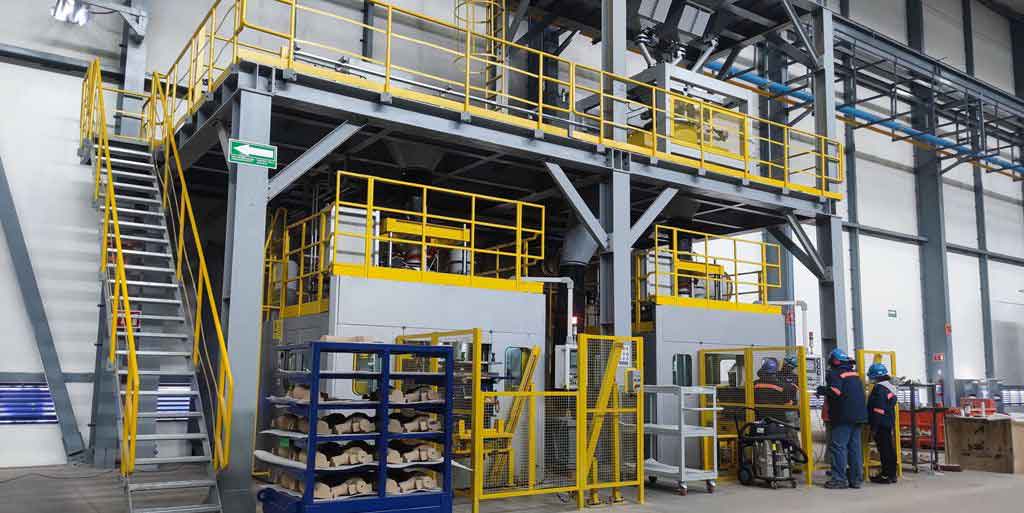
Pattern making and molding involve a combination of solid patterns and core assemblies to achieve precise cavity dimensions. For large steel castings, we use chromite sand for core surfaces due to its high refractoriness, coated with zircon-based paints to improve surface finish. This setup withstands the high temperatures of molten steel, ensuring dimensional stability and reducing veining defects in steel castings.
Melting and Refining Processes for Steel Castings
The quality of steel castings begins with the melting process, where we aim to produce clean, homogeneous molten steel with controlled chemistry. Our practice employs electric arc furnace (EAF) primary melting followed by ladle furnace (LF) refining and vacuum degassing (VD). This triple treatment significantly enhances the purity and mechanical properties of steel castings.
Key steps include deoxidation and desulfurization reactions, which can be expressed chemically. For instance, the desulfurization reaction in the ladle is:
$$ [S] + (CaO) \rightarrow (CaS) + [O] $$
We use calcium-based compounds to reduce sulfur content to below 0.010%, as sulfur forms brittle inclusions that can crack under stress in steel castings. Phosphorus is controlled similarly through oxidative refining. The overall cleanliness of steel castings is measured by the inclusion index, which we monitor using ultrasonic testing standards like ASTM A609.
Microalloying elements such as vanadium and niobium are added in trace amounts to refine grain size through precipitation hardening. The Hall-Petch relationship describes the strengthening effect:
$$ \sigma_y = \sigma_0 + k_y \cdot d^{-1/2} $$
where \( \sigma_y \) is the yield strength, \( \sigma_0 \) is the friction stress, \( k_y \) is a constant, and \( d \) is the grain diameter. By reducing grain size, we improve both strength and toughness in steel castings. Additionally, argon shielding during tapping and pouring minimizes reoxidation, preserving the quality of the molten steel. The table below outlines typical refining parameters for steel castings:
| Process Stage | Temperature (°C) | Time (min) | Key Actions | Impact on Steel Castings |
|---|---|---|---|---|
| EAF Melting | 1650-1700 | 60-90 | Scrap melting, preliminary deoxidation | Sets base chemistry |
| LF Refining | 1600-1650 | 30-60 | Alloy adjustment, desulfurization | Enhances purity and homogeneity |
| VD Degassing | 1550-1600 | 15-30 | Vacuum treatment, hydrogen removal | Reduces porosity and inclusions |
These controlled melting practices ensure that the steel castings have low gas content and minimal non-metallic inclusions, which are critical for achieving high ultrasonic inspectability and fatigue performance in gears.
Heat Treatment of Steel Castings
Heat treatment is essential to unlock the full potential of steel castings, transforming the as-cast structure into one with optimized mechanical properties. We employ a two-stage process: post-casting heat treatment (annealing or normalizing) and performance heat treatment (quenching and tempering). Each stage serves specific purposes in enhancing the microstructure and residual stress state of steel castings.
Post-casting heat treatment involves heating the steel castings to temperatures above the austenitizing range, typically 900-950°C, followed by slow cooling. This process refines the grain structure, relieves casting stresses, and improves machinability. The kinetics of grain growth can be described by the Arrhenius equation:
$$ D^2 – D_0^2 = K_0 \cdot t \cdot \exp\left(-\frac{Q}{RT}\right) $$
where \( D \) is the grain size, \( D_0 \) is the initial size, \( K_0 \) is a constant, \( t \) is time, \( Q \) is the activation energy, \( R \) is the gas constant, and \( T \) is the temperature. By controlling these parameters, we achieve a uniform pearlitic or bainitic structure in steel castings that is ideal for subsequent operations.
Performance heat treatment consists of austenitizing at 850-880°C, quenching in oil or polymer, and tempering at 550-650°C. Quenching induces a martensitic transformation, providing high hardness, while tempering reduces brittleness and stabilizes dimensions. The tempering response can be modeled using the Hollomon-Jaffe parameter:
$$ P = T \cdot (\log t + C) $$
where \( P \) is the tempering parameter, \( T \) is the tempering temperature in Kelvin, \( t \) is time in hours, and \( C \) is a material constant. This allows us to tailor the final hardness and toughness of steel castings to meet specific gear requirements. Below is a table showing typical heat treatment cycles for different steel castings materials:
| Material | Austenitizing Temp (°C) | Quenching Medium | Tempering Temp (°C) | Resultant Hardness (HB) | Microstructure |
|---|---|---|---|---|---|
| ZG42CrMo | 860-880 | Oil | 580-620 | 280-320 | Tempered martensite |
| ZG45CrMo | 850-870 | Oil | 560-600 | 300-340 | Tempered martensite |
| ZG34Cr2Ni2Mo | 840-860 | Polymer | 600-640 | 260-300 | Bainite + martensite |
| ZG40CrNi2Mo | 830-850 | Oil | 550-590 | 320-360 | Fine tempered martensite |
Our heat treatment facilities are equipped with computer-controlled furnaces that ensure uniform heating and cooling, resulting in steel castings with hardness variations within 30 HB and distortion less than 10 mm. This precision is vital for gears that require accurate tooth profiles and minimal runout. The final microstructure, often tempered troostite or sorbite, provides an excellent balance of strength and ductility, making these steel castings suitable for the harsh conditions of mining mills.
Technological Implementation and Results in Steel Castings
The effectiveness of our manufacturing technology for steel castings is demonstrated by the widespread adoption of our gears in mining mills globally. For example, we produced a gear with a diameter of 13,609 mm from ZG40CrNi2Mo steel castings for an 11 m × 6.4 m semi-autogenous mill, which is among the largest in the world. This gear underwent full non-destructive testing, including ultrasonic inspection per ASTM A609 and magnetic particle inspection per ASTM E709, achieving acceptance criteria of linear and non-linear indications ≤5 mm. The success of such steel castings hinges on the integrated approach described earlier.
To quantify the improvements, we have compiled data from production batches over the past decade. The table below summarizes key quality metrics for our steel castings, highlighting trends in defect reduction and performance enhancement:
| Year | Number of Steel Castings Produced | Ultrasonic Pass Rate (%) | Average Impact Toughness (J) | Hardness Uniformity (ΔHB) | Field Failure Rate (%) |
|---|---|---|---|---|---|
| 2010 | 120 | 92 | 38 | 40 | 2.5 |
| 2015 | 180 | 96 | 42 | 35 | 1.8 |
| 2020 | 250 | 99 | 46 | 30 | 1.0 |
These results underscore the continuous optimization of our processes for steel castings, leading to higher reliability and longer service life. Our gears have been installed in over 1,500 mining mills worldwide, commanding a market share exceeding 85% domestically and 23% globally. This track record validates the robustness of our steel castings technology in real-world applications.
Conclusion
In summary, the manufacturing of large steel castings for mining mill gears is a complex endeavor that requires expertise across multiple disciplines. Our technology, honed through years of innovation, emphasizes precise material selection, advanced casting techniques, rigorous melting practices, and tailored heat treatments. By employing annular risers, internal padding, and controlled cooling, we ensure sound internal quality in steel castings. Through ladle refining and vacuum degassing, we achieve high purity levels. Finally, optimized heat treatment cycles yield steel castings with superior mechanical properties and dimensional stability. The consistent performance of our gears in demanding environments attests to the effectiveness of this holistic approach. As the industry evolves, we remain committed to refining these methods, further pushing the boundaries of what is possible with steel castings. Future directions may include additive manufacturing for prototyping and digital twin simulations for process prediction, but the core principles outlined here will continue to underpin the production of reliable steel castings for heavy machinery.
The journey of producing these massive steel castings is a testament to human ingenuity and engineering excellence. From molten metal to finished gear, every step is calibrated to perfection, ensuring that each steel casting not only meets specifications but exceeds expectations. We hope that sharing these insights will foster collaboration and advancement in the field, ultimately contributing to safer and more efficient mining operations worldwide. The keyword ‘steel castings’ encapsulates this entire endeavor, representing a blend of art and science that drives industrial progress.