
In my extensive experience within the foundry industry, the production of high-quality spheroidal graphite cast iron has always been a focal point of technological advancement. Spheroidal graphite cast iron, often referred to as ductile iron, stands as a premier engineering material due to its exceptional combination of strength, ductility, and wear resistance. Its applications span across critical sectors such as automotive, power generation, and heavy machinery. The heart of achieving these superior properties lies in the meticulous control of the microstructure, specifically the formation of spherical graphite nodules within a matrix that can be tailored from ferritic to pearlitic. The journey to perfect this microstructure in spheroidal graphite cast iron is profoundly influenced by the melting and treatment processes, particularly the spheroidizing and inoculating treatments that fundamentally alter graphite growth morphology.
Lost foam casting, a modern and efficient technique, involves using a foam pattern identical to the final casting shape, coating it with a refractory material, embedding it in unbonded sand under vacuum, and pouring molten metal. This method offers significant advantages like excellent dimensional accuracy, reduced machining needs, and the potential for high-volume production. However, when applied to spheroidal graphite cast iron, it introduces unique challenges. The inherent high pouring temperatures required in lost foam casting, typically ranging from 1560°C to 1600°C, create a hostile environment for conventional spheroidizing treatment. The traditional ladle treatment method, where spheroidizing agent is placed at the bottom of a ladle and molten iron is poured over it, often leads to rapid and violent reaction of the agent. This results in poor magnesium recovery, swift fading of the spheroidizing effect, and consequently, a low nodule count, irregular graphite shapes, and insufficient pearlite content in the final spheroidal graphite cast iron components. These shortcomings manifest as subpar mechanical properties, unreliable performance, and high scrap rates, posing a significant hurdle for foundries utilizing lost foam technology for spheroidal graphite cast iron.
Driven by the imperative to overcome these limitations and elevate the quality of lost foam cast spheroidal graphite cast iron, I embarked on a systematic exploration and development of an enhanced spheroidizing and inoculating treatment process. This endeavor was not merely an adjustment but a fundamental rethinking of the treatment methodology to suit the demanding thermal regime of lost foam casting. The core objectives were to increase the absorption efficiency of spheroidizing elements like magnesium and cerium, delay the fading of both spheroidization and inoculation, and ultimately produce spheroidal graphite cast iron with a high density of well-formed graphite spheroids and a controlled, predominantly pearlitic matrix. The following sections detail the rationale, implementation, and outcomes of this process exploration, supported by data, tables, and theoretical formulations.
The conventional single-stage inoculation process was identified as a major weak link. The high temperature accelerates the dissolution and fading of inoculants, leading to undercooled graphite and chill formation. To combat this, I devised a multi-stage inoculation strategy employing a composite blend of inoculants with varying melting points and nucleation potentials. The selection was based on their respective abilities to provide immediate nucleation sites and sustain nucleation over time, thus resisting fade. The inoculants were categorized and added in sequence.
| Inoculant Stage | Type | Primary Function | Typical Composition |
|---|---|---|---|
| First Inoculant | Ferrosilicon (FeSi) | Immediate graphite nucleation during treatment | Si: 75%, Al: 1-2%, Ca: 0.5-1% |
| Second Inoculant | Silicon-Barium (FeSiBa) | Enhanced nucleation potency, moderate fade resistance | Si: 65-70%, Ba: 2-4% |
| Third Inoculant | Silicon-Barium-Calcium (FeSiBaCa) | Long-term fade resistance, promotes graphite spheroidization | Si: 60-65%, Ba: 1-2%, Ca: 1-2% |
The addition protocol was precisely timed. After initiating the spheroidizing reaction (which will be described later), the first inoculant (0.15% of the iron weight) is added. Subsequently, at 20 seconds into the reaction, the second inoculant (0.35-0.45% of iron weight) is introduced, followed immediately by the third inoculant (0.2-0.4% of iron weight). This sequential addition creates a sustained nucleation effect. The mathematical representation of effective inoculant particles surviving until solidification can be conceptualized by a fading equation:
$$ N_{eff}(t) = N_0 \cdot e^{-kt} $$
Where \( N_{eff}(t) \) is the number of effective nuclei at time \( t \), \( N_0 \) is the initial number of nuclei introduced, and \( k \) is a temperature-dependent fading constant. By using multiple inoculants with different \( k \) values, the overall \( N_{eff}(t) \) is maintained at a higher level throughout the pouring window for spheroidal graphite cast iron.
The central innovation in the spheroidizing treatment itself involved re-engineering the treatment ladle. A partitioned or “dam-type” ladle was employed. The critical modification was the introduction of a physical barrier—a cover plate—within one compartment to stage the spheroidizing reaction. The detailed setup and charge arrangement are summarized below:
| Ladle Zone | Material | Weight (% of Iron) | Purpose |
|---|---|---|---|
| Bottom Layer (Under Plate) | Spheroidizing Agent (FeSiMgRE) | 0.7 – 0.9% | Provides secondary, delayed Mg source |
| Covering Layer 1 | Covering Agent (e.g., Steel Punchings) | 0.05 – 0.15% | Protects bottom agent, ensures proper reaction start |
| Barrier | Cover Plate (Carbon Steel/Ductile Iron) | – | Physically separates reaction stages |
| Top Layer (Above Plate) | Spheroidizing Agent (FeSiMgRE) | 0.55 – 0.65% | Initiates primary reaction |
| First Inoculant (FeSi) | 0.05 – 0.15% | Early-stage inoculation | |
| Covering Agent | 0.05 – 0.15% | Prevents premature oxidation of top charge |
The cover plate is crucial. Its top surface is flat, and its bottom profile matches the ladle bottom. The clearance between its edges and the ladle wall is maintained at ≤5 mm. The molten iron, preconditioned in the furnace by superheating to 1560-1600°C, adding 0.05-0.15% silicon carbide as a preconditioner, and holding for 9-11 minutes, is poured into the empty section of the dam-type ladle, opposite the charged compartment.
The treatment dynamics unfold in two distinct phases. Initially, the molten iron flows over the dam, contacting the top layer of spheroidizing agent and inoculant. This triggers the first, relatively vigorous spheroidizing reaction. Magnesium vapor is released and absorbed into the iron. Concurrently, the cover plate begins to heat up and melt. The reaction rate in this phase, \( R_1 \), can be related to temperature and agent surface area. As the plate melts completely, the now-treated iron comes into contact with the bottom layer of spheroidizing agent. This initiates a second, more controlled reaction phase, rate \( R_2 \), providing a supplementary boost of magnesium. This staged reaction effectively prolongs the total active treatment time (\( t_{total} = t_1 + t_2 \)), enhancing magnesium recovery. The overall magnesium recovery efficiency \( \eta_{Mg} \) can be modeled as:
$$ \eta_{Mg} = \frac{Mg_{absorbed}}{Mg_{added}} = \alpha \left(1 – e^{-\beta_1 t_1}\right) + (1-\alpha) \left(1 – e^{-\beta_2 t_2}\right) $$
where \( \alpha \) is the fraction of Mg from the first stage, and \( \beta_1, \beta_2 \) are kinetic constants for each stage, influenced by temperature and slag conditions. This two-stage process for spheroidal graphite cast iron yields a more stable and higher residual magnesium content, mitigating rapid fade before casting.
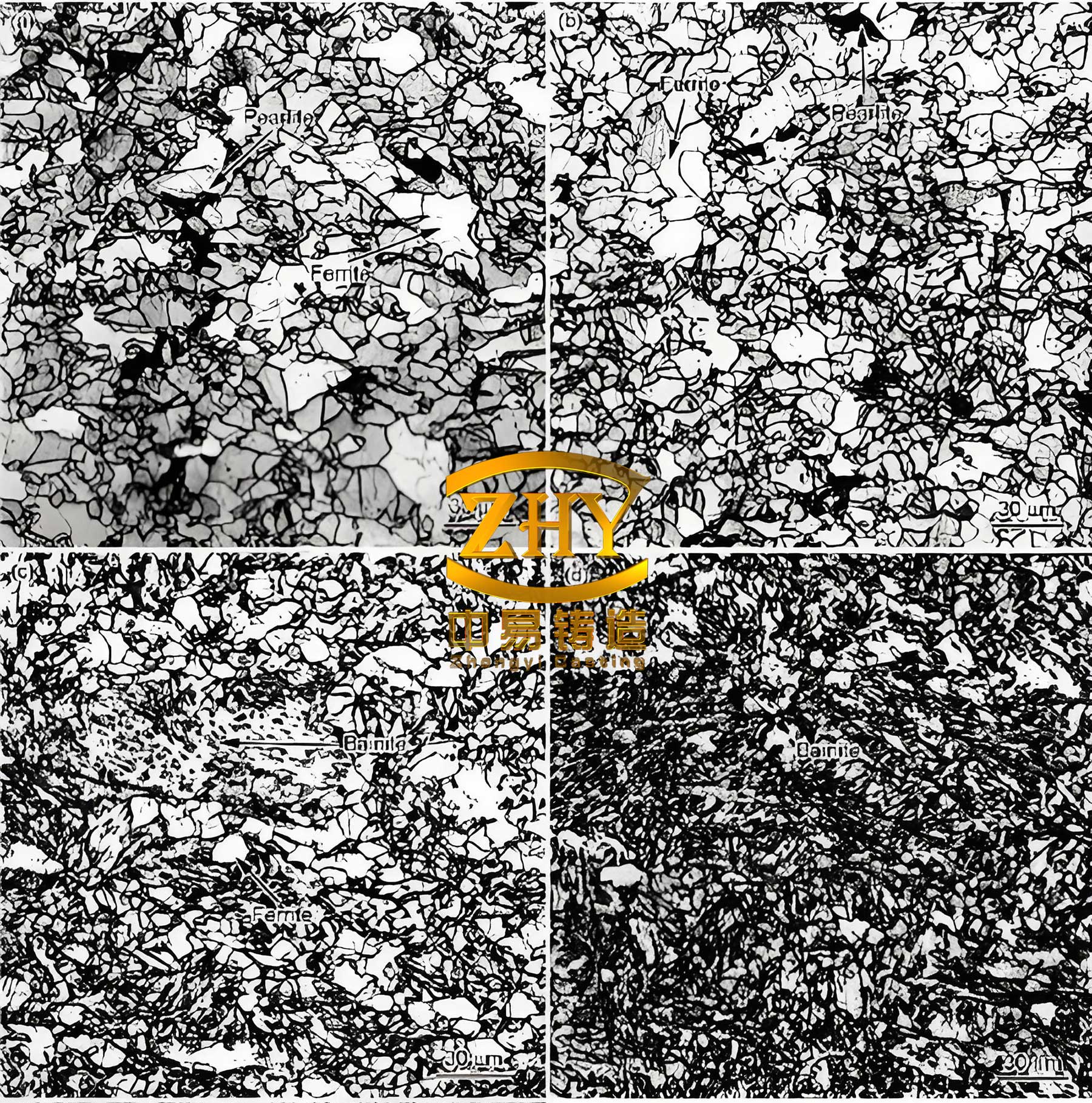
The efficacy of this integrated process modification was quantitatively assessed through metallographic analysis of the produced spheroidal graphite cast iron castings. Key metrics were graphite nodule count and pearlite content percentage. Comparative data between the conventional single-stage process and the new two-stage process with composite inoculation is presented below.
| Process | Average Nodule Count (per mm²) | Nodularity (%) | Pearlite Content (%) | Typical Residual Mg (%) |
|---|---|---|---|---|
| Conventional Ladle Treatment | 120-150 | 80-85 | 80-85 | 0.025 – 0.035 |
| New Two-Stage Process | 250-300 | 90-95 | 88-92 | 0.040 – 0.050 |
The improvement is stark. The nodule count more than doubled, directly contributing to enhanced mechanical properties. According to established relationships, the yield strength \( \sigma_y \) of spheroidal graphite cast iron is inversely related to the graphite nodule spacing \( \lambda \), which itself is a function of nodule count \( N_v \): \( \lambda \propto 1/\sqrt[3]{N_v} \). Therefore, a higher \( N_v \) leads to a finer microstructure and improved strength. The pearlite content also increased consistently, moving closer to the target of fully pearlitic grades for applications requiring high strength and wear resistance. The higher and more stable residual magnesium is the fundamental driver behind these improvements, ensuring effective graphite spheroidization throughout the casting process for spheroidal graphite cast iron.
The synergistic effect of the multi-stage inoculation and the two-stage spheroidization cannot be overstated. The inoculation strategy ensures that once magnesium spheroidizes the graphite, sufficient nucleation sites are available throughout the cooling period to promote the formation of numerous, small graphite spheres rather than a few large ones or degenerate forms. The relationship between undercooling \( \Delta T \) and critical nucleus radius \( r^* \) for graphite is given by the classic equation: \( r^* = \frac{2\gamma}{\Delta G_v} \), where \( \gamma \) is the interfacial energy and \( \Delta G_v \) is the volumetric free energy change. Effective inoculation reduces the practical \( r^* \) by providing heterogeneous sites, lowering the energy barrier for graphite nucleation in spheroidal graphite cast iron. The staged spheroidization, on the other hand, manages the exothermic reaction heat, reduces magnesium vapor loss to the atmosphere, and provides a more uniform distribution of magnesium in the melt. This is critical because the efficiency of spheroidization \( S \), often defined as the ratio of spherical graphite to total graphite, is highly sensitive to the local magnesium concentration \( C_{Mg} \), following a sigmoidal function: \( S \approx \frac{1}{1 + e^{-k(C_{Mg}-C_0)}} \), where \( C_0 \) is a critical concentration threshold. The new process helps maintain \( C_{Mg} > C_0 \) more consistently.
Further process parameters were optimized and monitored. The iron chemistry before treatment was tightly controlled. A base composition aiming for hypereutectic carbon equivalent (CE) was used to ensure graphite precipitation, but with balanced silicon to avoid excessive ferrite. The preconditioning with silicon carbide played a role in improving nucleation potential and reducing oxygen content. The temperature decay from treatment to pouring was tracked, and the pouring window was confined to within 8 minutes post-treatment to capitalize on the enhanced fade resistance. For every heat of spheroidal graphite cast iron, thermal analysis cups were used to check for recalescence and undercooling, providing immediate feedback on inoculation effectiveness.
While the results are highly promising, the exploration continues. The pearlite content, although improved, can be further optimized. Future work involves fine-tuning the balance between inoculant types and amounts to achieve even higher and more consistent pearlite percentages, potentially through the controlled use of pearlite-promoting elements like copper or tin in conjunction with the inoculation process. Additionally, the dynamics of the cover plate melting and its interaction with the slag layer present an area for computational fluid dynamics (CFD) modeling to further refine the reaction staging. The ultimate goal remains the robust and economical production of superior spheroidal graphite cast iron components via the lost foam process, expanding its application envelope into more demanding structural roles.
In conclusion, the challenges posed by the high-temperature environment of lost foam casting for producing spheroidal graphite cast iron have been addressed through a comprehensive re-engineering of the spheroidizing and inoculating treatment sequence. The adoption of a composite, multi-stage inoculation strategy coupled with a novel two-stage spheroidizing reaction in a dam-type ladle equipped with a sacrificial cover plate has yielded transformative results. This integrated approach significantly increases graphite nodule count, enhances nodularity, elevates pearlite content, and stabilizes residual magnesium levels. These metallurgical improvements translate directly into higher and more consistent mechanical properties, reduced scrap rates, and an enhanced capability to produce reliable, high-performance spheroidal graphite cast iron castings using the efficient lost foam method. This process exploration underscores the importance of adapting foundational treatment principles to the specific thermal and kinetic constraints of advanced casting processes, paving the way for broader adoption of lost foam casting for high-grade spheroidal graphite cast iron.