
In my extensive experience with advanced manufacturing techniques, lost foam casting has consistently proven to be a transformative method for producing complex, near-net-shape components. The process offers significant advantages, including reduced production costs, excellent surface finish, high dimensional accuracy, and minimized environmental impact compared to traditional sand casting. However, the inherent complexities of lost foam casting, particularly the influence of vacuum pressure on mold filling and solidification dynamics, make its process design notably more challenging. This complexity necessitates a departure from conventional sand-casting design philosophies. In my recent project, I leveraged computational numerical simulation technology to visualize and analyze the entire lost foam casting process, enabling a data-driven approach to optimize the gating system and overall工艺. This article details my application of simulation in developing a robust lost foam casting process for a large, intricate tractor transmission housing, demonstrating how targeted simulation reduces experimental iterations, shortens development cycles, and cuts costs, thereby steering foundry practice from semi-empirical methods toward a visualized, controllable future.
The component in focus was a critical front casing for a tractor transmission system, a high-volume production item. Its design posed substantial challenges for lost foam casting. The housing was characterized by its large envelope dimensions (approximately 816 mm × 530 mm × 578 mm), a complex geometry with internal cavities, a substantial theoretical weight of 265.1 kg (assuming a density of 7.3 × 10³ kg/m³), and a pronounced variation in wall thickness. The minimum wall section was merely 14 mm, while the maximum reached about 50 mm. For a lost foam casting of this scale and thin-wall nature, the primary concerns I identified were potential casting deformation and the risk of cold laps. Deformation control would require meticulous process management, a strategically designed gating and feeding system incorporating anti-deformation measures, and a precise sand-filling and compaction procedure. Cold laps, conversely, could be mitigated through optimal gate placement and employing a sufficiently high pouring temperature.
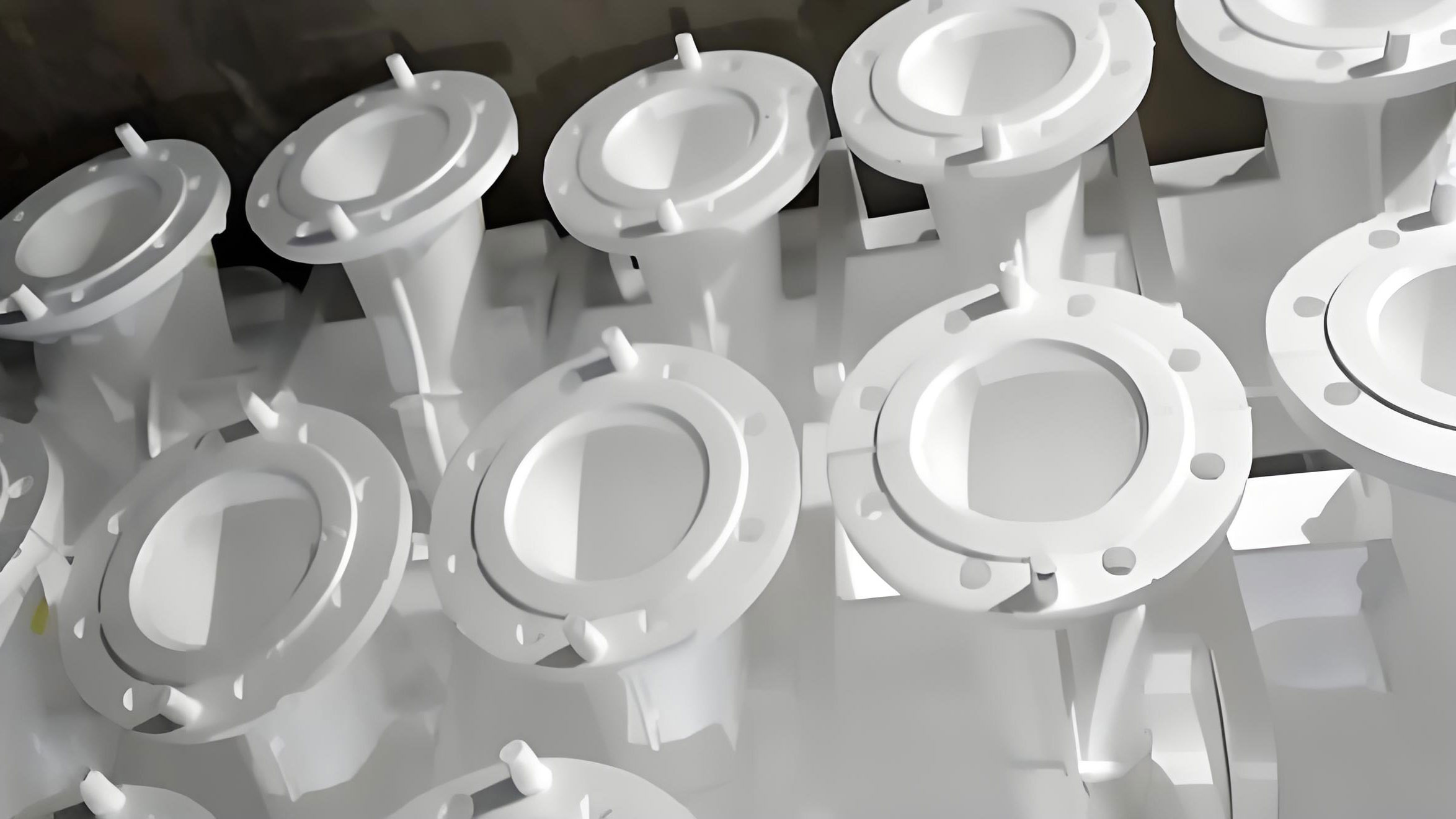
To efficiently navigate these challenges and improve the first-time success rate of physical trials, I formulated three distinct lost foam casting process schemes. A comparative analysis was crucial, and for this, I employed a dedicated lost foam simulation module within a commercial casting simulation system. The core physical phenomena in lost foam casting simulation involve coupled solving of momentum, energy, and mass conservation equations, accounting for the decomposition of the foam pattern. A simplified representation of the energy conservation during foam degradation and metal cooling can be expressed as:
$$ \rho C_p \frac{\partial T}{\partial t} = \nabla \cdot (k \nabla T) + S_{decomp} + S_{latent} $$
where $ \rho $ is density, $ C_p $ is specific heat, $ T $ is temperature, $ t $ is time, $ k $ is thermal conductivity, $ S_{decomp} $ is the heat source/sink term from foam pyrolysis, and $ S_{latent} $ accounts for the latent heat of fusion. The fluid flow during filling in a negative pressure environment is modeled by modified Navier-Stokes equations, considering the back-pressure from gaseous foam decomposition products.
| Process Scheme | Orientation & Gating | Gating System Dimensions | Metallostatic Head | Key Design Rationale |
|---|---|---|---|---|
| Scheme 1 | Horizontal placement, top gating | Sprue: Ø50 mm; Runner: 40×20 mm; Ingate: 40×7.5 mm | 210 mm | Simplified pattern assembly, direct feeding. |
| Scheme 2 | Inclined placement, side gating | Sprue: Ø50 mm; Runner: 60×55 mm; Ingate: 55×15 mm | 190 mm | Improved temperature gradient, reduced turbulence. |
| Scheme 3 | Vertical placement, top gating | Sprue: Ø50 mm; Runner: 45×50 mm; Ingate: 60×15 mm | 320 mm | Higher casting yield per mold, efficient use of flask volume. |
The simulation results for each lost foam casting scheme revealed distinct behaviors and potential defect tendencies. For Scheme 1, the filling pattern was relatively sequential but the solidification simulation indicated a high risk of shrinkage porosity and slag inclusion in the upper, heavy sections of the housing, remote from the ingates. This necessitated the addition of extensive feeder heads or flow-off channels. A significant practical concern with this horizontal lost foam casting setup was the risk of mold collapse (cope peel) under the large planar surface area during pouring, demanding very fast pouring rates and exceptionally careful sand compaction in multiple stages. The flask utilization was also low, typically one casting per mold.
The Scheme 2 lost foam casting simulation showed a more favorable temperature gradient during solidification. The inclined orientation and side gating promoted directional solidification towards the risers, significantly reducing the predicted shrinkage volume. The risk of cold laps was also lower due to better thermal management. However, this configuration introduced complexity in pattern assembly and, more critically, in the sand-filling and vibration compaction process for the uneven pattern cluster. It required multiple sand addition steps and specific vibration parameters (low amplitude, high frequency) to achieve uniform density without pattern distortion. Like Scheme 1, it allowed only one piece per mold in our specific setup.
The simulation of Scheme 3 presented a mixed outcome. The vertical lost foam casting arrangement enabled stacking two patterns in a single flask, dramatically improving productivity and yield. The high metallostatic head (320 mm) provided strong feeding pressure. However, the filling simulation displayed turbulent flow and potential for gas entrapment during the initial stages of metal-foam replacement. The solidification pattern was generally sound but required careful balancing of the gating to both castings. The decision matrix for selecting the optimal lost foam casting process often involves weighting factors for quality, cost, and throughput, which can be conceptually modeled as:
$$ \text{Optimization Score} = w_1 \cdot Q_{\text{sim}} + w_2 \cdot (1/C_{\text{est}}) + w_3 \cdot P_{\text{yield}} $$
where $ w_1, w_2, w_3 $ are weights for simulated quality ($Q_{\text{sim}}$), inverse of estimated cost ($C_{\text{est}}$), and production yield ($P_{\text{yield}}$), respectively.
Based on a comprehensive analysis of the lost foam casting simulation results, production line constraints, and quality priorities, I developed an optimized hybrid scheme. This final lost foam casting工艺 retained the inclined orientation of Scheme 2 to benefit from its superior thermal profile but adjusted the gating dimensions for more robust filling. The key parameters were: Sprue diameter of 50 mm, runner cross-section of 60 mm × 55 mm, ingate section of 55 mm × 15 mm, and a metallostatic head of 190 mm. Strategic flow-off blocks were added at the highest points to trap slag and alleviate shrinkage. This optimized lost foam casting design aimed to balance defect minimization with practical moldability.
The subsequent physical lost foam casting trial followed a stringent process protocol: 1) Expandable Polystyrene (EPS) bead pre-expansion and pattern molding; 2) Pattern assembly and gating system attachment; 3) Application of a refractory coating and controlled drying; 4) Mold filling with dry sand under vibration and vacuum; 5) Pouring. The process parameters were meticulously controlled: Pouring temperature was maintained between 1490°C and 1510°C, vacuum pressure at 0.055-0.06 MPa (corrected from the text’s erroneous MPa unit, typical range is 0.04-0.06 MPa), target pouring time of 90 seconds, and a mold hold time under vacuum exceeding 20 minutes post-pour. This rigorous application of the lost foam casting process yielded a casting with excellent surface quality after shakeout and shot blasting, with no visible defects like cold shuts or major sand inclusions. Hardness measurements on the cast surface ranged from 180 to 190 HB, indicating satisfactory metallurgical quality.
| Evaluation Method | Procedure | Key Findings for Lost Foam Casting |
|---|---|---|
| 3D Scanning & Digital Comparison | Scanning the as-cast part and aligning the point cloud data with the nominal CAD model to perform a full-field deviation analysis. | Maximum local deviations were within ±1.5 mm for most regions, with only a few isolated points showing slightly higher variance. The overall form error (warpage) was less than 2 mm, well within the machining allowance. This confirmed the effectiveness of the anti-deformation strategy in the lost foam casting process. |
| Machining Trial | Subjecting the casting to full CNC machining to final part dimensions. | The part machined successfully without encountering subsurface porosity or hard spots. All critical mating surfaces and bore locations were achieved, verifying the internal soundness and dimensional stability of the lost foam produced casting. |
The integration of numerical simulation at the forefront of the lost foam casting process development cycle proved invaluable. Traditionally, developing a process for such a complex component would have required at least three, if not more, sequential “build-and-test” experimental cycles. By using lost foam casting simulation to virtually test and refine the gating design, I was able to converge on a viable process in a single experimental iteration. This approach resulted in direct savings in material costs (EPS patterns, coating, metal), labor, and production time. More broadly, it underscores a modern paradigm where lost foam casting is elevated from a craft-based practice to an engineered solution. The ability to visualize fluid flow, temperature fields, and solidification sequences empowers engineers to make informed decisions, optimize feeder placement, and predict defect formation before any metal is poured.
In conclusion, the successful development of the tractor transmission housing via lost foam casting was fundamentally enabled by systematic numerical simulation. The methodology involved creating multiple digital prototypes, simulating their behavior under lost foam casting conditions, analyzing the results to identify weaknesses like potential shrinkage or turbulent fill, and iterating the design digitally. This virtual optimization loop is particularly powerful for lost foam casting due to the process’s unique physics. The final validated process scheme, derived from this simulation-led approach, produced castings that met all dimensional, structural, and quality specifications. This case study solidly advocates for the standard integration of casting simulation software as an essential tool in the foundry engineer’s portfolio, especially for advancing the capabilities and reliability of lost foam casting for large, complex, and thin-walled components. The future of lost foam casting lies in deepening this synergy between computational prediction and physical process control, enabling even more ambitious applications across heavy machinery, automotive, and other sectors.