
In my extensive research on nodular cast iron, particularly focusing on its heat treatment processes, I have dedicated significant effort to understanding how isothermal quenching affects the mechanical and fatigue properties of this material. Nodular cast iron, also known as ductile iron, is renowned for its versatility and strength, but its performance can be greatly enhanced through controlled thermal processing. Isothermal quenching, which involves austenitizing followed by rapid cooling to a specific temperature and holding to allow bainitic transformation, is a critical technique for achieving high strength, toughness, and fatigue resistance in components like crankshafts and camshafts. This article, based on my experimental work and analysis, delves into the factors that influence these properties, with a special emphasis on minimizing detrimental microstructural features such as white areas containing quenched martensite. I will present detailed data, incorporate tables and formulas to summarize findings, and propose practical countermeasures to optimize the performance of isothermally quenched nodular cast iron.
The foundation of my study lies in the premise that the microstructure of nodular cast iron after isothermal quenching dictates its mechanical behavior. Specifically, the presence of white areas—regions rich in residual austenite or quenched martensite—can significantly impair toughness and fatigue strength. Through systematic experimentation, I aimed to identify the optimal processing parameters and compositional adjustments to mitigate these effects. My approach involved preparing specimens from as-cast nodular cast iron with a grade equivalent to QT800-2, subjecting them to various austenitizing and isothermal temperatures, and then evaluating their tensile strength, elongation, impact toughness, hardness, and fatigue performance. Metallographic analysis was conducted to correlate these properties with microstructural features. The insights gained from this work are crucial for advancing the application of nodular cast iron in demanding automotive and industrial contexts.
To begin, I will outline the materials and methods used in my investigations. The nodular cast iron specimens were derived from crankshaft castings, ensuring they represented real-world components. The chemical composition range of the material is summarized in Table 1, which highlights key elements like carbon, silicon, manganese, phosphorus, and sulfur. This composition is typical for high-strength nodular cast iron, but variations can influence phase transformations during heat treatment.
| Element | Content Range (wt.%) |
|---|---|
| C | 3.78–3.99 |
| Si | 1.83–2.26 |
| Mn | 0.46–0.50 |
| P | 0.05–0.06 |
| S | 0.022 |
The specimens were machined to near-final dimensions with minimal allowance, then subjected to isothermal quenching. The austenitizing temperature was varied between 870°C and 920°C, while the isothermal temperature ranged from 240°C to 300°C. After heat treatment, the specimens were finished to standard sizes for mechanical testing. Tensile tests followed GB/T 228-2002, using cylindrical specimens; impact tests used unnotched Charpy specimens per GB 229-2007; and hardness was measured on the surface. Fatigue testing involved rotating bending fatigue tests to assess endurance limits. Metallographic samples were prepared, etched, and examined under optical and scanning electron microscopes to identify phases like upper bainite, lower bainite, residual austenite, and quenched martensite. Energy-dispersive spectroscopy (EDS) was employed for microchemical analysis of white areas.
The results of my mechanical tests are consolidated in Table 2, which presents average values for tensile strength, elongation, impact toughness, hardness, and corresponding microstructures at different isothermal temperatures. This data reveals clear trends: as the isothermal temperature decreases, tensile strength slightly increases, but elongation and impact toughness drop markedly. For instance, at 300°C, the nodular cast iron exhibited a balanced combination of strength and toughness, whereas at 240°C, brittleness increased due to the presence of quenched martensite in white areas.
| Isothermal Temperature (°C) | Impact Toughness (J/cm²) | Tensile Strength (MPa) | Elongation (%) | Surface Hardness (HRC) | Microstructure |
|---|---|---|---|---|---|
| 300 | 75.1 | 1469 | 3.7 | 43–45 | Upper bainite + minor lower bainite + residual austenite |
| 280 | 67.9 | 1470 | 3.2 | 44–46 | Upper bainite + lower bainite + residual austenite |
| 260 | 60.1 | 1513 | 2.8 | 46–48 | Upper bainite + lower bainite + white areas (austenite + martensite) |
| 240 | 43.7 | 1536 | 1.2 | 50–51 | Lower bainite + upper bainite + martensite (≈10%) |
From this, I deduced that the toughness of nodular cast iron is closely linked to fatigue performance. Higher toughness correlates with better fatigue resistance, as evidenced by finer fatigue striations and more ductile dimples around graphite nodules in fracture surfaces. To quantify the relationship between microstructure and fatigue strength, I developed a simplified model based on linear elastic fracture mechanics. The fatigue crack growth rate da/dN can be expressed as:
$$ \frac{da}{dN} = C (\Delta K)^m $$
where C and m are material constants, and ΔK is the stress intensity factor range. In nodular cast iron, the presence of quenched martensite in white areas increases C, accelerating crack propagation and reducing fatigue life. Conversely, a microstructure dominated by fine bainite with residual austenite lowers C, enhancing fatigue resistance. My fatigue tests showed that specimens treated at 300°C had an endurance limit approximately 15% higher than those treated at 240°C, underscoring the detrimental effect of martensite.
To further analyze the microstructural evolution, I considered the kinetics of bainitic transformation in nodular cast iron. The volume fraction of bainite VB as a function of time t and temperature T can be described using the Johnson-Mehl-Avrami-Kolmogorov (JMAK) equation:
$$ V_B = 1 – \exp(-k t^n) $$
where k is a rate constant dependent on temperature and composition, and n is the Avrami exponent. For nodular cast iron, k increases with higher silicon content and lower manganese, promoting bainite formation and reducing white area formation. My EDS analysis of white areas, summarized in Table 3, confirmed significant segregation of manganese and chromium, which stabilize austenite and favor martensite formation upon quenching. This microsegregation is a key factor in the development of deleterious phases.
| Region | Mn (wt.%) | Si (wt.%) | Cr (wt.%) | Fe (wt.%) |
|---|---|---|---|---|
| White Area | 1.78 | 1.25 | 0.51 | 95.22 |
| Bainite Matrix | 0.17 | 2.33 | 0.10 | 97.41 |
The data in Table 3 illustrates that manganese and chromium levels in white areas are 4–5 times higher than in the bainitic matrix. This segregation occurs at eutectic cell boundaries due to solidification dynamics, and it inhibits bainitic transformation, leaving enriched austenite that may transform to martensite during cooling. To mitigate this, I explored compositional adjustments. Increasing silicon content to around 2.5–3.0 wt.% enhances bainite formation by reducing carbon activity and suppressing carbide precipitation, as described by the thermodynamic relation:
$$ \Delta G_{bainite} = \Delta G_{chem} + \Delta G_{strain} $$
where ΔGbainite is the Gibbs free energy change for bainite formation, ΔGchem is the chemical driving force, and ΔGstrain accounts for strain energy. Silicon raises ΔGchem, making bainite more favorable. Conversely, reducing manganese below 0.3 wt.% minimizes segregation and lowers the martensite start temperature Ms, which can be estimated using the equation:
$$ M_s (°C) = 539 – 423C – 30.4Mn – 17.7Si – 12.1Cr – 7.5Mo $$
where element symbols represent weight percentages. By lowering Ms, the likelihood of martensite formation in white areas during cooling is reduced, preserving toughness in the nodular cast iron.
In addition to composition, process parameters play a pivotal role. My experiments varied austenitizing temperature from 870°C to 920°C and isothermal temperature from 240°C to 300°C. I found that a moderate austenitizing temperature of 890°C yields a fine prior austenite grain size, which refines the bainitic microstructure and improves fatigue strength. The Hall-Petch relationship can be applied to describe the strength dependence on grain size d:
$$ \sigma_y = \sigma_0 + k_y d^{-1/2} $$
where σy is yield strength, σ0 is lattice friction stress, and ky is a constant. Finer grains enhance both strength and toughness in nodular cast iron. However, excessive austenitizing at 920°C coarsens grains and increases white area content, detrimentally affecting properties. As for isothermal temperature, higher temperatures (e.g., 280–300°C) promote upper bainite formation with residual austenite, leading to better toughness and fatigue performance. Lower temperatures (e.g., 240–260°C) favor lower bainite but often accompany quenched martensite in white areas, causing embrittlement. The optimal range I identified is 260–280°C, where a mix of fine upper and lower bainite with minimal white areas is achieved.
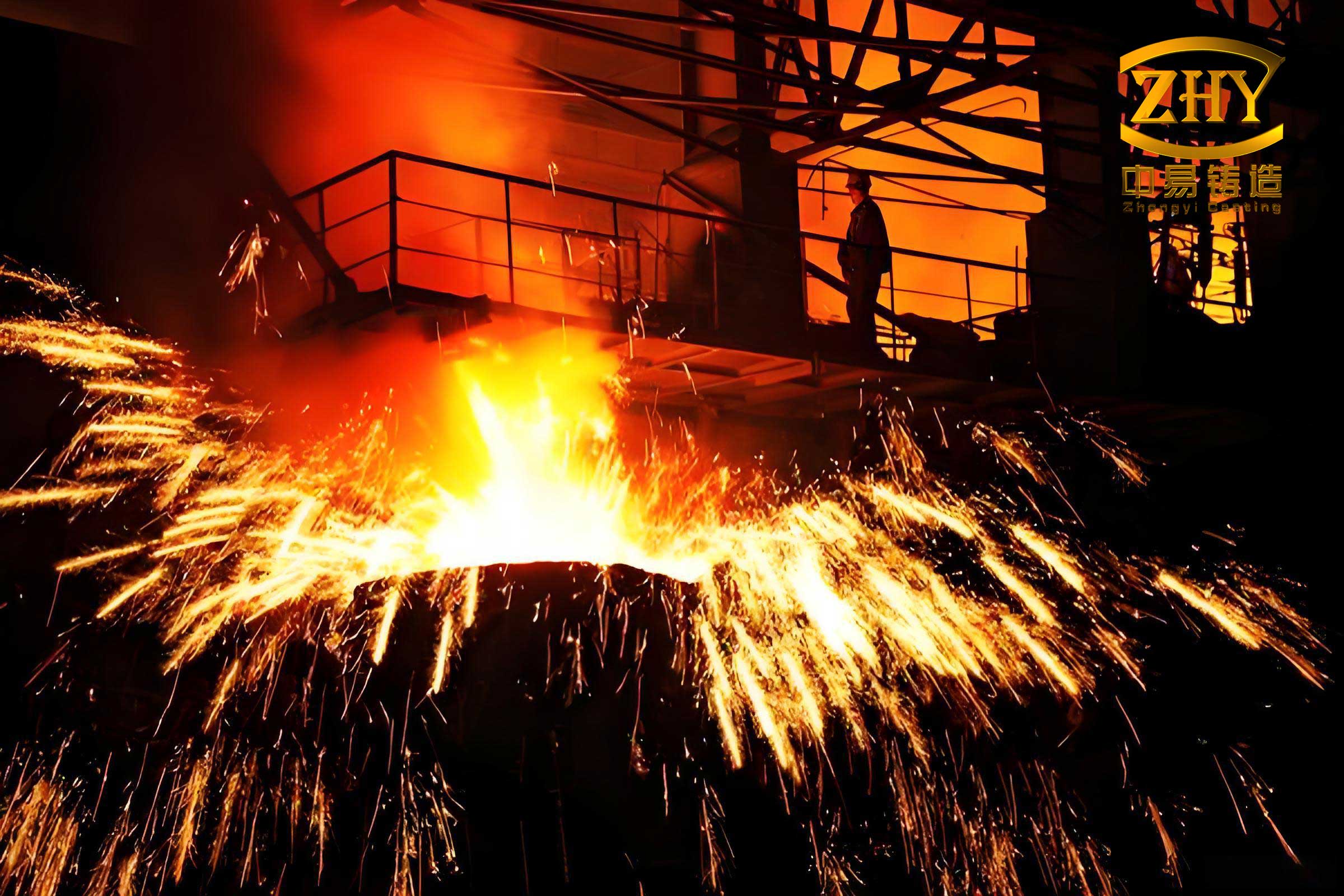
The image above illustrates typical ductile iron castings, highlighting the complexity of components like crankshafts where isothermal quenching is applied. In my work, such castings served as the basis for specimens, emphasizing the practical relevance of this study. The visual reinforces the importance of microstructure control in real-world nodular cast iron parts.
To delve deeper into the fatigue behavior, I conducted fracture surface analysis using scanning electron microscopy. Specimens with quenched martensite in white areas exhibited brittle cleavage facets and secondary cracking along eutectic boundaries, reducing fatigue life. In contrast, those with bainite and residual austenite showed ductile dimples and finer striations, indicating slow crack propagation. The stress concentration factor Kt around graphite nodules can be approximated as:
$$ K_t = 1 + 2\sqrt{\frac{a}{\rho}} $$
where a is the nodule radius and ρ is the root radius of surrounding phases. Bainitic matrices provide better accommodation of stress than martensitic white areas, lowering effective Kt and enhancing fatigue resistance. This aligns with my findings that fatigue strength is maximized when white areas are absent or consist solely of residual austenite.
Based on these insights, I propose several countermeasures to optimize isothermally quenched nodular cast iron. First, adjust the chemical composition: increase silicon to 2.4–2.8 wt.% to promote bainite, reduce manganese to below 0.3 wt.% to minimize segregation, and avoid alloying elements like chromium and molybdenum unless necessary for hardenability. Second, control process parameters: use an austenitizing temperature of 880–900°C for fine grains, and an isothermal temperature of 260–280°C to balance strength and toughness while avoiding martensite formation. Third, implement rapid quenching after austenitizing to minimize segregation effects, followed by precise isothermal holding. The quenching rate Q can be related to the critical cooling rate to avoid pearlite, given by:
$$ Q_{critical} = \frac{T_{austenite} – T_{isothermal}}{t_{nose}} $$
where Taustenite is the austenitizing temperature, Tisothermal is the isothermal temperature, and tnose is the time at the nose of the time-temperature-transformation (TTT) curve for nodular cast iron. Ensuring Q > Qcritical prevents unwanted transformations prior to bainite.
Furthermore, I investigated the role of inoculation and nodulization in the as-cast structure. Proper inoculation with ferrosilicon enhances graphite nodule count and uniformity, which improves heat treatment response. The nodule count N per unit area correlates with toughness via the relation:
$$ \text{Toughness} \propto \frac{1}{\sqrt{N}} $$
but higher N generally refines microstructure and reduces stress concentrations. In my specimens, a nodule count of 150–200 nodules/mm² (size 5–6 per ASTM A247) yielded optimal results after isothermal quenching.
In summary, my research underscores that the performance of isothermally quenched nodular cast iron is highly sensitive to microstructural details. The ideal microstructure comprises fine upper and lower bainite with less than 5% white areas consisting of fragmented residual austenite, and no quenched martensite. Achieving this requires careful balance of composition and process parameters. The toughness and fatigue strength of nodular cast iron are directly linked; higher toughness from bainitic structures translates to better fatigue resistance, crucial for dynamic components. By implementing the countermeasures outlined—such as optimizing silicon and manganese levels, controlling austenitizing and isothermal temperatures, and minimizing microsegregation—manufacturers can consistently produce high-quality nodular cast iron parts with enhanced durability.
To conclude, nodular cast iron remains a material of great interest due to its cost-effectiveness and property tailorability. Isothermal quenching unlocks its potential for high-performance applications, but only when white area formation, particularly quenched martensite, is suppressed. My work provides a framework for achieving this, backed by experimental data and theoretical models. Future studies could explore advanced techniques like additive manufacturing for nodular cast iron or in-situ monitoring during heat treatment. Nevertheless, the principles established here offer a solid foundation for improving the reliability and longevity of components made from this versatile material.