
In my extensive experience within the foundry industry, the adoption of green sand casting for producing small and medium-sized steel castings has presented both significant opportunities and challenges. This process, which utilizes moist sand molds without a drying stage, offers considerable advantages in terms of production cycle time, cost reduction, and resource efficiency. However, transitioning from more traditional methods like sodium silicate-sand molding required a deep understanding and mitigation of specific defects inherent to the wet mold environment. The successful production of high-quality sand casting parts hinges on precise control over materials and processes.
The fundamental appeal of green sand casting lies in its operational simplicity and economic benefits. By eliminating the mold drying operation, the production cycle for sand casting parts can be compressed to a single day—allowing for molding and pouring within the same shift. This eliminates the need for drying ovens, reduces energy consumption, saves on floor space for equipment, and enables a high rate of sand reclamation. My work has consistently shown that with meticulous attention to process parameters, the mechanical properties and surface quality of steel sand casting parts can meet stringent specifications, achieving substantial savings in labor, time, and materials.
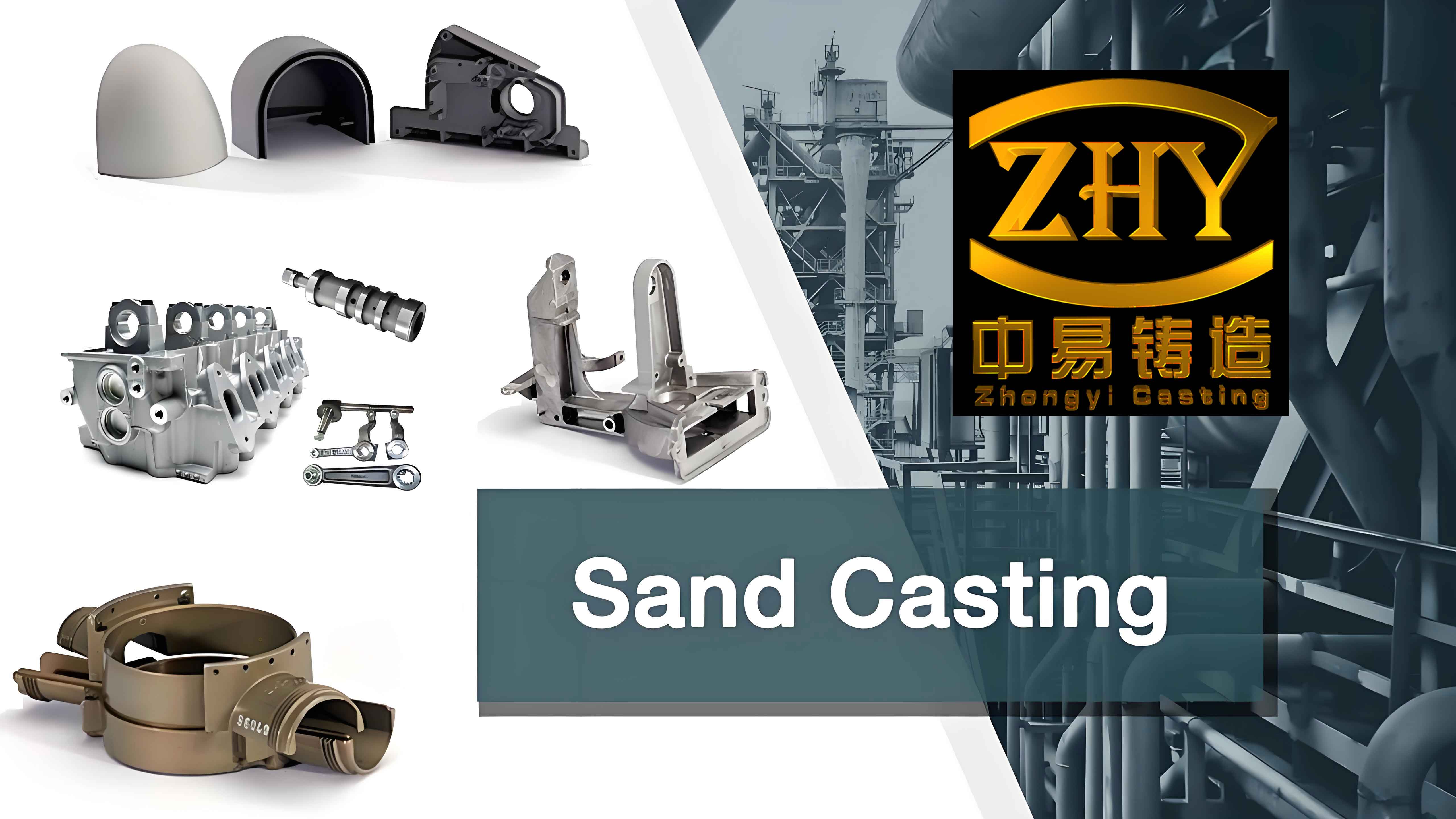
However, the high moisture content and relatively lower strength of green sand molds compared to dried systems introduce a set of characteristic defects when in contact with molten steel around 1600°C. The rapid vaporization of moisture and the thermal degradation of binders generate substantial gases, while the thermal shock can compromise mold integrity. The most prevalent issues jeopardizing the quality of sand casting parts are gas porosity, sand inclusion (scabbing), and slag inclusion.
Analysis of Prevalent Defects in Green Sand Casting
Gas Porosity Formation
Gas porosity is arguably the most frequent cause of rejection in green sand casting of steel components. In my observations, it can account for over half of the scrap in such operations. The mechanism is a direct consequence of the mold’s high initial moisture. Upon pouring, the intense heat from the molten metal causes instantaneous vaporization of water and pyrolysis of organic additives in the sand adjacent to the mold wall. This generates a large volume of gas. If the mold’s permeability is insufficient to allow this gas to escape fully through the sand mass or through vents, pressure builds at the mold-metal interface.
The condition for gas entrainment into the metal can be described by considering the pressure balance. A gas bubble will penetrate the liquid metal if the local gas pressure at the interface, \( P_{gas} \), exceeds the sum of the metallostatic pressure, \( P_{metal} \), and the capillary pressure resisting bubble entry, which is a function of surface tension \( \gamma \) and bubble radius \( r \).
$$ P_{gas} > P_{metal} + \frac{2\gamma}{r} $$
Where \( P_{metal} = \rho g h \), with \( \rho \) being the metal density, \( g \) gravity, and \( h \) the depth from the metal surface. If the metal is hot and fluid, entrained bubbles may float out. However, if the metal cools rapidly, viscosity increases, hindering bubble flotation. Subsurface porosity forms when bubbles are trapped just beneath a solidified skin. The permeability of the molding sand, \( K \), is therefore a critical parameter. It can be approximated for a packed bed of spheres using the Carman-Kozeny equation:
$$ K = \frac{\phi^3}{k (1-\phi)^2 S^2} $$
Here, \( \phi \) is the porosity fraction, \( S \) is the specific surface area per unit volume of the sand grains, and \( k \) is the Kozeny constant. High clay and moisture content reduce \( \phi \) and increase \( S \), drastically lowering \( K \) and promoting gas-related defects in sand casting parts.
Sand Inclusion (Scabbing) Mechanism
Sand inclusion, or scab, manifests as a rough metal surface with embedded sand layers. Its origin is tied to the migration of moisture and differential thermal expansion within the mold wall during pouring. As the metal heats the mold face, a dry, hot layer forms at the surface (Zone A). Just behind it, the incoming steam condenses on cooler sand grains, creating a narrow zone with abnormally high moisture content—a “water condensation zone” or “high moisture zone” (Zone B). This zone experiences a severe drop in strength, often to less than 10% of its original value, due to water blocking the inter-particle bonds.
Simultaneously, the surface layer (primarily quartz sand) expands rapidly upon heating. Quartz undergoes a significant volumetric expansion of approximately 1.4% at its α-β phase transition temperature of 573°C. The stress \( \sigma \) developed due to the constrained expansion of the hot surface layer by the cooler, stronger underlying sand can be modeled as:
$$ \sigma = E \cdot \alpha \cdot \Delta T $$
Where \( E \) is the effective elastic modulus of the sand layer, \( \alpha \) is the coefficient of thermal expansion of quartz, and \( \Delta T \) is the temperature gradient. When this thermal stress, combined with the low strength of the moist intermediate layer, exceeds the layer’s cohesive strength, the surface layer buckles and cracks. Molten metal then penetrates behind this lifted layer, solidifying to form a scab on the final sand casting part. This defect is particularly prevalent on large, flat surfaces of sand casting parts.
Slag and Sand Erosion Inclusion
This defect involves non-metallic inclusions, either eroded sand grains or oxidized metal slag, embedded in the casting surface. The low high-temperature strength of green sand makes the mold vulnerable to erosion by the high-velocity, high-temperature metal stream. Eroded sand particles are often partially vitrified by the steel melt, forming complex silicate slags. Furthermore, turbulence during pouring promotes metal oxidation. If the gating system lacks effective slag traps, these impurities are carried into the mold cavity. The probability of an eroded particle of diameter \( d_p \) being carried into the cavity depends on the flow velocity \( v \) and the dynamic pressure exerted on the mold wall, which relates to the Reynolds number \( Re \):
$$ Re = \frac{\rho v d_p}{\mu} $$
Higher \( Re \) indicates more turbulent flow, increasing erosion risk. Controlling flow dynamics is thus paramount for producing clean sand casting parts.
Implemented Process Measures for Quality Assurance
To counteract these defects, a comprehensive set of process controls was developed and implemented. The strategy focuses on optimizing the mold material, redesigning the metal delivery system, refining molding practices, and strictly controlling pouring parameters.
Molding Sand Preparation and Selection
A dual-sand system was adopted: a high-refractoriness facing sand for the mold cavity interface and a highly permeable backing sand. The facing sand, typically 10-30 mm thick, directly contacts the molten metal and must withstand thermal shock without breaking down. The backing sand provides structural support and venting. After extensive trials with various compositions, the most cost-effective and performant facing sand formulation was selected, as detailed in Table 1.
| Component | Proportion (wt.%) | Function and Notes |
|---|---|---|
| Silica Sand (50/100 mesh) | 100 (Base) | Provides refractoriness and base structure. |
| Bentonite | 10 | Primary clay binder, provides green strength and plasticity. |
| Molasses (Sugar Syrup) | 2 | Organic additive enhances flowability, surface finish, and provides some dry strength after water evaporation. |
| Water | 4 – 5 | Activates the bentonite; critical control parameter. |
The mixing procedure is crucial. Dry powders are blended first for 5 minutes to ensure homogeneity. The molasses is pre-diluted in the required water and then added, followed by an extended mixing cycle of 15 minutes. The final moisture content is tightly controlled between 4.0% and 4.5% to balance strength and permeability. The key sand properties for producing sound sand casting parts are summarized by the following target ranges: Green Compressive Strength: 120-150 kPa; Permeability Number: >120; Moisture Content: 4.0-4.5%.
Gating and Risering System Design
The design philosophy centers on minimizing turbulence, preventing mold erosion, and effectively filtering slag. The key principles applied were:
- Quiescent Metal Flow: The system is designed to maintain a full, non-turbulent flow. The sprue well and runner dimensions are calculated to avoid aspiration and reduce velocity. The choke area is typically enlarged by 10-15% compared to dry sand molds to compensate for faster heat loss and prevent premature freezing in the gating system.
- Effective Slag Trapping: A centrifugal or whirl gate slag trap was integrated into the runner system. As the metal enters the enlarged, circular chamber, it creates a vortex. Centrifugal force drives denser metal to the periphery and lighter slag to the center, where it is trapped. The efficiency of separation can be related to the centrifugal acceleration \( a_c \):
$$ a_c = \frac{v_t^2}{r} $$
Where \( v_t \) is the tangential velocity and \( r \) is the radius of the trap. A well-designed trap maximizes \( a_c \) for effective slag removal from the metal destined for sand casting parts. - Adequate Venting: Multiple vents and ample permeability in the cope mold are essential to provide easy escape paths for generated gases, preventing back-pressure that drives gas into the metal.
Molding Practice Precautions
Molding operations require careful execution to preserve mold integrity:
- Pattern Design: Patterns, including gating elements, are given generous draft angles (3° to 5°) to facilitate easy withdrawal without damaging the fragile mold cavity for intricate sand casting parts.
- Rammer Density: The cope is rammed less densely than the drag to ensure higher overall permeability for gas escape, while still maintaining enough strength to handle.
- Moisture Control: During patching or finishing, water is sprayed minimally to avoid creating localized high-moisture zones that become weak points.
- Mold Sealing: Mold joints are carefully sealed to prevent run-outs, but venting is never compromised.
Pouring Parameters and Control
Strict control during the final pouring stage is the last defense against defects:
- Pouring Temperature: An optimal range is maintained. While sufficient superheat is needed for fluidity, excessive temperature intensifies mold-metal reaction and gas generation. For the typical low-carbon steels used in these sand casting parts, a pouring temperature of 1580 ± 10°C has proven effective. The thermal load \( Q \) on the mold can be approximated:
$$ Q = m_m c_m (T_{pour} – T_{solidus}) $$
Where \( m_m \) is the metal mass, \( c_m \) is specific heat. Lowering \( T_{pour} \) directly reduces \( Q \), lessening mold degradation. - Pouring Rate and Technique: The pour is performed quickly but smoothly to maintain a rising metal front in the mold. The ladle is kept as close as possible to the pouring cup to minimize the stream’s kinetic energy, which is proportional to \( \frac{1}{2} \rho v^2 \). A controlled, non-eroding velocity is critical for preserving the mold surface that defines the sand casting parts.
Economic and Operational Impact Analysis
The transition to green sand casting yielded measurable and significant benefits across multiple metrics. A direct comparison based on the production of a batch of representative sand casting parts, such as brake hubs and brackets, quantifies the advantage. The data in Table 2 contrasts the key performance indicators between the old sodium silicate process and the new green sand process.
| Performance Metric | Sodium Silicate Sand Process | Green Sand Process | Notes and Implications |
|---|---|---|---|
| Production Cycle Time | 3 days | 1 day | 67% reduction, enabling faster turnaround for sand casting parts. |
| Material Cost per Heat (150 kg) | $356.08 | $154.88 | 56% reduction. Cost for green sand is further lowered due to sand reclamation. |
| Energy Cost for Mold Drying | $90.00 | $0.00 | Elimination of drying oven (30 kW) usage. |
| Direct Labor Cost (per batch) | $120.00 | $40.00 | 67% reduction, due to simpler process and easier shakeout. |
| Capital Equipment (Drying Oven) | Required | Not Required | Frees up floor space and reduces maintenance. |
| Sand Reclamation Rate | ~0% | ~80% | Dramatic reduction in new sand purchase and waste disposal for sand casting parts production. |
| Shakeout & Cleaning Effort | High | Moderate | Green sand molds break down more easily, reducing labor. |
The total cost saving per batch exceeds 60%, not accounting for the added benefits of reduced inventory (work-in-progress), smaller production footprint, and improved operational flexibility. The ability to recycle 80% of the sand fundamentally alters the material cost equation, making the production of small and medium-sized steel sand casting parts highly economical.
Conclusion and Broader Applicability
My hands-on implementation and refinement of the green sand casting process for steel components demonstrate that its perceived limitations are manageable through targeted scientific and engineering interventions. The core defects—gas porosity, sand inclusion, and slag inclusion—stem from predictable thermophysical and mechanical interactions between the moist mold and the molten metal. By systematically addressing these through optimized sand composition (balancing strength, permeability, and refractoriness), intelligent gating design (promoting laminar flow and slag removal), precise molding practices, and controlled pouring parameters, consistently high-quality sand casting parts can be achieved.
The economic and efficiency gains are substantial and transformative, offering a compelling alternative to more energy and time-intensive molding processes for a wide range of steel castings. This green sand process represents a lean, agile, and sustainable pathway in foundry operations, proving that robust quality and high productivity in manufacturing sand casting parts are not only compatible but can be synergistically enhanced through thoughtful process innovation. The principles outlined here provide a foundational framework that can be adapted and scaled for various grades of steel and geometries of sand casting parts.