
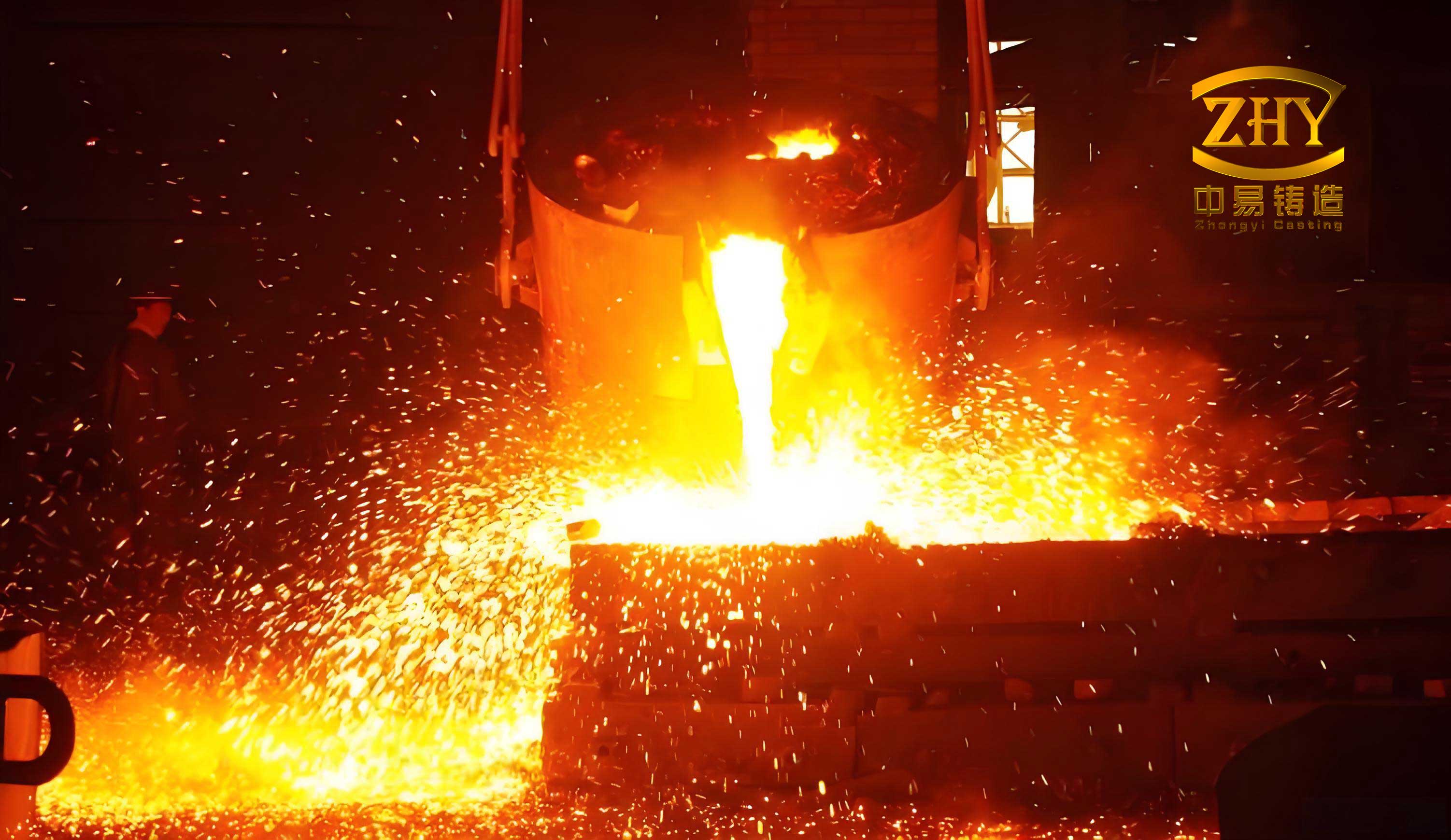
In my work with heavy-section ductile iron casting, I have learned that chemical composition is not merely a list of alloying additions. It is the foundation of solidification behavior, graphite morphology, matrix formation, segregation resistance, and final service performance. A heavy-section ductile iron casting cools slowly, retains heat for a long time, and develops complex internal gradients. These conditions make every element more influential than it would be in a thin-wall casting. The same element that improves strength in a small part may cause severe segregation, carbide formation, or graphite degeneration in a thick part. Therefore, I treat the composition of a heavy-section ductile iron casting as a system of balances rather than isolated targets.
My perspective is practical. I begin with the casting geometry, wall thickness, pouring temperature, nodularity requirement, matrix target, and inspection standard. Only then do I select the carbon, silicon, manganese, sulfur, phosphorus, rare earth, magnesium, alloy, and trace element ranges. This sequence is essential because a heavy-section ductile iron casting cannot be corrected by pouring practice alone if the chemistry is fundamentally unsuitable. The interaction among carbon equivalent, silicon partitioning, magnesium residual, and trace element neutralization determines whether the final casting will be sound, machinable, and durable.
The article below summarizes the elemental composition analysis of heavy-section ductile iron casting from my first-person perspective. I use tables, formulas, and process observations to explain how base elements, alloying elements, and trace elements influence the production and application of heavy-section ductile iron casting. I also discuss applications in thermal power, wind power, and other demanding industries. Throughout this discussion, the central idea is that a successful heavy-section ductile iron casting depends on controlled chemistry, controlled cooling, and controlled treatment.
My View of Heavy-Section Ductile Iron Casting
A heavy-section ductile iron casting is generally characterized by large dimensions, thick walls, high thermal capacity, and slow solidification. In my experience, the most common problems include shrinkage porosity, shrinkage cavities, inverse chill, graphite flotation, spheroidal degeneration, nodularity loss, intercellular carbides, and severe segregation. These problems are not independent. They are linked by the local cooling rate, the local concentration of elements, and the local availability of nuclei for graphite formation.
The slow cooling of a heavy-section ductile iron casting allows solute elements to redistribute over long distances. When the partition coefficient of an element is less than one, that element tends to enrich in the liquid. The Scheil equation gives me a useful first estimate of this behavior:
$$w_i^s = k_i w_i^0 (1 – f_s)^{k_i – 1}$$
Here, \(w_i^s\) is the solid composition of element \(i\), \(k_i\) is the partition coefficient, \(w_i^0\) is the initial liquid composition, and \(f_s\) is the solid fraction. When \(k_i < 1\), the remaining liquid becomes enriched in that element. In heavy-section ductile iron casting, this enrichment can produce intergranular compounds, carbides, and unstable graphite shapes. I therefore examine segregation-prone elements such as manganese, phosphorus, chromium, molybdenum, and certain trace elements with special care.
Cooling rate is another controlling factor. I often use Chvorinov’s rule as a simple approximation for solidification time:
$$t_s = B \left(\frac{V}{A}\right)^n$$
In this expression, \(t_s\) is solidification time, \(V/A\) is the volume-to-surface-area ratio, \(B\) is a mold constant, and \(n\) is an exponent usually close to 2. For a heavy-section ductile iron casting, \(V/A\) is large, so \(t_s\) becomes long. The long solidification time increases graphite growth, magnesium fading, and segregation. I therefore reduce silicon and adjust alloying elements when the modulus increases.
The carbon equivalent is one of my first calculation checks:
$$CE = w_C + \frac{1}{3}(w_{Si} + w_P)$$
For ductile iron, I usually target a near-eutectic carbon equivalent, but I shift the carbon and silicon balance depending on section size. A high carbon content improves graphite formation and reduces chilling tendency, while a high silicon content strengthens ferrite and promotes ferrite formation. However, excessive silicon can cause brittleness, low impact toughness, and undesirable graphite morphology. I therefore define the carbon equivalent and the silicon-to-carbon ratio together.
A useful additional index is carbon saturation:
$$S_c = \frac{w_C}{4.26 – 0.31 w_{Si} – 0.27 w_P}$$
When \(S_c\) is near 1.0, the alloy is close to eutectic. In heavy-section ductile iron casting, I prefer to remain slightly below or near the eutectic point to reduce graphite flotation and shrinkage. The exact target depends on wall thickness, pouring temperature, inoculation, and nodularity requirement.
Elemental Classification in Heavy-Section Ductile Iron Casting
From my analysis, the elements in heavy-section ductile iron casting can be divided into three broad groups: base elements, alloying elements, and trace elements. This classification is not rigid, because some elements can act as alloying elements at higher levels and as trace elements at lower levels. Nevertheless, the classification helps me organize treatment decisions and inspection priorities.
| Group | Typical Elements | Primary Role in Heavy-Section Ductile Iron Casting | Main Risk When Uncontrolled |
|---|---|---|---|
| Base elements | Carbon, silicon, manganese, sulfur, phosphorus, rare earth, magnesium | Control graphite formation, matrix structure, nodularity, desulfurization, and deoxidation | Shrinkage, flotation, spheroidal degeneration, carbides, brittleness |
| Alloying elements | Nickel, chromium, copper, molybdenum, vanadium | Strengthen matrix, control pearlite, improve heat resistance, hardenability, and wear resistance | Segregation, excessive pearlite, carbides, reduced ductility |
| Trace elements | Antimony, bismuth, lead, tin, tellurium | Refine graphite, increase nodule count, neutralize excess rare earth, modify matrix | Graphite degeneration, embrittlement, inverse chill, micro-shrinkage |
In my practice, the boundary between alloying and trace elements is determined by the section size. For example, tin at a low level can increase pearlite and nodule count in a heavy-section ductile iron casting, but a slight excess can embrittle the matrix. Similarly, antimony can improve graphite shape when rare earth is high, but too much antimony can cause graphite flotation and abnormal shape. I therefore use these elements with narrow windows and strict weighing.
Base Elements in Heavy-Section Ductile Iron Casting
The base elements of heavy-section ductile iron casting include carbon, silicon, manganese, sulfur, phosphorus, rare earth, and magnesium. I treat carbon and silicon as the primary structural elements, manganese and phosphorus as segregation-sensitive elements, sulfur as a nodularity-limiting element, and rare earth plus magnesium as the nodularizing elements.
Carbon
Carbon is the most important element for graphite formation in ductile iron casting. In my experience, carbon increases the graphite volume fraction, reduces chill, improves fluidity, and helps feed shrinkage. It also controls the number, size, roundness, and distribution of graphite nodules. For a heavy-section ductile iron casting, I usually target carbon in the range of \(3.4\%\) to \(3.7\%\), but I adjust this range based on carbon equivalent, silicon content, and wall thickness.
When carbon is too low, the alloy moves away from eutectic solidification. This increases the risk of shrinkage porosity and carbide formation. When carbon is too high, graphite flotation may occur, especially in very thick sections. The flotation tendency can be estimated qualitatively by the density difference between graphite and liquid iron, the cooling time, and the local convection. I therefore avoid excessively high carbon in castings with large modulus and long solidification time.
$$CE = w_C + \frac{1}{3}w_{Si} + \frac{1}{3}w_P$$
For heavy-section ductile iron casting, I prefer a near-eutectic carbon equivalent with a controlled silicon level. The exact carbon target is often \(3.5\%\) to \(3.65\%\) when the wall thickness is large. I also monitor the carbon loss during melting, treatment, and pouring. The final carbon must be measured from a representative sample, not assumed from the charge calculation.
Silicon
Silicon is a strong ferrite stabilizer and graphitizer. In heavy-section ductile iron casting, silicon promotes ferrite formation, increases tensile strength through solid-solution strengthening, and improves yield strength. However, silicon also raises the ductile-to-brittle transition temperature and can reduce impact toughness when it is too high. I therefore keep silicon lower in thick sections than in thin sections.
For heavy-section ductile iron casting, I usually control silicon in the range of \(1.8\%\) to \(2.2\%\). As wall thickness increases, I lower the upper limit. If the casting is intended for low-temperature service, I am even more conservative because silicon increases the risk of brittle fracture. The silicon-to-carbon ratio is also important. In my experience, a silicon-to-carbon ratio around \(0.5\) to \(0.7\) can provide a good balance between strength and toughness in certain ductile iron castings, but the optimum depends on section size and matrix target.
$$R_{Si/C} = \frac{w_{Si}}{w_C}$$
When \(R_{Si/C}\) is too high, ferrite becomes brittle and impact toughness decreases. When \(R_{Si/C}\) is too low, carbon may be oxidized and graphite formation may be insufficient. I therefore use carbon and silicon as a paired variable, not as independent targets.
| Silicon Range | Effect in Heavy-Section Ductile Iron Casting | My Action |
|---|---|---|
| Below 1.8% | Insufficient ferrite strengthening, possible chill, lower graphite promotion | Increase inoculation and check carbon equivalent |
| 1.8% to 2.2% | Balanced ferrite strengthening, acceptable toughness, good graphitization | Use for most heavy-section ferritic ductile iron casting |
| Above 2.2% | Higher strength but lower toughness, increased brittleness risk | Reduce for low-temperature or impact-critical castings |
Manganese
Manganese stabilizes pearlite and increases hardenability, but it also promotes intercellular segregation and carbide formation. In heavy-section ductile iron casting, manganese has a strong tendency to segregate because its partition coefficient is less than one. This segregation can produce carbides at cell boundaries and reduce ductility. For ferritic ductile iron casting, I usually keep manganese below \(0.3\%\). For pearlitic ductile iron casting, I may allow up to \(0.5\%\), but I avoid the upper end when the section is very thick.
In heavy-section ductile iron casting, my typical manganese range is \(0.1\%\) to \(0.4\%\). The exact limit depends on the matrix target. If I need a ferritic matrix with high impact toughness, I keep manganese as low as possible. If I need pearlite and strength, I may use a higher manganese level, but I then compensate with inoculation and careful cooling control. I also remember that manganese increases the risk of inverse chill and white iron formation in thin sections, while in thick sections it enriches in the last liquid.
$$k_{Mn} < 1 \Rightarrow w_{Mn}^{liquid} \uparrow \text{ during solidification}$$
Sulfur
Sulfur is a harmful element for nodularity in ductile iron casting. It consumes magnesium and rare earth, forms sulfides, and reduces the effective nodularizing power. In heavy-section ductile iron casting, sulfur must be kept low before treatment. I typically target sulfur in the base iron at \(0.01\%\) to \(0.03\%\), and I prefer the lower end for critical castings. After nodularization, the residual sulfur should be very low, often below \(0.01\%\).
However, sulfur should not be reduced to zero. A very low sulfur content can reduce nucleation and increase the risk of chunky graphite or broken graphite. I therefore maintain a minimum sulfur level, usually not below \(0.005\%\), to preserve nucleation potential. The balance is important: enough sulfur for nucleation, but not so much that magnesium is wasted.
$$w_{Mg,effective} = w_{Mg,total} – a w_S – b w_O$$
This simplified expression reminds me that not all magnesium is available for nodularization. Some magnesium combines with sulfur and oxygen. The residual magnesium that actually controls graphite shape is the effective magnesium. I therefore calculate the magnesium addition from the sulfur and oxygen load, not from a fixed recipe alone.
Phosphorus
Phosphorus is a harmful element in heavy-section ductile iron casting. It has low solubility in iron and a strong segregation tendency. It forms phosphide eutectic at cell boundaries, raises the ductile-to-brittle transition temperature, and reduces impact toughness. In thick sections, phosphorus segregation can be ten to twenty times the nominal composition or more. This means that even a small average phosphorus content can create local brittle regions.
For heavy-section ductile iron casting, I limit phosphorus to \(0.02\%\) maximum, and I prefer below \(0.015\%\) for low-temperature or high-impact applications. When phosphorus is high, the risk of shrinkage porosity and cold cracking increases. I therefore control the charge materials carefully and avoid phosphorus-bearing scrap.
| Phosphorus Level | Expected Effect | Acceptability in Heavy-Section Ductile Iron Casting |
|---|---|---|
| Below 0.015% | Low segregation, good toughness, low cracking risk | Preferred for critical and low-temperature castings |
| 0.015% to 0.020% | Moderate segregation, acceptable for many general castings | Acceptable with careful inspection |
| Above 0.020% | High segregation, phosphide eutectic, brittleness, cold cracking | Not acceptable for heavy-section ductile iron casting |
Rare Earth and Magnesium
Rare earth and magnesium are the nodularizing elements in ductile iron casting. Rare earth has strong desulfurization and deoxidation ability. Magnesium has a low boiling point, so it produces boiling and stirring during treatment, which helps homogenize the iron liquid. When magnesium and rare earth residuals are correctly controlled, graphite nodules become round and well distributed. When they are excessive, graphite shape deteriorates, dross increases, and cost rises.
In my experience, the residual magnesium must be matched to the residual sulfur. A common target is:
$$1.5 \le \frac{w_{Mg,res}}{w_{S,res}} \le 2.0$$
For heavy-section ductile iron casting, I usually target residual magnesium in the range of \(0.04\%\) to \(0.06\%\) or \(0.01\%\) to \(0.03\%\) depending on the treatment method, sulfur level, and casting modulus. Too little magnesium causes spheroidal degeneration and flake graphite. Too much magnesium increases the risk of subcutaneous porosity, micro-shrinkage, dross, and poor graphite shape. High magnesium also expands the solidification interval, which can increase shrinkage porosity.
Rare earth is especially useful when the iron contains residual antimony, bismuth, lead, or other interfering elements. However, excess rare earth can cause chunky graphite in heavy sections. I therefore balance rare earth with trace elements rather than adding it blindly.
| Nodularizing Variable | Typical Heavy-Section Target | Effect of Excess |
|---|---|---|
| Residual magnesium | 0.04% to 0.06% or 0.01% to 0.03% | Dross, gas porosity, micro-shrinkage, poor graphite shape |
| Residual sulfur | Below 0.01%, but not below 0.005% | If too low, poor nucleation and chunky graphite risk |
| Residual rare earth | Balanced with trace elements | Chunky graphite, dross, increased cost |
| Mg/S ratio | 1.5 to 2.0 | Outside this range, nodularity and shrinkage control suffer |
Alloying Elements in Heavy-Section Ductile Iron Casting
Alloying elements are added to heavy-section ductile iron casting to modify the matrix, increase strength, improve hardenability, or enhance heat resistance. The most common alloying elements in my practice are nickel, chromium, copper, molybdenum, and vanadium. Each has a different partition behavior and a different effect on graphite morphology. I use them only when the base chemistry and nodularization are already under control.
Nickel
Nickel is a graphitizing and austenite-stabilizing element. It reduces the chilling tendency, improves toughness, and increases strength through solid-solution strengthening. In ferritic ductile iron casting, each \(0.5\%\) nickel addition can increase yield strength by approximately \(18\,\text{MPa}\). Nickel also lowers the pearlite transformation temperature, which favors pearlite formation, but it can suppress ferrite precipitation when used at higher levels.
In heavy-section ductile iron casting, I often use nickel in the range of \(0.1\%\) to \(1.0\%\) for low-temperature ferritic castings. Nickel improves low-temperature impact toughness when the matrix is ferritic and the silicon content is controlled. However, nickel is costly, so I use the minimum amount that meets the mechanical property requirement. I also check that nickel does not increase the risk of excessive pearlite in a casting that is specified as fully ferritic.
| Nickel Addition | Matrix Effect | Property Effect | My Typical Use |
|---|---|---|---|
| 0.1% to 0.5% | Slight pearlite promotion, ferrite strengthening | Improved toughness and yield strength | Low-temperature ferritic heavy-section ductile iron casting |
| 0.5% to 1.0% | Stronger pearlite stabilization, ferrite suppression | Higher strength, moderate toughness loss | Heavy-section castings requiring strength and hardenability |
| Above 1.0% | High alloy cost, possible retained austenite | Higher strength but uncertain toughness | Used only for special high-alloy ductile iron casting |
Chromium
Chromium is a carbide-forming element that increases pearlite content, hardenability, and wear resistance. In heavy-section ductile iron casting, chromium is powerful but dangerous. A small amount can improve hardness and heat fatigue resistance, but excess chromium segregates to cell boundaries and forms network carbides. These carbides reduce ductility and machinability. For this reason, I keep chromium very low in most heavy-section ductile iron casting, often below \(0.05\%\) when carbides are not desired.
When chromium is intentionally used, I usually target \(0.15\%\) to \(0.25\%\) for certain wear-resistant or heat-resistant castings. Above \(1.6\%\), the alloy moves toward a different class of material and cannot be treated as a standard ductile iron casting. I therefore specify chromium only after evaluating the section size, cooling rate, and matrix requirement.
$$w_{Cr} \uparrow \Rightarrow \text{carbide volume fraction} \uparrow \Rightarrow \text{ductility} \downarrow$$
Copper
Copper is a mild graphitizer and a pearlite stabilizer. It strengthens the matrix and increases the pearlite volume fraction. In heavy-section ductile iron casting, copper can improve strength and hardness, but it also raises the ductile-to-brittle transition temperature. I therefore limit copper carefully. In thick sections, I usually keep copper below \(0.5\%\). The maximum limit in many specifications is \(1.2\%\), but I avoid this upper limit unless the application requires high pearlite and the toughness requirement is low.
Copper is also affected by the purity of the iron. When the charge is clean and the residual elements are low, copper can refine graphite shape and increase nodule count. When the iron contains high levels of interfering elements, copper may worsen segregation. I therefore consider copper together with nickel, manganese, and trace elements.
| Copper Level | Structural Effect | Risk | My Recommendation |
|---|---|---|---|
| Below 0.3% | Slight pearlite increase, mild strengthening | Low risk | Common in heavy-section ductile iron casting |
| 0.3% to 0.5% | Moderate pearlite increase, higher strength | Transition temperature increases | Use when strength is required and toughness permits |
| Above 0.5% | Strong pearlite promotion | Embrittlement, segregation, reduced impact toughness | Avoid in thick sections unless specified |
Molybdenum
Molybdenum is a weak carbide former and a strong matrix strengthener. It improves high-temperature strength and thermal fatigue resistance. It also promotes uniform carbide distribution under certain conditions and improves corrosion resistance. In heavy-section ductile iron casting, molybdenum is often added at \(0.1\%\) to \(0.3\%\) to improve elevated-temperature performance. When silicon is above \(2.3\%\) and phosphorus is above \(0.05\%\), molybdenum can help prevent temper embrittlement.
Molybdenum segregates slowly and is less damaging than chromium in heavy sections, but it still increases hardenability and can form carbides. I use it when the casting must resist thermal cycling, such as in exhaust components, glass molds, or certain power-generation parts. I also check that molybdenum does not raise the hardness beyond the machining limit.
$$w_{Mo} = 0.1\% \text{ to } 0.3\% \Rightarrow \text{improved thermal fatigue resistance}$$
Vanadium
Vanadium is a strong carbide former. In ductile iron casting, increasing vanadium increases hardness and decreases elongation. When vanadium is below \(0.5\%\), it does not necessarily destroy nodular graphite, but it increases carbide content and shrinkage. Above \(0.3\%\), I usually need stronger inoculation and silicon addition to prevent free carbides. For heavy-section ductile iron casting intended to be machinable and ductile, I keep vanadium below \(0.1\%\).
Vanadium is sometimes present as a residual from scrap. This is why I carefully control the charge mix. A low residual vanadium may be acceptable, but an uncontrolled increase can make the casting brittle and difficult to machine. In my experience, vanadium is one of the elements that must be monitored even when it is not intentionally added.
| Alloying Element | Typical Range in Heavy-Section Ductile Iron Casting | Main Benefit | Main Concern |
|---|---|---|---|
| Nickel | 0.1% to 1.0% | Toughness, strength, low-temperature impact resistance | Cost, pearlite promotion |
| Chromium | Below 0.05% if carbides are undesirable; 0.15% to 0.25% for special wear resistance | Hardenability, wear resistance, heat fatigue resistance | Network carbides, segregation, poor machinability |
| Copper | Below 0.5% in thick sections | Pearlite strengthening, hardenability | Embrittlement, transition temperature increase |
| Molybdenum | 0.1% to 0.3% | High-temperature strength, thermal fatigue resistance | Carbides, cost, hardness control |
| Vanadium | Below 0.1% for ductile heavy-section casting | Hardness, wear resistance | Carbides, shrinkage, reduced elongation |
Trace Elements in Heavy-Section Ductile Iron Casting
Trace elements can be beneficial or harmful depending on their concentration and interaction with rare earth and magnesium. In heavy-section ductile iron casting, the most important trace elements I monitor are antimony, bismuth, lead, tin, and tellurium. These elements often segregate to graphite-liquid interfaces or cell boundaries. They can change nodule count, nodule shape, matrix structure, and shrinkage behavior.
A general principle in my work is that trace elements must be balanced against rare earth and magnesium. When rare earth is high, a small amount of antimony or bismuth can neutralize excess rare earth and improve graphite shape. When rare earth is low, the same trace element can destroy nodularity. I therefore never specify a trace element without also specifying the rare earth residual and the magnesium residual.
Antimony
Antimony is a surface-active element that is not a strong nodularizer by itself. In heavy-section ductile iron casting, a very small antimony addition can improve graphite shape and increase nodule count when rare earth is high. Antimony tends to enrich on graphite surfaces and can prevent graphite degeneracy. It also promotes pearlite, so it is useful in high-strength ductile iron casting when some pearlite is desired.
However, antimony can cause graphite flotation and abnormal graphite when it exceeds a narrow limit. In my practice, the antimony addition is usually \(0.006\%\) to \(0.010\%\). I add it as fine powder with the inoculant stream. I do not use antimony in castings that require maximum ferrite and low pearlite unless the specification allows it.
$$w_{Sb} = 0.006\% \text{ to } 0.010\% \Rightarrow \text{improved nodule shape when rare earth is high}$$
Bismuth
Bismuth is a strong trace element for graphite refinement in heavy-section ductile iron casting. When rare earth is present, bismuth can form stable nuclei that make graphite nodules more stable and more numerous. This improves nodularity and mechanical strength. The best results in my experience occur when bismuth is added at \(0.008\%\) to \(0.010\%\) and the residual rare earth to bismuth ratio is controlled.
$$\frac{w_{RE,res}}{w_{Bi}} = 1.4 \text{ to } 1.9$$
When this ratio is too low, bismuth may become excessive and cause graphite degeneration. When the ratio is too high, the benefit is reduced. I therefore treat bismuth as a balancing element, not as a simple additive.
Lead
Lead is a strong graphite-degenerating element in ductile iron casting. At very low levels, and in the presence of rare earth, lead can reduce thermal conductivity and protect the austenite shell, which may help nodular graphite formation and prevent degeneration. However, when lead exceeds about \(0.004\%\), it can deform graphite nodules and promote pearlite and carbides. In heavy-section ductile iron casting, I keep lead as low as possible, preferably below \(0.002\%\), unless a specific balanced treatment is being used.
$$w_{Pb} > 0.004\% \Rightarrow \text{graphite deformation and carbide promotion}$$
Tin
Tin is an anti-nodularizing element and a strong pearlite stabilizer. At \(0.06\%\) tin, ferrite may be almost completely eliminated in the matrix. Tin has a low melting point and tends to segregate near graphite nodules during solidification. This can strengthen the austenite shell and prevent irregular growth. When added in a controlled way, tin can increase nodule count and roundness in heavy-section ductile iron casting.
However, tin above \(0.08\%\) increases embrittlement. At \(0.3\%\), the interface distortion becomes severe and mechanical strength drops sharply. Tin also increases shrinkage porosity and micro-shrinkage. I therefore use tin only when pearlite is required and the toughness requirement permits it. In ferritic heavy-section ductile iron casting, I avoid tin completely.
| Tin Level | Matrix and Graphite Effect | My Decision |
|---|---|---|
| Below 0.02% | Minor pearlite promotion, low risk | Acceptable in many heavy-section castings |
| 0.02% to 0.06% | Pearlite increases, ferrite decreases, nodule count may improve | Use only for pearlitic specifications |
| 0.06% to 0.08% | Ferrite nearly absent, toughness decreases | Avoid for impact-critical castings |
| Above 0.08% | Embrittlement, shrinkage, micro-shrinkage | Not acceptable |
Tellurium
Tellurium is a powerful carbide stabilizer and a strong chill-promoting element. In heavy-section ductile iron casting, especially in roll shells or similar parts, a very small tellurium addition can refine the microstructure and improve resistance to graphite deformation. It also reduces shrinkage cavities and porosity in some cases. However, tellurium is dangerous because it can cause inverse chill and carbide formation. When tellurium exceeds about \(0.003\%\), strength drops significantly.
$$w_{Te} > 0.003\% \Rightarrow \text{strength reduction and chill risk}$$
I therefore use tellurium only in special applications with strict process control. It is not a general-purpose addition for heavy-section ductile iron casting.
| Trace Element | Typical Target | Benefit | Risk Above Target |
|---|---|---|---|
| Antimony | 0.006% to 0.010% | Graphite shape improvement, pearlite promotion | Flotation, abnormal graphite |
| Bismuth | 0.008% to 0.010%, with RE/Bi = 1.4 to 1.9 | Nodule refinement, stable graphite nuclei | Graphite degeneration, dross |
| Lead | Below 0.004%, preferably below 0.002% | Possible austenite shell protection at very low levels | Graphite deformation, carbides, pearlite |
| Tin | Below 0.06% for pearlite; avoid for ferrite | Pearlite stabilization, nodule count increase | Embrittlement, shrinkage, micro-shrinkage |
| Tellurium | Below 0.003% | Microstructure refinement, chill control in special parts | Inverse chill, carbides, strength loss |
Interactions and Process Windows in Heavy-Section Ductile Iron Casting
In heavy-section ductile iron casting, no element acts alone. I evaluate interactions among carbon, silicon, manganese, sulfur, phosphorus, magnesium, rare earth, alloys, and trace elements. The following formulas and rules help me define a process window.
The nodularity index can be estimated from residual magnesium and sulfur:
$$N_i = f(w_{Mg,res}, w_{S,res}, w_{RE,res}, w_{O,res})$$
When residual magnesium is sufficient and residual sulfur is low, nodularity is high. When residual rare earth is balanced with trace elements, nodule count and roundness improve. When residual oxygen is high, magnesium is consumed and dross forms. I therefore measure magnesium, sulfur, and rare earth together.
The shrinkage tendency of heavy-section ductile iron casting can be described qualitatively by the solidification interval:
$$\Delta T_s = T_L – T_S$$
A wider solidification interval generally increases shrinkage porosity. Elements that widen the interval, such as magnesium, phosphorus, and some alloys, must be controlled. Elements that narrow the interval or promote graphite expansion, such as carbon and silicon within limits, can reduce shrinkage. However, excessive graphite expansion can also cause mold wall movement and internal porosity if the mold strength is insufficient.
I also use the cooling rate and temperature gradient to decide inoculation and alloying:
$$G = \frac{\Delta T}{\Delta x}$$
$$R = \frac{G}{v}$$
In these expressions, \(G\) is the thermal gradient, \(v\) is the solidification velocity, and \(R\) is a solidification parameter. Slow cooling in heavy sections reduces \(G\) and \(v\), which favors graphite growth but also increases segregation. I therefore compensate with lower silicon, controlled magnesium, and trace element balancing.
| Process Variable | Effect on Heavy-Section Ductile Iron Casting | My Adjustment |
|---|---|---|
| Wall thickness increase | Longer solidification time, more segregation, graphite flotation risk | Lower silicon, control carbon, reduce magnesium excess |
| Pouring temperature increase | Longer freezing time, more magnesium fading | Lower pouring temperature within fluidity limits |
| High sulfur base iron | Magnesium consumption, low nodularity | Desulfurize, increase magnesium/rare earth, verify residual |
| High phosphorus | Segregation, brittleness, cold cracking | Use low-phosphorus charge, limit to below 0.02% |
| High manganese | Intercellular carbides, pearlite increase | Keep below 0.4%, lower for ferritic castings |
| High rare earth | Chunky graphite, dross | Add antimony or bismuth within narrow limits |
| Low rare earth | Poor graphite shape, low nodule count | Increase rare earth or adjust magnesium |
Applications of Heavy-Section Ductile Iron Casting in Thermal Power
In the thermal power industry, heavy-section ductile iron casting is used for turbine casings, valve bodies, pump housings, and large structural components. These parts often have complex shapes and wall thicknesses ranging from \(60\,\text{mm}\) to \(320\,\text{mm}\). The service conditions include high temperature, high pressure, thermal cycling, and steam exposure. Therefore, the casting must have high nodularity, controlled matrix, low segregation, and reliable internal soundness.
In my experience with thermal power components, the technical requirements are strict. Nodularity is often required to be at least \(3\) on a specified scale, graphite size is controlled between \(5\) and \(8\), and pearlite content is often at least \(10\%\). The casting may require \(100\%\) magnetic particle inspection and \(100\%\) ultrasonic inspection. Critical zones may need a sound velocity above \(5500\,\text{m/s}\). After precision machining, a water leakage test may be performed within \(30\,\text{minutes}\).
To meet these requirements in heavy-section ductile iron casting, I use a carefully designed sand box, bottom pouring, and an open pouring system. A small neck-type feeder is placed at the top. The pouring temperature is controlled at \(1450^\circ\text{C}\) to \(1465^\circ\text{C}\). A low rare earth magnesium ferrosilicon nodularizer is added at about \(1.3\%\). The first inoculation uses a long-acting inoculant, and the second inoculation uses an inoculant that increases nodule count. The final pouring temperature is \(1340^\circ\text{C}\) to \(1360^\circ\text{C}\). This combination produces good microstructure and reliable properties.
| Thermal Power Requirement | Typical Specification | My Process Response |
|---|---|---|
| Wall thickness | 60 mm to 320 mm | Adjust carbon equivalent and silicon downward as thickness increases |
| Nodularity | At least 3 | Control residual Mg and S, use rare earth balancing |
| Graphite size | 5 to 8 | Use inoculation and controlled cooling |
| Pearlite content | At least 10% | Adjust Cu, Ni, Mn, Sn within limits |
| Inspection | 100% MT and 100% UT | Use clean charge, controlled treatment, and proper feeding |
| Sound velocity in critical zones | Above 5500 m/s | Ensure high nodularity and low porosity |
Applications of Heavy-Section Ductile Iron Casting in Wind Power
Wind power is another major application for heavy-section ductile iron casting. Wind turbine components operate under fatigue loads, low temperatures, and difficult maintenance conditions. Once installed, they must operate reliably for many years. Typical heavy-section ductile iron casting parts include hubs, bases, bearing housings, and gearbox housings. These parts are large and thick, so they are usually specified as ferritic ductile iron casting to maximize toughness and low-temperature impact resistance.
For wind power heavy-section ductile iron casting, I focus on ferrite matrix, high nodularity, low residual elements, and low shrinkage porosity. The phosphorus content must be very low to avoid cold brittleness. Silicon must be controlled to balance strength and low-temperature toughness. Nickel may be added at \(0.1\%\) to \(1.0\%\) to improve low-temperature impact properties. Manganese must be kept low to avoid intercellular carbides. Trace elements such as tin and antimony must be avoided unless they are intentionally balanced, because they promote pearlite and reduce toughness.
Inspection for wind power heavy-section ductile iron casting often includes surface magnetic particle testing, internal ultrasonic testing, and radiographic testing. The acceptance criteria are strict because the parts are safety-critical. I therefore use a clean charge, precise nodularization, multi-stage inoculation, and controlled cooling. I also verify that the microstructure is uniform from the surface to the core.
| Wind Power Component | Key Property Requirement | Composition Focus | Inspection Focus |
|---|---|---|---|
| Hub | High fatigue strength, low-temperature toughness | Ferritic matrix, low P, low Mn, controlled Si, Ni if needed | UT, MT, microstructure uniformity |
| Base | Stiffness, fatigue resistance, soundness | Near-eutectic CE, low segregation elements | UT, dimensional control |
| Bearing housing | Strength, wear resistance, dimensional stability | Controlled pearlite and ferrite balance | MT, UT, hardness mapping |
| Gearbox housing | Fatigue strength, pressure tightness | Low porosity, controlled Mg and RE | UT, pressure test, X-ray in critical zones |
My Recommended Composition Strategy for Heavy-Section Ductile Iron Casting
Based on my experience, I recommend the following strategy for heavy-section ductile iron casting. First, establish the carbon equivalent target from the section modulus. Second, set the carbon and silicon ranges together, not separately. Third, keep manganese and phosphorus as low as the specification allows. Fourth, control sulfur before nodularization and verify residual sulfur after treatment. Fifth, balance magnesium and rare earth with sulfur and oxygen. Sixth, add alloying elements only when the mechanical property target requires them. Seventh, use trace elements only within narrow windows and only with rare earth balancing.
The following table summarizes my typical starting ranges for heavy-section ductile iron casting. These ranges are not universal recipes. They must be adjusted for casting geometry, melting practice, treatment method, mold material, pouring temperature, and inspection standard.
| Element | Typical Range in Heavy-Section Ductile Iron Casting | Primary Purpose | My Control Priority |
|---|---|---|---|
| Carbon | 3.4% to 3.7% | Graphite formation, fluidity, shrinkage reduction | High |
| Silicon | 1.8% to 2.2% | Ferrite strengthening, graphitization | High |
| Manganese | 0.1% to 0.4% | Pearlite stabilization, strength | High for ferritic castings |
| Sulfur | 0.01% to 0.03% before treatment; below 0.01% after | Nodularization control, nucleation balance | Very high |
| Phosphorus | Below 0.02% | Minimize segregation and brittleness | Very high |
| Magnesium | 0.04% to 0.06% or 0.01% to 0.03% residual | Nodularization | Very high |
| Rare earth | Balanced with S and trace elements | Desulfurization, deoxidation, graphite shape | High |
| Nickel | 0.1% to 1.0% | Toughness, strength, low-temperature impact | Medium |
| Chromium | Below 0.05% or 0.15% to 0.25% for special wear | Hardenability, wear resistance | High if carbides are a concern |
| Copper | Below 0.5% in thick sections | Pearlite strengthening | Medium |
| Molybdenum | 0.1% to 0.3% | High-temperature strength, thermal fatigue resistance | Medium |
| Vanadium | Below 0.1% for ductile heavy-section casting | Hardness, wear resistance | High if residual |
| Antimony | 0.006% to 0.010% | Graphite shape, pearlite promotion | Very high |
| Bismuth | 0.008% to 0.010%, RE/Bi = 1.4 to 1.9 | Nodule refinement | Very high |
| Lead | Below 0.004%, preferably below 0.002% | Avoid graphite degeneration | Very high |
| Tin | Below 0.06% for pearlite; avoid for ferrite | Pearlite stabilization | High |
| Tellurium | Below 0.003% | Special chill and refinement | Very high |
Quality Control and Verification in Heavy-Section Ductile Iron Casting
I verify the composition and performance of every heavy-section ductile iron casting through a combination of thermal analysis, spectroscopy, microstructure examination, mechanical testing, and nondestructive inspection. Thermal analysis helps me predict the carbon equivalent, eutectic temperature, and inoculation response. Spectroscopy gives me the chemical composition, including residual magnesium, rare earth, sulfur, and trace elements. Microstructure examination shows nodularity, nodule count, graphite size, matrix constitution, and carbide presence. Mechanical testing confirms tensile strength, yield strength, elongation, and impact toughness. Nondestructive inspection reveals internal shrinkage, porosity, inclusions, and cracks.
In my practice, the most important verification points for heavy-section ductile iron casting are the following:
- Carbon equivalent and carbon saturation must match the section modulus.
- Residual magnesium must be sufficient for nodularity but not excessive.
- Residual sulfur must be low, but not so low that nucleation is lost.
- Rare earth must be balanced with trace elements to avoid chunky graphite.
- Manganese and phosphorus must be low enough to prevent segregation and brittleness.
- Alloying elements must be selected for the required matrix and service condition.
- Trace elements must be measured, not assumed.
- Inoculation must be strong enough to prevent chill and promote nodule count.
- Pouring temperature and cooling rate must be controlled to reduce shrinkage.
I also use the following relation as a practical reminder that nodule count and cooling rate are linked:
$$N \propto \left(\frac{dT}{dt}\right)^m$$
In this expression, \(N\) is nodule count, \(dT/dt\) is cooling rate, and \(m\) is a positive exponent. Faster cooling generally increases nodule count, while slower cooling in heavy sections decreases it. I therefore increase inoculation and control trace elements to compensate for the slow cooling of heavy-section ductile iron casting.
Final Remarks from My Perspective
Heavy-section ductile iron casting is a demanding field because the slow cooling rate amplifies every chemical imbalance. In my experience, the most successful castings are produced when the composition is designed for the section size, the nodularization is balanced with sulfur and oxygen, the inoculation is sufficient, and the trace elements are controlled within narrow limits. Carbon and silicon establish the graphite and matrix foundation. Manganese, sulfur, and phosphorus define the segregation and toughness limits. Magnesium and rare earth control nodularity. Nickel, chromium, copper, molybdenum, and vanadium adjust strength, hardness, and heat resistance. Antimony, bismuth, lead, tin, and tellurium refine or damage graphite depending on their concentration and balance.
I do not treat any of these elements in isolation. A heavy-section ductile iron casting succeeds when the entire composition system is consistent with the casting geometry, molding method, pouring practice, and inspection requirement. When I follow this approach, I can produce heavy-section ductile iron casting with high nodularity, uniform microstructure, low shrinkage, good machinability, and reliable service performance in thermal power, wind power, mining, machine tools, and transportation applications.
The future of heavy-section ductile iron casting will continue to depend on precise composition control. As sections become thicker and service conditions become more severe, the tolerance for residual elements will become tighter. I expect that advanced thermal analysis, automated weighing, real-time spectroscopy, and digital process control will make it easier to keep every element within its proper window. Even so, the fundamental principle remains unchanged: a heavy-section ductile iron casting is only as good as its chemical foundation.