
In my experience as a metallurgical engineer specializing in railway components, I have consistently observed that high manganese steel casting is the material of choice for critical parts such as switches, crossings, frogs, and guard rails. These components endure severe friction and impact from metal-to-metal contact, demanding exceptional wear resistance and toughness. The superiority of high manganese steel casting lies in its unique combination of core strength, plasticity, and toughness, coupled with a work-hardened surface layer that can reach depths of several millimeters and hardness values exceeding 500 HB. This surface hardening, achieved through cold working, not only dramatically extends service life but also prevents sudden failures that could lead to catastrophic derailments. The exceptional properties of high manganese steel casting are not inherent; they must be meticulously developed through precise control of raw materials, melting, casting, heat treatment, and hardening processes. Below, I elaborate on these key aspects, incorporating tables and formulas to summarize critical data and principles.
The development of high manganese steel casting dates back over a century, with its invention attributed to Sir Robert Hadfield. This austenitic steel is characterized by moderate strength but outstanding ductility and toughness, non-magnetic behavior, and a single-phase austenitic structure. Its most remarkable feature is the ability to become extremely hard and wear-resistant at the surface when subjected to cold working. The foundational step in producing a reliable high manganese steel casting is the melting process. Typically, high manganese steel is a high-carbon, high-alloy steel with a standard chemical composition as outlined in Table 1.
| Element | Range | Key Effects and Control |
|---|---|---|
| Carbon (C) | 1.0 – 1.4% | Primary contributor to strength and hardenability. Higher carbon increases hardness but may reduce toughness. |
| Manganese (Mn) | 11.0 – 14.0% | Stabilizes austenite, suppresses pearlite transformation, and enables work hardening. The main source is high-carbon ferromanganese. |
| Silicon (Si) | 0.3 – 0.8% | Deoxidizer. Improves fluidity but excessive silicon can promote carbide precipitation. |
| Phosphorus (P) | ≤ 0.07% (max 0.10%) | Harmful impurity. Reduces wear resistance, low-temperature impact value, and increases crack susceptibility. Control via low-P ferroalloys and aluminum addition to form AlP inclusions. |
| Sulfur (S) | ≤ 0.05% | Forms low-melting MnS inclusions that float into slag. Generally kept low. |
| Aluminum (Al) – residual | < 0.10% | Used for deoxidation and P fixation. Excess residual Al can adversely affect properties. |
Given its composition, high manganese steel casting is ideally melted in a basic electric arc furnace. This environment allows for precise adjustment of chemistry and temperature control. The basic slag helps in phosphorus removal. A critical aspect is melt purification; I often employ inert gas stirring (using argon or nitrogen) in the ladle to homogenize the bath and remove non-metallic inclusions. The pouring temperature must be rigorously controlled. Excessive temperature leads to coarse as-cast grain structure, which even subsequent heat treatment cannot fully rectify, resulting in degraded strength and ductility, increased cracking tendency, and poor surface quality due to intense metal-mold reactions. The optimal pouring temperature, $T_{pour}$, can be estimated relative to the liquidus temperature, $T_L$, which for a typical high manganese steel is approximately 1350°C. A common practice is:
$$ T_{pour} = T_L + \Delta T $$
$$ \Delta T \approx 50 – 100 \, ^\circ\mathrm{C} $$
Thus, $T_{pour}$ is typically maintained around 1400-1450°C. Deviations beyond this range are detrimental.
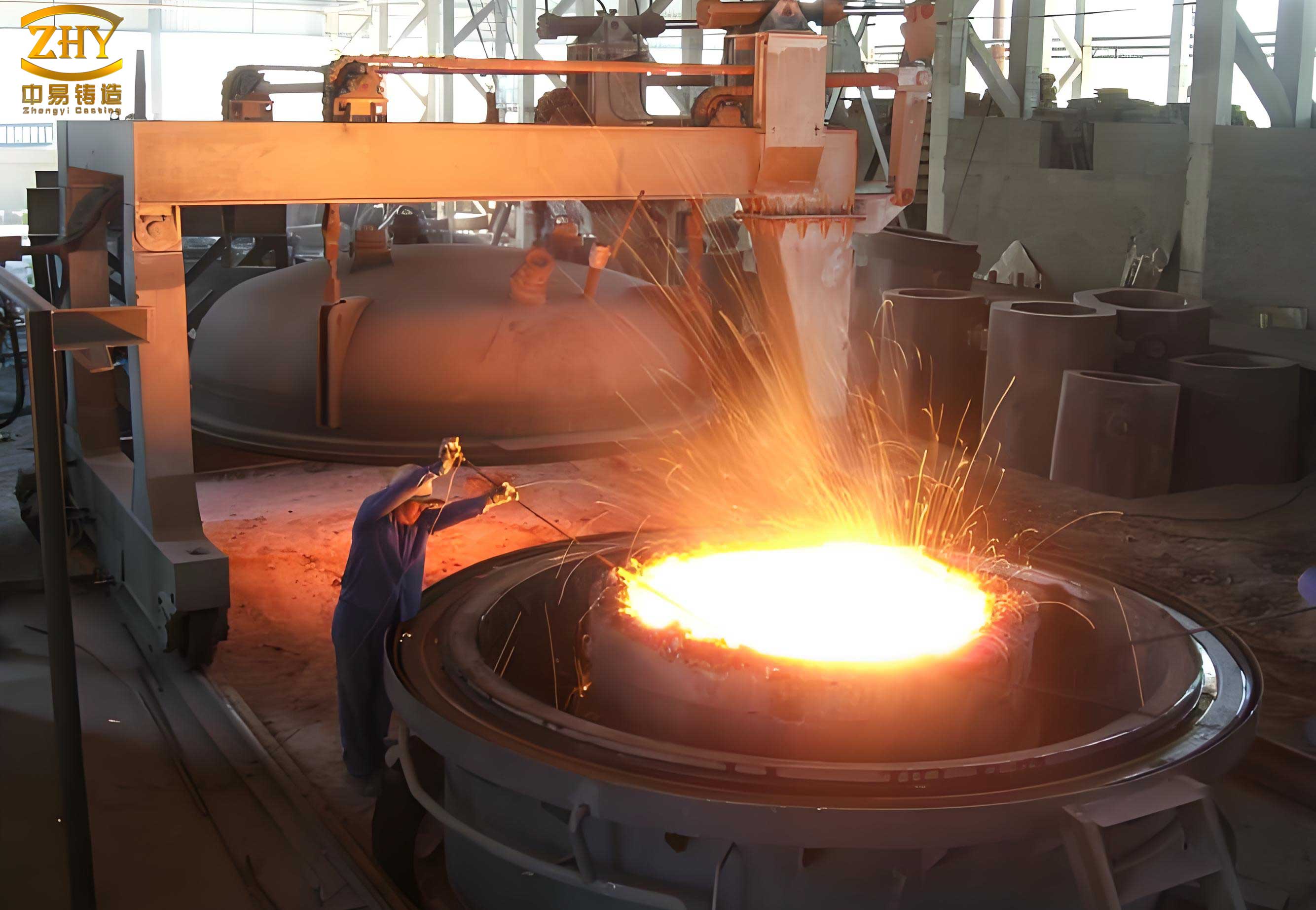
The casting process for high manganese steel casting presents unique challenges due to its physical properties. The linear expansion coefficient of high manganese steel is significantly higher than that of carbon steel (approximately $18 \times 10^{-6} \, \mathrm{K}^{-1}$ vs. $12 \times 10^{-6} \, \mathrm{K}^{-1}$), and its as-cast plasticity is relatively low. Therefore, patternmakers must incorporate adequate shrinkage allowances to avoid hot tearing. The mold design must provide sufficient collapsibility. While sand casting is common, the low thermal conductivity of high manganese steel ($\sim 12 \, \mathrm{W/(m\cdot K)}$) can lead to coarse grains in thick sections. Consequently, for certain geometries, metal mold (permanent mold) casting is advantageous, improving productivity, yield, and grain refinement. A critical issue is chemical reactivity; molten high manganese steel reacts vigorously with acidic silica sand, causing severe burn-on and poor surface finish. To mitigate this, the mold surface must be coated with a basic refractory wash, such as magnesia or alumina-based coatings. The selection of molding parameters often involves empirical relationships. For instance, the solidification time, $t_s$, for a sand-cast plate of thickness $d$ can be approximated by Chvorinov’s rule:
$$ t_s = k \left( \frac{V}{A} \right)^n $$
where $V$ is volume, $A$ is surface area, and $k$ and $n$ are constants dependent on mold material and metal properties. For high manganese steel casting in silica sand, $k$ is generally higher than for carbon steels due to lower thermal conductivity.
The as-cast microstructure of high manganese steel casting contains undesirable networks of brittle carbides (e.g., $(Fe,Mn)_3C$) at grain boundaries, which severely impair toughness. Thus, heat treatment is indispensable. The objective is to dissolve these carbides into the austenite matrix and then rapidly cool to retain a supersaturated, single-phase austenitic structure. This process, known as solution heat treatment or water quenching, involves heating the casting to the austenitizing temperature range. Based on the phase diagram, the solution temperature, $T_{sol}$, must be above the carbide solvus line, typically between 1050°C and 1100°C. The holding time, $t_{hold}$, is crucial for complete carbide dissolution and homogenization. A common rule of thumb is:
$$ t_{hold} \, (\text{hours}) \approx \frac{\text{Section Thickness (mm)}}{25} $$
For example, a 50 mm thick casting would require approximately 2 hours at temperature. After holding, the casting is rapidly quenched in water. The rapid cooling suppresses the re-precipitation of carbides and avoids pearlite transformation, which is kinetically hindered by the high manganese content. The cooling rate must exceed a critical value, $v_{crit}$. The transformation kinetics can be described schematically by Time-Temperature-Transformation (TTT) diagrams, where the “nose” of the carbide precipitation curve is shifted to longer times due to manganese. The effectiveness of this heat treatment is quantified by the resulting mechanical properties, as shown in Table 2.
| Property | Typical Range | Test Standard / Notes |
|---|---|---|
| Tensile Strength ($\sigma_u$) | 700 – 900 MPa (≈ 70 – 90 kg/mm²) | ASTM A128 |
| Yield Strength (0.2% offset, $\sigma_y$) | 350 – 450 MPa | Lower yield point is typical for austenitic steels. |
| Elongation ($\delta$) | 35 – 60% | Exceptionally high, indicating superior ductility. |
| Reduction of Area ($\psi$) | 30 – 50% | Further evidence of high toughness. |
| Charpy Impact Energy (at 20°C) | 100 – 200 J (≈ 10 – 20 kg·m/cm²) | Outstanding impact resistance. |
| Brinell Hardness (as-quenched) | 180 – 220 HB | Soft austenitic matrix ready for work hardening. |
The defining characteristic of high manganese steel casting is its ability to work-harden. When the surface is subjected to cold deformation—through impact, pressure, or abrasion during service—the austenite transforms into martensite (ε-martensite or α’-martensite) and develops a high density of dislocations, leading to extreme surface hardness. The hardened layer depth, $d_h$, and its hardness, $H_h$, are functions of the applied strain, $\epsilon$, strain rate, $\dot{\epsilon}$, and the initial microstructure. Empirically, the surface hardness can exceed 500 HB. The work hardening behavior can be modeled using equations that relate flow stress to strain. A simplified form is:
$$ \sigma = K \epsilon^n $$
where $\sigma$ is the true stress, $\epsilon$ is the true strain, $K$ is the strength coefficient, and $n$ is the work hardening exponent. For high manganese steel casting, $n$ is very high (often >0.4), indicating a pronounced hardening response. Traditionally, hardening occurs in service. However, controlled pre-service hardening methods are also employed. Mechanical methods like shot peening or press hardening are used. More recently, explosive hardening has emerged as a powerful technique. By detonating an explosive charge in contact with the casting surface, a high-intensity shock wave induces severe plastic deformation, creating a hardened layer. The hardened depth and hardness can be controlled by the charge density, stand-off distance, and number of explosions. A parametric relationship might be:
$$ d_h \propto \sqrt[3]{\frac{E}{\rho \cdot c_p \cdot (T_m – T_0)}} $$
where $E$ is the specific energy of the explosion, $\rho$ is density, $c_p$ is specific heat, $T_m$ is melting point, and $T_0$ is initial temperature. This underscores the tailored approach possible with modern high manganese steel casting processing.
Machining and welding of high manganese steel casting require special considerations due to the work-hardening tendency. During conventional machining, the cutting action itself hardens the surface layer immediately ahead of and beneath the tool, leading to rapid tool wear and blunting. Therefore, machining is generally avoided when possible. When necessary, I recommend using tools with cemented carbide (e.g., WC-Co) or ceramic inserts, operating at low cutting speeds ($v_c < 50 \, \text{m/min}$), high feed rates, and significant depths of cut to minimize passes and work hardening. Alternatively, abrasive machining (grinding) is effective. The specific cutting force, $F_c$, can be exceptionally high, approximated by:
$$ F_c = k_c \cdot A_c $$
where $k_c$ is the specific cutting pressure (very high for work-hardened high manganese steel casting) and $A_c$ is the cross-sectional area of cut.
Welding is employed for repair or fabrication of high manganese steel casting components. The goal is to produce a weld metal with a matching austenitic structure to maintain properties. Typically, electrodes or wires with high nickel (e.g., 12-15%) and manganese content are used. A common electrode composition is Ni: ~12%, Mn: ~4-6%, with balanced iron and other deoxidizers like Mo. The welding process must minimize heat input to avoid excessive grain growth and carbide precipitation in the heat-affected zone (HAZ). Preheating is usually not required, and interpass temperature should be kept below 150°C. The dilution with base metal must be controlled to maintain adequate Mn and C levels in the weld to prevent martensite formation. The weldability can be assessed via the carbon equivalent formula adapted for high manganese steels, though standard carbon equivalent formulas are less applicable. An empirical index, $I_w$, might consider key elements:
$$ I_w = \mathrm{C} + 0.04\,\mathrm{Mn} – 0.1\,\mathrm{Ni} + 0.06\,\mathrm{Cr} + … $$
A lower $I_w$ indicates better weldability. Successful welding extends the life of expensive high manganese steel casting parts.
Quality control and testing are integral to ensuring the performance of high manganese steel casting. Beyond chemical analysis and standard tensile/impact tests, non-destructive testing (NDT) like ultrasonic testing is used to detect internal flaws. Furthermore, the depth and uniformity of the work-hardened layer in service can be monitored using hardness traverses. The relationship between service life, $L$, and material parameters can be modeled. For wear applications, the Archard wear equation provides a framework:
$$ V = K \frac{N \cdot s}{H} $$
where $V$ is wear volume, $K$ is a wear coefficient, $N$ is normal load, $s$ is sliding distance, and $H$ is hardness. For high manganese steel casting, $H$ is not constant but increases with $s$, making the relationship non-linear and contributing to exceptional longevity.
In practical railway applications, the design of components like frogs and crossings must account for the material’s behavior. Finite Element Analysis (FEA) simulations incorporating the work-hardening constitutive model are used to predict stress distributions and wear patterns. The economic impact is significant; the extended service life of high manganese steel casting reduces maintenance frequency, downtime, and overall lifecycle cost. To illustrate the interplay of process parameters on final properties, consider Table 3, which summarizes key process-property relationships.
| Process Stage | Key Parameter | Effect on Microstructure/Property | Optimal Range / Target |
|---|---|---|---|
| Melting | Pouring Temperature ($T_{pour}$) | Grain size, surface quality, shrinkage | $T_L + (50-100)^\circ\mathrm{C}$ |
| Melting | Phosphorus Content [P] | Toughness, wear resistance, crack sensitivity | ≤ 0.07% (use low-P FeMn, Al addition) |
| Casting | Mold Type & Coating | Surface finish, grain refinement, cooling rate | Metal mold preferred; basic coating for sand molds |
| Heat Treatment | Solution Temperature ($T_{sol}$) | Carbide dissolution, austenite homogeneity | 1050 – 1100°C |
| Heat Treatment | Quench Rate ($v_q$) | Retention of supersaturated austenite, avoidance of carbides | > $v_{crit}$ (water quench essential) |
| Hardening | Applied Plastic Strain ($\epsilon$) | Surface hardness ($H_h$), hardened depth ($d_h$) | Strain > 0.2 for significant hardening |
| Service | Impact Energy/Frequency | Progression of work-hardened layer | Design for uniform impact distribution |
The future of high manganese steel casting lies in further optimization and innovation. Research is focused on micro-alloying with elements like titanium, vanadium, or boron to refine as-cast grain size and improve yield strength without compromising toughness. Computational thermodynamics using software like Thermo-Calc aids in designing new compositions. Additive manufacturing (3D printing) of high manganese steel components is an emerging field, offering geometric freedom and controlled microstructure. However, the challenges of managing high thermal stresses and achieving desired properties in as-printed states remain. Furthermore, lifecycle assessment and sustainability drive efforts to improve recyclability and reduce energy consumption during melting and heat treatment of high manganese steel casting.
In conclusion, the successful application of high manganese steel casting in demanding railway environments is a testament to sophisticated materials engineering. From careful melting and casting through precise heat treatment to leveraging its unique work-hardening capability, each step must be controlled. The material’s exceptional toughness and evolving wear resistance make it irreplaceable for safety-critical components. As technologies advance, the processes for manufacturing and maintaining high manganese steel casting will become even more efficient and tailored, ensuring continued reliability on the world’s railways. The integration of empirical knowledge, theoretical models, and advanced manufacturing will further solidify the position of high manganese steel casting as a cornerstone of durable railway infrastructure.