
The continuous advancement of agricultural mechanization necessitates constant innovation in the design and manufacturing of critical components. Clamping arms, essential for tasks like grasping, lifting, and manipulating crops or implements, directly influence operational efficiency, reliability, and machine versatility. Traditional designs often rely heavily on monolithic sheet metal fabrication, which, while cost-effective for certain geometries, can impose limitations on structural complexity, weight optimization, and localized strength. The integration of casting part technology with sheet metal design presents a transformative hybrid approach. This paradigm leverages the high-dimensional freedom and excellent mechanical properties of casting parts for complex, high-stress regions, while utilizing the lightweight and formable nature of sheet metal for large, lightly-stressed surfaces. This article explores, from a first-person engineering perspective, the methodologies for optimizing sheet metal clamp arm design and the strategic hybrid application of casting parts, supported by analytical models, material selection tables, and process optimization frameworks.
1. Foundational Design Methodologies and Optimization for Sheet Metal Arms
Before integrating casting parts, a robust and optimized sheet metal design foundation is crucial. This involves a multi-faceted approach targeting mass reduction, functional integration, structural performance, and durability.
1.1 Topology Optimization and Material Selection for Mass Reduction
The primary step is to define the design space and load cases. Using Finite Element Analysis (FEA) software, the volume where material can be distributed is subjected to operational forces, moments, and constraints. Topology optimization algorithms, such as the Solid Isotropic Material with Penalization (SIMP) method, iteratively solve for the material layout that minimizes compliance (maximizes stiffness) or stress under a given mass constraint. The governing equation for a typical stiffness-maximization problem is:
$$
\min_{\rho} \quad c(\rho) = \mathbf{U}^T \mathbf{K} \mathbf{U} = \sum_{e=1}^{N} (\rho_e)^p \mathbf{u}_e^T \mathbf{k}_e \mathbf{u}_e
$$
$$
\text{subject to:} \quad \frac{V(\rho)}{V_0} = f
$$
$$
\quad \mathbf{K} \mathbf{U} = \mathbf{F}
$$
$$
\quad 0 < \rho_{\min} \leq \rho_e \leq 1
$$
Where \(c\) is compliance, \(\rho_e\) is the pseudo-density of element \(e\) (design variable), \(p\) is the penalty factor (typically \(p=3\)), \(\mathbf{K}\) is the global stiffness matrix, \(\mathbf{U}\) and \(\mathbf{F}\) are displacement and force vectors, \(V\) is the material volume, \(V_0\) is the design space volume, and \(f\) is the volume fraction constraint. The result is a conceptual framework indicating optimal material distribution, guiding the design of ribs, cutouts, and contours.
Complementing this, material selection is paramount. The trade-off between strength, stiffness, density, cost, and manufacturability must be evaluated. High-Strength Low-Alloy (HSLA) steels, aluminum alloys, and, for premium applications, fiber-reinforced composites are key candidates.
| Material Type | Typical Alloy/Grade | Yield Strength (MPa) | Density (g/cm³) | Specific Strength (MPa·cm³/g) | Primary Application Suggestion |
|---|---|---|---|---|---|
| HSLA Steel | S700MC | 700 – 850 | 7.85 | ~89 – 108 | Main structural frames, high-wear areas. |
| Aluminum Alloy | 6082-T6 | 260 – 310 | 2.70 | ~96 – 115 | Large panels, lightweight linkages, covers. |
| Composite (Glass Fiber) | Epoxy/GF (UD) | 800 – 1500* | 1.8 – 2.1 | ~400 – 700* | Specialized, non-metallic contact arms, prototype sections. |
1.2 Modular and Integrated Functional Design
Modern clamping arms are systems, not just structures. A modular approach segments the arm into functional units: Gripping Interface Module, Structural Linkage Module, Actuation Mount Module, and Sensory & Control Module. Standardized mechanical and data interfaces between modules enable customization, easy repair, and technology upgrades. For instance, different gripper heads can be attached to a standard linkage module. Furthermore, functions like wiring conduits, lubrication channels, and sensor mounts (for pressure, position, vibration) are integrated into the sheet metal design from the outset, using formed channels and welded housings to protect components.
| Module Name | Primary Function | Key Design Features | Potential Integration with Casting Part |
|---|---|---|---|
| Gripping Interface | Direct contact, force application | Replaceable wear pads, conformal surfaces, quick-change mechanism. | Complex jaw geometry with integrated wear-resistant surface. |
| Structural Linkage | Force transmission, reach & motion | Topology-optimized truss or box sections, lightweight cores. | High-stress pivot points, complex multi-branch joints. |
| Actuation Mount | Cylinder/pin connection, load transfer | Reinforced lugs, self-aligning bearing seats, threaded inserts. | Entire mount block with precise bearing bores and reinforcement. |
| Sensory & Control | Data acquisition, system feedback | Pre-machined sensor pods, embedded conduit paths, connector slots. | Housing for sensitive electronics with thermal management. |
1.3 Structural Performance Validation and Enhancement
Following conceptual design, detailed FEA is performed on the refined sheet metal model. This static and dynamic analysis validates strength and stiffness under worst-case scenarios, such as shock loading or asymmetric grabbing. Stress (\(\sigma\)), strain (\(\epsilon\)), and displacement (\(d\)) fields are analyzed. Areas where stress approaches material limits are targeted for reinforcement. A common metric is the safety factor (\(SF\)):
$$
SF = \frac{\sigma_{\text{yield}}}{\sigma_{\text{von Mises, max}}}
$$
The goal is an \(SF\) > 1.5 across the structure. For fatigue life prediction, stress-life (S-N) curves are used with alternating stress (\(\sigma_a\)) calculated from dynamic FEA:
$$
N_f = C \cdot (\sigma_a)^{-m}
$$
Where \(N_f\) is cycles to failure, and \(C\) and \(m\) are material constants. High-cycle fatigue zones often become candidates for reinforcement via a casting part insert or local geometry change.
1.4 Advanced Surface Engineering and Corrosion Protection
The agricultural environment is corrosive. A multi-layer protection strategy is essential. The process often follows: 1) **Substrate Preparation**: Shot blasting to Sa 2.5 standard. 2) **Primary Coating**: Cathodic Electrodeposition (E-coat) provides excellent edge coverage and corrosion resistance. 3) **Secondary Coating**: Powder coating for abrasion and UV resistance. 4) **Functional Coating**: Wear-critical areas receive thermal-sprayed coatings (e.g., WC-Co) or detachable hardened steel plates.
| Protection Layer | Technology | Key Properties | Typical Thickness |
|---|---|---|---|
| Base Conversion | Zinc Phosphate | Enhances paint adhesion, provides mild corrosion inhibition. | 2 – 5 μm |
| Primary Barrier | Cathodic Epoxy E-coat | Superb throw power, uniform film, excellent corrosion resistance. | 15 – 25 μm |
| Environmental Shield | Polyester Powder Coat | High durability, UV resistance, wide color range, good abrasion. | 60 – 80 μm |
| Localized Defense | HVOF Thermal Spray (WC-12Co) | Extreme hardness (1100+ HV), superior wear resistance. | 100 – 300 μm |
2. Strategic Hybrid Application of Casting Parts
The true innovation lies in the selective integration of casting parts to overcome the inherent limitations of pure sheet metal fabrication. This is not a mere replacement but a synergistic combination.
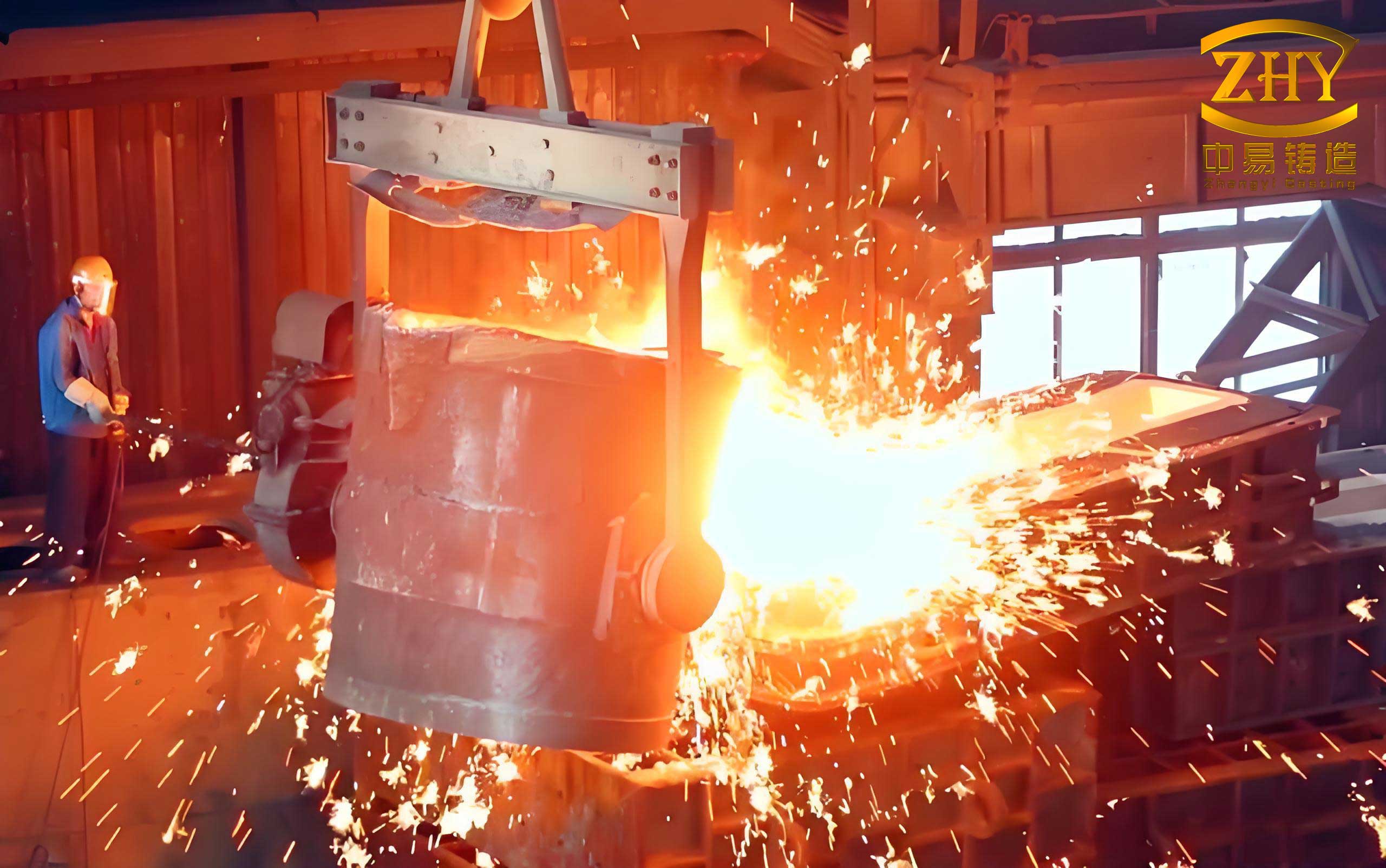
2.1 Reinforcement of Critical Load Points with Casting Parts
The most straightforward application is replacing high-stress sheet metal joints or brackets with a single, robust casting part. Pivot lugs, cylinder mounting ears, and the central hinge of a scissor-type arm are ideal candidates. The casting part here is designed using topology optimization focused solely on that load point, resulting in organic, efficient shapes with optimized wall thickness and internal ribs that are impossible to fabricate from folded sheet metal. The connection between the sheet metal arm and the casting part is critical. Mechanical fasteners (high-strength bolts) are common, but for permanent joints, welding or adhesive bonding is used, requiring careful material compatibility selection (e.g., cast steel to HSLA steel). The local stress concentration factor \(K_t\) at the interface must be minimized through generous fillets and smooth transitions:
$$
\sigma_{\text{max}} = K_t \cdot \sigma_{\text{nom}}
$$
A well-designed hybrid joint aims for \(K_t\) as close to 1 as possible.
2.2 Integration of Complex Geometry and Internal Features
Casting parts excel at producing complex 3D shapes in a single piece. This capability can be leveraged to integrate multiple functional features into a single casting part that forms a core section of the arm. Examples include:
- Monoblock Pivot Housings: A single casting that incorporates multiple bearing seats for parallel linkages, along with internal lubrication galleries and seal grooves.
- Closed-Section Torque Tubes: Replacing a fabricated box section with a hollow cast beam allows for variable, aerofoil-shaped cross-sections that optimize bending and torsional stiffness. The polar moment of inertia \(J\) for a complex hollow section can be significantly higher than a simple rectangular tube of the same weight.
- Integrated Hydraulic Manifolds: For hydraulically actuated arms, the structural casting part can have cast-in fluid passages, port threads, and valve mounting faces, eliminating external pipes and reducing leak points.
The manufacturability of such casting parts is ensured through simulation of the casting process (magmasoft or similar) to predict and eliminate defects like shrinkage porosity or cold shuts, especially in thick sections adjacent to thin walls.
2.3 Casting Part-Based Functional Components
Beyond reinforcement, entire functional sub-assemblies can be realized as dedicated casting parts. The gripping jaw is a prime example. A cast jaw can be designed with:
- Complex, conformal gripping surfaces tailored to specific crop morphology.
- Internal cavities for embedding force/pressure sensors.
- Integrated wear-resistant materials, either through alloy selection (high-chromium white iron) or as-cast composite structures (MMC – Metal Matrix Composites).
- Directly cast gear teeth or rack segments for jaw actuation mechanisms.
This approach transforms the gripper from a simple welded assembly into a high-performance, smart casting part. Another example is a cast counterweight with a complex shape to precisely balance the arm’s moment, optimizing actuator size and energy consumption.
2.4 Hybrid Manufacturing and Process Synergy
The final product quality hinges on seamlessly integrating the manufacturing and finishing processes for both sheet metal and casting parts. A proposed hybrid workflow is:
- Concurrent Engineering: Sheet metal and casting part designs are developed in parallel with constant DFM/A (Design for Manufacturing/Assembly) feedback.
- Precision Casting: The casting part is produced using processes like V-Process or Investment Casting for superior surface finish and dimensional accuracy, minimizing post-cast machining.
- Primary Machining: Critical datum faces, holes, and threads on the casting part are CNC machined.
- Sub-assembly: The machined casting part is joined to the formed and welded sheet metal structure via precision jigging.
- Unified Finishing: The entire hybrid assembly undergoes the same surface preparation (blasting) and coating process (E-coat + powder coat), ensuring uniform corrosion protection and appearance.
The economic viability is assessed using a Total Cost Model (\(C_{total}\)):
$$
C_{total} = C_{mat,sm} + C_{fab,sm} + C_{mat,cast} + C_{proc,cast} + C_{mach} + C_{assy} + C_{finish}
$$
While the per-unit cost of a casting part (\(C_{mat,cast} + C_{proc,cast}\)) may be higher than a simple welded bracket, the savings from reduced assembly time (\(C_{assy}\)), improved performance (allowing lighter actuators), and enhanced durability (lower warranty cost) often justify the hybrid approach, especially for medium to high production volumes.
3. Advanced Topics and Future Convergence
The frontier of hybrid design lies in deeper technological integration. Digital Twin technology creates a virtual replica of the hybrid arm, fed with real-time sensor data, enabling predictive maintenance and performance optimization. Generative Design algorithms can now propose organic shapes that explicitly define which regions are best made as sheet metal and which as a casting part, based on cost and performance constraints. Additive Manufacturing (AM) intersects here, not for final production but for creating complex sand molds or cores for casting parts, pushing geometrical freedom even further. The concept of Functionally Graded Materials (FGM) within a single casting part—gradually transitioning from a wear-resistant surface to a tough, ductile core—is an area of active research. Finally, the integration of smart materials, like shape memory alloys, into cast components could enable arms that adapt their stiffness or shape in response to load.
In conclusion, the hybrid application of sheet metal and casting parts in agricultural clamping arm design represents a sophisticated engineering strategy. It moves beyond material substitution to a holistic system-level optimization. By strategically employing casting parts at critical junctures for complexity, strength, and functional integration, while utilizing advanced sheet metal techniques for lightweight, large-scale structures, a new generation of high-performance, durable, and intelligent clamping arms can be realized. This approach directly contributes to enhanced agricultural productivity, machine longevity, and the sustainable advancement of mechanized farming. The future of this field is inextricably linked to the continued convergence of advanced design simulation, innovative materials science, and flexible, synergistic manufacturing processes centered on the optimal use of both formed and cast components.