
In the field of heavy-duty agricultural machinery, the driving wheel is a critical component for large crawler-type tractors, requiring high strength, durability, and precision. The use of nodular cast iron, specifically grade GGG60 per DIN 1693, is preferred due to its excellent mechanical properties, including good ductility and fatigue resistance. This material, a type of nodular cast iron, is characterized by its graphite spheroidization, which enhances toughness and load-bearing capacity. In this article, I will detail the comprehensive improvement of the casting process for a nodular cast iron driving wheel, focusing on addressing internal shrinkage and surface porosity defects through advanced simulation, design modifications, and process optimizations. The goal is to produce castings that meet stringent quality standards for applications in demanding environments.
The driving wheel, as a key part of the tractor’s undercarriage, has a complex gear-like structure with 19 uniformly spaced teeth around its circumference. Each tooth root forms an isolated hot spot, posing significant challenges for feeding and solidification control. The casting must adhere to strict internal and surface quality requirements: radiographic inspection to Level 2, and anatomical verification allowing shrinkage porosity less than φ12.7 mm within a 38.1 mm × 38.1 mm area. Surface defects are limited to pores no larger than 2 mm in diameter and no more than 5 in a similar area. The component’s dimensions are φ916 mm × 526 mm, with a mass of 260 kg, and it is manufactured entirely from nodular cast iron. The following table summarizes the mechanical properties required for this grade of nodular cast iron.
| Property | Minimum Requirement | Typical Value for Nodular Cast Iron |
|---|---|---|
| Tensile Strength (MPa) | ≥ 600 | 600-800 |
| Yield Strength (MPa) | ≥ 370 | 370-480 |
| Elongation (%) | ≥ 3 | 3-12 |
| Hardness (HBW) | 187-269 | 190-270 |
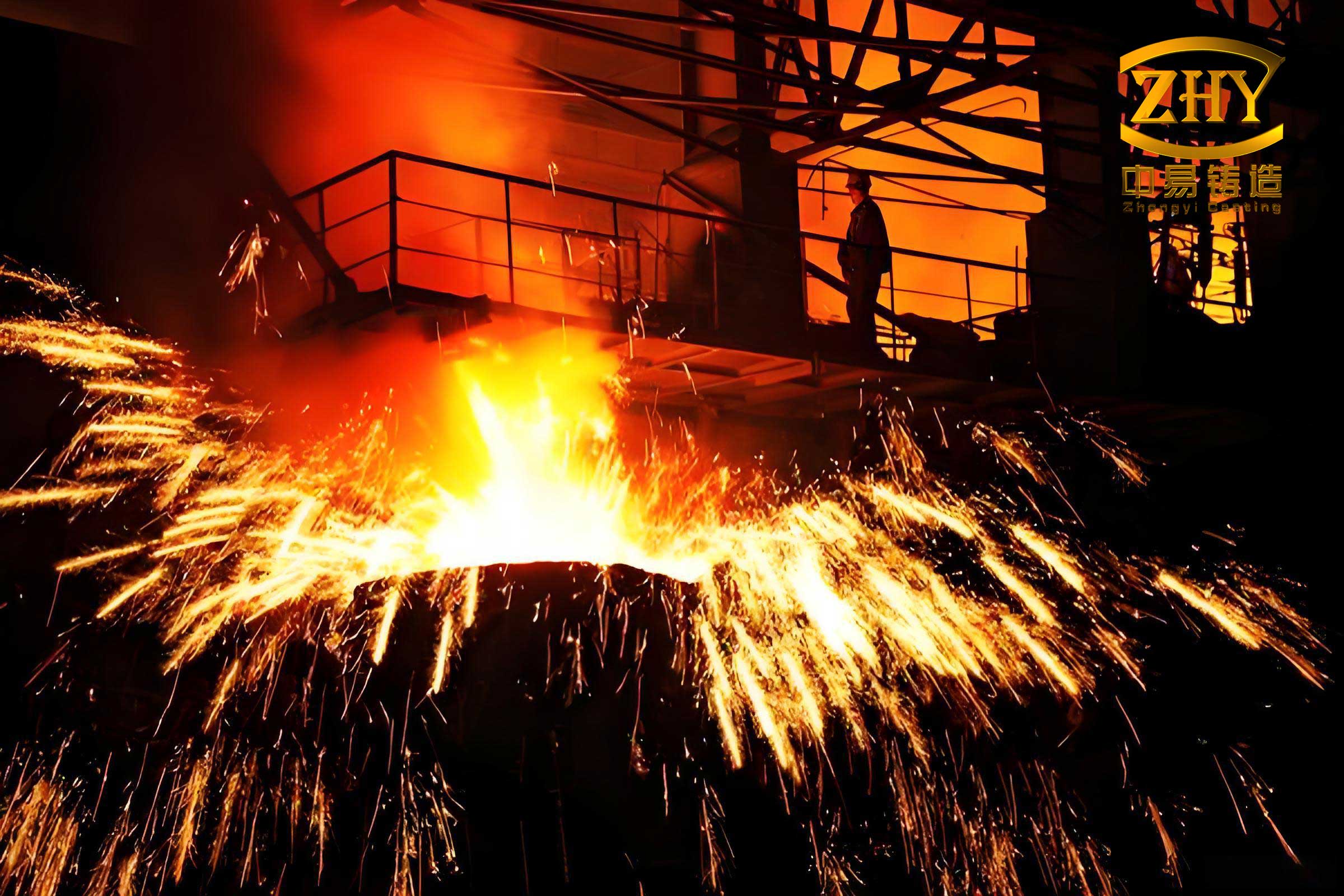
Nodular cast iron’s performance stems from its microstructure, where graphite exists as spheroids rather than flakes, reducing stress concentrations and improving fracture resistance. The chemical composition typically includes 3.6-3.8% carbon, 2.0-2.5% silicon, and controlled levels of magnesium for nodularization. The driving wheel’s design prohibits draft angles on the teeth to ensure proper engagement with the track, necessitating innovative molding techniques. Below is an illustration of a typical nodular cast iron casting, highlighting its application in complex geometries like the driving wheel.
The initial molding process involved a split pattern with the parting line at the axial center, using symmetric molding to minimize distortion. Since the teeth could not have draft angles, a core assembly approach was adopted. Each tooth was formed by combining two sand cores (1# and 2#) into a 3# core unit. Three such units were then assembled into a larger 6# core using positioning cores (4# and 5#). This assembly was placed in the bottom mold. The upper and lower molds were made with resin-bonded sand, while the 1#, 2#, 4#, and 5# cores were produced using hot-box coated sand with a resin film. This method reduced flash at the tooth roots and ensured precise tooth profiles, crucial for the functionality of the nodular cast iron component. The core assembly process can be represented by a set of equations for volume and surface area calculations to optimize core design. For a single tooth core, the volume $V_c$ and surface area $A_c$ are critical for heat transfer analysis. The modulus $M_c$, a key parameter in casting design, is given by:
$$M_c = \frac{V_c}{A_c}$$
where $V_c$ is the volume of the tooth and $A_c$ is its cooling surface area. For the driving wheel tooth, $V_c = 6.03 \times 10^{-6} \, \text{m}^3$ and $A_c = 5.58 \times 10^{-4} \, \text{m}^2$, yielding $M_c = 0.0108 \, \text{m}$ or 1.08 cm. This modulus influences the solidification time, which for nodular cast iron follows Chvorinov’s rule:
$$t = B \cdot \left( \frac{V}{A} \right)^2 = B \cdot M_c^2$$
where $t$ is the solidification time and $B$ is a constant dependent on the material and mold properties. For nodular cast iron, $B$ typically ranges from 0.8 to 1.2 $\text{min/cm}^2$, affecting the feeding requirements.
After initial process design, ProCAST simulation software was employed to analyze the solidification and feeding behavior. The simulation revealed significant shrinkage porosity at the center of each tooth, exceeding the allowable limits. This defect is common in nodular cast iron due to its prolonged solidification range and graphite expansion, which can lead to microporosity if not properly fed. The simulated shrinkage volume $V_s$ was estimated using the Niyama criterion, which relates thermal gradients $G$ and cooling rates $R$ to predict porosity:
$$N_y = \frac{G}{\sqrt{R}}$$
where $N_y$ below a critical threshold indicates a high risk of shrinkage. For the initial design, $N_y$ values were below 1 $\text{°C}^{1/2} \cdot \text{s}^{1/2} / \text{mm}$ in tooth centers, confirming porosity. To address this, iterative simulations showed that adding risers above each tooth and chills below them could mitigate shrinkage. The riser provides supplemental feeding, while the chill accelerates cooling to reduce the hot spot size. The effectiveness of a chill can be quantified by the chill modulus $M_{chill}$, defined as:
$$M_{chill} = \frac{V_{chill}}{A_{chill}}$$
where $V_{chill}$ and $A_{chill}$ are the volume and surface area of the chill, respectively. For a cylindrical chill placed at the tooth root, $M_{chill}$ was designed to be 0.5-0.7 times the tooth modulus to ensure rapid heat extraction without causing defects. The riser design was based on modulus calculations for nodular cast iron. The required riser modulus $M_R$ is given by:
$$M_R = f_1 \cdot f_2 \cdot f_3 \cdot M_c$$
where $f_1$, $f_2$, and $f_3$ are correction factors for feeding path, alloy properties, and riser type, respectively. For this nodular cast iron driving wheel, $f_1 = 1.19$ (accounting for the isolated hot spot), $f_2 = 0.76$ (for nodular cast iron’s feeding characteristics), and $f_3 = 1.2$ (for a side riser). Thus, $M_R = 1.17 \, \text{cm}$. The riser neck modulus $M_N$ ensures proper feeding without premature freezing:
$$M_N = f_p \cdot f_4 \cdot M_R$$
with $f_p = 0.65$ (pressure factor) and $f_4 = 0.9$ (neck shape factor), yielding $M_N = 0.68 \, \text{cm}$. For a cylindrical riser with height-to-diameter ratio $K = H/D = 1.8$, the dimensions were set to φ80 mm × 120 mm. The gating system was modified to connect 19 such risers via a horizontal runner, with ingates linking risers to the casting. Pouring temperature was maintained at 1355-1365°C to ensure fluidity while minimizing gas dissolution in the nodular cast iron melt. The table below summarizes the key parameters for the improved process.
| Parameter | Value | Description |
|---|---|---|
| Tooth Modulus (M_c) | 1.08 cm | Calculated from tooth geometry |
| Riser Modulus (M_R) | 1.17 cm | Derived from correction factors |
| Riser Dimensions | φ80 mm × 120 mm | Cylindrical side riser |
| Pouring Temperature | 1355-1365°C | Optimal for nodular cast iron |
| Chill Modulus (M_chill) | 0.65 cm | For effective heat extraction |
Prototype castings were produced using this improved design. Anatomical analysis showed that shrinkage defects were eliminated in most teeth, with only minor microporosity in a few upper regions, well within specification. This confirms the efficacy of riser and chill placement for nodular cast iron components with isolated hot spots. However, surface inspection revealed extensive gas porosity, compromising the casting’s integrity. This issue is often prevalent in nodular cast iron due to gas evolution from sand cores and mold materials. The gas porosity volume $V_g$ can be estimated from the gas pressure $P_g$ and solubility $S$ in molten iron:
$$V_g = k \cdot (P_g – P_{atm}) \cdot S \cdot V_m$$
where $k$ is a constant, $P_{atm}$ is atmospheric pressure, and $V_m$ is the metal volume. For nodular cast iron, hydrogen and nitrogen solubility are high, exacerbating porosity if cores generate excessive gas.
To address surface porosity, several measures were implemented. First, the coated sand for 1# and 2# cores was switched to a coarser grade (50/100 mesh) to reduce specific surface area and gas generation. The gas evolution rate $Q_g$ from sand cores is proportional to the binder content and surface area:
$$Q_g = \alpha \cdot A_s \cdot e^{-\beta / T}$$
where $\alpha$ and $\beta$ are constants, $A_s$ is the core surface area, and $T$ is temperature. Using coarser sand reduced $A_s$, thereby lowering $Q_g$. Second, assembled 6# cores were baked in a dryer at 180°C for 4 hours to remove residual moisture and volatiles, further decreasing gas potential. The baking process reduces gas content by driving off water vapor and organic compounds, which can otherwise cause defects in nodular cast iron castings. Third, additional venting channels were incorporated into the mold to facilitate gas escape. The venting efficiency $E_v$ can be expressed as:
$$E_v = \frac{P_{out} – P_{in}}{\mu \cdot L}$$
where $P_{out}$ and $P_{in}$ are pressures at the vent outlet and inlet, $\mu$ is gas viscosity, and $L$ is vent length. By increasing vent cross-sectional area and number, $E_v$ was improved, preventing gas entrapment. After these modifications, over 120 driving wheels were produced with no surface porosity, meeting all quality standards for nodular cast iron parts.
The success of this process improvement highlights key principles in casting nodular cast iron. Core assembly techniques enable complex geometries without draft angles, minimizing flash. Riser and chill integration effectively controls solidification shrinkage, a common challenge in nodular cast iron due to its unique solidification behavior. The use of baking and venting mitigates gas defects, which are particularly critical in nodular cast iron because of its high gas solubility. Furthermore, simulation tools like ProCAST are invaluable for optimizing processes, reducing trial-and-error. For future work, other factors such as molten metal treatment for nodular cast iron—like magnesium inoculation and slag control—could be explored to enhance properties. The table below compares the initial and improved process outcomes.
| Aspect | Initial Process | Improved Process |
|---|---|---|
| Internal Shrinkage | Excessive, >φ12.7 mm | Minimal, within limits |
| Surface Porosity | Severe gas pores | None observed |
| Core Assembly | Basic core design | Optimized with baking |
| Simulation Use | Limited analysis | Comprehensive ProCAST |
| Material Utilization | Higher scrap rate | Improved yield for nodular cast iron |
In conclusion, the driving wheel casting process for nodular cast iron was significantly enhanced through a multi-faceted approach. By employing core assembly to eliminate draft angles, adding risers and chills to reduce shrinkage, and implementing core baking and venting to eliminate gas porosity, high-quality castings were achieved. Nodular cast iron, with its superior mechanical properties, remains a preferred material for such demanding applications, and these process improvements ensure reliable performance. Continuous innovation in casting techniques will further advance the manufacturability of complex nodular cast iron components, supporting the agricultural machinery industry’s needs for durability and efficiency.
To generalize, the principles discussed here—modulus-based design, simulation validation, and gas control—are applicable to other nodular cast iron castings with similar challenges. For instance, the riser sizing formula can be adapted for different geometries, and the gas evolution models aid in selecting core materials. As nodular cast iron continues to evolve, with developments in alloying and processing, casting methods must adapt to leverage its full potential. This case study underscores the importance of integrated process engineering in producing defect-free nodular cast iron parts, contributing to sustainable and cost-effective manufacturing.