
The production of castings from spheroidal graphite cast iron is fundamentally governed by its unique and complex solidification behavior. Among the various defects encountered, volumetric shrinkage defects—namely shrinkage cavities and shrinkage porosity—are predominant causes for scrap and rework. These defects severely compromise the mechanical properties of castings, potentially leading to catastrophic failures in service. The challenge stems from the fact that spheroidal graphite cast iron solidifies not as a coherent skin but as a mushy mass across a wide temperature range, a characteristic known as pasty or mushy solidification. This paper aims to elucidate the solidification process of spheroidal graphite cast iron through the lens of its dynamic volume changes and to derive practical foundry methodologies to mitigate shrinkage-related defects.
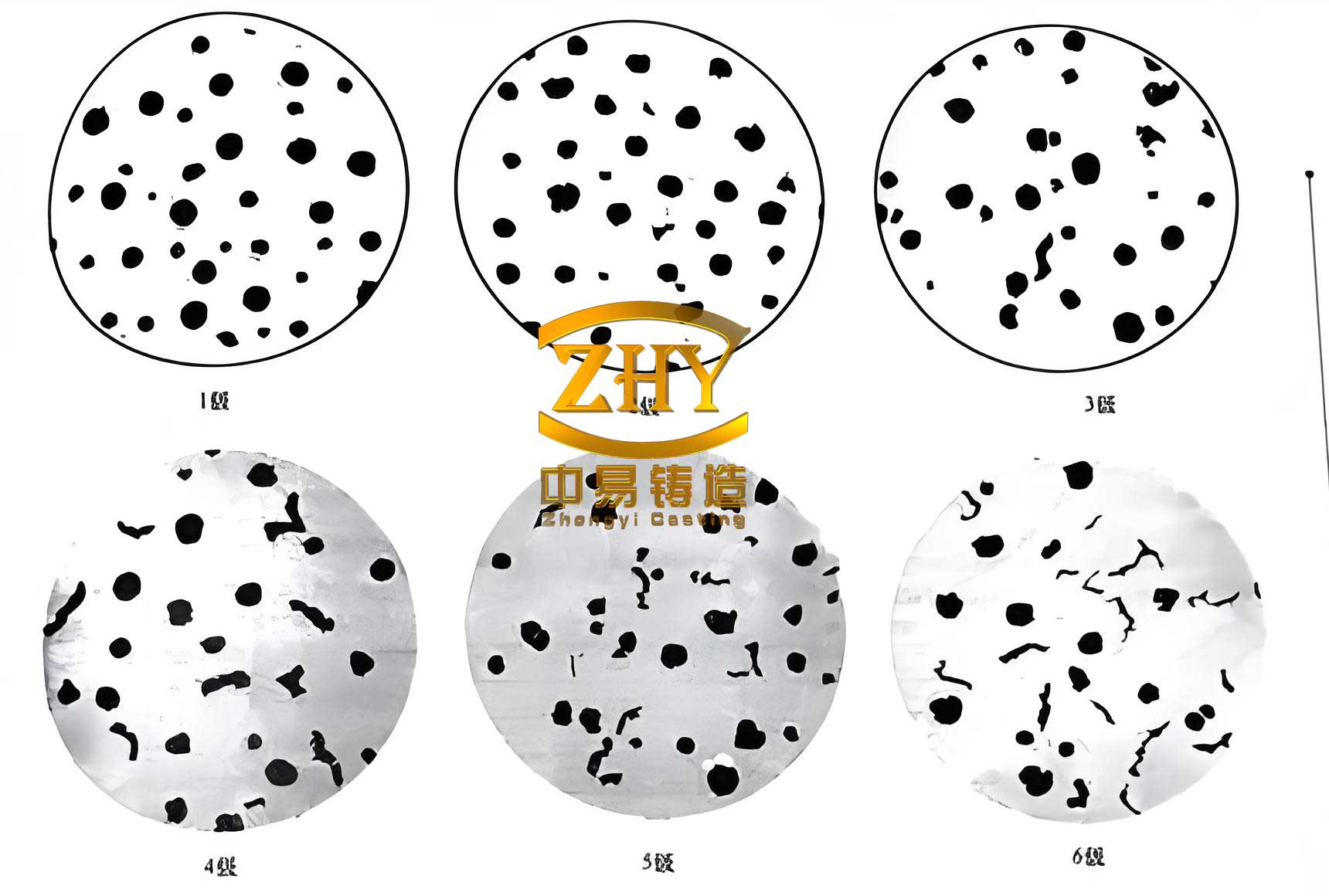
The solidification of spheroidal graphite cast iron is a dynamic interplay between contraction and expansion, setting it apart from most other casting alloys like steels or gray irons. This process can be modeled as a sequence of three contractions and one major expansion phase. Understanding this model is the cornerstone for designing effective gating, risering, and cooling systems.
The volume change during solidification of spheroidal graphite cast iron can be described as the algebraic sum of the individual effects:
$$ \Delta V_{total} = \sum \Delta V_{liquid} + \sum \Delta V_{initial\,graphite} + \sum \Delta V_{solidification} + \sum \Delta V_{eutectic} + \sum \Delta V_{solid} $$
where $\Delta V_{liquid}$ is liquid contraction, $\Delta V_{initial\,graphite}$ is expansion from primary graphite precipitation, $\Delta V_{solidification}$ is contraction from austenite formation, $\Delta V_{eutectic}$ is expansion from eutectic graphite growth, and $\Delta V_{solid}$ is solid-state contraction.
1. Detailed Phases of Solidification in Spheroidal Graphite Cast Iron
1.1 Liquid Contraction ($\Delta V_{liquid}$)
As the molten spheroidal graphite cast iron cools from the pouring temperature down to the liquidus temperature, it undergoes a reduction in volume due to the decreasing kinetic energy and interatomic spacing. This macroscopic shrinkage manifests as a falling metal level in the pouring basin or sprue. The volumetric liquid contraction can be quantified by:
$$ \Delta V_{SL} = \alpha_{SL} (T_t – T_{t+\Delta t}) V_0 $$
where $\Delta V_{SL}$ is the volume of liquid shrinkage within the time step $\Delta t$, $\alpha_{SL}$ is the coefficient of liquid volumetric shrinkage for the alloy, $T_t$ and $T_{t+\Delta t}$ are temperatures at the beginning and end of the time step, and $V_0$ is the initial volume. For typical spheroidal graphite cast iron, the liquid contraction is approximately 1.5% per 100°C temperature drop. The total liquid contraction from pouring to the start of solidification is therefore directly proportional to the superheat.
| Pouring Temperature (°C) | Approximate Liquid Contraction (%) |
|---|---|
| 1450 | 4.5 |
| 1400 | 3.75 |
| 1350 | 3.0 |
| 1300 | 2.25 |
1.2 Primary Graphitization Expansion ($\Delta V_{initial\,graphite}$)
For hypereutectic spheroidal graphite cast iron (where the carbon equivalent, CE, is above the eutectic point), solidification begins with the precipitation of primary graphite spheroids directly from the melt. This phase occurs between the liquidus temperature and the eutectic temperature. The growth of these low-density graphite nodules (density ~2.25 g/cm³) causes a net volume expansion of the solidifying mass. The condition for this expansion is $CE_x – CE_0 > 0$, where $CE_0$ is the eutectic carbon equivalent and $CE_x$ is the actual composition. The fraction of primary graphite precipitated, $G_{primary}$, can be estimated as:
$$ G_{primary} = \frac{C_x – C_c}{100 – C_c} \times 100\% $$
where $C_x$ is the total carbon content and $C_c$ is the carbon content at the eutectic. The associated volume expansion is significant, estimated at 2.05% to 3.4% for every 1% of graphite precipitated. This expansion counteracts part of the initial liquid contraction. A critical related phenomenon is graphite flotation in heavy-section castings, where primary graphite nodules have sufficient time to buoy upwards, creating a degenerate layer near the upper surfaces of the casting.
1.3 Solidification Contraction ($\Delta V_{solidification}$)
As the temperature reaches the eutectic range, the remaining liquid undergoes the eutectic transformation, precipitating austenite and graphite simultaneously. The crystallization of austenite, a dense, close-packed FCC structure, involves a substantial volume contraction, typically taken as 3.5%. This is a continuous source of demand for liquid feed metal during the solidification of spheroidal graphite cast iron. The amount of austenite formed depends on the final matrix structure and the chemistry.
1.4 Eutectic Expansion ($\Delta V_{eutectic}$)
Concurrent with austenite formation, the majority of the graphite in spheroidal graphite cast iron precipitates during the eutectic reaction. The growth of these eutectic graphite spheroids, enveloped by austenite shells, generates a powerful expansion force. This is the most pronounced expansion phase in spheroidal graphite cast iron and is the key mechanism that enables riserless casting practices under the right conditions. The expansion magnitude is again tied to the mass of graphite formed, with the same 2.05-3.4% volume increase per 1% graphite. The net volume change during the eutectic stage is the sum of the austenite contraction and the graphite expansion. A favorable balance (more expansion than contraction) leads to self-feeding of the casting.
1.5 Solid-State Contraction ($\Delta V_{solid}$)
After complete solidification, the casting continues to cool to room temperature, undergoing thermal contraction. This phase dictates the patternmaker’s shrinkage allowance and is responsible for stresses and potential distortion but does not contribute to internal shrinkage porosity.
2. Classification and Manifestation of Shrinkage Defects in Spheroidal Graphite Cast Iron
The pasty solidification mode of spheroidal graphite cast iron, where liquid remains interspersed within a dendritic austenite-graphite network until late in the process, makes it particularly susceptible to forming dispersed microporosity rather than a single macro cavity. The type and location of shrinkage are influenced by thermal gradients, alloy chemistry, and mold rigidity.
| Category | Defect Name / Location | Typical Characteristics & Causes |
|---|---|---|
| Macroscopic / Open Defects | Shrinkage Cavity at Gating Points | Large, open cavity often located at the hottest spot where the gate meets the casting, due to delayed solidification and insufficient feeding. |
| Shrinkage at Vent or Riser Neck | Surface depression or pipe at the top of risers or at vent points, acting as the last point to freeze. | |
| Corner or Edge Shrinkage | External shrinkage at thermal junctions where two sections meet, creating a hot spot. | |
| Leak-Path Porosity | Interconnected spongy porosity leading to pressure-tightness failure, often in isolated hot spots. | |
| Internal / Subsurface Defects | Hot Spot Shrinkage Porosity | Internal, often macroscopic porosity located at isolated thermal centers within heavy sections or junctions. |
| Centerline/Axial Shrinkage | Porosity or looseness along the thermal centerline of a long, uniform section, typical of pasty solidification with weak directional solidification. | |
| Dispersed Microshrinkage | Fine, scattered pores throughout the matrix, often visible only under magnification, resulting from insufficient interdendritic feeding in the last stages of solidification. | |
| Spongy or Sponge-Type Porosity | A severe form of interconnected microshrinkage, giving a sponge-like appearance on a fractured surface. |
3. Foundry Process Guidelines Derived from Solidification Analysis
The understanding of the volume change model provides direct and powerful levers for process optimization in spheroidal graphite cast iron production.
3.1 Control of Metallurgical Quality and Chemistry
The chemical composition is the primary control for the solidification sequence. The Carbon Equivalent (CE) and the carbon-to-silicon ratio (C/Si) are paramount.
- Carbon Equivalent (CE): Targeting a slightly hypoeutectic composition (CE ≈ 4.3-4.4%) is generally recommended. This avoids significant primary graphite expansion and the associated risk of graphite flotation in heavy sections, promoting a more controlled and predictable solidification that starts with austenite dendrites.
- Carbon-to-Silicon Ratio: A higher C/Si ratio is often beneficial. Carbon promotes graphite expansion, while silicon strengthens the austenite dendrites and reduces the feeding demand. A balanced ratio (e.g., C/Si > 1) can reduce shrinkage tendency by optimizing the expansion/contraction balance.
- Alloying and Inoculation: Elements like copper and tin promote pearlite and can influence the temperature range of solidification. Effective inoculation ensures a high nodule count, which distributes the graphite expansion more evenly and creates a finer, more interconnected austenite network that is easier to feed in its final stages. Residual magnesium must be controlled to the minimum necessary for nodularity, as excess Mg increases contraction tendency.
3.2 Optimization of Pouring Temperature
As shown in Table 1, lowering the pouring temperature directly reduces the liquid contraction volume. The guiding principle is to use the lowest possible pouring temperature that ensures complete mold filling and avoids mistruns. This practice minimizes the total volumetric deficit that must be compensated for by feeding or expansion, thereby inherently reducing the risk of shrinkage in spheroidal graphite cast iron.
3.3 Maximizing Mold Rigidity
This is arguably the most critical factor for harnessing the eutectic expansion. If the mold wall can yield (e.g., in soft green sand), the expansion pressure is dissipated by moving the mold wall outward, providing no useful feeding to the casting interior. A rigid mold resists this movement, causing the expansion pressure to compress the still-liquid metal within the mushy zone, effectively feeding shrinkage internally. This is the principle behind riserless casting of spheroidal graphite cast iron.
- Mold Materials: Chemically bonded sands (resin sands), dense molds, and metal chills significantly increase mold rigidity.
- Reinforcements: In green sand molding, the use of internal mold reinforcements like densener blocks, chills, or special high-pressure molding techniques enhances local rigidity.
- Geometric Criterion: For a successful riserless design, the casting modulus (Volume/Surface Area) should typically be above 2.5 cm to ensure sufficient thermal mass to generate the required expansion pressure.
3.4 Design of Gating and Riser Systems
The pasty solidification and expansion phase demand specific design rules contrary to those for white solidification alloys like steel.
- Gating Design – Quick Freeze-Off: Gates should be designed to freeze rapidly after pouring. This prevents liquid metal from being pushed back into the gating system during the eutectic expansion phase, which would create shrinkage in the casting itself. The use of thin, wide gates (with an aspect ratio, width:thickness, > 3) is common to achieve this quick sealing.
- Riser Neck Design – Modulus Control: The neck connecting a riser to the casting must have a smaller modulus than the casting’s hot spot it is intended to feed. This ensures the neck solidifies before the casting’s critical section. When the casting later expands, the solidified neck prevents metal from being forced back into the riser, a phenomenon known as “back-suction” which leaves a shrink hole in the casting at the neck junction. The neck should also be designed to avoid creating an additional thermal junction (contact hot spot).
- Riser Function Shift: In spheroidal graphite cast iron, risers often serve more as “liquid reservoirs” to feed the liquid and early solidification contraction, rather than as classical pressure-feeding devices for the entire solidification period. Their effectiveness is complemented and often superseded by the internal feeding from eutectic expansion in a rigid mold.
4. Computational Modeling and Practical Verification
Modern foundry science relies heavily on numerical simulation to predict the solidification behavior of spheroidal graphite cast iron. These simulation tools implement the volume change model, accounting for:
$$ \alpha_{SL}, G_{primary}, \Delta V_{austenite}, \Delta V_{graphite} $$
as functions of local temperature, time, and chemistry. By solving the heat transfer equations coupled with these volume change algorithms, simulation software can predict the location and severity of shrinkage porosity with good accuracy. This allows for virtual prototyping and optimization of feeder placement, chill application, and gating design before any metal is poured, significantly reducing development time and cost for new spheroidal graphite cast iron components. The practical verification always involves meticulous process control and non-destructive testing (like radiography) of initial castings to calibrate and confirm the simulation predictions and process parameters.
5. Conclusion
The production of sound castings in spheroidal graphite cast iron hinges on a deep understanding of its distinctive pasty solidification and the dynamic volume change cycle of contraction and expansion. The defect spectrum, from macroscopic cavities to dispersed microporosity, is a direct consequence of this behavior. Successful foundry practice is therefore not about brute-force feeding but about intelligent process design that manages chemistry, temperature, and mold conditions to favorably influence the natural solidification sequence. By targeting a slightly hypoeutectic composition, minimizing pouring temperature, maximizing mold rigidity, and designing gating/risering systems that accommodate—rather than fight—the expansion phase, foundries can effectively control shrinkage defects. This systematic approach, increasingly aided by predictive simulation, transforms the challenges posed by the solidification of spheroidal graphite cast iron into a controllable and reliable manufacturing process, leading to higher quality, yield, and performance of the final cast components.