
The pursuit of advanced wear-resistant materials is a constant endeavor in industrial applications, and among these, high-chromium white cast iron stands out due to its exceptional abrasion resistance imparted by a high volume fraction of hard chromium carbides embedded within its metallic matrix. The fundamental challenge with conventional high-chromium white cast iron lies in its inherent brittleness in the as-cast condition, which is primarily dictated by the continuous network of coarse, rod-like eutectic carbides and a predominantly pearlitic matrix. While subsequent heat treatment can significantly improve toughness, it adds complexity, energy consumption, and cost to the manufacturing process. Therefore, enhancing the mechanical properties, particularly the toughness, of high-chromium white cast iron in its as-cast state presents a compelling technological and economic advantage. This investigation explores a strategic approach of multi-element microalloying, examining the synergistic effects of elements such as Molybdenum (Mo), Vanadium (V), Titanium (Ti), and Copper (Cu) on modifying the as-cast microstructure and, consequently, the mechanical and tribological properties of high-chromium white cast iron.
The design philosophy for this grade of white cast iron centers on achieving an optimal balance. The composition must ensure a sufficient volume of the desirable M7C3-type carbides, which are harder and less continuous than the alternative M3C type. A key parameter is the chromium-to-carbon ratio (Cr/C), with a value greater than 5 generally promoting the formation of M7C3. Furthermore, the composition should be slightly hypoeutectic to avoid primary austenite dendrites that can be detrimental to wear resistance, yet close to the eutectic point to maximize the hard phase content. The base chemistry selected for this study adheres to these principles. The target composition range is summarized in Table 1.
| Element | C | Cr | Si | Mn | S | P |
|---|---|---|---|---|---|---|
| Content | 2.8 – 3.0 | 16.0 – 18.0 | ~1.0 | < 1.0 | < 0.05 | < 0.05 |
To this base alloy, various combinations of microalloying elements were added. The hypothesis is that these elements, through their individual and combined effects on nucleation, growth kinetics, and phase stability, can refine the carbide morphology and stabilize a tougher matrix phase directly from the casting process. Five distinct alloying schemes were formulated, with progressively increased additions, as detailed in Table 2. The alloys were designated for reference as Alloy 1 through Alloy 5.
| Alloy Designation | Mo | V | Ti | Cu | Total Added Alloy Content |
|---|---|---|---|---|---|
| Base (Unalloyed) | 0 | 0 | 0 | 0 | 0 |
| Alloy 1 | 1.0 | 0.2 | 0.1 | 0 | 1.3 |
| Alloy 2 | 1.0 | 0.2 | 0.1 | 0.5 | 1.8 |
| Alloy 3 | 1.5 | 0.25 | 0.15 | 1.5 | 3.4 |
| Alloy 4 | 2.0 | 0.3 | 0.2 | 1.5 | 4.0 |
| Alloy 5 | 2.5 | 0.3 | 0.2 | 1.5 | 4.5 |
The melting of all heats was conducted in a 20 kg capacity medium-frequency induction furnace, with the superheating temperature carefully controlled to approximately 1500°C to ensure complete dissolution of the alloying elements and adequate fluidity. The furnace charge consisted of pig iron, ferrochromium, ferrosilicon, and the requisite ferro-alloys (Fe-Mo, Fe-V, Fe-Ti) and electrolytic copper for microalloying. After reaching the target temperature and achieving a homogeneous melt, the metal was poured into green sand molds to produce standard unnotched impact test specimens with dimensions of 20 x 20 x 110 mm. These specimens were subsequently ground on all four sides to ensure precise cross-sectional area measurement for accurate impact energy calculation.
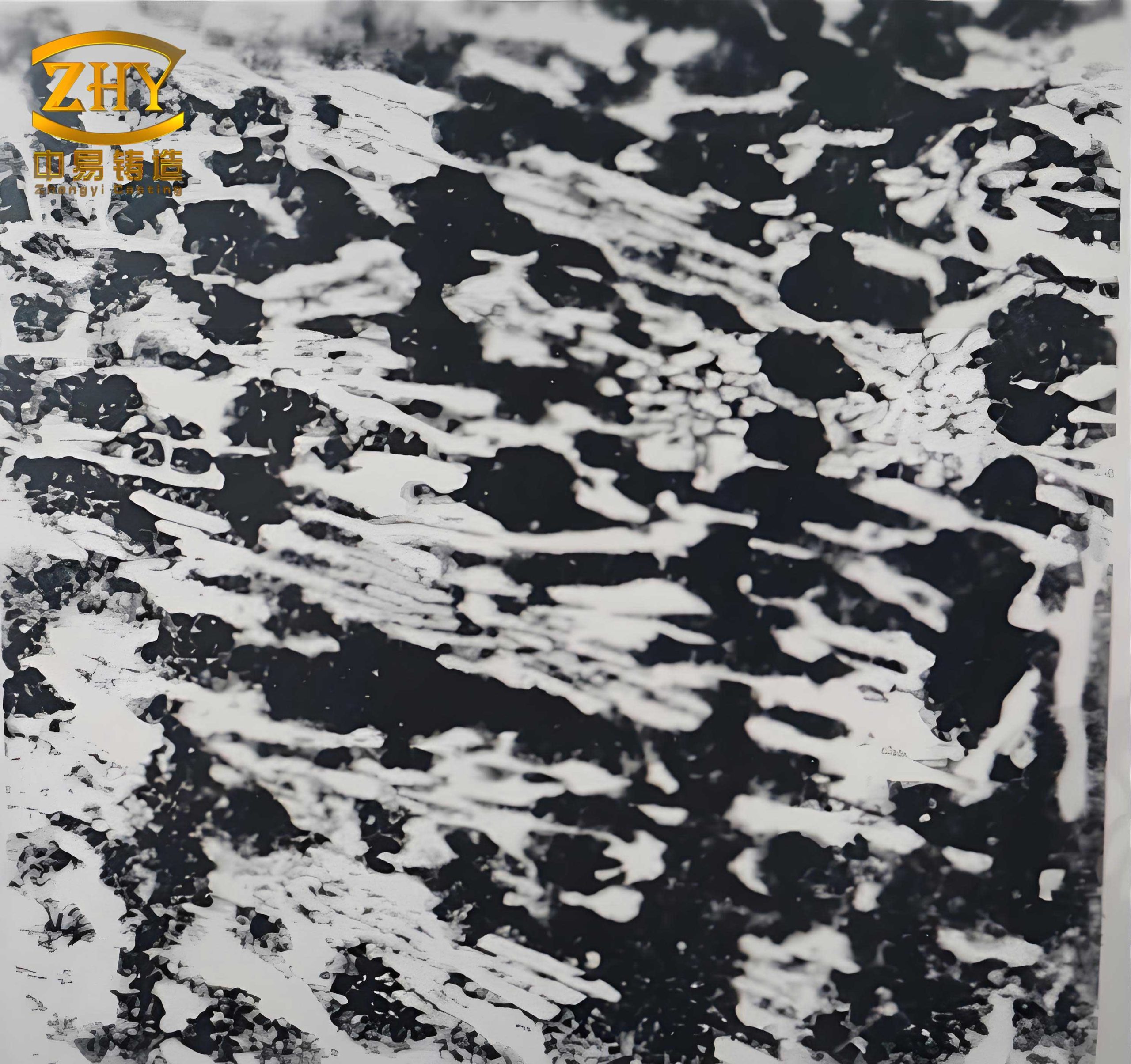
The microstructural evolution induced by multi-element microalloying was profound and formed the core of the property enhancements. In the unalloyed base white cast iron, the microstructure was characteristic of many conventional grades: a continuous network of long, rod-like eutectic carbides within a matrix that was primarily pearlitic, with possibly some transformed austenite. This structure is a direct consequence of a relatively low nucleation rate for carbides during solidification and a wide eutectic reaction temperature range, allowing the carbides to grow extensively along their preferred crystallographic direction, typically [010].
The addition of microalloying elements fundamentally altered this solidification paradigm. Elements like V and Ti are strong carbide and nitride formers. During the initial stages of solidification, they precipitate as high-melting-point compounds such as VC, TiC, VN, and TiN. These particles act as potent heterogeneous nucleation sites for the subsequent formation of the (Cr, Fe)7C3 eutectic carbides. This dramatically increases the nucleation rate (I), which can be conceptually related to the undercooling (ΔT) and the potency of substrates. A simplified representation is:
$$ I = I_0 \exp\left(-\frac{\Delta G^*}{kT}\right) $$
where ΔG* is the critical energy for nucleation, lowered by the presence of effective substrates. The increased nucleation event density results in a finer dispersion of carbides, interrupting their growth and leading to a transition from long rods to shorter rods, and eventually to more isolated, blocky or granular morphologies as seen in Alloys 3 and 4. This refined and redistributed carbide structure significantly improves the continuity of the metallic matrix.
Concurrently, the alloying elements Mo, V, and Cu dissolve extensively in the austenite matrix during solidification. These elements are potent austenite stabilizers and increase the hardenability of the white cast iron. Their presence shifts the continuous cooling transformation (CCT) diagram to longer times, effectively suppressing the diffusion-controlled pearlite transformation during cooling after solidification. This stabilization effect can be qualitatively described by extending the time to the nose of the pearlite transformation curve. Consequently, the as-cast matrix structure is transformed from predominantly pearlite to predominantly retained austenite. With sufficient alloy content, as in Alloys 4 and 5, the hardenability is high enough to partially transform some austenite to martensite, even under the relatively slow cooling conditions of a sand casting. The phase identification was confirmed via X-ray diffraction analysis, showing a clear shift in peak patterns corresponding to the decrease of ferrite/cementite (pearlite) peaks and the increase of austenite peaks, with the emergence of martensite peaks in the highly alloyed variants.
The synergy between refined carbides and a stabilized austenitic/martensitic matrix directly translates to superior mechanical and wear properties. The performance data for all alloys are consolidated in Table 3.
| Alloy | Hardness (HRC) | Impact Toughness, ak (J/cm²) | Relative Wear Resistance, ε |
|---|---|---|---|
| Base (Unalloyed) | 54 | 7.0 | 2.91 |
| Alloy 1 | 57 | 9.0 | – |
| Alloy 2 | 57 | 10.7 | – |
| Alloy 3 | 54 | 12.0 | 6.66 |
| Alloy 4 | 53 | 13.8 | 6.03 |
| Alloy 5 | 53 | 12.8 | 5.75 |
The macro-hardness, measured on the Rockwell C scale, showed remarkable consistency despite the significant microstructural changes. The unalloyed white cast iron, with its hard pearlitic matrix but lower carbide volume fraction, exhibited a hardness of 54 HRC. With microalloying, although the matrix became softer austenite, the volume fraction of hard carbides increased. These two opposing effects balanced each other, resulting in a nearly constant macro-hardness ranging from 53 to 57 HRC. This highlights that bulk hardness is a composite property and not a direct indicator of microstructural state in complex materials like multi-phase white cast iron.
The most dramatic improvement was observed in impact toughness. The unalloyed material had a low toughness of 7.0 J/cm², characteristic of its brittle microstructure. Multi-element microalloying led to a steady increase, peaking at 13.8 J/cm² for Alloy 4—an improvement of approximately 97%. This enhancement can be attributed to two primary factors: first, the replacement of brittle pearlite with ductile retained austenite provides a much more forgiving matrix capable of absorbing energy through plastic deformation. Second, the refinement and isolation of the carbides reduce stress concentration sites and crack initiation points. The continuity of the matrix is improved, allowing for more effective load transfer and crack blunting. The slight decrease in toughness for Alloy 5 suggests an optimal alloying level, beyond which other factors, such as potential carbide coarsening or excessive martensite content, may become detrimental.
The wear resistance was evaluated using a dry sand/rubber wheel abrasion test, and the results are expressed as a relative wear resistance coefficient, ε, defined as:
$$ \epsilon = \frac{\Delta W_{standard}}{\Delta W_{sample}} $$
where ΔWstandard is the weight loss of a reference material (AISI 1045 steel) and ΔWsample is the weight loss of the white cast iron test sample. A higher ε indicates better wear resistance. Contrary to the simplistic notion that toughness is gained at the expense of wear resistance, the microalloyed white cast iron exhibited a spectacular increase in ε, more than doubling from 2.91 for the base alloy to a maximum of 6.66 for Alloy 3. This demonstrates that wear resistance is governed not just by hardness, but by a complex interplay of microstructure, fracture toughness, and the mechanics of abrasive wear.
The mechanism for this enhanced wear resistance in microalloyed white cast iron can be interpreted through the lens of wear crack nucleation and propagation. During abrasion, micro-cracks initiate preferentially at stress concentrators, such as the interface between hard carbides and the matrix. The nucleation energy for a wear crack is inversely related to the size of the carbide particle. By refining the carbides, microalloying increases the required energy for crack nucleation. Furthermore, the austenite matrix, with its higher strain hardening capacity and toughness, presents a more resistant barrier to crack initiation compared to the lamellar pearlite structure.
Once a crack initiates, its propagation is controlled by the stress intensity factor at the crack tip (K). Under cyclic loading from abrasive particles, the range of the stress intensity factor (ΔK) is critical. If ΔK exceeds a material-specific threshold (ΔKth), crack growth occurs. The long, interconnected carbides in the unalloyed white cast iron act as easy pathways for crack propagation, leading to large ΔK values and rapid material removal via spalling of large carbide clusters. In the microalloyed material, the refined, blocky carbides and the tougher matrix work synergistically to reduce the effective ΔK at crack tips. The matrix can deform plastically to dissipate energy and blunt the crack, while the isolated carbides are less effective at linking up to form long, critical cracks. Therefore, material removal requires more energy, manifesting as higher wear resistance. A simplified model for wear rate (W) could incorporate these ideas:
$$ W \propto \frac{1}{H} \cdot \frac{1}{K_{IC}} \cdot f(d_{carbide}) $$
where H is hardness, KIC is fracture toughness, and f(dcarbide) is a function describing the detrimental effect of large carbide size (d). Multi-element microalloying improves KIC and reduces dcarbide, outweighing any minor change in H.
In conclusion, the strategic application of multi-element microalloying with Mo, V, Ti, and Cu has been conclusively demonstrated as a highly effective method for enhancing the performance of high-chromium white cast iron in its as-cast condition. The technique successfully addresses the classic brittleness issue without resorting to energy-intensive heat treatments. The key achievements are a profound refinement and redistribution of the eutectic M7C3 carbides and a stabilization of a predominantly austenitic matrix, with possibilities of martensite formation at higher alloy levels. This microstructural engineering resulted in a near-doubling of impact toughness, from 7.0 to 13.8 J/cm², while simultaneously more than doubling the relative wear resistance, from 2.91 to over 6.66. The macro-hardness remained effectively unchanged, underscoring the fact that hardness alone is an insufficient metric for grading the quality of wear-resistant white cast iron. The optimal combination in this study was achieved with approximately 2.0% Mo, 0.3% V, 0.2% Ti, and 1.5% Cu (Alloy 4), which yielded the best balance of high toughness and excellent wear resistance. This research validates a potent pathway for developing cost-effective, high-performance white cast iron components for demanding abrasive environments directly from the foundry.