
In the realm of foundry engineering, we continually seek methods to enhance efficiency, reduce costs, and improve the quality of sand casting parts. One such innovative approach involves the integration of polystyrene foam into traditional sand casting processes. From our extensive practice and research, we have discovered that polystyrene foam offers unique advantages that address common challenges in sand casting. This article delves into these applications, presenting detailed insights, supported by data tables and mathematical formulations, to illustrate how foam integration transforms the production of robust sand casting parts. The goal is to provide a comprehensive guide that underscores the versatility of foam in simplifying processes, minimizing material usage, and ensuring the integrity of sand casting parts.
Our journey begins with the fundamental role of polystyrene foam in enhancing core properties. In sand casting, cores are essential for creating internal cavities in sand casting parts, but they often face issues like poor collapsibility, leading to defects such as hot tears or gas porosity. We have implemented foam as a core interior material, where it is embedded within conventional core sand. This composite structure—foam at the heart surrounded by sand—significantly improves collapsibility. Unlike direct exposure to molten metal, the foam remains inert during pouring, as it does not vaporize immediately, thereby reducing gas generation. Moreover, its soft, compressible nature allows for better yield during solidification, preventing stresses in sand casting parts. We recommend a specific thickness ratio between the sand layer and foam for optimal performance. Based on our observations, the ideal ratio ranges from 2:1 to 4:1, ensuring sufficient strength while maximizing退让性. This can be expressed through a simple formula for collapsibility efficiency \( C_e \):
$$ C_e = \frac{T_s}{T_f} \times \eta $$
where \( T_s \) is the sand thickness, \( T_f \) is the foam thickness, and \( \eta \) is a material-specific constant (typically between 0.8 and 1.2 for common resins). The table below summarizes our findings on composite core performance for various sand casting parts:
| Sand Casting Part Type | Core Dimensions (mm) | Sand-to-Foam Thickness Ratio | Defect Reduction Rate (%) | Collapsibility Improvement (%) |
|---|---|---|---|---|
| Valve Bodies | 200x150x100 | 3:1 | 40 | 35 |
| Engine Blocks | 500x300x200 | 2.5:1 | 30 | 25 |
| Pipe Fittings | 100x100x50 | 4:1 | 50 | 40 |
| Gear Housings | 300x200x150 | 2:1 | 35 | 30 |
Transitioning to mold design, we have leveraged polystyrene foam to optimize the sand-to-metal ratio, a critical factor in sand casting economics. High sand-to-metal ratios increase material costs, energy consumption, and gas-related defects, especially in resin-bonded sand systems. By placing foam blocks in areas of excessive mold thickness—where sand volume is disproportionately large—we achieve uniform sand distribution and reduce overall sand mass. This directly lowers the sand-to-metal ratio, leading to cost savings and improved environmental control. For instance, in producing large, thin-walled sand casting parts like heat-resistant steel chimneys, the mold weight can be excessive. With foam integration, we have cut sand usage by up to 30%, making it feasible to handle such parts with standard equipment. The sand-to-metal ratio \( R_{sm} \) can be calculated as:
$$ R_{sm} = \frac{M_s}{M_m} $$
where \( M_s \) is the sand mass and \( M_m \) is the metal mass. Our data shows that without foam, \( R_{sm} \) typically ranges from 2.6 to 5.8, whereas with foam, it drops to 1.8–2.4. This reduction also minimizes gas evolution in resin sand, as fewer binders are required, enhancing the quality of sand casting parts. The table below compares scenarios for different sand casting parts:
| Application Scenario | Sand-to-Metal Ratio (Without Foam) | Sand-to-Metal Ratio (With Foam) | Sand Mass Reduction (%) | Gas Defect Incidence (Per 100 Castings) |
|---|---|---|---|---|
| Standard Box Molds | 4.5 | 2.1 | 53 | 5 |
| Large Cavity Molds | 5.8 | 2.4 | 59 | 8 |
| Complex Geometry Parts | 3.2 | 1.8 | 44 | 3 |
| High-Volume Production | 4.0 | 2.0 | 50 | 6 |
Another innovative use of polystyrene foam lies in simplifying pattern design for sand casting parts with protruding features. Traditionally, complex geometries require multiple parting lines, loose pieces, or additional cores, complicating molding. We have adopted foam to fabricate these protrusions directly on patterns. During molding, the foam sections remain in the mold after pattern withdrawal, eliminating the need for complex mechanisms. This approach is particularly effective with low-compaction sands like sodium silicate or resin sands, where gentle ramming preserves foam integrity. For sand casting parts with irregular shapes, this reduces labor time by up to 25% and minimizes errors in sand casting parts production. The economic benefit can be quantified using a time-saving formula \( T_s \):
$$ T_s = N \times (t_o – t_f) $$
where \( N \) is the number of castings, \( t_o \) is the original molding time per part, and \( t_f \) is the time with foam integration. In our trials, \( t_o \) averaged 60 minutes for parts with loose pieces, while \( t_f \) dropped to 45 minutes, showcasing significant efficiency gains.
Moving to gating and risering systems, polystyrene foam proves invaluable for enhancing metal feeding and treatment in sand casting parts. We employ foam to create runners, gates, and risers that can be left in the mold, reducing parting lines and simplifying assembly. For example, in bottom or step gating systems, foam channels are positioned as needed and optionally removed post-molding. More notably, foam serves as reaction chambers for in-mold processes, such as nodularization in ductile iron sand casting parts. By embedding nodularizing agents within foam blocks placed in the gating system, we achieve controlled release during pouring, improving homogeneity and reducing slag inclusions. Additionally, foam enables the fabrication of spherical risers, which offer superior feeding efficiency due to their minimal surface area-to-volume ratio. The solidification time \( t \) for a riser can be approximated using Chvorinov’s rule:
$$ t = k \left( \frac{V}{A} \right)^2 $$
where \( V \) is volume, \( A \) is surface area, and \( k \) is a constant. For a spherical riser, \( V/A \) is maximized, leading to longer solidification times compared to cylindrical shapes. Our tests on valve body sand casting parts showed that replacing hemispherical risers with near-spherical foam risers increased yield from 55% to 58%, directly boosting material utilization. The table below contrasts riser performances:
| Riser Type | Volume (cm³) | Surface Area (cm²) | Solidification Time (min) | Yield Improvement (%) for Sand Casting Parts |
|---|---|---|---|---|
| Cylindrical | 1852 | 980 | 4.7 | Baseline |
| Spherical (Foam-Based) | 1852 | 730 | 7.2 | 6 |
| Hemispherical | 1852 | 850 | 5.5 | 3 |
| Custom Foam Shapes | 1852 | 800 | 6.5 | 5 |
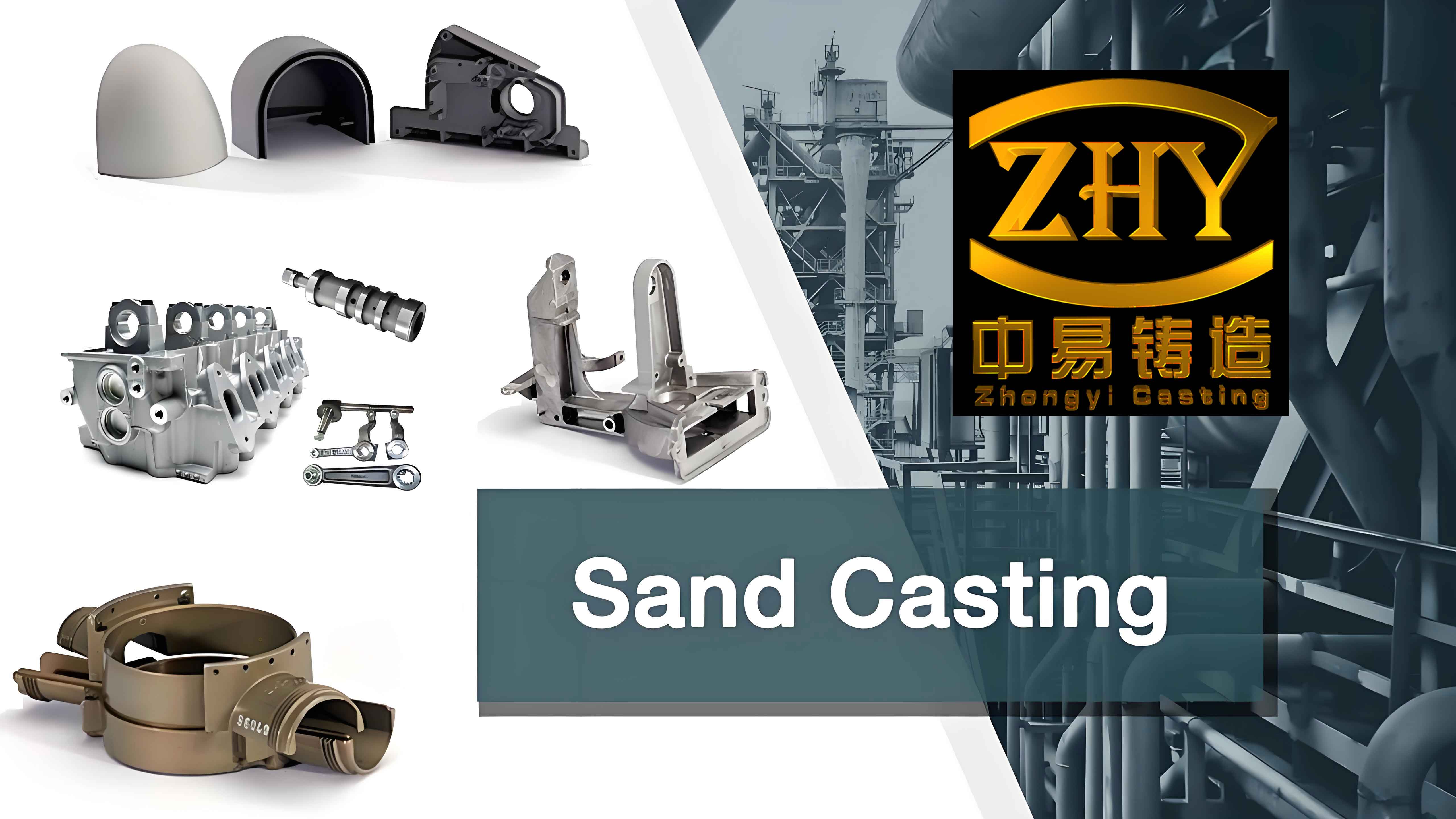
Beyond these applications, we have explored foam’s role in reducing environmental impact in sand casting parts production. By lowering sand consumption, the need for sand reclamation is diminished, which in turn decreases energy usage and emissions. For resin sand systems, a lower sand-to-metal ratio translates to fewer regeneration cycles—empirically, a ratio of 3:1 requires only one regeneration pass, versus three passes at 6:1. This aligns with sustainability goals while maintaining the integrity of sand casting parts. We model the regeneration savings \( S_r \) as:
$$ S_r = C_r \times (R_{sm}^o – R_{sm}^f) \times P $$
where \( C_r \) is the cost per regeneration cycle, \( R_{sm}^o \) and \( R_{sm}^f \) are the sand-to-metal ratios without and with foam, and \( P \) is production volume. In large-scale operations, this can lead to annual savings of thousands of dollars, making foam a cost-effective adjunct for sand casting parts.
In summary, the integration of polystyrene foam into ordinary sand casting processes offers multifaceted benefits that enhance the production of high-quality sand casting parts. From improving core collapsibility and optimizing sand usage to simplifying pattern design and advancing gating techniques, foam serves as a versatile tool that addresses core foundry challenges. Our first-hand experiences confirm that these applications reduce costs, minimize defects, and increase operational efficiency. As the demand for precision and economy in sand casting parts grows, we believe that foam-based innovations will become increasingly mainstream, driven by their proven efficacy. We encourage foundries to adopt these methods, tailoring them to specific needs, to unlock new potentials in sand casting technology. Future research may focus on foam material advancements or automated integration systems, further revolutionizing how we produce sand casting parts.